


Sunak, growth and the great acceleration
Gareth Wyn Jones
My dear, here we must run as fast as we can, just to stay in place. And if you wish to go anywhere you must run twice as fast as that. [Lewis Carroll].
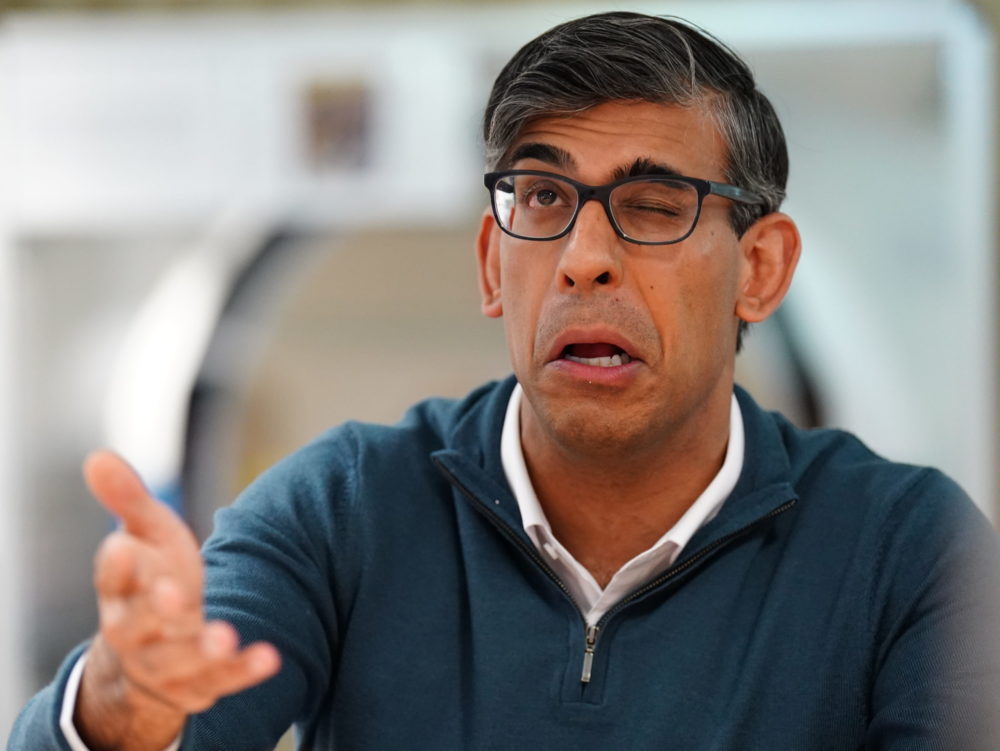
In an article emphasising the importance of growth to economic and political success, Rishi Sunak admits that “the hardest thing about being Prime Minister is that you have no time to think. The urgent crowds out the important time and again”.
I suspect Sunak, the UK Prime Minister for two turbulent years from autumn 2022, is unaware of the profound paradox and irony of this juxtaposition.
Economic growth, of necessity, means an exponential increase in activity: more events in any given time, year on year. This means, inexorably, an acceleration in the rate change. Some will remember Harold Macmillan, when himself Prime Minister, was asked what was the greatest challenge for a statesman. He is reputed to have replied: ‘Events, my dear boy, events’. Events now follow even more rapidly than some 65 years ago.
The ‘great acceleration’, set in motion by the industrial revolution, continues unchecked. Now reinforced by digitization and rapid information processing. It is leading to a near-panic surrounding the effects of social media and AI on society in general, but especially young people. The rapid changes have also created the profound crises in communities whose economic foundation has been torn away by new technologies or cheaper imported alternatives. Schumpetarian ‘creative destruction’ is occurring ever faster.
While major inventions such as electricity and the telephone took decades to be rolled out, the latest electronic devices and AI, based on LLM, have become common place in months. These, it must be emphasized, make ever greater demands on resources, particularly energy, whilst promoting ever more rapid information processing and, possibly, looming redundancies. Events are stacking up in ever greater piles of ungainly and ill-digested files. Yet the standard answer in Westminster and elsewhere is more growth and even more rapid change. We seem determined to be a chasing our tails faster and faster.
The problem Sunak identified in government can only worsen and, indeed, now permeates our everyday lives. From many, life is headlong rush.
Cumbersome
Importantly, as David Runciman has pointed out, our democratic system is by its very nature cumbersome. It depends on debate, deliberation, due process and on achieving, at least, a degree of common ground. It’s a cliché but all political parties are broad churches. These processes are challenged by the accelerating rate of change. Serious debate and consideration of important choices takes time. In contrast authoritarian regimes can make rapid decisions, albeit often arbitrary and ill-advised, and thrive on conflict.
Nevertheless continuous economic growth is perceived to be a socio-economic imperative. It allows some prosperity and hope to trickle down to the least fortunate while satisfying the demands of the rich and powerful. It is a system which, in turn, requires convenient, cheap supplies of energy. Consequently governments are committing vast sums to secure this energy.
Some seek, in the face of the ever growing evidence of disastrous climate change, to prioritise sources with low GHG emissions. Others, especially on the political right such as Trump, choose to ignore the scientific evidence and focus on fossil fuels as the key to their physical, economic and political power. In doing so they, of course, ignore the overwhelming evidence and the added costs, both economic and social, being imposed on all our futures.
Nevertheless unrepentant climate change deniers, those betting on global geo-engineering to cool the planet and those committed to major cuts in GHG emissions to achieve net zero by mid-century, share one crucial presumption. They accept the need for more and more energy, better coupled to work to allow ever more events and to give humans ever more power. (Power being defined in physics as work done per unit time).
Such a policy is understandable in countries and regions suffering from poverty and short of resources. But, in reality, it is being driven mainly by the insatiable demands and hubris of the already rich, the expectations of the electorates in many, relatively well-off countries and the lack of any coherent alternative; certainly in the eyes of most politicians.
Sadly there is too little discussion of the implications, indeed the validity, of this crucial assumption. Our most basic scientific understanding is that more energy will allow more work: this is more available energy will catalyse ever more events in a given time so increasing our demands on this planet’s renewable and non-renewable resources.
While wealth may be partly conceptual, it is also concrete involving real things – a larger house[s], more travel, newer clothes, more gadgets, and more physical demands on this planet. All this when overall humanity’s impacts are already exceeding several planetary boundaries although a large minority are still dirt poor.
These processes are also generating increasing social and material complexity. A complexity whose stability requires a near continuous input of energy.
Vulnerability
Consider the vulnerability of any major conurbation or single household to a major cut in the electricity supply or if the food energy supply in the supermarkets were suddenly to fail. This fragility is being exploited ruthlessly by Russia’s attacks on the Ukrainian energy infrastructure and was at the root of Putin’s hope that Europe would be hamstrung by its dependence on Russian gas.
The instability of accelerating complexity has a further implication. More regulations are needed to limit the negative impacts of new initiatives and innovations. It’s worth recalling the sophisticated changes and regulations required to move, in relative safety, from horse, to train, to car, to plane transport.
Again digitization in its various guises illustrates the problem. The web was initially seen as a great leveller and potential educator. Now it appears to be a toy to allow the tech bros, not only to become super-rich, but to manipulate both governments and the ordinary public to do their will. Our governments are struggling to regulate misinformation and the gross abuse of this medium.
Rishi Sunak’s problem was not unique to his high office. It is an extreme example of a fundamental phenomenon. Clearly indefinite acceleration and infinite complexity is impossible and incompatible with our humanity. It can only lead to a catastrophic crash. However getting off an accelerating treadmill is both difficult and dangerous.
There is logic in seeking to slow down but this has major consequences. It will require everyone to resist the pressures from the beneficiaries of the new technologies and siren calls of mythic abundance.
Equity
It will require a recognition of importance of equity and of honest and fair dealing. A recognition that human flourishing is not, beyond a certain level of material wealth, a function of more, and more stuff.
A recognition that we are all stewards of this planet and conjoined. A recognition that more and more is the road to worse and worse and not to relatively benign UK Prime Ministers, such as Macmillan or Sunak, but to a bleak authoritarian future.
And a recognition that we in Wales are not immune to these tensions.
Support our Nation today
For the price of a cup of coffee a month you can help us create an independent, not-for-profit, national news service for the people of Wales, by the people of Wales.



AI / Digitalisation are years away for UK. We voted Brexit and realistically there is no going back in short-term. So how much more are we extra are we spending now in UK that before Brexit? What new supply-chains have been created outside Europe? Or has the UK public and private sectors just continued to procure expensive nuclear reactors from France’s EDF and given all complex rail projects to France’s Alstom and Germany’s Siemens – I do not need to state the answer. I thought Sunak would use his network of bankers to make London a true global financial hub,… Read more »