


Teithiau Tom: History Forgotten … Remembered Again
Tom Maloney
It is probably a huge understatement to say that we have all had enough of the daily, incessant rain! January certainly felt like a washout, with only just a few moments of sunshine to charge the batteries and, so far, February has not been much better either.
Well, spare a thought for the good folk who lived on the Gwent Levels and on the other side of Môr Hafren (The Severn Estuary) four hundred years ago.
You never quite know what a day will bring and the 30th January 1607 brought with it such a barrage of trouble that this date marks one of the biggest, if not the biggest, natural disasters to befall the UK called ‘The Great Flood’.
Unlike the ‘Gunpowder Plot’ that occurred during the same time frame, roughly speaking, during the reign of James I and which is firmly fixed in our historical consciousness, ‘The Great Flood’ somehow seems to go under the history-remembered radar.
The research carried out by Professor Simon Haslett and Dr. Ted Bryant which led in turn to the BBC Timewatch documentary ‘The Killer Wave’ first broadcast in April 2005, posing the hypothesis that this extraordinary event may have been a Tsunami, has kindled renewed interest and discussion:
‘At 9am on 30 January 1607, a massive wave devastated the counties of the Bristol Channel. It came without warning, sweeping all before it. The flooding stretched inland as far as the Glastonbury Tor. Two hundred square miles of Somerset, Devon, Glamorganshire and Monmouthshire were inundated. Up to 2,000 people died. Yet for 400 years, the killer wave of 1607 has been forgotten. Timewatch relives the terror and the human tragedy of 1607 and follows the research of two scientists who are increasingly convinced that the wave was not simply a freak storm but a tsunami.’
One thing for certain that came through the eyewitness accounts of the time was that this was a catastrophe that no one could have predicted. By most of the accounts, the 30th of January started off just like any other day, when all of a sudden, a huge wall of water arrived without warning and with such incredible speed that there was very little chance of escape. The devastation was enormous and widespread.
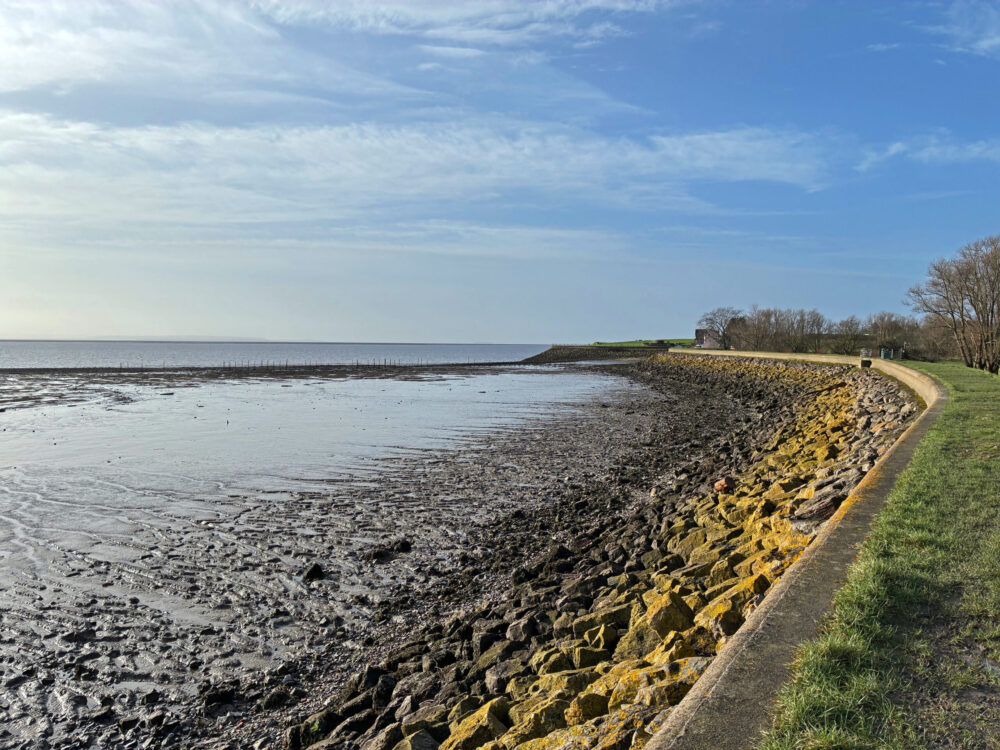
The photographs in this feature were all taken on a rare, but very welcome sunny morning on the 30th January 2026 along a walk following the sea wall from Goldcliff to Redwick, Newport.
There was real warmth in the air and it was so good to feel the refreshing breeze along the coast. To be honest it felt good just be outside.
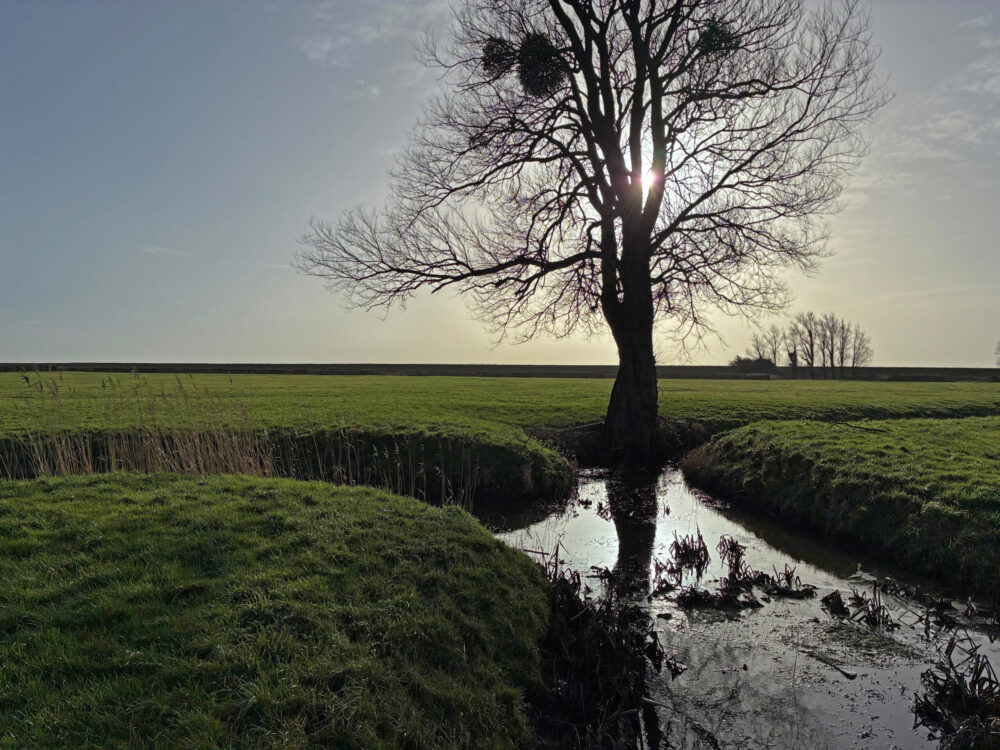
As a walker I am more familiar with the hilly landscapes that surround my home in Abersychan, so the flatness of the landscape and its relationship with water was immediately evident and impactful. Even though I have visited ‘The Levels’ on many occasions it always feels new to me.
Water drainage ‘reens’ that have been doing their job for centuries criss-cross the low-lying fields have a certain noble and yet at the same time rustic beauty about them, somewhat reminiscent of the landscapes painted by the great Dutch masters of art, especially in the glow of the morning light.
I found myself transfixed by the sculptural beauty of the trees with their intricate silhouettes sharply outlined against the winter blue of the sky.
As you ascend the steps that rise to the top of the sea wall at Goldcliff you are not really prepared for the panorama that lies beyond.
‘Môr Hafren – The Severn Estuary’ is as grand a vista as you could expect to see, it fills your eyes completely and a veritable orchestra of birdsong accompanies every footstep, with the enigmatic song of the Curlew seemingly hanging effortlessly in the air.
This is the perfect place to observe the majestic artistry of a seagull in flight; the wonder of these birds is so much more difficult to fully appreciate when a fish and chip shop is nearby.
All along the coastline here you will see lines of wooden stakes, sometimes like long spindles, but mostly just stumps garlanded with glistening seaweed embedded in the mud-flats snaking their way down to the water.
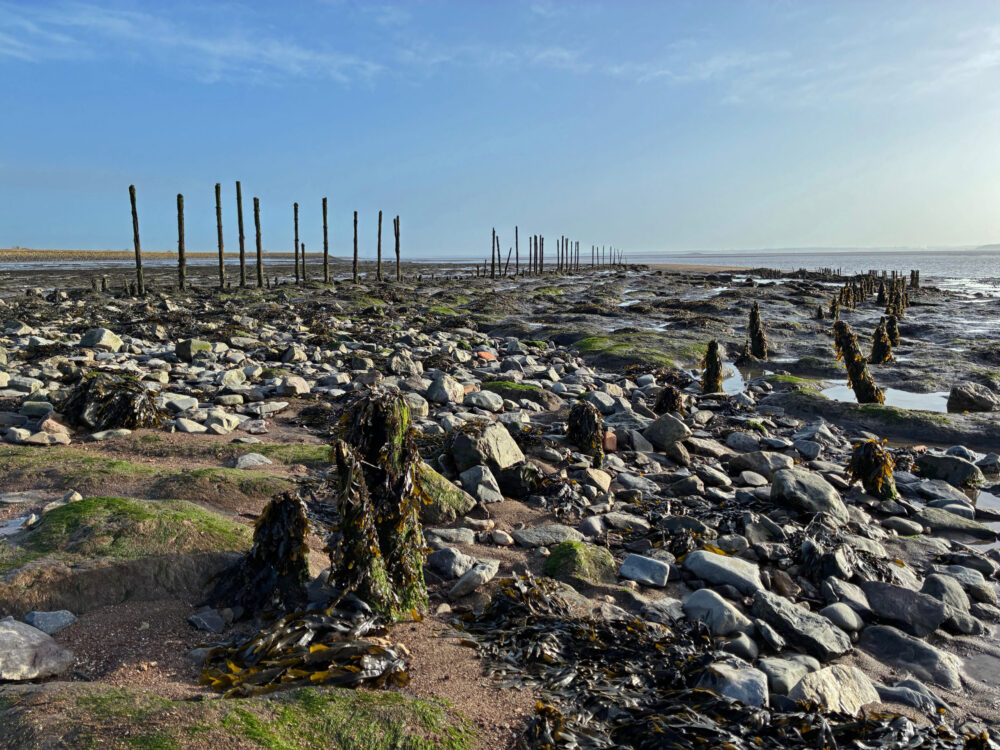
I remember well when I first saw these wooden ranks standing to attention thinking that they were some sort of structure to minimise tidal erosion, but I could not have been more wrong.
A chance visit to Newport Museum revealed that the purpose here had once been to catch salmon and other fish!
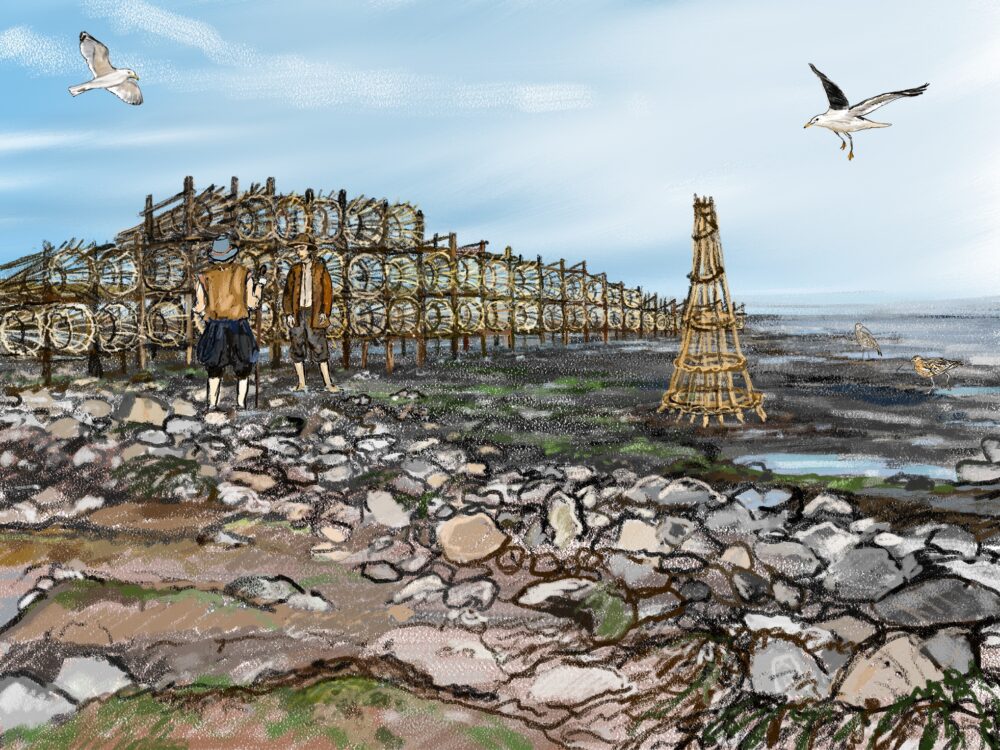
Racks of funnel shaped willow baskets called ‘putchers’ were attached to the posts, often piled high in row upon row.
The ‘Living levels’ website has an excellent description of their history:
‘Putcher fishing is a traditional method for catching salmon, and other fish, that dates back to at least medieval times, and may be much older.
The fishery at Goldcliff was one of the largest and oldest; it was in operation at the time of the medieval priory and would have been a major source of income for the monks.’
Surprisingly, perhaps, according to the website this type of fishing continued well into the twentieth century.
At the time of the Great Flood the mud-flats may well have been a hive of activity as the catch would have been an important food source and quite valuable.
Would there have been people working on the shoreline at the exact time the wall of water arrived? Of course, it is difficult to know, but if people were exposed on the tidal flats, the danger would have been acute and quite possibly difficult to judge.
Whether it was a freak storm or a tidal surge caused by a tsunami, even today the mud is a danger all in itself. Its oozing, sticky consistency is like glue, making rapid movement extremely difficult.
In truth, it was quite a ‘stretch’ along the sea wall, above the gold crusted shoreline to Redwick. Although the trail is flat, after weeks of rainfall the ground was heavy going at times, especially where the path had been churned up by grazing cattle. Nevertheless, I enjoyed it very much.
There was much to see along the way, including a field with around twenty to thirty swans congregating on the rich grassy growth. I don’t think that I have ever seen so many on land before.
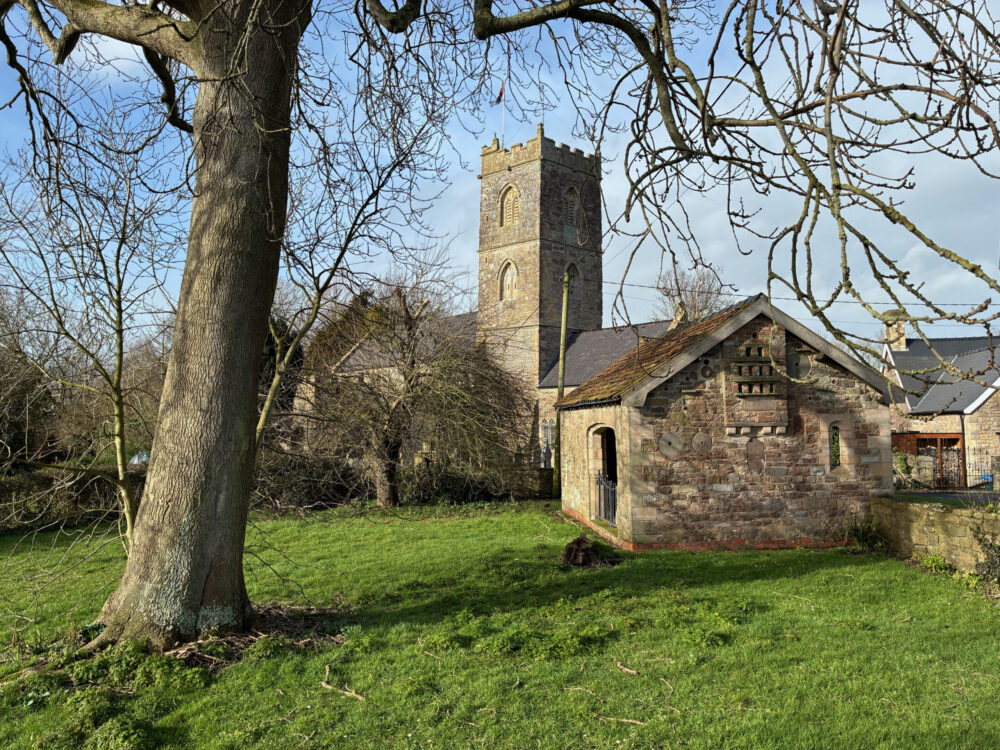
Redwick is a tranquil village and a lovely destination with all the sights and sounds of a farming community still being very much a part of local life.
The Church of St. Thomas sits quietly at the heart of things, just as it has for hundreds of years and the abundance of snow drops growing in amongst the graves adds to the impression that nothing drastic could ever have happened here.
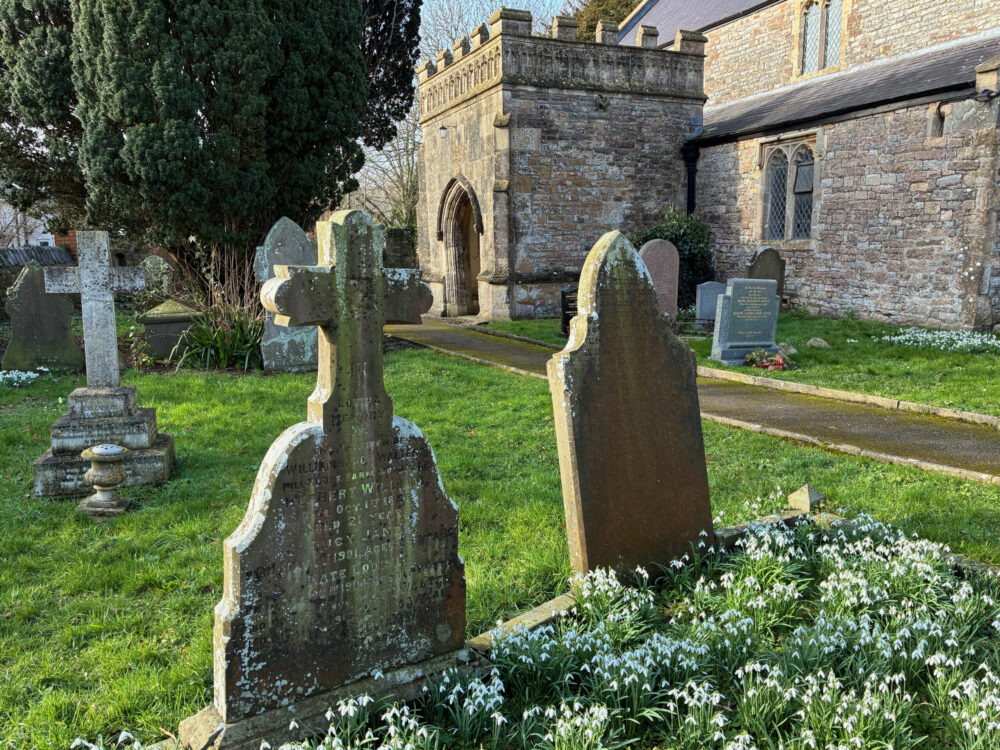
But … the church walls bear witness to the height that the flood water reached in 1607, except that the date inscribed is 1606! As with most things historical there is always a puzzle to be found.
Surely, the date carved onto the Church of St. Thomas, not just once, but in two places, cannot be wrong?
Thankfully, the answer to this conundrum is relatively straight forward and it’s all to do with Britain changing from the Julian to the Gregorian calendar in 1752.
Under the Julian calendar the flood occurred on the 20th January 1606, but after making the adjustments necessary in the change to the Gregorian calendar the generally accepted date is the 30th January 1607. (Source: The Living Levels)
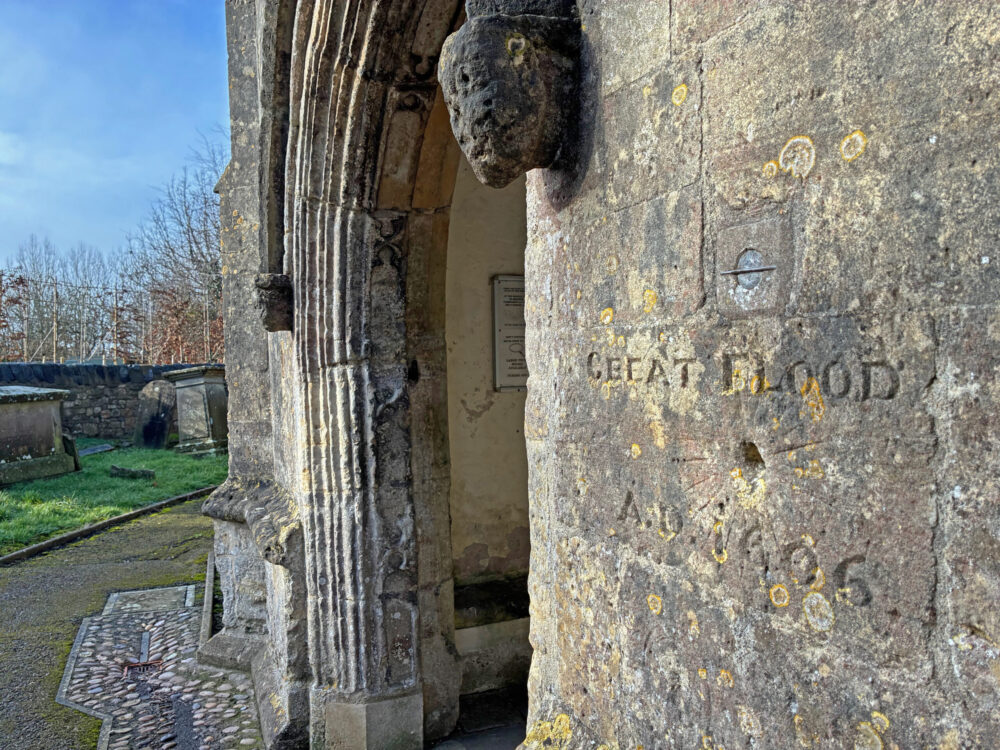
Whichever form of the date that you choose to use, the level marked remains the same and it must surely have been a tragedy that would have stayed in the minds of everyone living all those years ago.
Standing where the water would have been so deep, my thoughts revolved around how strange it is to think that the ‘The Great Flood’ could have become so forgotten.
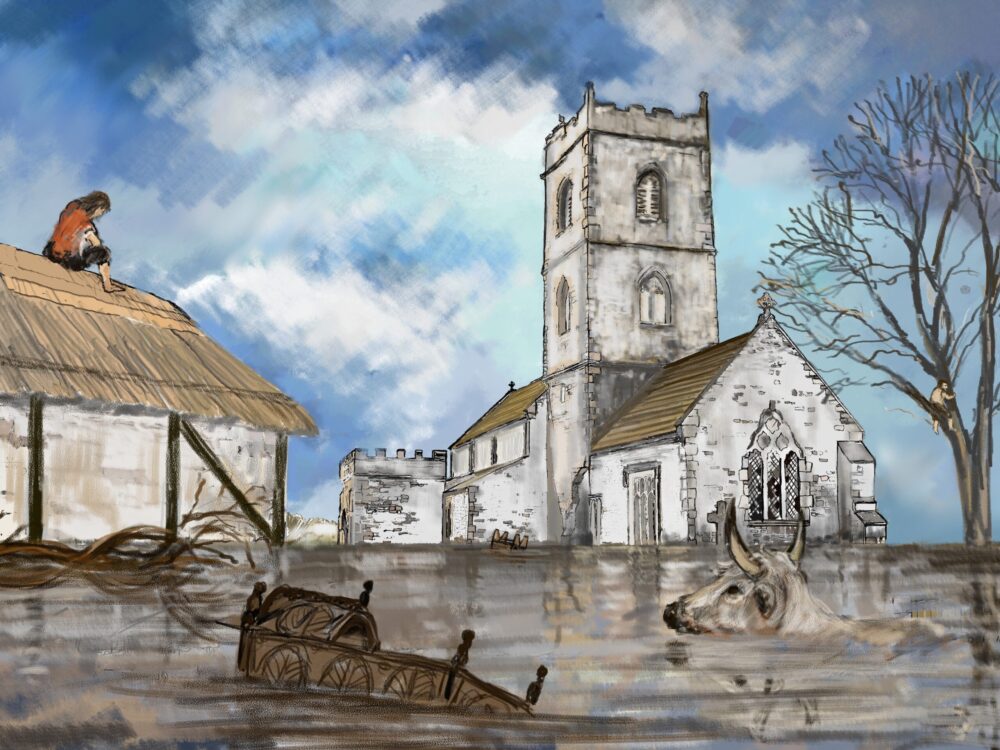
Was this cruel event the result of a huge storm surge or due to a tsunami caused by an earthquake?
Professor Haslett and Dr. Bryant have certainly done much to raise questions, linking eye witness accounts with modern day fieldwork showing inland deposits of sand, pebbles and shells made by the sea in places you would not expect.
We will probably never know the full answer for sure, as so much of the surviving evidence could be interpretated to support the differing arguments.
Perhaps, the most important message that comes through their research in the programme is that we should remember events like this and continue to research them, so that lessons can be learned
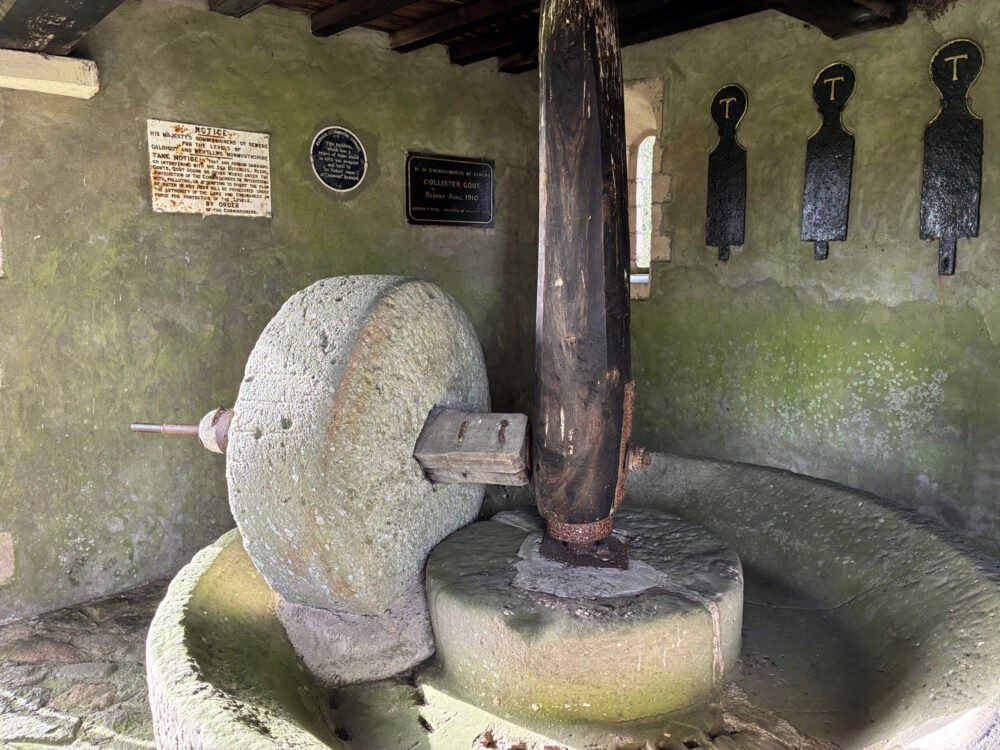
Next to the Church of St. Thomas I took a little time to marvel at the collection of artefacts and signage assembled by Hubert Jones of Redwick housed in a building that would not have looked out of place in earlier times.
It is a fine creation and I found myself admiring the creativity involved in its construction, but one sign stood out for me:
NOTICE
HIS MAJESTY’S COMMISSIONERS OF SEWERS
FOR THE LEVELS OF
CALDICOT AND WENTLLWG MONMOUTHSHIRE
TAKE NOTICE THAT ANY PERSON DAMAGING
OR INTERFERING WITH THE SEA DEFENCES, REENS,
GOUTS, GOUT DOORS OR OTHER WORKS UNDER THE
JURISDICTION OF THE COMMISSIONERS OR INTERFERING
WITH, POLLUTING, OR ATTEMPTING TO DIVERT THE FLOW
OF WATER IN ANY REEN WILL BE PROSECUTED UNDER
THE AURTHORITY OF THE LAWS AND ORDINANCES IN
FORCE FOR PROTECTION OF THE LEVELS.
BY ORDER
OF THE COMMISSIONERS.
You could not spell it out any better than this just how important the sea defences and reens have been over the centuries.
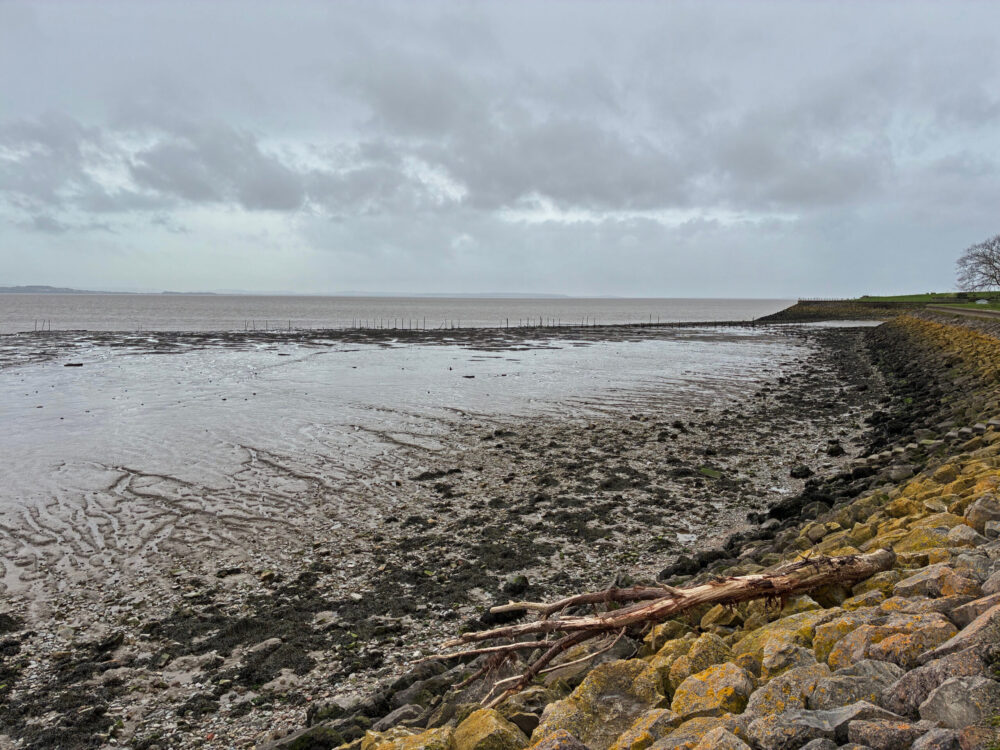
I chose to walk back to Goldcliff along the sea wall one more time.
The beautiful sunlight of the morning was on the turn and the sky was visibly changing to the threat of rain again. How quickly the weather can change in just the space of a few hours!
Further Information:
Parking
Parking is limited to a few cars at the sea wall at Goldcliff, but there are other places in the area that it is possible to park your car with consideration.
The Sea Wall
Although walking here is ‘on the flat’ the paths can be very muddy after heavy rain. Wellingtons or sturdy boots and a stick are definitely recommended.
The Weather
Môr Hafren is a wide-open landscape with very few places, if any, to shelter from a storm. It is well worth checking the weather forecast before walking here.
Sources:
The Great Flood
https://www.livinglevels.org.uk/stories/2018/12/10/the-great-flood-1607
‘Putcher Fishing’
https://www.livinglevels.org.uk/stories/2019/8/12/putcher-fishing?rq=putchers
Support our Nation today
For the price of a cup of coffee a month you can help us create an independent, not-for-profit, national news service for the people of Wales, by the people of Wales.



The Tsunami hypothesis is now accepted as historical fact with studies conducted since on sediment, non-glacial erractic boulders and the undersea topography of the Celtic sea. The nature and shape of Mor Hafren explains the severity of the event. This should be as part of our national curriculum in Welsh schools as Ox bow lakes and U shaped valleys. It’s part of what shapes our country and landscape.
Many thanks for the update in this reply. It’s amazing really that ‘The Great Flood’ became so forgotten over time. Professor Simon Haslett and Dr. Ted Bryant have done so much to reawaken this important history. I am not sure whether it is studied in schools, but it would make good sense for this huge, natural event to be part of the national curriculum for Welsh schools and as it affected so much of the landscape on the other side of Mor Hafren to be part of the national curriculum for England as well.