


Teithiau Tom: The Last Pirate Attack, The Last Invasion and The Last Pirate
Tom Maloney
The truth they say is often stranger than fiction, but sometimes, I would go one step further and say that it can absolutely bowl you over and can come from such unexpected directions.
Like most people, I enjoy listening to music and since learning Welsh my musical taste has broadened greatly. From the moment that I first heard the band ‘Bwncath’, (meaning ‘Buzzard) on Radio Cymru I was enthralled by the lyrics of their songs. One song in particular, all about the Welsh pirate ‘Barti Ddu’, kept coming back into my mind as only songs can.
I couldn’t be sure whether I had heard of him and forgotten, I am certain that he wasn’t on the school curriculum when I was a young lad, but one thing for sure was that I wanted to know more about his story.
Then I came across a children’s book ’10 Stori o Hanes Cymru – y dylai pawb eu gwybod / 10 Stories from Welsh History – that everyone should know’ and as if right on cue this featured the life and times of Bartholemew Roberts, better known as Barti Ddu. This led in turn to further research and the more I read, the more I wanted to know.
As I dug deeper, I felt myself drawn to Fishguard and the rolling Preseli Hills of Sir Benfro (Pembrokeshire) and for history lessons that you could just not make up!
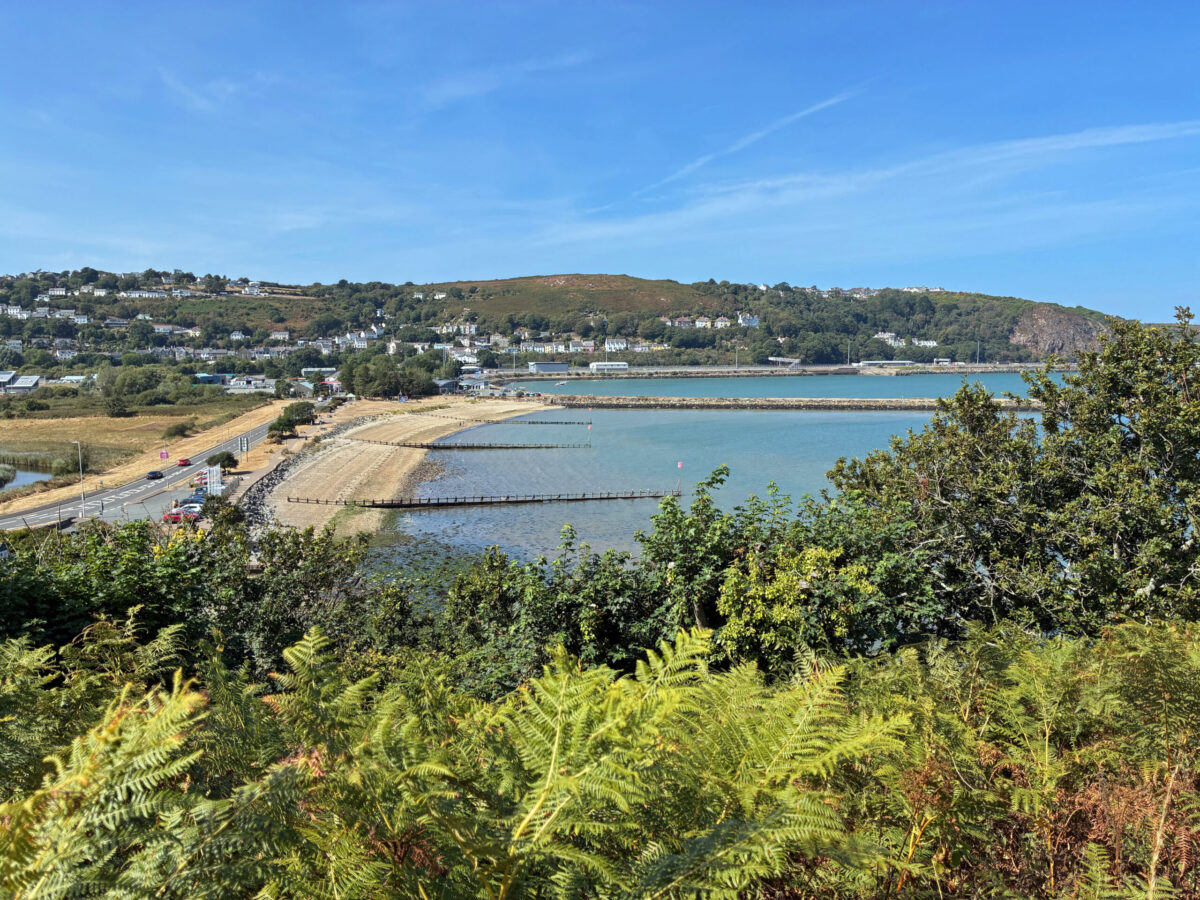
Sadly, I have to confess that previously I had only been to Fishguard to catch the ferry to Ireland and now realise that there are in fact twin towns that make up this locality, namely Fishguard and Goodwick, linked together by a short headland. It is a stunning coastline and I feel somewhat guilty that I had not given it the time that it deserves before.
The ‘Marine Walk’ following the headland is well appointed and a good place to begin is from the Goodwick side, where the parking is plentiful along ‘The Parrog’ (Parrog is a Welsh word meaning a flat stretch of land).
I feel I should point out that whilst the route is gentle on the whole, there are points along the trail that are steep with steps.
The visitor signage is really well thought out and positioned to afford fantastic panoramic views. I enjoy understanding place names, they reveal so much about the identity and history of a location, though Welsh names and the alternative English versions do not always translate to meaning the same thing at all! It was so good to read the explanation for Fishguard:
‘Fishguard derives its name from the old Norse ‘fiskigaror’, meaning ‘fish trap’. The remains of two ancient V-shaped stone traps are exposed at low tides.’
Abergwaun, Fishguard’s Welsh name, is altogether different and means the mouth of the River Gwaun, which I think probably alludes to the river coming from a heath or moorland area, again telling the story of the land from a different perspective.
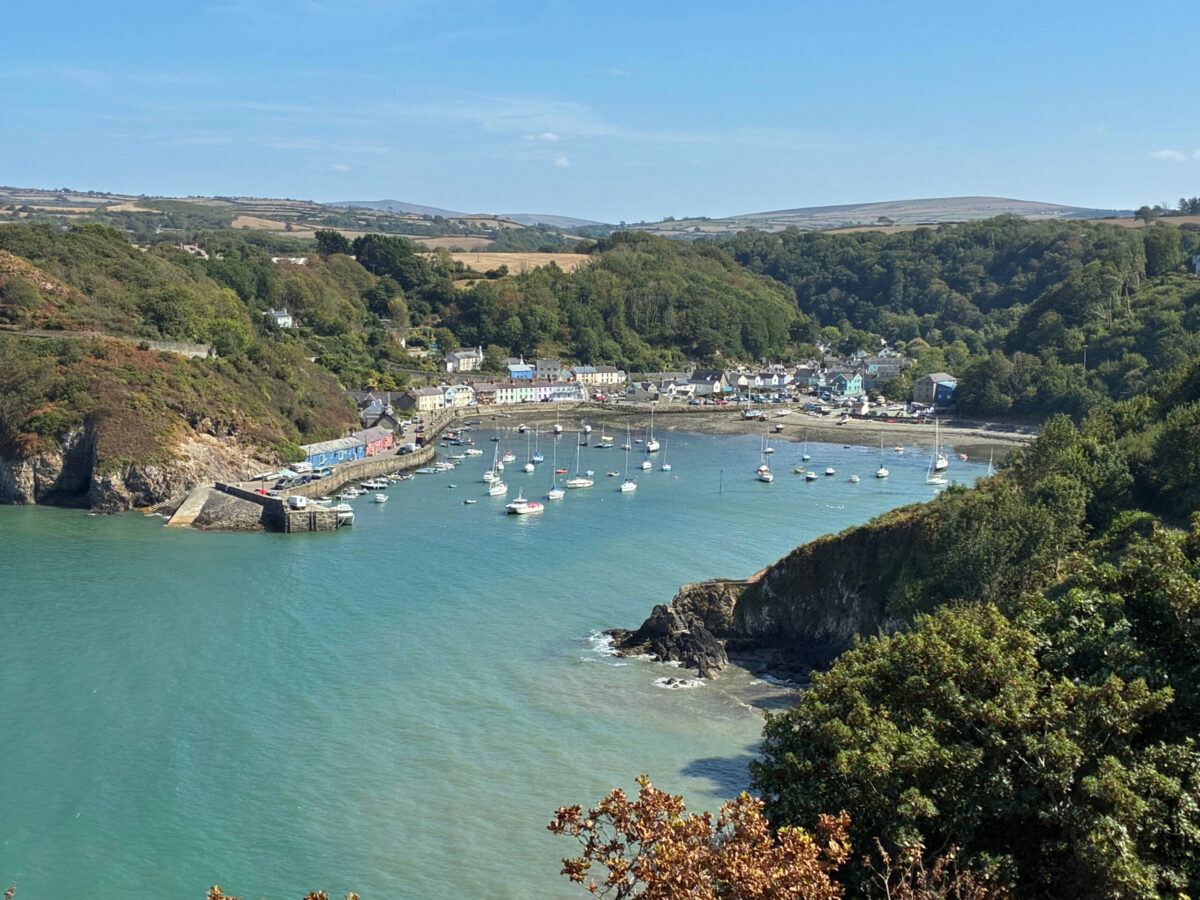
In some ways walking along the path reminded me of being on a train when all of a sudden obscured views are replaced by the grandest of pictures that you could imagine.
Seeing Fishguard Lower Town for the first time was just like that for me. It is as pretty a coastal town as you could imagine with its buildings decked out in shades of pastel pink, blue, yellow and white.
And then … it disappeared again behind the cliff top trees and coastal foliage only to emerge once more, as if out of hiding, lower down the path.
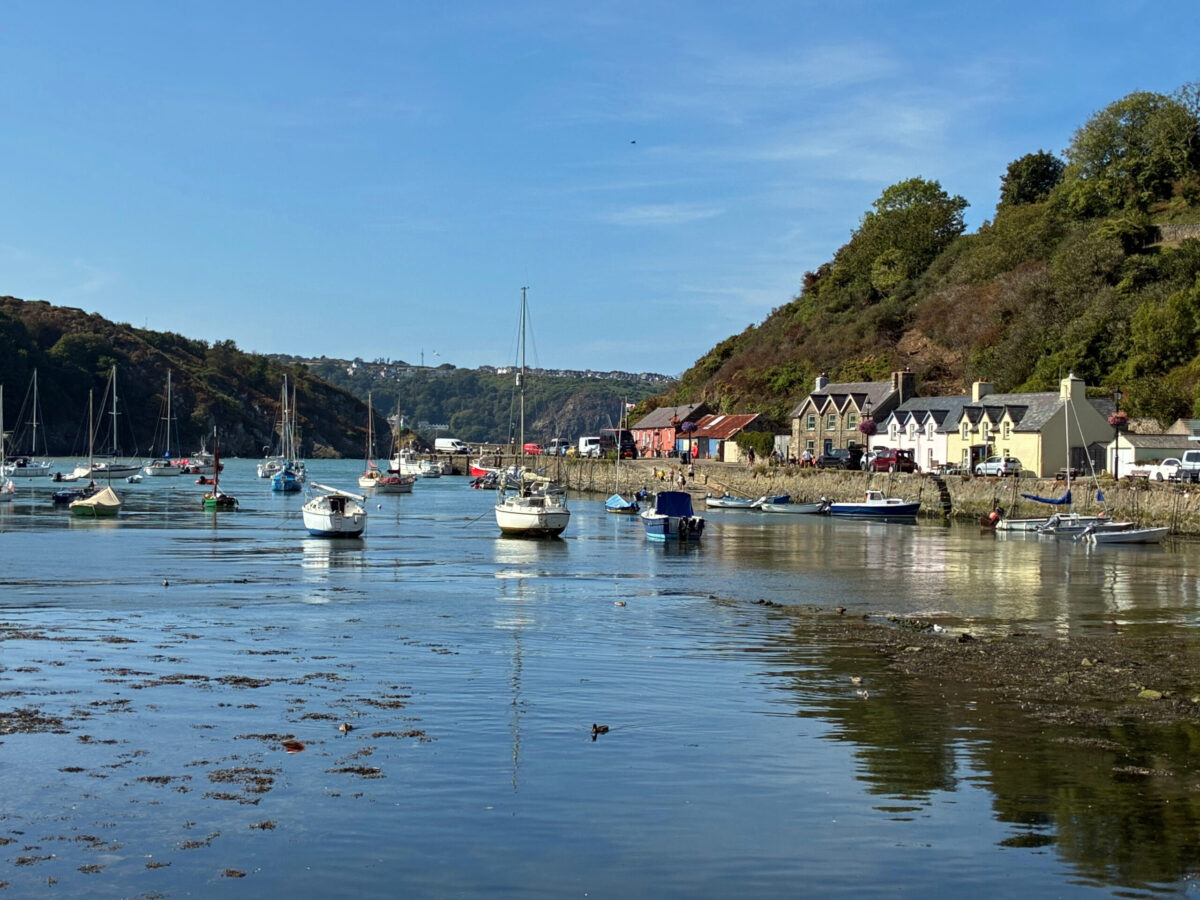
There is much to like about this sleepy little harbour. The lapping tide, the scent of the sea and the songs of so many seabirds all add to its sense of tranquillity, but this serene picture isn’t all it seems.
In its day this was the main harbour for the bay and in the Year 1779 the ordinary everyday comings and goings of the local people were rocked by the arrival of a ‘privateer’ whose intentions were hostile.
‘Privateers’ were essentially privately owned warships acting on behalf of a country, but were often considered as no better than pirates of the sea. The prime motivation for a pirate is robbing without any official authority to do so whatsoever. In this case the actions of the ship were being carried out with the approval of both America and France during the period of the American War of Independence.
By all accounts a ransom was demanded along with the threat of bombardment. No money was paid, despite the ship’s cannons firing upon the town and in the end the end the privateer thought better of things and left (See sources). Was this an attack by a pirate ship? I suppose it all depends on your point of view.
Nevertheless, whether it was piratical in nature or not, this episode had a huge impact and a small fort was constructed shortly afterwards where cannons were placed strategically to give a wide arc of defensive fire.
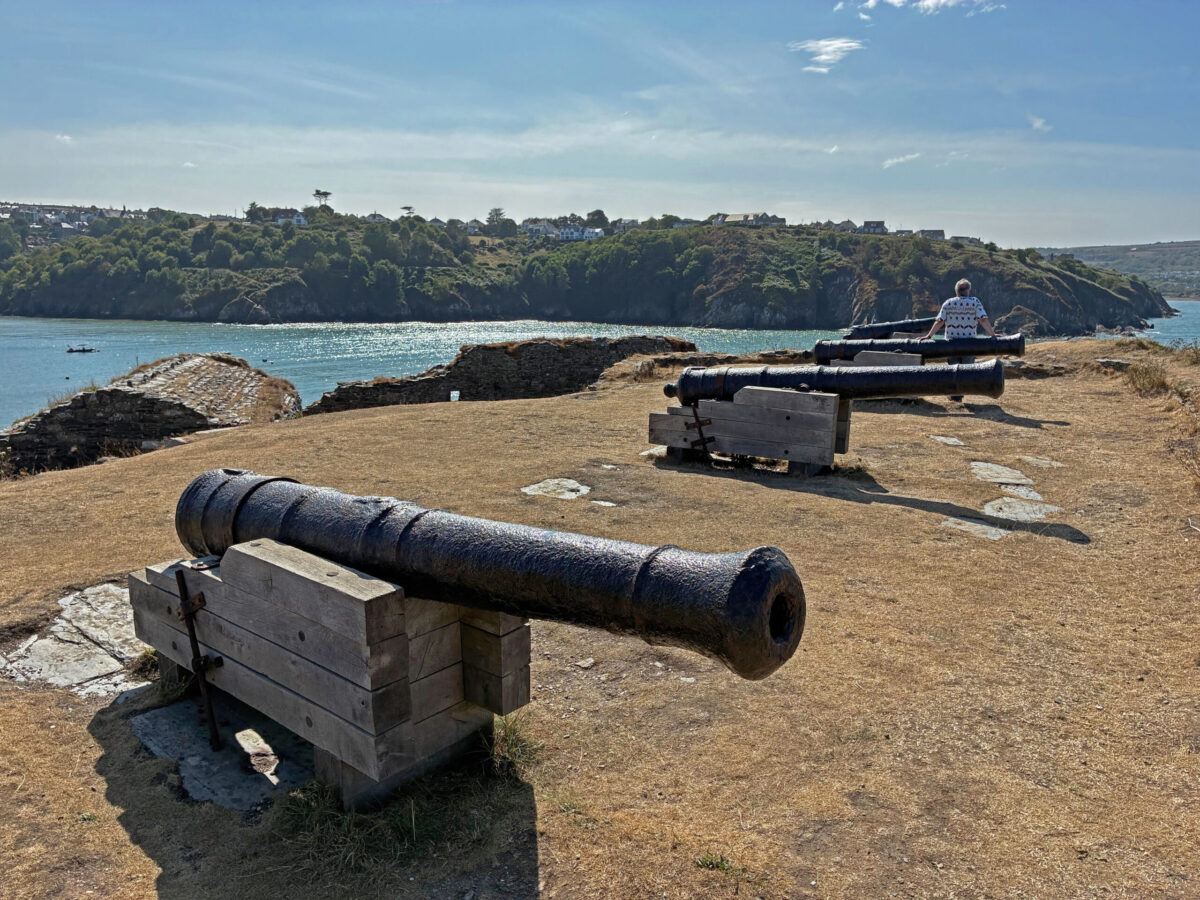
Were the cannons ever fired in anger? Well here the history takes on an altogether fascinating tale of heroes and villains, along with a little bit of myth or uncertainty, thrown in for good measure. The townspeople did not have long to wait find out whether their fort would be worthwhile.
The Last Invasion
In February 1797 French ships of war successfully landed a force of troops at Carreg Wasted, just a little further down the coast from Goodwick. At some point a shot was fired from the fort. Was this a warning shot against the French or a warning for the town? No one can be sure. There was so little ammunition available that it played no further part in repelling the invasion, though the French not being aware of this state of affairs quite probably kept well away from this vicinity afterwards.
From the moment of landing things went from bad to worse for the invading force, who lacked discipline from the outset, having a large number of convicts and deserters in their number. The attack was all over in just a few days, with the surrender of troops and arms taking place on the sands of Goodwick Parrog (See Sources).
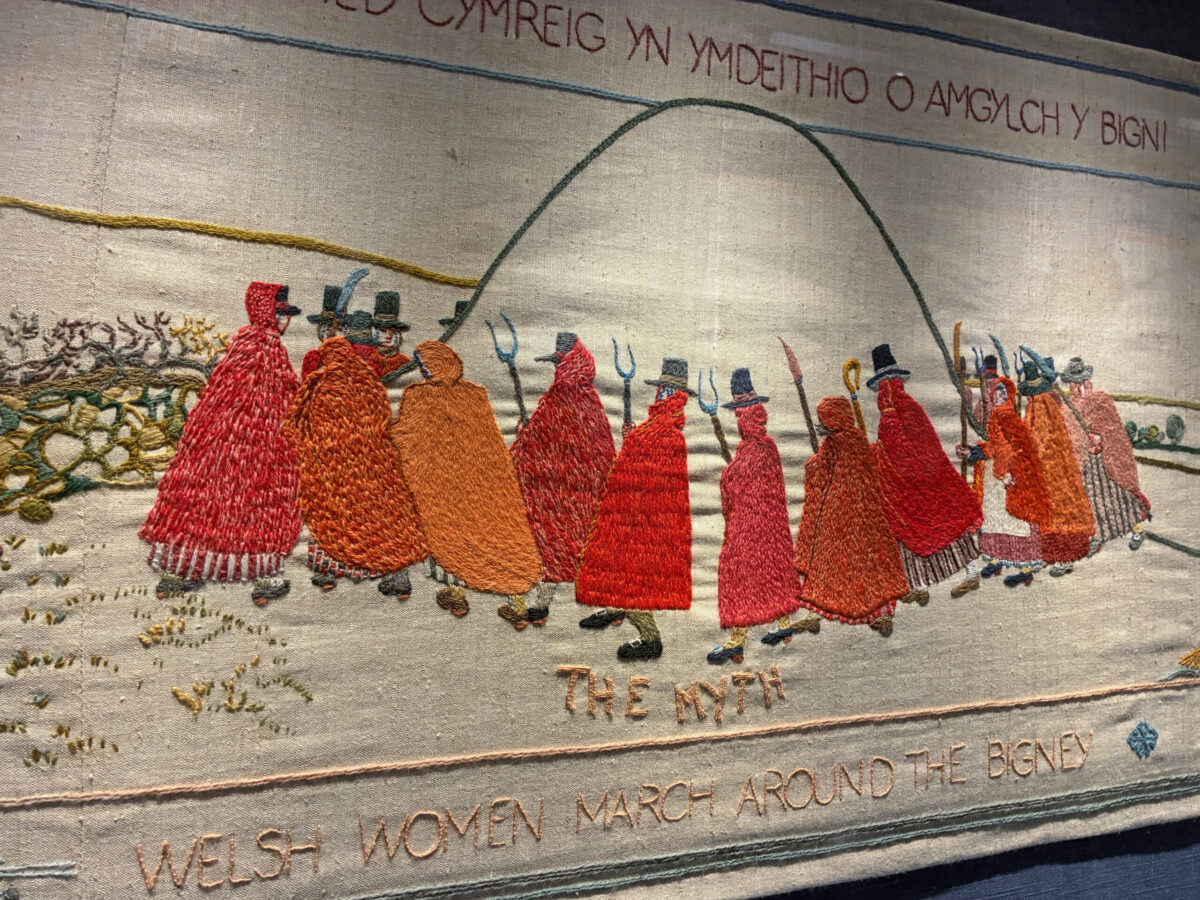
The story is captured most beautifully in the Last Invasion Tapestry held in Fishguard Library at the Town Hall.
To me, the tapestry is Art and History all rolled into one and with the arrival of the magnificent Bayeux Tapestry for its historic loan to The British Museum, it seems fitting to highlight this masterpiece by the community of Fishguard as well, as it has the same traditional craft at its heart.
I was most fortunate to have Jackie Stokes, Chair of the Fishguard Invasion Trust as my guide during my visit.

Jackie took great pride in showing the tapestry to me and it was obvious that the work of everyone involved in completing the work for the two hundredth anniversary in 1997, including the artist Elizabeth Cramp, advisers Rozanne Hawksley, Eirian Short and Audrey Walker and all the dedicated stitchers meant so much to her.
“From the moment I first saw the tapestry I was amazed and I never get tired of looking at its wonderful colours, all 178 of them. It is breath taking really all the way along its 100ft length. Each one of its 37 panels is just beautiful and they have been all been beautifully sewn together.
As a Trust we want to get the story of the Last Invasion more commonly known and the tapestry does just that. We have visitors from all over Wales, the UK and the world and they love it.” Jackie Stokes
As I looked at the tapestry I shared Jackie’s enthusiasm. It is amazing and something that I feel everyone in Wales should see.
It reflects both the history and the myths or uncertainties that have grown around the event. The much-celebrated story of ‘Jemima Fawr’, the local woman who it was reported captured 12 French soldiers with the aid of a twin pronged fork rightly takes centre stage, alongside the myth that Welsh women marched around the Bigney hillside in their traditional Welsh costume, wearing tall black hats, causing the French to think that they were in actual fact British soldiers!
Barti Ddu
And what of the pirate Barti Ddu? For his story we have to go inland a little from Fishguard and travel back in time to the second half of the 17th Century and the early part of the 18th Century.
What is the fascination with pirates? Sometimes it is very hard to understand their appeal and yet they do excite our imaginations. The fascination continues right through to modern times with the popularity of the ‘Pirates of the Caribbean’ films and who has not played at being a pirate as a child?
I have wondered what makes someone choose this way of life. Does it go back to childhood and perhaps thoughts of swopping an ordinary, humdrum life for one of excitement and danger or does it just happen through a series of circumstances?
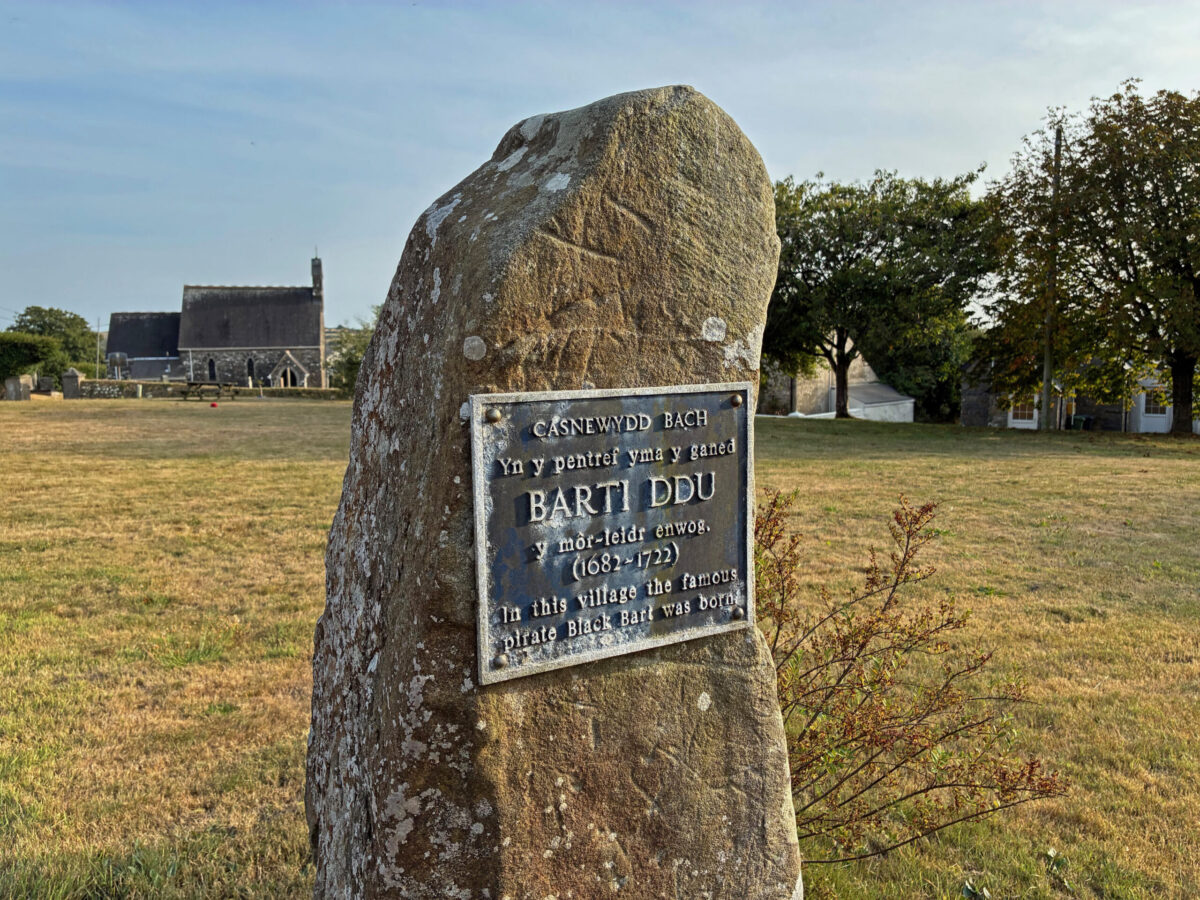
Barti Ddu was born as ‘John Roberts’ in the little village of Casnewydd-bach (Little Newcastle) in 1682 and a commemorative plaque marks his birth on the green known locally ‘Y Castell’. The location is very close to the site where his family home once stood.
CASNEWYDD BACH
Yn y pentref yma y ganed
BARTI DDU
Y môr-leidr enwog.
(1682 – 1722)
In this village the famous
pirate Black Bart was born.
Môr-leidr enwog, literally translates from the Welsh as ‘famous sea-thief’, but he just may be the most famous pirate that you may not have heard of, although he was well renowned in his day and still is by many, many people.
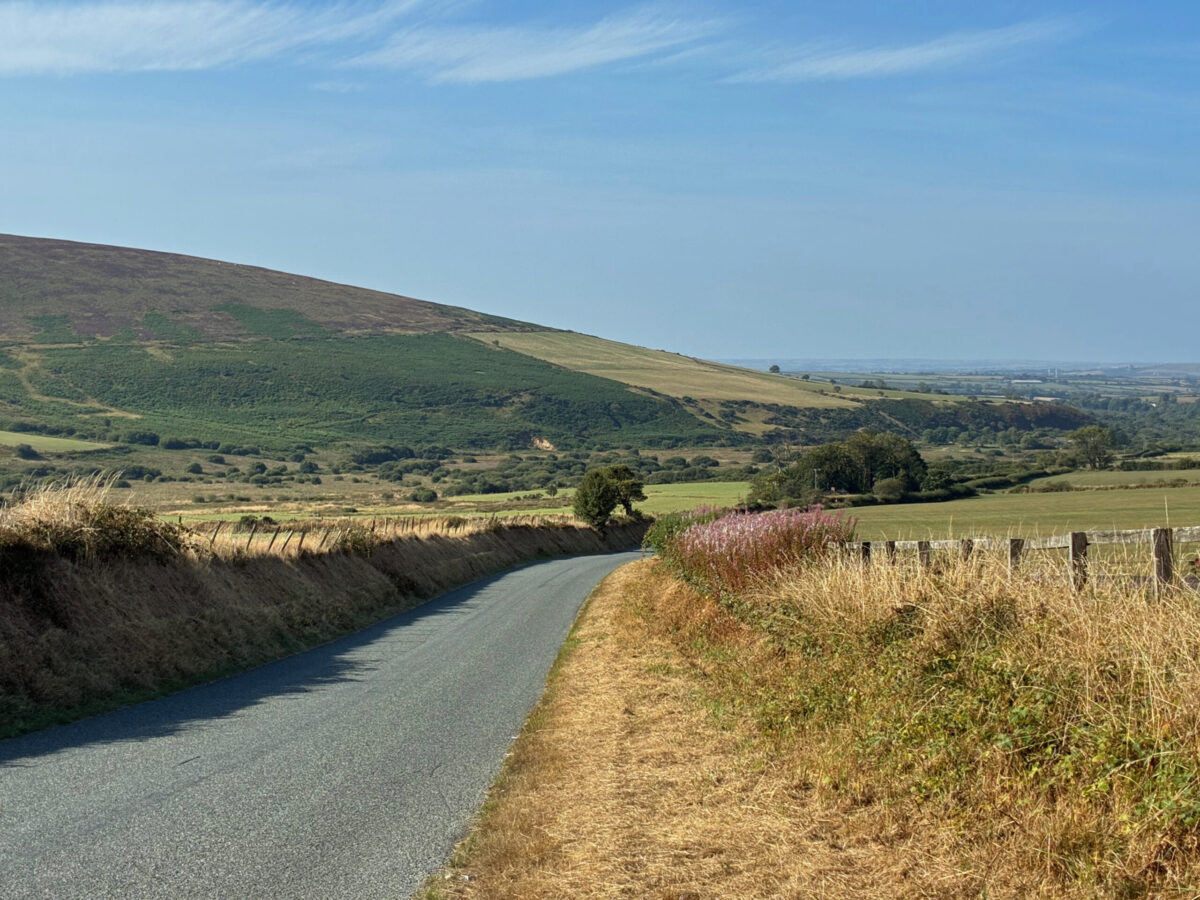
Casnewydd-bach is a quiet village, set in a landscape of green fields and farms and there is nothing that would set it out as a place for a ‘sea-thief’ to be born, though being so close to Fishguard the call of the sea would undoubtedly have been strong.
The song ‘Barti Ddu’ by Bwncath follows in the tradition of an earlier poem by Isaac Daniel Hooson and as I have read his wonderful ballad over and over, the lines have felt so familiar to me, but yet somehow over time they have become misplaced in my memory, though not anymore.
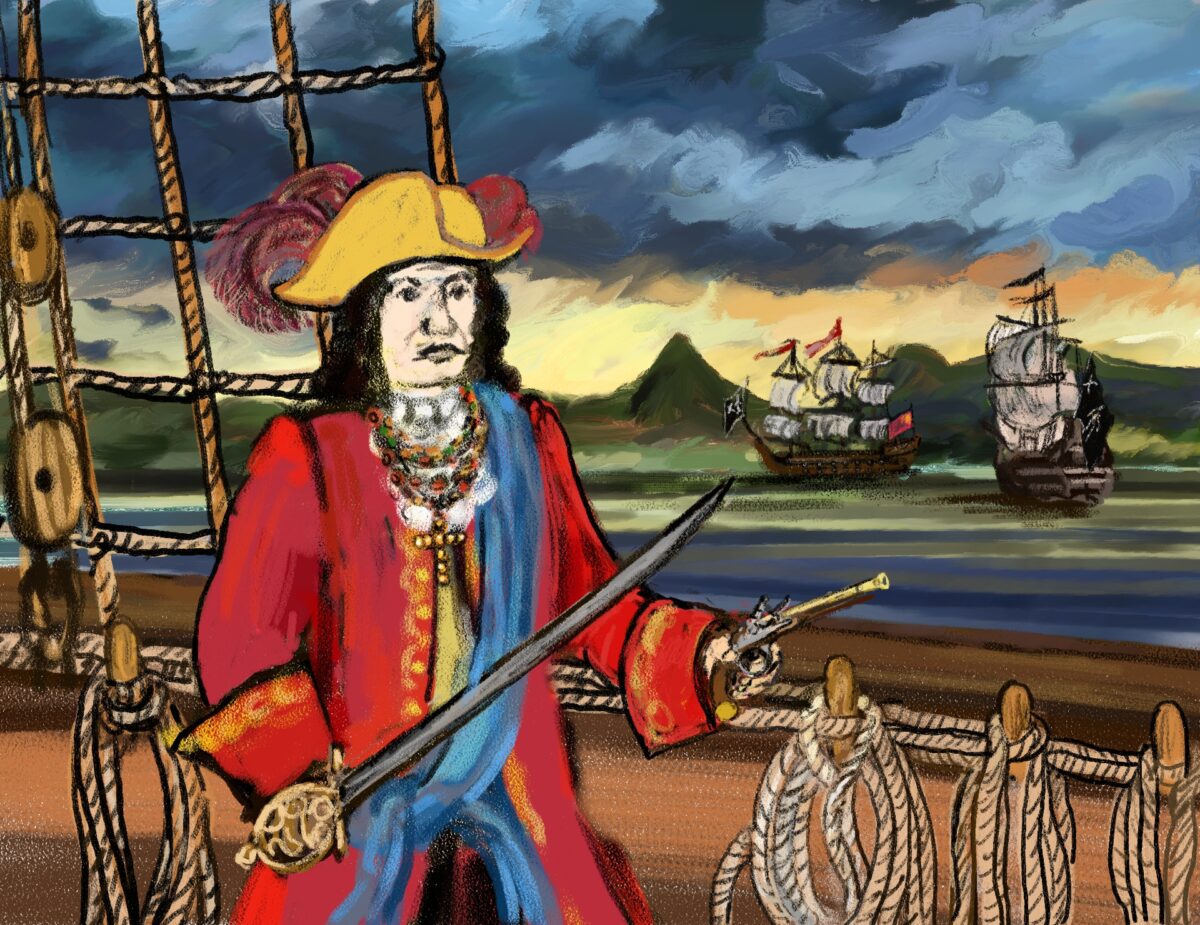
He captures the flamboyant, swashbuckling character of the pirate very well and it is so fitting that the ballad was written in Welsh as Barti Ddu was a Welsh speaker himself:
Barti Ddu yn ei wasgod goch. Barti Ddu in his waist coat of red
A gerddai y bwrdd gan weiddi’n groch; Would walk the deck and loudly shout
Gyda’i wn a’i gledd, With his gun and sword
Yn ddiofn ei wedd, Fearless in his appearance
Yn ei felyn gap gyda’i bluen goch. In his yellow cap with red feathers
Verse from Barti Ddu by I. D. Hooson
But it would be a mistake to think too romantically about his exploits. All the sources that I came across in my research point to a very successful and ruthless buccaneer, that is of course until he wasn’t.
For fans of ‘The Pirates of The Caribbean’ he was instrumental in instigating a pirate code, that demonstrated a surprising level of democracy well ahead of its time and that he cared about those that served under his leadership.
‘Article 1 – Every Man has a Vote in Affairs of Moment; has equal Title to the fresh Provisions, or strong Liquors, at any Time seized, and use them at pleasure, or unless a Scarcity make it necessary, for good of all, to vote for Retrenchment.’ Captain Charles Johnson ‘A General History of Pyrates’ 1724
Barti Ddu was a complex man, that is for sure!
Relatively speaking he came into piracy quite late on. His life was quite above board until 1719 when the ship on which he was sailing was captured by Howell Davies, another Welsh ‘sea- thief’ and that is when things took on an altogether different dimension.
Though his given name was John, Bartholemew became his pirate’s name and the shortened form of Barti stuck, becoming Barti Ddu in due course. He operated at a time known as the ‘Golden Age of Piracy’ and it is said that he captured in excess of 400 ships
Acquiring booty on such an industrial scale was not the kind of thing to go unnoticed. The misappropriated riches made him and his crew much wanted outlaws and they were hunted down. Barti’s destiny was to die in battle at sea in 1722 (See Sources).
At the end of my visit to Sir Benfro, I sat on a bench on the green close to St Peter’s Church in Casnewydd Bach quietly mulling over everything that I had seen and heard over the day, but to my surprise my day was not over at all.
Church Warden Alison Evans and the Revd. Richard Davies very kindly invited me to look inside the Church, something that I had not expected, but welcomed very gratefully, as this lovely building and its grounds are worthy of an article of their own. The stained-glass windows within are stunning.
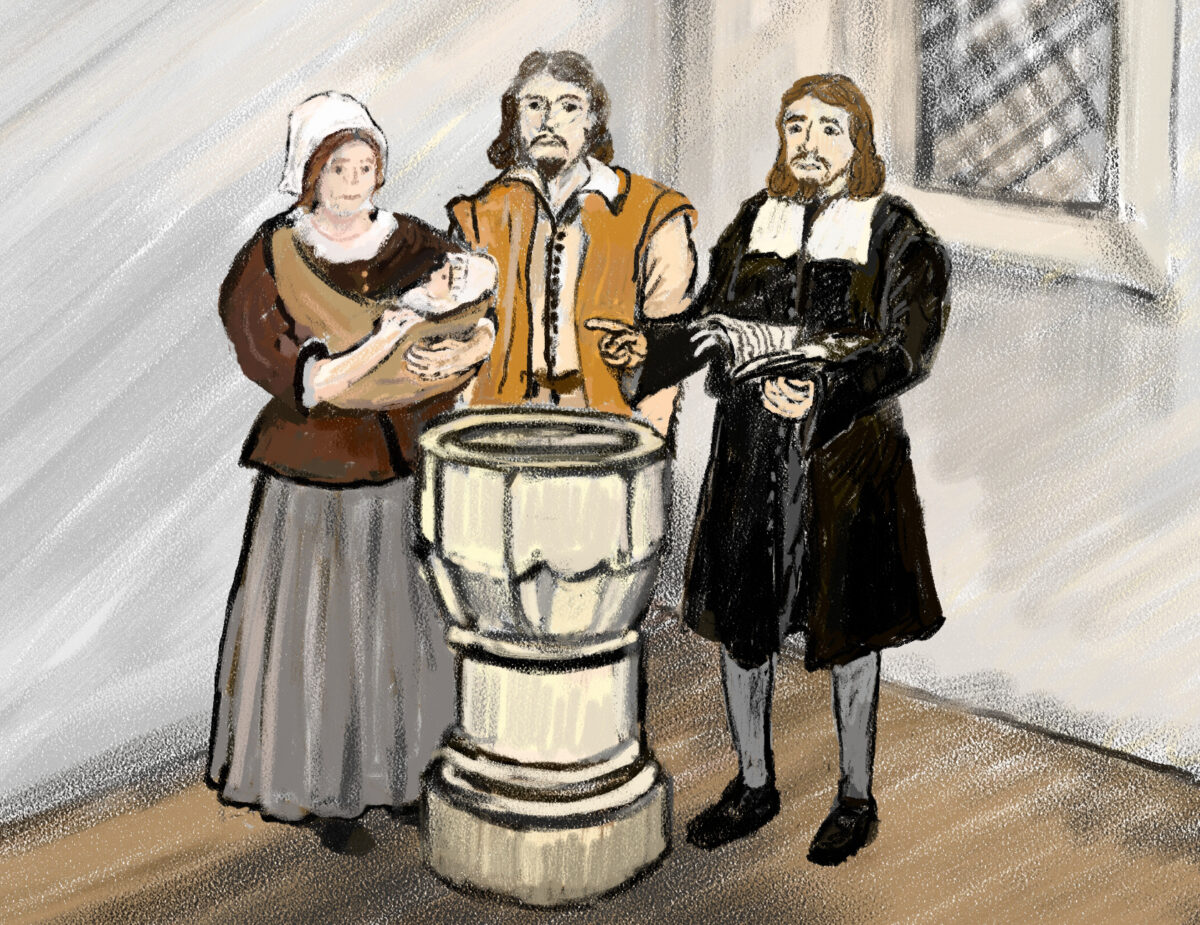
As you take your first steps inside the nave you will see the baptismal font. Every object has a story and this is the oldest part of church, dating back to the 12th century of the Middle Ages. As such, it may even have been used to baptise Barti Ddu, an object that he may have even touched and even held his gaze from time to time in his younger days.
I thought of the description of Barti in ‘A General History of the Pyrates’ which appeared in 1724 where it is reported that he wore a large cross. Perhaps, he never fully forgot his Christian upbringing in Casnewydd-bach after all.
The chorus lyrics of Bwncath’s song sum things up very well for me
O Barti Ddu. Oh Barti Ddu
Wrth ‘mi weld drwy dy lygaid di. As I see though your eyes
Dw I’n gweld dy long a’i hwliau gwynion ar y lli I see your ship with white sails on the sea
O Barti Ddu Oh Barti Ddu
Tria weld drwy fy llygaid i Try to see through my eyes
Mi welai’r don ond does dim ryyddid arni hi. I see the wave but there is no freedom in it
I began my journey home with the enduring thought that there was still so much to see in this little part of Wales.
Thank You
Many, many thanks to Revd. Richard Davies, of St. Peter’s Church, Casnywedd-bach for the very kind assistance given in understanding the rich history of the area.
Useful Information
Photographs
All the photographs in this article were taken on the 24th August.
Learning Welsh
There are lots of Welsh learning courses available at different levels, both online and classroom based at Learn Welsh Cymru:
Visiting Fishguard
Sources and other information:
Pirate Attack on Fishguard
https://northpembrokeshiretours.co.uk/index.php/pirate-attack-on-fishguard/
https://www.peoplescollection.wales/items/2003991
The Last Invasion Tapestry
https://lastinvasiontapestry.cymru/
The Last Invasion of Britain 1797 – The Waterloo Association
https://www.waterlooassociation.org.uk/2018/07/26/the-last-invasion-of-britain/
Britain’s last invasion: Fishguard 1797
https://thehistorypress.co.uk/article/britains-last-invasion-fishguard-1797/
St. Peter’s Church, Casnewydd Bach
https://www.churchinwales.org.uk/en/structure/church/3336/
Barti Ddu
https://biography.wales/article/s-ROBE-BAR-1682.html
https://famouspeople.wales/famous-people/bartholomew-roberts/
A General History of Pyrates – Published in 1724 by Captain Charles Johnson (A pseudonym that many believe to have been used by Daniel Defoe)
Barti Ddu – by the Band Bwncath
Barti Ddu – from Cerddi a Baledi by I. D. Hooson
Support our Nation today
For the price of a cup of coffee a month you can help us create an independent, not-for-profit, national news service for the people of Wales, by the people of Wales.
Get more trusted Welsh news
Choose Nation.Cymru as a preferred source in Google News to see more of our journalism.


