


Teithiau Tom: Under the Witch’s Nose
Tom Maloney
As countries go Wales may not be the biggest, but rather like a richly filled treasure chest it is packed full of amazing and wonderful places, some with such an evocative atmosphere that you could easily imagine a land fit for giants or even witches.
Dunraven Bay, located at Southerndown on the Glamorgan Heritage Coast, easily comes into this category. In fact the limestone headland that noses its way into the sea is appropriately named the ‘Witch’s Nose’, or ‘Trwyn y Gwrach’ in the Welsh.
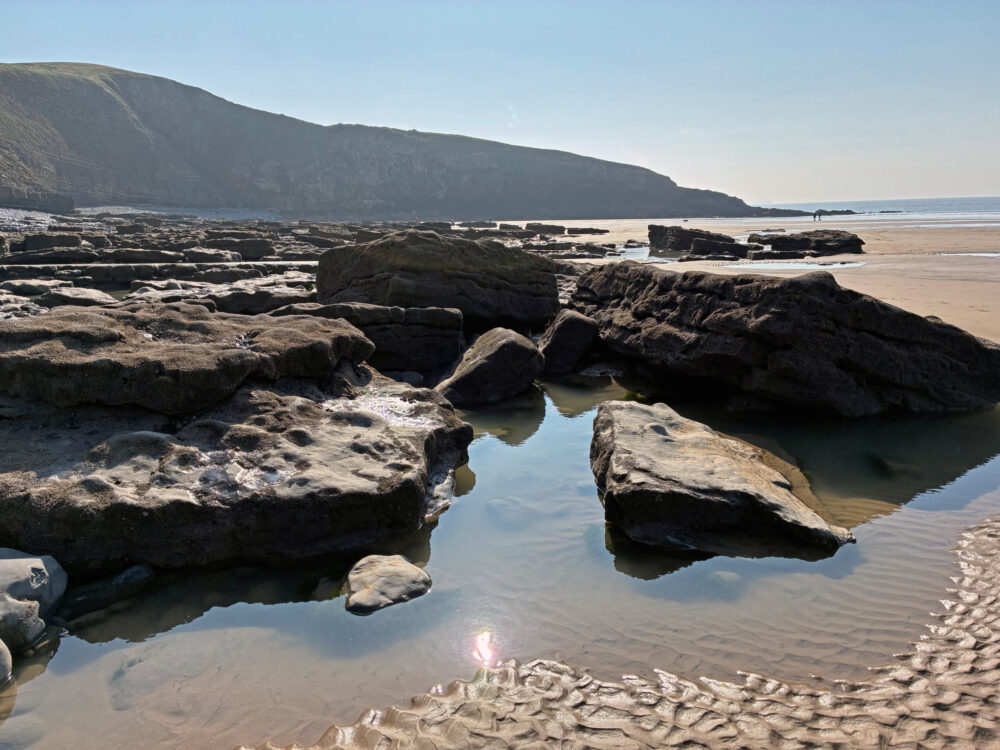
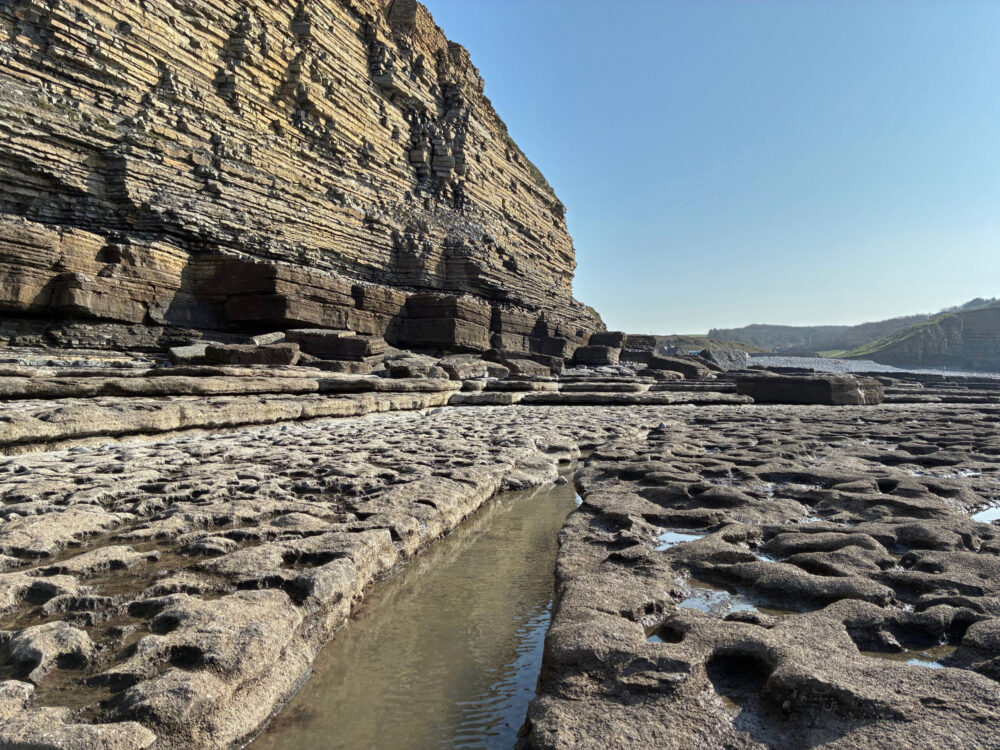
If you have never ventured to this beautiful ‘corner’ of Wales, then put it on the list. The very first sight of the impressive jagged cliffs, with their compressed layers of limestone and shale, entirely grabs your attention and will lead your eyes continuously along a journey following every contour into the distance, compelling you to wander.
Word association will almost always make me think of science-fiction adventure films when I come across the term ‘Jurassic’, but the reality of this geological period of time is right here in abundance.
Each exposed seam is rather like a bank vault holding fascinating fossil deposits millions of years old, though walking close to the cliffs should be avoided at all times due to their instability.
The National Museum of Wales has a wonderful resource available online all about Southerndown Fossils with clear safety advice (see sources).
And … as if the geology was not enough, the more you look, as the saying goes, the more you will see and even on the briefest of seaside walks here you will encounter the most amazing honeycomb, tubelike structures attached to the rocks and boulders strewn across the beach.
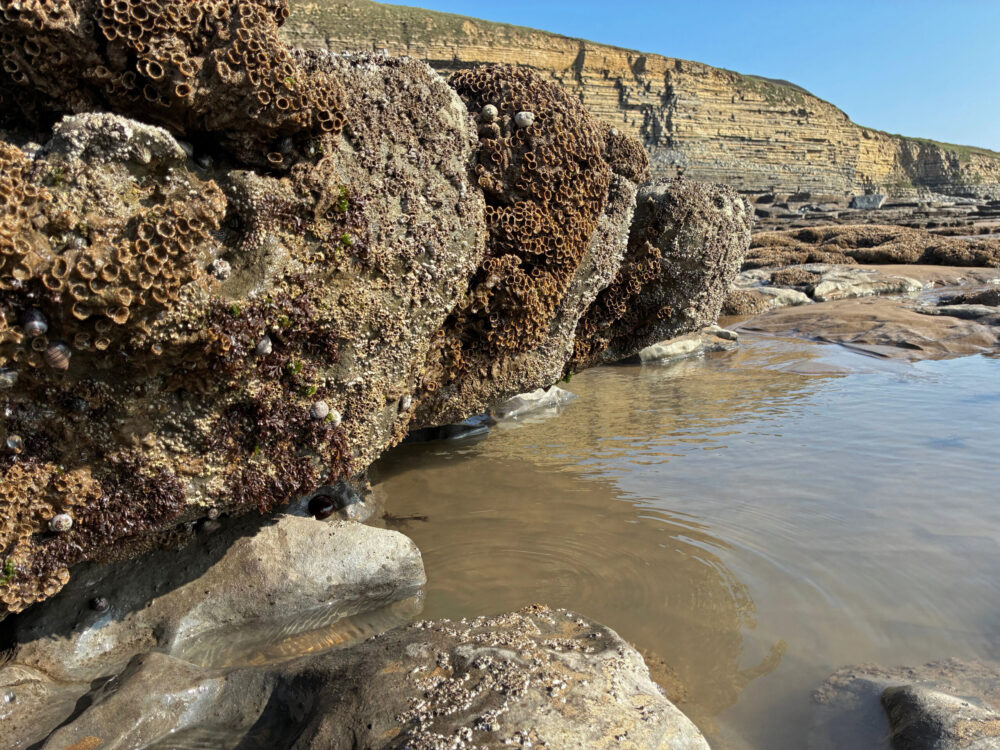
Rocks and sand provide the perfect habitat for the reef-building honeycomb worm, and the reefs are really well established along the shore. Each golden, brown trumpet is an artwork in itself, but when so many are seen together, reef upon glorious reef, the sight is truly spectacular.
It was not the cliffs or the honeycomb worm that inspired this visit, but a connection with my last article ‘History Forgotten … Remembered Again’ about the Goldcliff area near Newport, which was inspired by the research carried out by Professor Simon Haslett and Dr. Ted Bryant into the Great Flood of 1607, which in turn led to the BBC Timewatch documentary ‘The Killer Wave’.
The essential thrust of their research was that it was a Tsunami which created the wave that caused one of the biggest natural disasters to be recorded in the UK.
In their search for physical evidence to support their tsunami theory, Dunraven Bay came into focus. Seeing the landscape, especially the huge boulders settled near the ‘Witch’s Nose’, brought a whole new level of understanding.
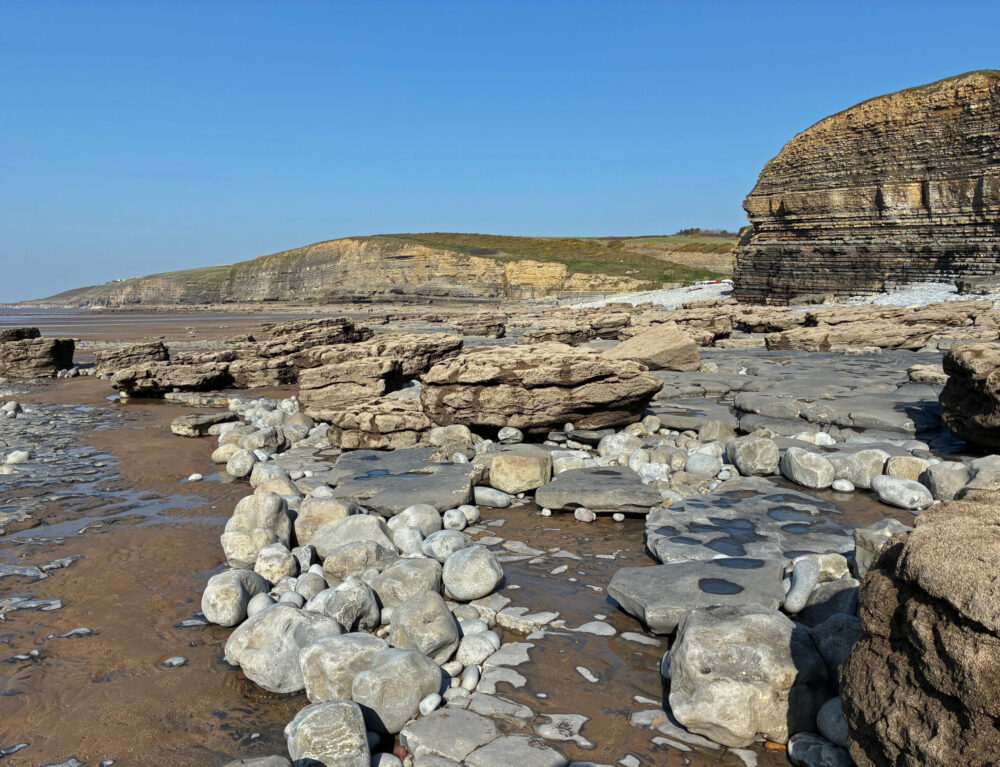
I have been to Southerndown on several occasions previously and had always assumed that the boulders and rocks resting in the vicinity of the cliffs would be there simply as a result of rock falls. Why would I think otherwise?
For Professor Haslett and Dr. Bryant there was much more going on than would be recognised at first, especially on a casual visit.
Rockfall just did not seem to be a good enough answer to the puzzle of why these weighty boulders came to rest in the way that they have.
After careful analysis, what they discovered was game changing. Rather like a train of toppled dominoes, the displacement pattern on the beach was more reminiscent of a ‘train of boulders’ shifted along by terrific force, rather than just dropping off the cliff face … and this could be explained by a tsunami.
I was intrigued by their findings and very much wanted to take the time to explore this coast with new eyes.
The more I explored and the more I walked around these megaliths, the more their observations made sense of the picture in front me.
And it was very humbling indeed to stand next to one of these giants. In fact you realise just how small you are in the scheme of things. It is so easy to imagine them as monsters from the deep marooned for all time.
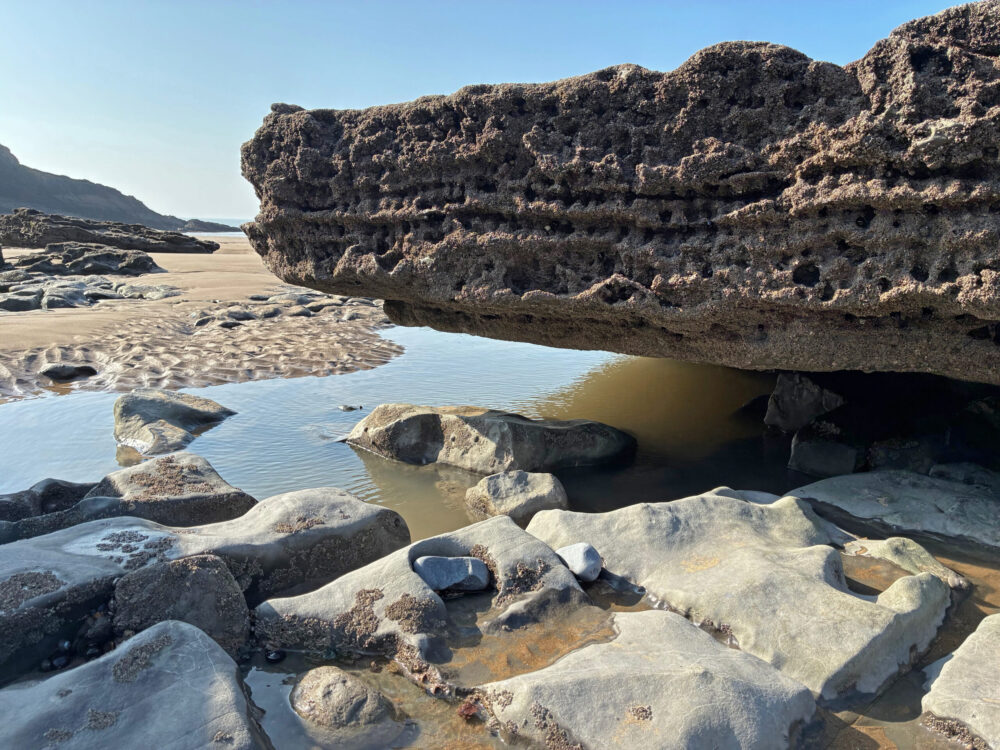
What must the scene have been like with the arrival of a huge wave capable of picking up their weight?
My thoughts turned the tumultuous, almost wild, seascapes of Turner, so far ahead of their time in their abstraction, that evoke the power and force of nature better than any camera in their brushstrokes. You could say that the photographs in this article were taken a world away, on a beautiful March day, without a cloud in the sky!
And what about the ‘Witch’s Nose’, what stories lie there? It would be a great pity not to include a little more about this remarkable place.
From the car park next to the beach, two paths called out to me. The gentlest path leads to Dunraven Walled Gardens, but a more ‘adventurous’ path, no more than a sheep trail really, will take you above to the emerald green top of the headland, where Dunraven Castle once stood.
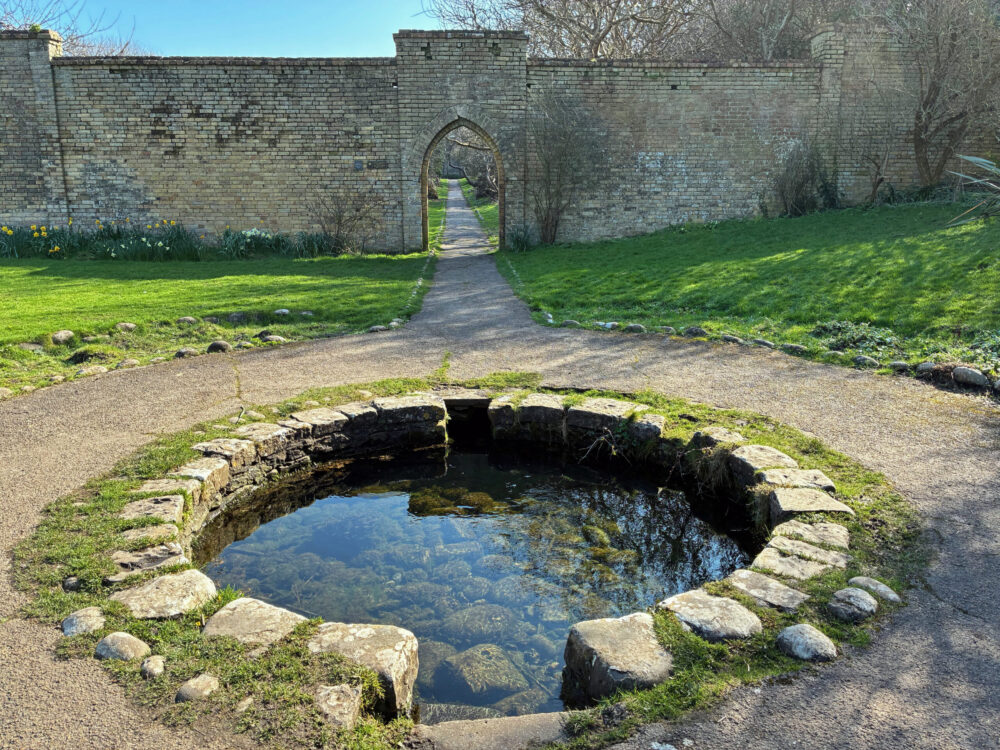
The picturesque walled gardens, which in their heyday served the needs of the castle, have been sensitively restored and have a calming, peaceful ambience to spend a little time away from the noise of the world.
Again, I was reminded of the works of Turner, especially of his rustic and at the same time romantic watercolour landscapes of architectural ruins such as Tintern Abbey.
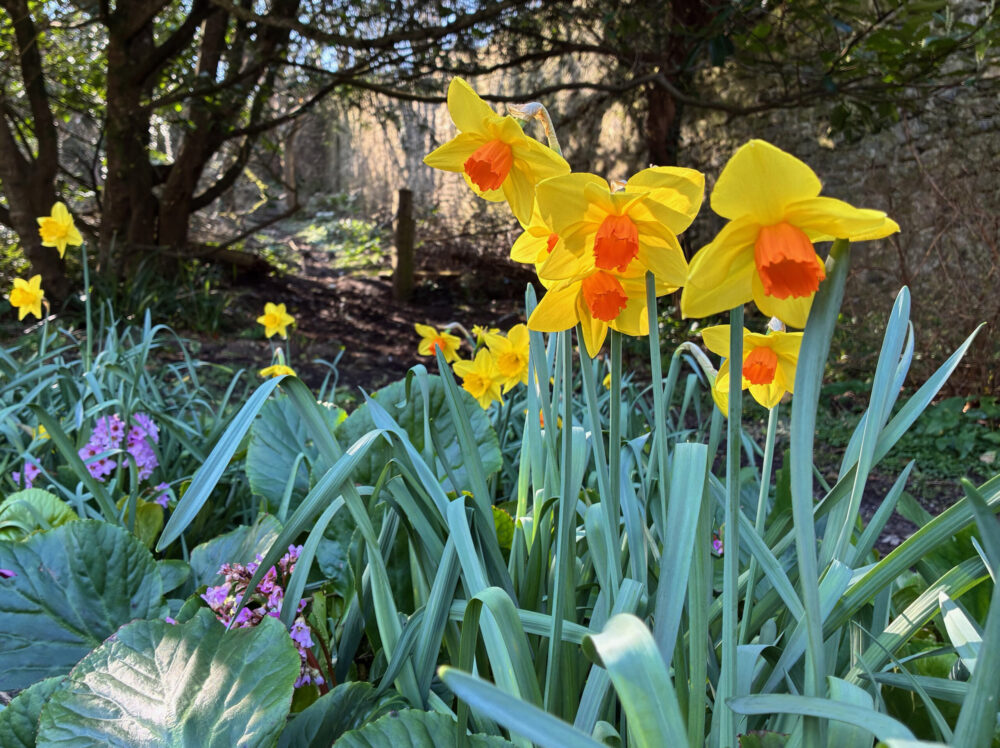
It is best to amble and to savour the delights on offer as you wander along the paths. Look for the smaller places, the corners of the gardens where the fall of light creates magical, intimate little scenes to enjoy.
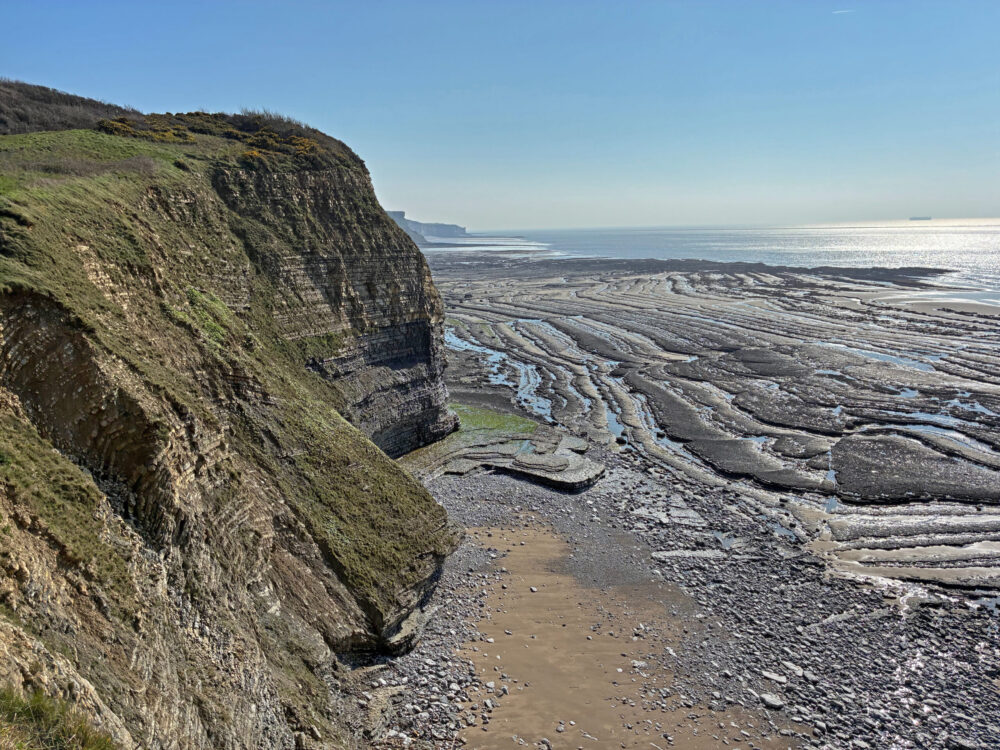
Just a little beyond the top of the gardens a short path will take you to a panoramic view of the Glamorgan Heritage Coast that is simply breathtaking, though great care should be exercised when walking here to stand well back from the edge as the line of the cliff is abrupt, and the drop below is very steep and very dangerous.
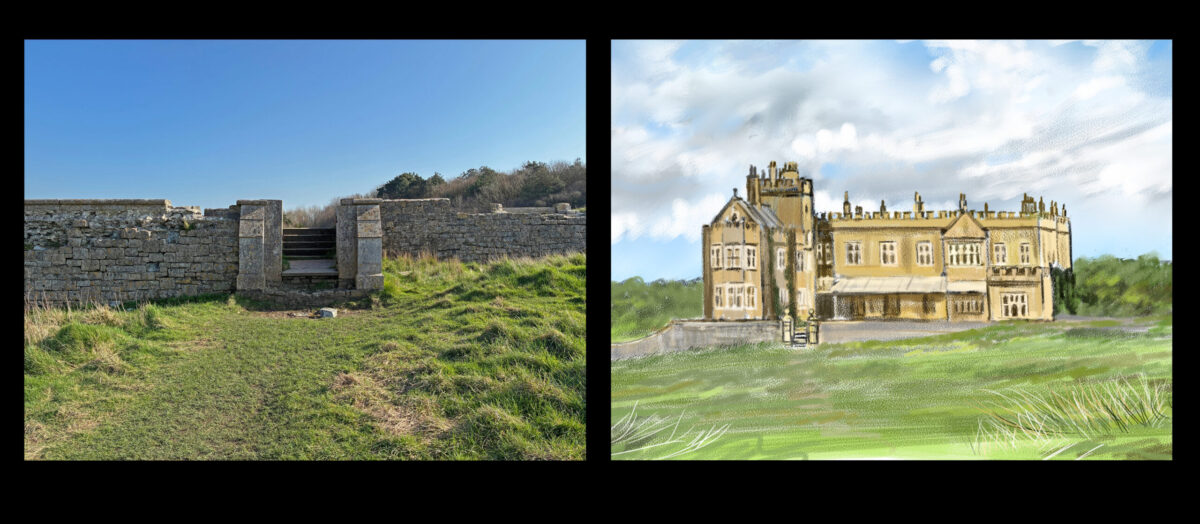
Little remains of Dunraven Castle, the seat of the Earls of Dunraven, which stood astride ‘The Witch’s Nose’ until it was demolished in the early 1960s.
Although it was called a castle and built on the site of a much earlier Iron Age fort, in its latter days it could be better described architecturally as a grand mansion house. But it certainly had presence.
Its location and size meant it could be re-purposed as a hospital during the world wars and it must surely have been a welcome place to recover away from the horrors.
You can get a sense of the building and its past from the ruined low walls and steps as you approach the site from the coastal side. It seems a shame that it has gone.
It was a lovely few hours at Dunraven Bay, and I know there is still so much to see and explore in this wonderfully rich treasure chest.
Some Useful Information
The Site
There is a car park and toilet facilities are available at Dunraven Bay.
It is a beautiful place to wander, but it is as well to remember that whilst many of the paths are accessible and safe some paths are more challenging. Great care must be exercised to keep well back from cliff edges and to avoid walking beneath the cliffs themselves due to the possibility of falling rocks.
Sources:
Glamorgan Heritage Coast
Southerndown Fossils
The Honeycomb Worm
https://www.wildlifetrusts.org/wildlife-explorer/marine/worms/honeycomb-worm
The Killer Wave
https://www.bbc.co.uk/programmes/b0078w1y
Site of Dunraven Castle
https://historypoints.org/index.php?page=site-of-dunraven-castle
https://www.itv.com/news/wales/2024-02-16/why-was-this-grand-coastal-castle-demolished
Support our Nation today
For the price of a cup of coffee a month you can help us create an independent, not-for-profit, national news service for the people of Wales, by the people of Wales.
Get more trusted Welsh news
Choose Nation.Cymru as a preferred source in Google News to see more of our journalism.




Thank you for all this wonderful information have visited here a number of times and always wanted more information, shall have a good look at your sources 👍
Thank you too for taking the time to write this lovely reply. There is so much in this beautiful landscape that is a pleasure to share.
Indeed Dunraven Bay, at Southerndown, is a wonder. I did a lot of research there and the geology I studied is amazing. Well worth a visit.
What a lovely place to spend time in research. Many thanks for taking the time to reply, it is very much appreciated.