


The American Traveller
G. Rhys Davis
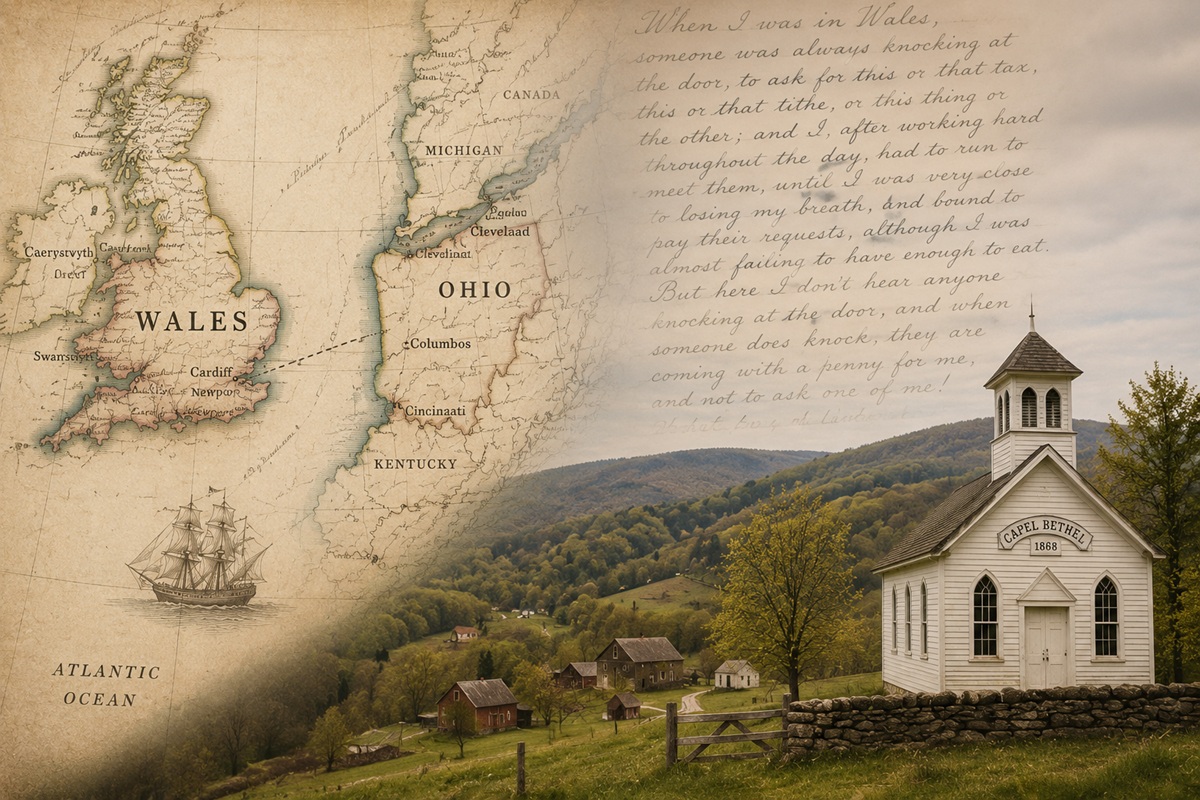
“When I was in Wales, someone was always knocking at the door, to ask for this or that tax, this or that tithe, or this thing or the other; and I, after working hard throughout the day, had to run to meet them, until I was very close to losing my breath, and bound to pay their requests, although I was almost failing to have enough to eat. But here I don’t hear anyone knocking at the door, and when someone does knock, they are coming with a penny for me, and not to ask one of me!”
As a Welsh American, I have no shortage of experience with the elusive American Dream, neither as in literature nor as in life.
Before reading Rev Edward Jones’s “Y Teithiwr Americanaidd” (the American Traveler), however, I had never read about the American Dream in Cymraeg.
The American Traveler was published in Aberystwyth in 1837, nearly 20 years after the earliest party of Welsh immigrants established themselves in my corner of Southeastern Ohio.
This travelogue, written by a Calvinistic Methodist reverend of Welsh descent, provides profiles of the various Welsh communities that he was called to visit, presumably while serving the local chapels.
To a young American reader like myself, this work provides an incredibly interesting record of the Welsh societies that dotted the fledgling United States – some of which have since become thriving, 21st century cities, and some of which have now come to an end.
With no deference to order nor chronology, here are some passages which stuck out to me. To read the
travelogue in its entirety, one can find a PDF of the original Welsh here: Y Teithiwr Americanaidd
Agriculture
Did you know that farming was one of the Welsh’s prime motivations for leaving their motherland?
Facing intense economic pressures, many rural Welsh farmers struggled to earn a living during the 19th century, working for wages without owning land.
Rev. Jones makes explicit mention of this all-too-familiar issue in his introduction, writing: “Hearing, while traveling in Wales, of so many farmers failing to have a place for their children, forced to go into tiny houses, and so running out of money, and portending to be burdens on their parishes before the end of their days; I wrote that which follows so that they may not go that way, but that they may have sufficient room for themselves and their children, and that the parishes may be saved from paying for those who cannot work, through acquainting them with places where many of their kind have had a comfortable living without support.”
To poor Welsh farmers and many other Europeans beside them, the promise of fruitful and affordable land was too tempting to refuse.
Y Gymraeg – The Welsh Language
Another driving force behind emigration from Wales in this period was freedom of religion – the right to worship as one pleases and in their own language. The tie between the Welsh language and the capel runs deep on both sides of the Atlantic.
In my own hometown of Oak Hill, OH, church services were held in Welsh all the way up until the 1930’s.
Reverend Jones comments on the status of both the Welsh language and Welsh religious efforts throughout his travelogue, noting once of the state of Indiana: “Although there are some Welsh scattered here and there about the country, there is not yet one Welsh house of worship in the whole State; but the Americans have various churches.”
Some contemporary historians suppose that this same “scattered” settlement pattern of incoming Welsh immigrants contributed greatly to the eventual loss of their language and practices. Jones’s inclusion of the “American” churches here reminds readers of the rapid force of assimilation.
‘The Indians’
“The Northern part of America is divided into four parts, as follows:–
1. The possessions of the Indians, namely the first inhabitants of the land; men of copper color, and smooth black hair, generally, with much greater strength than we possess. They are in a very uncivilized condition, and live in a sort of hut in the middle of the Western woods.”
Throughout all 36 pages of Jones’s travelogue, he only makes one mention of the country’s native population.
President Andrew Jackson’s Indian Removal Act was signed in 1830, and it is thus possible that Jones might not have come across a single Native American throughout all of his travels. He does, however, take care to inform readers of their barbarous (anwaraidd) nature before continuing onward under the assumption of Terra Nullius.
Jones in My Hometown
“I am of the opinion that [Ohio] is by far the best one for the Welsh to settle in, until it is filled up, and then the states of Indiana and Illinois, and Michigan Territory; and the increase in residents has already demonstrated that; because although it hasn’t been many years since she united with the States, only three of the 25 States have as many residents. And it should be remembered that the best places are on the Southern side.”
Growing up in Southern Ohio over 150 years after these words were first written, I must admit that I was surprised, reading them for the first time. Since the publication of Reverend Edward Jones’s “Y Teithiwr Americanaidd” (the American Traveler) in 1837, Gallia and Jackson counties – once known as “Little Cardiganshire” – have changed.
In the latter half of the 19th century, immigrant parties poured into this quiet corner of the Appalachian countryside, many of them coming from the Cilcennin area in Ceredigion.
Shortly following their arrival to the New World, Welsh immigrants were responsible for the radical industrialization of their new home. From the Jones family’s prosperous Globe Iron Company in Jackson, to my own family’s success running a fire brick factory in Oak Hill, the arrival of the Welsh in this part of the country served to spread the fires of the Industrial Revolution.
Like many industrial towns all across the world, however, the furnaces of Jackson County have long since grown cold.
Reading through “The American Traveler”, I am struck each time by the optimism and excitement of Jones’s writing.
Not only does he express interest in the development of the area’s Welsh settlements, but he encourages others to join in on the efforts.
Living in a rural community like this one comes with its own frustrations and limitations. In 1837, Reverend Jones noted this region as “y Lle Goreu i’r Cymry”, and if it’s good enough for him, then I’ll have to give it a chance.
Support our Nation today
For the price of a cup of coffee a month you can help us create an independent, not-for-profit, national news service for the people of Wales, by the people of Wales.
Get more trusted Welsh news
Choose Nation.Cymru as a preferred source in Google News to see more of our journalism.



That AI image is awful. Swanstyth as the only city in Wales? Caerystwyth as the capital of Ireland? Getting to America by sailing east from Newpw to Colombos?