


The most and least expensive areas for household energy in Wales revealed

Nation.Cymru staff
New analysis has revealed a striking divide in household energy costs across Wales, with Ceredigion facing the highest effective price per unit and Merthyr Tydfil the lowest.
Households in Ceredigion face the highest effective energy price anywhere in Wales, according to new analysis of household energy costs across Great Britain.
Ceredigion has a modelled blended energy price of 22.84p per kWh, compared with just 13.96p per kWh in Merthyr Tydfil.
That means the effective price per unit in Ceredigion is around 64% higher, a difference of 8.88p for every kWh of household energy used.
Ceredigion also ranks among the most expensive areas in Great Britain, taking fifth place nationally under the study’s dense-ranking system.
It is followed in Wales by Anglesey at 21.09p per kWh, Powys at 20.33p and Gwynedd at 20.21p.
The research by Alan Boswell Group analysed all 350 local authorities in England, Scotland and Wales, combining the latest available local household energy-consumption figures with Ofgem’s regional price-cap rates for October to December 2026.
The findings point to a strong divide between areas with widespread access to mains gas and those where households rely more heavily on electricity.
Under the October price cap, the average electricity unit rate is 26.32p per kWh, compared with 7.97p for gas.
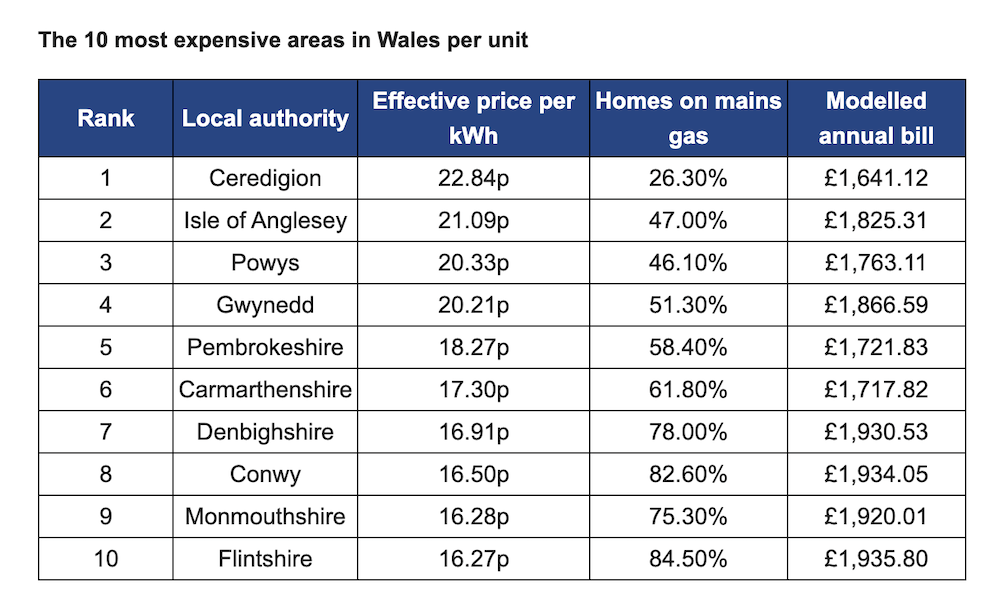
Ceredigion tops the Welsh ranking at 22.84p per kWh. Just 26.3% of homes are estimated to be connected to mains gas, the lowest rate in Wales, while its modelled annual household bill is £1,641.12.
Anglesey ranks second at 21.09p per kWh, with an estimated 47.0% of homes connected to mains gas. Its modelled annual bill is £1,825.31.
Powys is third at 20.33p per kWh, with an estimated mains-gas connection rate of 46.1% and a modelled annual bill of £1,763.11.
Gwynedd follows closely in fourth at 20.21p per kWh. Just over half of homes – 51.3% – are estimated to be connected to mains gas, while its modelled annual bill is £1,866.59.
Pembrokeshire ranks fifth at 18.27p per kWh, with an estimated 58.4% of homes connected to gas and a modelled annual bill of £1,721.83.
Carmarthenshire is sixth at 17.30p per kWh. Its estimated mains-gas connection rate is 61.8%, while the modelled annual household bill is £1,717.82.
Denbighshire comes seventh at 16.91p per kWh, with 78.0% of homes estimated to be on mains gas and a modelled annual bill of £1,930.53.
Conwy ranks eighth at 16.50p per kWh, with an estimated gas-connection rate of 82.6% and a modelled annual bill of £1,934.05.
Monmouthshire is ninth at 16.28p per kWh, with 75.3% of homes estimated to be connected to mains gas and a modelled annual bill of £1,920.01.
Flintshire completes Wales’s ten most expensive areas per unit at 16.27p per kWh, with 84.5% of homes estimated to have mains-gas access and a modelled annual bill of £1,935.80.
At the other end of the ranking, the cheapest areas generally have much higher estimated levels of mains-gas connection.
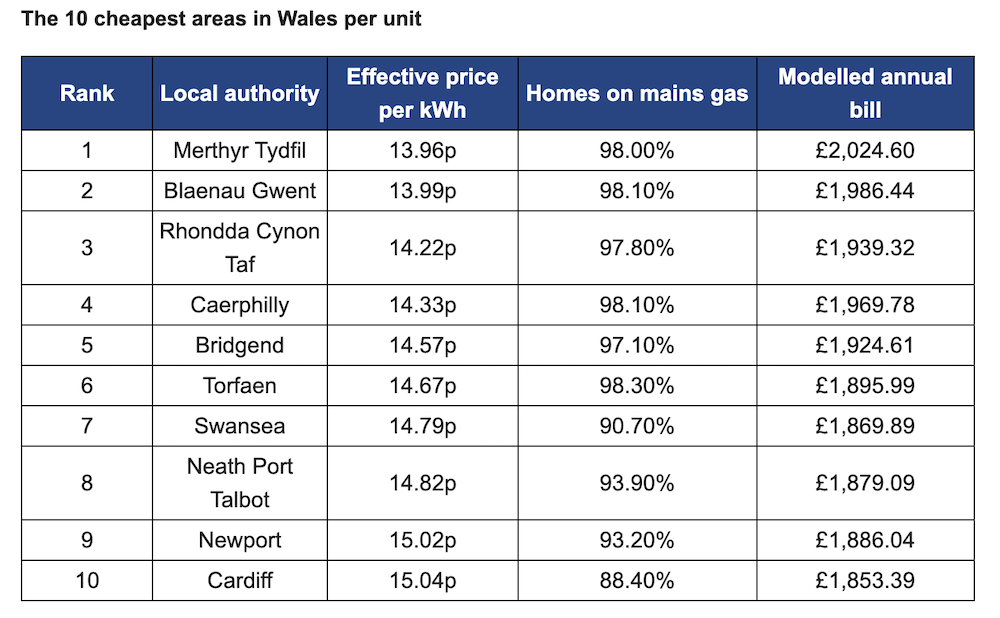
Merthyr Tydfil has the lowest effective energy price in Wales at 13.96p per kWh. An estimated 98.0% of homes are connected to mains gas, while its modelled annual bill is £2,024.60.
Blaenau Gwent is second cheapest at 13.99p per kWh, with an estimated 98.1% of homes connected to mains gas and a modelled annual bill of £1,986.44.
Rhondda Cynon Taf ranks third cheapest at 14.22p per kWh, with 97.8% estimated mains-gas coverage and a modelled annual bill of £1,939.32.
Caerphilly follows at 14.33p per kWh. Its estimated mains-gas connection rate is 98.1%, while its modelled annual bill is £1,969.78.
Bridgend ranks fifth cheapest at 14.57p per kWh, with 97.1% of homes estimated to be connected to gas and a modelled annual bill of £1,924.61.
Torfaen comes sixth at 14.67p per kWh and has the highest estimated gas-connection rate of any Welsh local authority in the study, at 98.3%. Its modelled annual bill is £1,895.99.
Swansea ranks seventh cheapest at 14.79p per kWh, with an estimated 90.7% of homes connected to mains gas and a modelled annual bill of £1,869.89.
Neath Port Talbot follows at 14.82p per kWh, with 93.9% estimated mains-gas coverage and a modelled annual bill of £1,879.09.
Newport ranks ninth cheapest at 15.02p per kWh, with an estimated gas-connection rate of 93.2% and a modelled annual bill of £1,886.04.
Cardiff completes the ten cheapest Welsh areas at 15.04p per kWh, with 88.4% of homes estimated to be connected to mains gas and a modelled annual bill of £1,853.39.
The data also highlights the additional pressure faced by households in parts of north and mid Wales from fixed charges.
Anglesey, Powys and Gwynedd have the three highest effective standing-charge burdens in the entire Great Britain study, at 3.45p, 3.43p and 3.28p per kWh respectively.
All three are priced within Ofgem’s Merseyside and Northern Wales region.
Under the October price cap, households in this region face the highest electricity standing charge in Great Britain.
The figures also show why having the most expensive energy per unit does not necessarily mean having the largest annual bill.
Despite Ceredigion having the highest effective price per kWh in Wales, its modelled annual bill is just £1,641.12.
Meanwhile, Merthyr Tydfil has the lowest effective price per unit in Wales, but a modelled annual bill of £2,024.60.
The difference reflects how much energy households use as well as the underlying price they effectively pay. For this reason, the study ranks areas primarily by their blended effective price per kWh rather than simply comparing final annual bills.
Heath Alexander-Bew, Personal Lines Director at Alan Boswell Group, said:
“Where you live can have a surprisingly big impact on what your household effectively pays for energy, particularly if mains gas simply isn’t available to large numbers of homes.
“The figures in Wales show a really clear divide. Areas with lower gas-grid coverage dominate the expensive end of the table, while many of the cheapest areas have connection rates close to 100%.
“For households facing higher energy costs, reducing the amount of heat a home loses can make a meaningful difference. We’d recommend starting with the fabric of the building – looking at loft insulation, draughts and poorly insulated walls – before automatically assuming the answer has to be replacing the heating system.”
From 1 October 2026 to 31 March 2027, VAT on domestic electricity in Great Britain will temporarily fall to 0%, while gas remains at 5%.
Support our Nation today
For the price of a cup of coffee a month you can help us create an independent, not-for-profit, national news service for the people of Wales, by the people of Wales.
Get more trusted Welsh news
Choose Nation.Cymru as a preferred source in Google News to see more of our journalism.


