


The passing of a Swansea character: Matthew G. Rees remembers Mal Barnett
Matthew G. Rees
Obituaries ought not to be the preserve of captains of industry, politicians, prelates, and those who’ve starred on stage, screen and in sporting arenas.
“Ordinary people” are entitled to be remembered too.
Mal Barnett was an “ordinary man”—and utterly extraordinary to boot.
I first met him a dozen or so years ago when he was working on a boat in the dry dock of a car park behind a block of flats in The Uplands district of Swansea (through which I was—fortuitously—taking a short cut).
At the time, I’d been tasked with a writing project at Swansea University—to find and interview someone with a story to tell.
Perhaps from my past years in newspapers, I sensed—pretty much immediately—that in Mal—a stocky, bearded, barrel-chested figure who had the look of an old-school mariner: a veritable tugboat of a man—I’d struck gold… sea treasure, it might be said.
He responded in civil and positive fashion to my request for an interview and—a few days later—we sat down together in his flat, high above Swansea Bay, Mal recounting episodes from his multi-faceted life, as he perched on a stool by a window that had panoramic views over the city and the sea.
As I later came to appreciate, the brief passage I penned arising from that meeting barely scratched the surface of a life of the kind which the combined imaginations of all of the great writers of Swansea—Dylan Thomas, Kingsley Amis, Alun Richards, and more—might have struggled to conjure…
Hailing from Carmarthen and a family connected with the local canals, Mal had—on leaving school—become an apprentice mechanic.
Early jobs saw him working for bus operators, both locally and in London.
His real calling though was the sea and—in the tradition of Swansea’s great history of Cape Horners (old Copperopolis having more such seafarers than anywhere on the globe)—he rounded that fierce South American headland on some seven occasions, rising to the rank of chief engineer on merchant ships.
But there was more, much more to the life of Mal. His work and activities included time as a diver and a diving instructor; a period as a publican (keeping The Coopers Arms at Landore); and stints as a square-shouldered doorman at the likes of Swansea’s legendary Townsman and Top Rank clubs (hosts in their heyday to Shirley Bassey, Tina Charles, and even the Welsh-descended Donny Osmond, and a springboard to fame for local girl Gaynor Hopkins—better known to audiences the world over as Bonnie Tyler).
A perhaps surprising-to-some turn in Mal’s life came with his opening of a restaurant in Swansea Marina. Here—donning a kitchen apron rather than the engineer’s overalls of his early career—he was the chef (having become versed in the culinary arts during a past spell spent in France).
Named The Penguin, the speciality of his popular eatery was fish. And every time Swansea’s fleet set sail, Mal would make sure he was present on the harbourside for the skippers’ homecoming… to purchase the pick of their catch.
I remember Mal once mock chiding me for my ignorance of “Toerag”. ‘You mean to say you don’t know what “Toerag” is?!’ he exclaimed as we chatted about this and that in his flat. ‘Rita!’—he called to his wife—’Get this man some “Toerag” next time you’re in the market!’ (It is—for the uninitiated—a hunk of salted, white fish. Best served, declared Mal, with buttered, mashed potato. ‘Lovely!’)
Away from work, Mal’s interests included martial arts and motorbikes. Aged 70, he built one of the latter—lock, stock and barrel—from scratch—in the spare bedroom of the couple’s flat.
On one occasion, he and Rita were astride one of Mal’s machines, motoring to a bikers’ “meet”, when they became stuck behind some slow-moving traffic.
Rita cautioned Mal that there was no need to rush.
Mal (for whom the phrase “his own man” might have been minted) had other ideas.
He opened-up the throttle… and the two of them roared past a convoy of lorries and cars—at a hair-raising 100 miles per hour, or so it seemed.
That was but one moment in the colourful—perhaps combustible—life of thrice-married Mal.
According to one anecdote, he once went to have words with “a committee man” (as the terminology has it in South Wales)—to put the fellow right, as Mal saw it, on a certain sore point, at the committee man’s house.
The fellow’s front door was opened by the committee man’s wife, cradling a cat.
The committee man, whom Mal was keen to “address”, appeared at her shoulder.
Cue something of a “scene” (so the story goes) as the cat-clutching lady stood in the doorway, between Mal and her husband.
Allies of Mal—who had themselves fast arrived on learning of the “situation”—attempted to intervene.
Happily, they persuaded impassioned Mal to stand down, and the incident—with hindsight, perhaps more comic than threatening—was brought to an end. Mal felt he had made his point. No charges were pressed.
Removal for health reasons of one of his legs above the knee, late in life, was a daunting matter. But it did not—of itself—defeat Mal.
Even with this severe disability, he continued to go sailing with Rita (whose skills as a seawoman he much admired) on their small yacht, Sid’s Run (this being named after the couple’s much-loved lurcher, my regular co-occupant of their sofa after I’d become a near neighbour and a caller-in for cups of tea at their flat).
Mal liked to talk. Not so much about himself as about current affairs and economics. He became a reader of such journals as The Economist and The New Statesman and was interested in some of the more serious fare that could occasionally be encountered on TV.
He was a good neighbour and once arrived at my door in the wheelchair he was by that time using, offering his help with a spot of problematic plumbing. I think he had ridden the lift to my somewhat altitudinous accommodation, wheeling himself in and out of the lift and along the hall. I wondered if he had done this with his screwdriver clamped between his teeth. Indomitable Mal.
I was very sorry to learn of his passing this year—aged seventy-five—after an apparent sudden decline in his health.
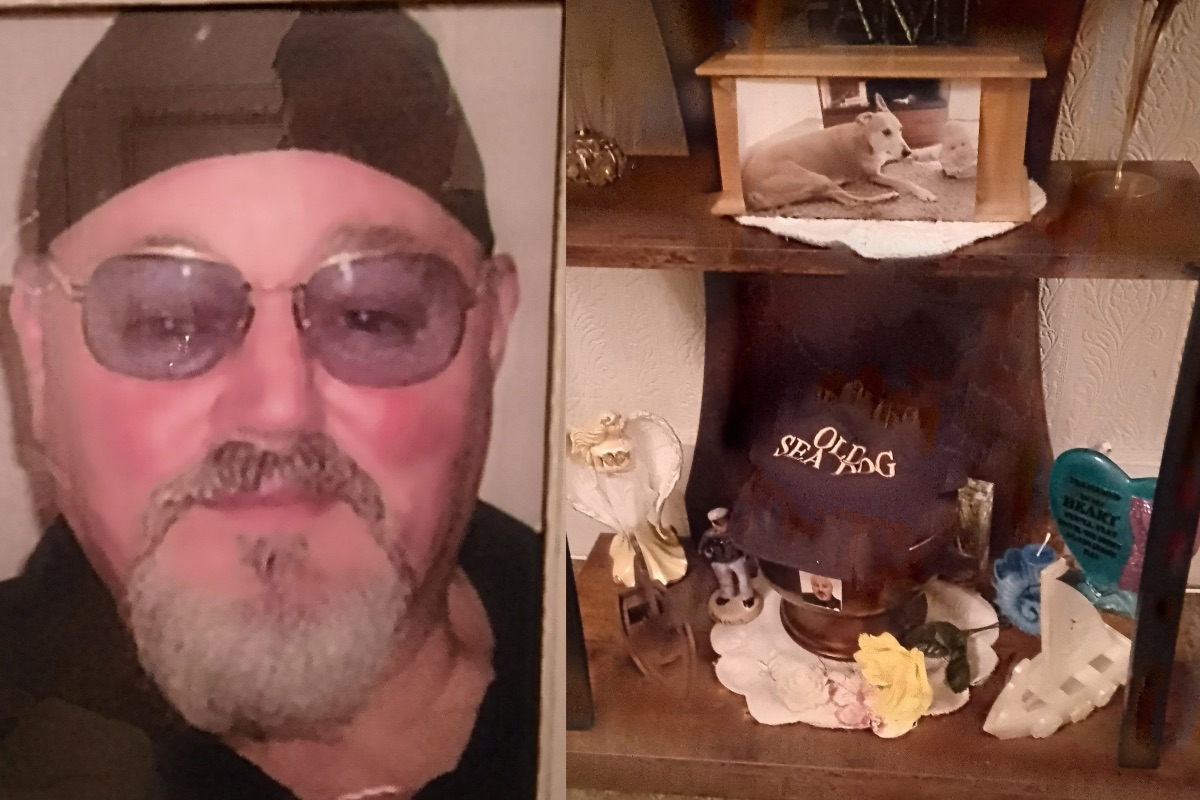
A sailor’s navy-blue cap threaded with the golden legend “Old Sea Dog” now sits atop an urn of his ashes in a shrine maintained by Rita (which also serves as a memorial to the couple’s much-missed lurcher Sid).
With Mal’s “crossing of the bar”, Swansea has surely lost one of her stars. Poetic souls might feel the lamplight from Mumbles shines somewhat dimmer.
I sense a chapter in Swansea’s story has come to an end. More’s the pity, some might think.
My personal tribute will take the form of a platter of “toerag” and mashed potatoes (creamed with Welsh farmhouse butter)—and a toast, of course… to the one-and-only Mal.
Support our Nation today
For the price of a cup of coffee a month you can help us create an independent, not-for-profit, national news service for the people of Wales, by the people of Wales.
Get more trusted Welsh news
Choose Nation.Cymru as a preferred source in Google News to see more of our journalism.


