

The personal made political in forceful Luned Rhys Parri exhibition
Stephen Price
A new exhibition of works by Luned Rhys Parri has launched today, opened by none other than Dafydd Iwan, bringing together forceful protest pieces alongside surprising forays into new territory that are no less vital and moving.
Luned Rhys Parri is one of Wales’ most celebrated and original artists – and perhaps one of our most recognisable.
With works snapped up by collectors across the world, and held in prestigious collections such as the National Library of Wales and CADW, Rhys Parri is peerless, and her admirers know this.
Working from her studio in Groeslon, Gwynedd, her mixed media and papier-mâché documents of Wales capture a nation in a way no other person or medium could.
Rhys Parri’s celebrated dioramas are a record of a nation in unexpected form. Like their very three dimensional nature, they are world of their own – broken free of the confines of frame and border, they ask questions, they make statements, they are outspoken and bold.
A former pupil of the late Peter Prendergast, Rhys Parri’s sellout shows often leave us wanting more – so when a new solo show arrives, it’s an event. A very special event indeed.
Luned’s characters often document scenes from Wales’ volatile past – protest over land rights, resource theft, the fight to preserve and protect the Welsh language – but also many modern struggles, or glimpses of day to day life in pieces that are as up-to-date and as modern as art can be.
Luned’s latest works are set to be exhibited at Oriel Plas Glyn y Weddw from today, and Nation.Cymru was lucky enough to get a glimpse of some of her creations in advance.
As ever, many of the artworks are based on photographs by Geoff Charles, who took pictures of thousands of Welsh people, including members of her family in the 1960’s, but this exhibition signals a change in Rhys Parri both as an artist, and as a person.
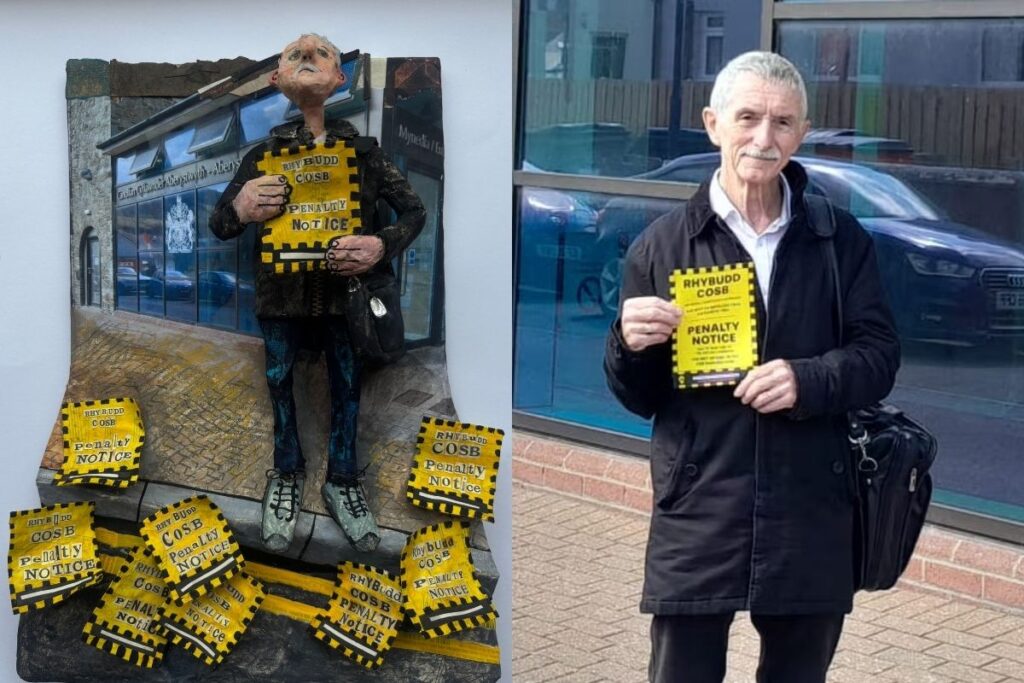
One of the centre pieces of this show is a piece featuring veteran Welsh language campaigner Toni Schiavone – a close family friend who Rhys Parri’s mother worked with for many years at Ysgol Dyffryn Conwy Llanrwst were they were both teachers
Luned’s piece offers a picture-perfect take on Schiavone’s iconic appearance outside a courthouse where he faced a fine for parking in a private car park, but refused to pay as he did not receive the charge in Welsh or bilingually, despite sending the company two letters as well as calling them.
Mr Schiavone said: “The Welsh language is an official and equal language in Wales and we as Welsh speakers have rights according to the law, and in principle, that should be respected.”
Following the verdict, Mr Schiavone said he will continue to refuse to pay until he receives a copy of the notice from the parking company in Welsh. His photos have since gone on to inspire others to stand their ground. To stand up for Cymraeg.
The exhibition itself may not have happened, had Luned not used her art to channel recent losses and to honour friends and family. Her losses can be seen in the works, however, with delicate pieces honouring or hinting at loved ones – immortalising them in a way only she could.
Her grief has also led to her work melding and moulding into new forms – quiet, touching shelf scenes and even two dimensional pieces. Like her own work, something in her needed change and to rip up the script – something any artist feeling pigeonholed must do on times to keep things fresh, moving, alive and to test their own boundaries.
Luned told Nation Cymru: “It has been a difficult year for me after losing my mother and also two of my friends ( who were my age) at Christmas. I lost a big part of my support network.
“I carried on working , regardless, towards this exhibition at Plas Glyn y Weddw because my mother absolutely adored this wonderful place. All the work in this exhibition somehow reflects my life and my family’s history, although it might not be so obvious on first glance.
“I wanted to include “portraits”( of sorts) of my mother and father . My father is in “Llangefni Post Office Protest” and I am borrowing a piece called “Pont Trefechan” from a collector friend. The “Pont Trefechan” piece was in the last exhibition I had in the Plas and I have fond memories of my mother sitting next to the artwork recalling the day of the protest to friends and passers by.”
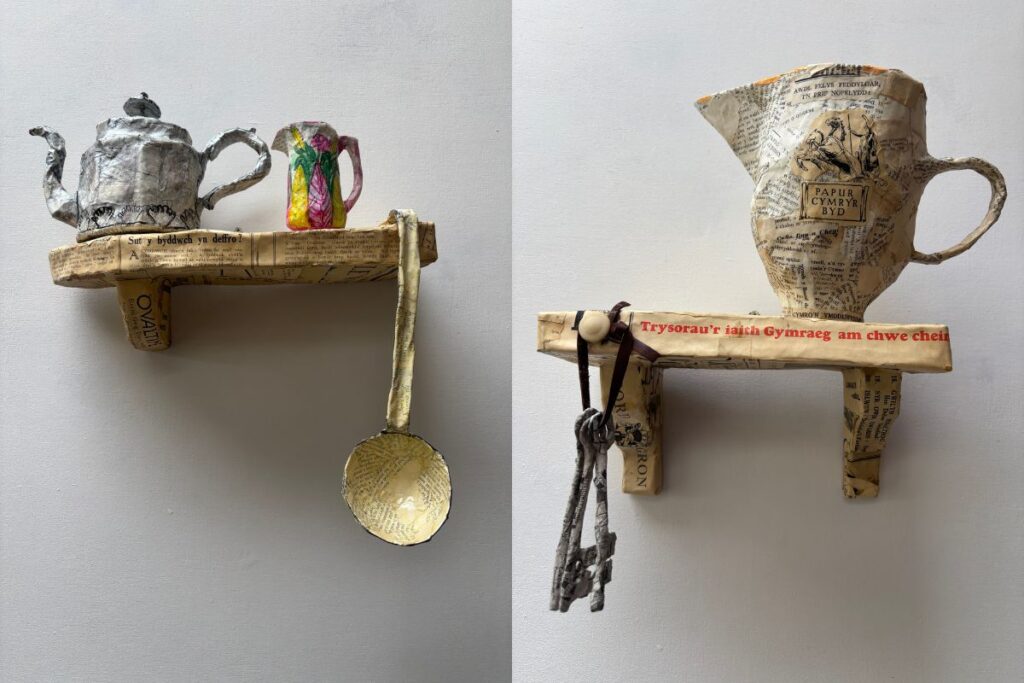
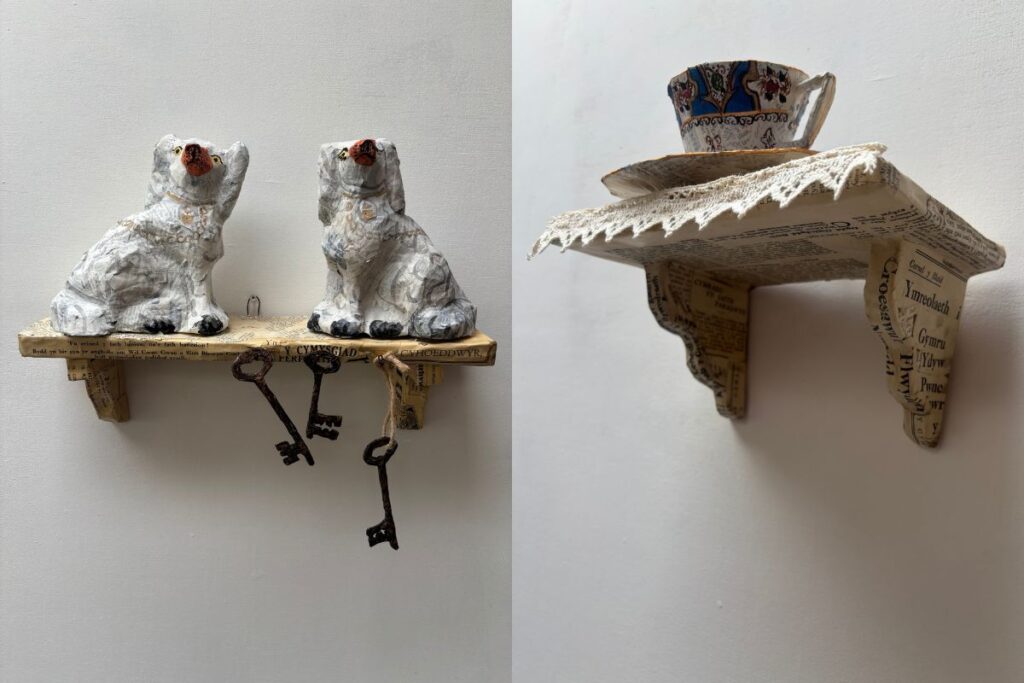
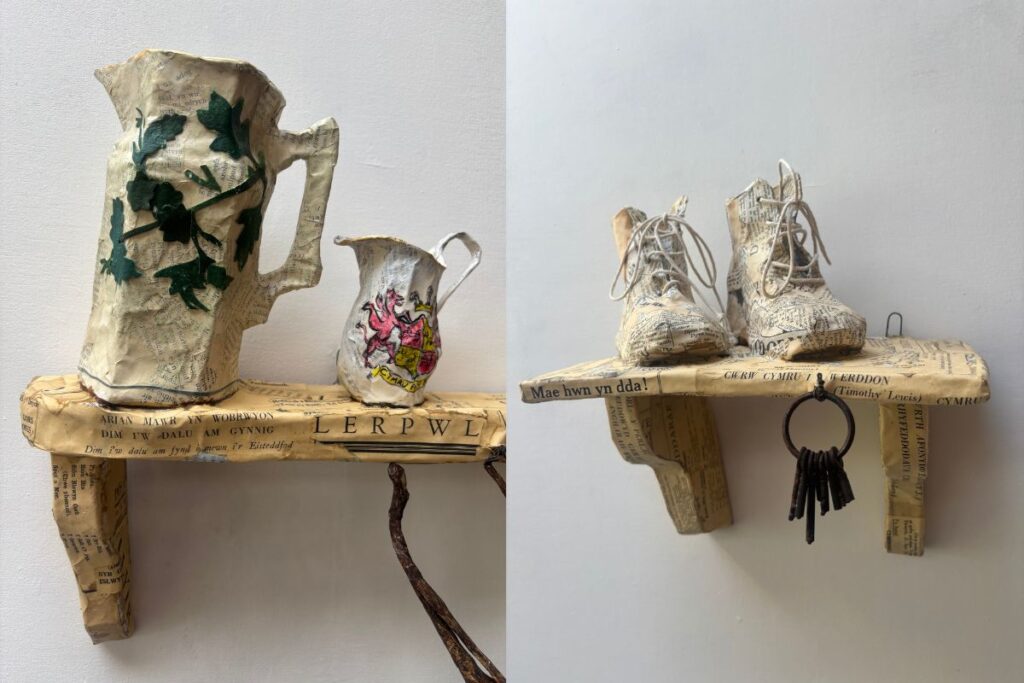
“I was incredibly fortunate to spend time being mentored by the amazing Welsh artist , Julia Griffiths Jones. I explained to Julia that I was interested in re creating objects that I’ve “inherited” and that are part of my family history , but I didn’t have a clue how to display them. Julia encouraged me to make shelves from card and wire as “platforms” for the purpose of exhibiting these sculptures.
“The shelves were then covered with old 1930’s newspapers like “Y Ford Gron” , “Y Geninen” and “Y Cymro” . I tried to glue particular sentences that I found interesting and bits of articles about Welsh independence and the very young Plaid Cymru.
“One of the pieces features shoes that are based on my Taid’s first shoes. As a very young man he walked all the way from Anglesey to Swansea to find work.
“I have collaged the words “Prydau bwyd maethlon yn yr haf” on the shelf.”
Like the Schivaone piece, however, there is much of the familiar handiwork of Rhys Parri across the exhibition – unmistakable marriage of old photographs and newspapers, vintage “finds” of all kinds, and life in Wales both past and present.
Her dioramas are tangible artworks more often than not based on real people must take a great deal of time, effort and emotion.
One such piece concerns one of the most pivotal Welsh language events of recent decades – the flooding of Tryweryn to supply water to Liverpool.
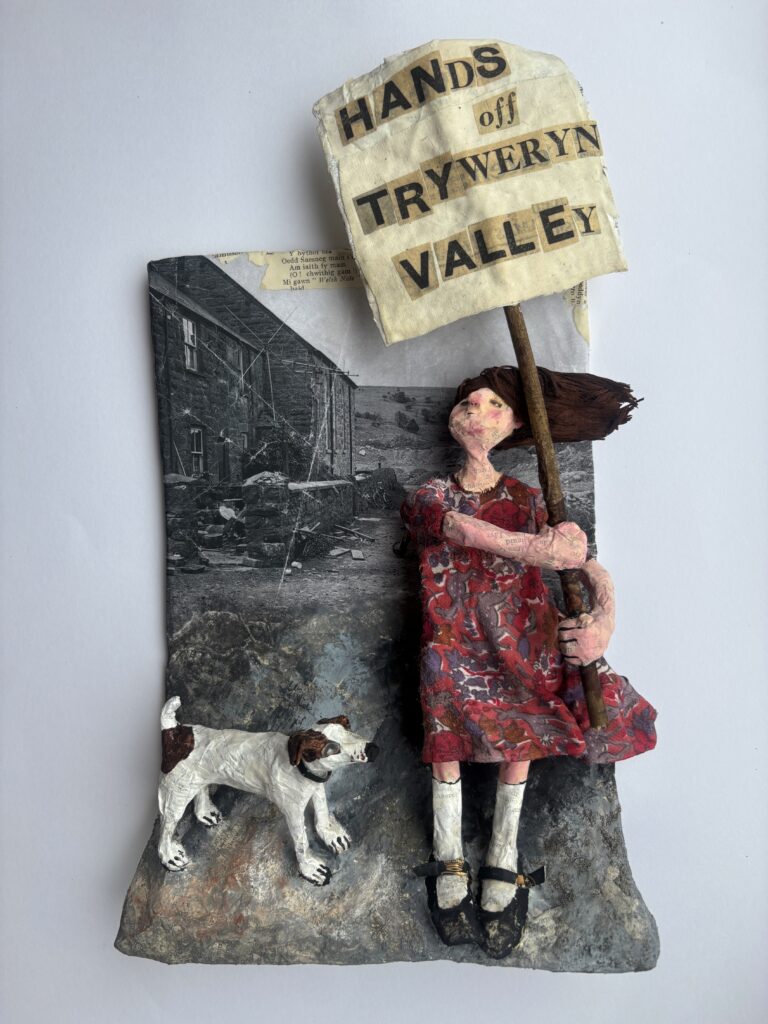
Perhaps to some, the inclusion of English might be a shock among her work, but Rhys Parri explained its inclusion – and, importantly, its historic accuracy.
She shared: “It’s interesting that the placards created by the people changed languages from Welsh to English as the inhabitants became more determined to get their views seen by a wider audience at home and abroad.
“The placards changed from Welsh to English because the inhabitants of Cwm Celyn were desperate to get their voices heard and knew that the messages had to be in English for the people of Liverpool to understand”
Among other protest pieces is one dedicated to one that took place at Llangefni Post Office. Another everyday location, and scene, that formed a battleground for those whose shoulders Wales rests on for the rights our language has. A reminder, too, at the cost paid by everyday people, and a reminder that our language still stands at a crossroads at the whim of political figures and private bodies who often had little regard for Wales and its people.
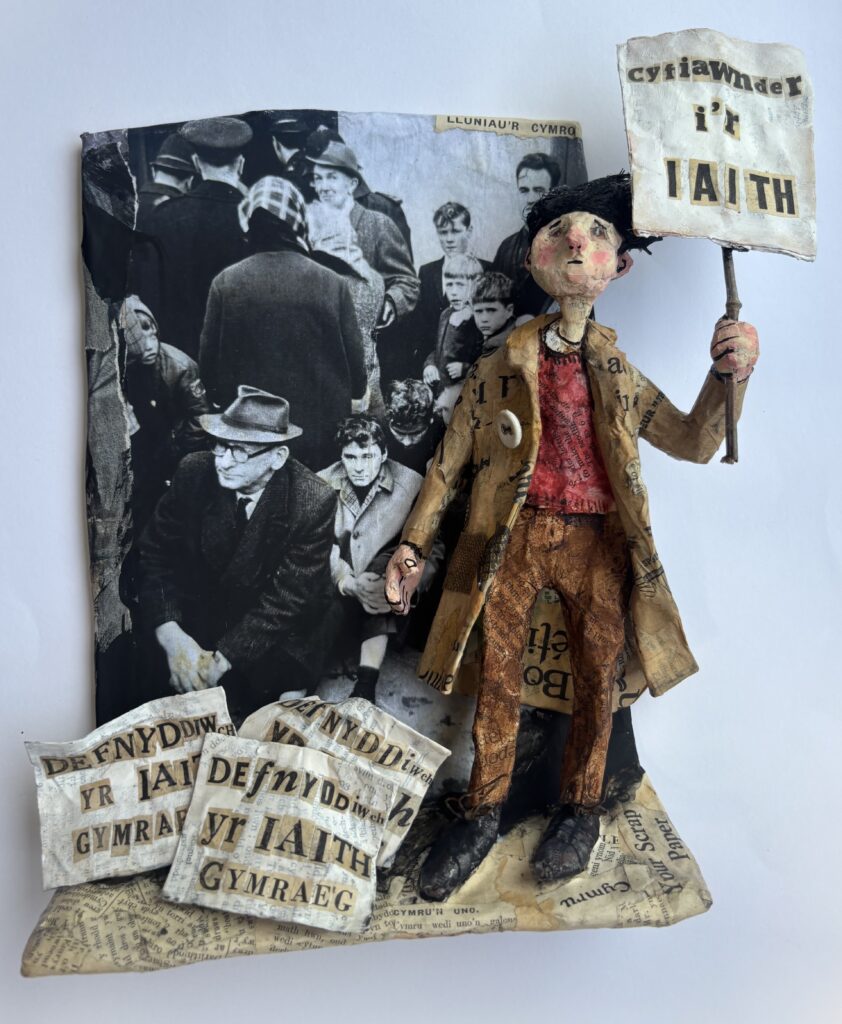
Highlighting the personal and political, and the very nature of a small nation, Parri told Nation Cymru: “My father is the handsome young man in the centre of Geoff Charles’ photo which is in the background of this piece. The protest was in Llangefni , my mother’s home town, although I don’t think they knew each other at this time”
Her hope is that her work will eventually speak to a wider audience than just the fortunate few of us who are still able to live and work in our country.
With a lack of the history from our own doorsteps being taught in our classrooms until recently, she asked: “Could this exhibition possibly remind exiles, as well as survivors, of our common history and the past struggles which have made us what we are today?
“Some people might learn a little about our way of life, as it is today and as it was in the recent past.”
As for another of the changes in direction to land at an exhibition are works that are, surprisingly, two dimensional and not three.
She told Nation Cymru: “I have also had some mentoring from the excellent Welsh artist, Cefyn Burgess, who helped me develop a couple of two dimensional pieces which are in this exhibition.
“I am making some attempts to develop my methods of working, but the themes are the same. Life in Wales and recent Welsh history.”
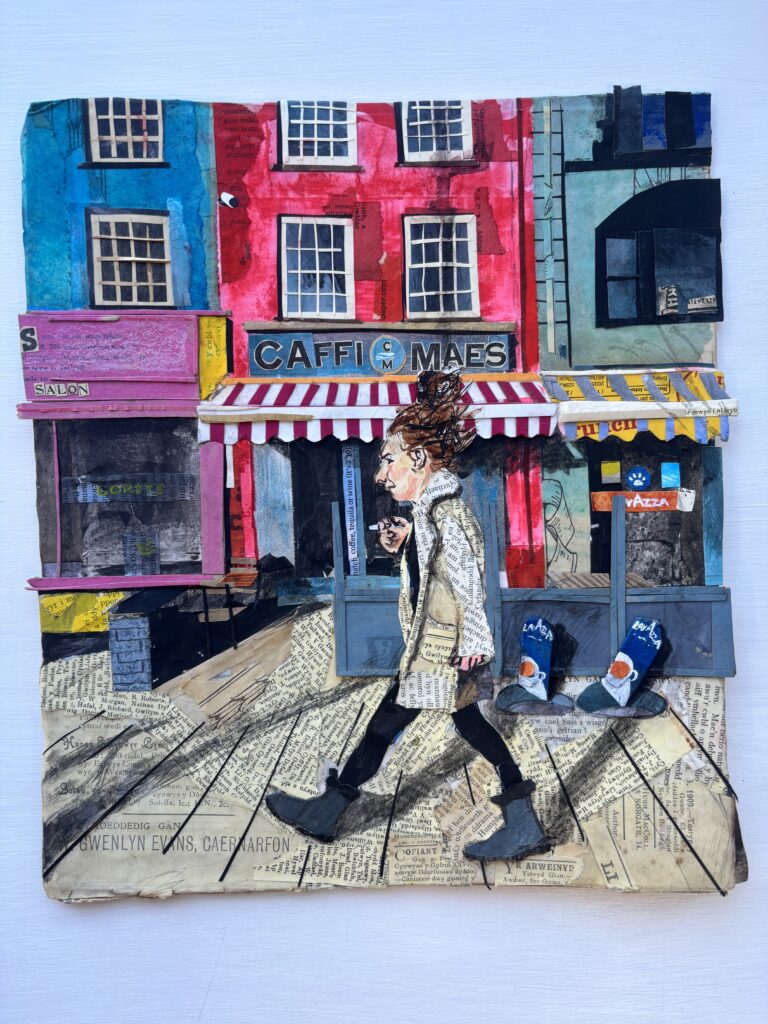
She added: My artwork is changing very gradually because of the nature of the very slow techniques that I use. It is always a struggle to make a living as an artist in Wales and I often have to make work that I hope will sell in a gallery, and occasionally lose confidence in my ideas.
“I started making work from card, paper and other found materials around 30 years ago due to lack of money, although I have found that there is an attraction to art made of rubbish all over the world.”
As important among her protest works, however, are simple documents of the everyday – the small moments, the overlooked moments, the touching human moments of Welsh life and, now, life in Ireland too.
One such piece is is a portrait of her artist friend, Lelia ni Chathmhaoil – an Irish multidisciplinary visual artist, sculptor, and textile maker – in her kitchen in the Gaeltacht.
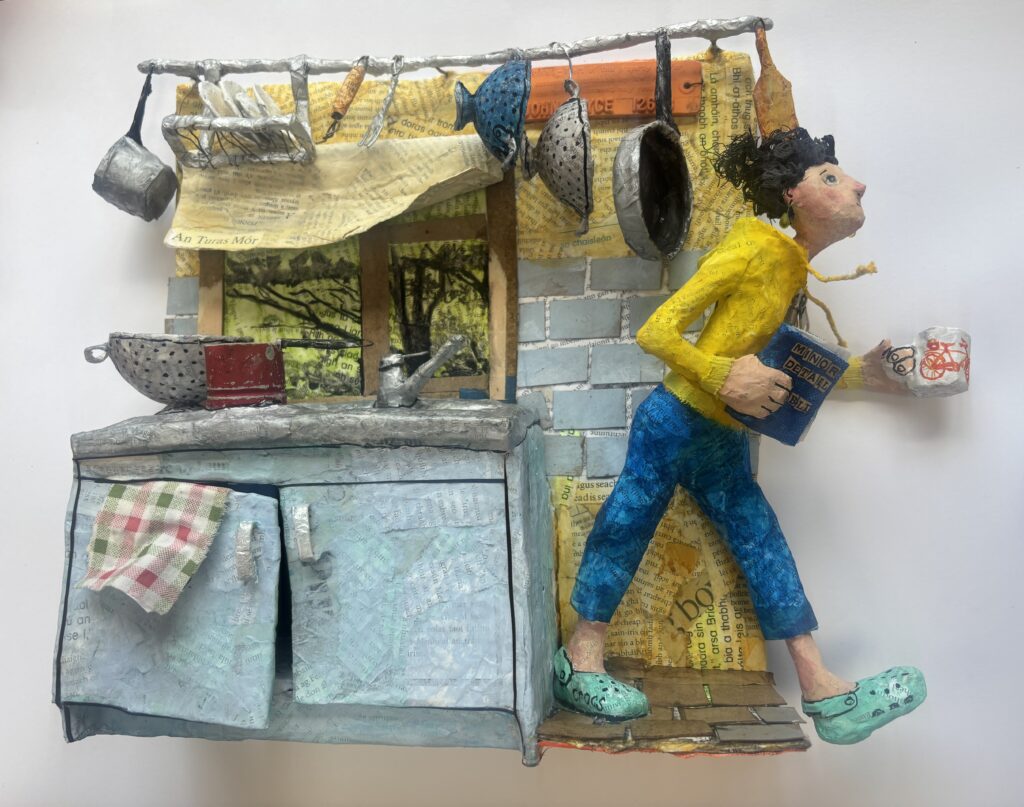
For both artists, it was an opportunity to come together as minority language-speaking artists working in small rural communities and to highlight the importance of our centuries of real, human connection and shared history far away from city lights and current trends.
Important for this piece was the use of found materials – and in this case rubbish found close to the sea – a restorative act, and one she hopes might inspire others to come together and enact similar acts of protest to protect our waters and sea life.
Rhys Parri shared: “The whole piece is created mainly from bits of rubbish found on the shoreline near her home.”
“I collected the rubbish near Lelia’s home in Connamara and attempted to transform it into a piece of art, which became this portrait of Lelia in her kitchen.
“Lelia spent a few nights staying in Glyn y Weddw about a year ago and also collected stuff on the beaches in Wales in order to make sculptures . There are plans to organise an exchange exhibition with the Connamara artists’ group “Cul an tí” in the future.”
Cymuned
As important as making art for collectors and institutions alike – and keeping her head above the water as a self-employed artist in Wales – is sharing the joy of making, creating, of celebrating Welsh art with others, particularly school children.
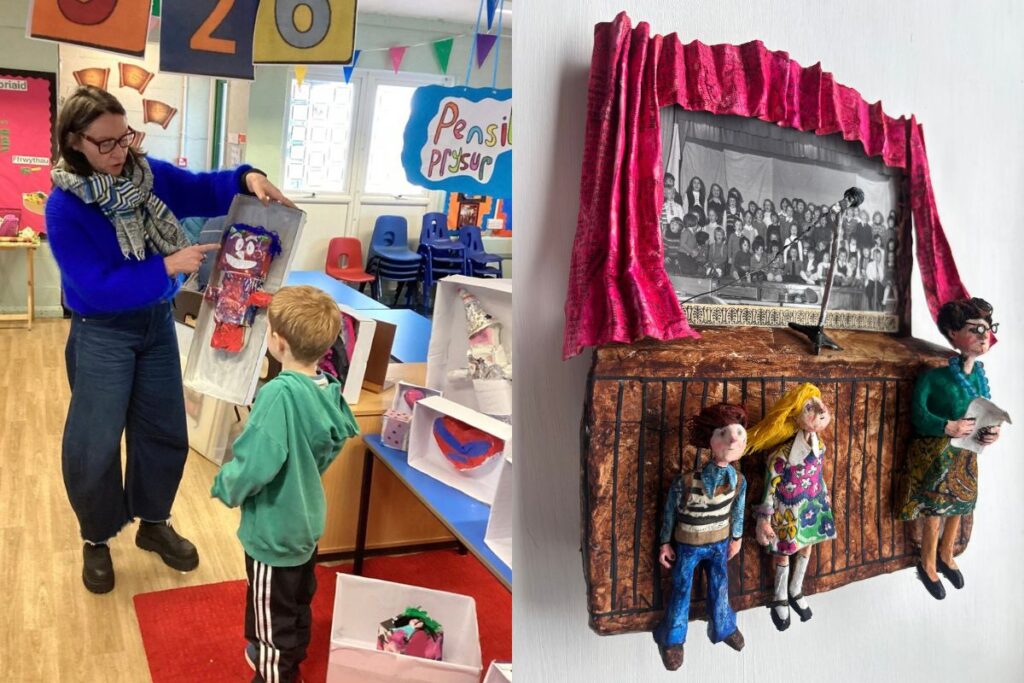
She said: “I am still visiting schools and worked with Ysgol Bro Hedd Wyn , Trawsfynydd creating colourful mixed media murals. This project was organised by Parc Cenedlaethol Eryri and the artwork will soon be shown at Yr Ysgwrn , Hedd Wyn’s home, near Trawsfynydd.
“I also made a collection of paper shoes with the community in Yr Orsaf Penygroes. This work will be exhibited in Amgueddfa Sain Ffagan as part of REACH at the end of October.”
Despite suffering life-changing losses, one can sense a calling – a duty even – in Luned’s work ethic. Ancestral voices channelled into work of immeasurable beauty and joy, but never shying away from a nation’s pain and bruises.
Seeds sown, history recounted, and eyes opened. This is art that matters.
As ever, this very special exhibition from Rhys Parri gives us all a chance to double-take and re-evaluate the overlooked beauty and the nation-shaping protest, both small and large, that has kept Wales and Welshness alive despite constant attack and threat.
The ordinary is uplifted and celebrated, as are the unsung heroes of our communities or the everyday people who show up to protest, demanding ‘chwarae teg’ for Wales, its people, its resources.
Peerless, potent and masterful work. And overflowing from the page in a charm all of her own.
Luned’s new works are available to view and purchase from today, or you can see them in person at Oriel Plas Glyn y Weddw from today until 24 December.
Support our Nation today
For the price of a cup of coffee a month you can help us create an independent, not-for-profit, national news service for the people of Wales, by the people of Wales.
Get more trusted Welsh news
Choose Nation.Cymru as a preferred source in Google News to see more of our journalism.


