


The plan to reshape Swansea’s civic centre
Richard Youle, Local Democracy Reporter
It was never the most raucous of buildings, but Swansea’s Civic Centre really is quiet. Eerily so.
Home until recently to the central library, the archives service, a cafe and various council services only a small number of staff remain in the squat seafront complex.
Also hunkered down in one of offices there is the person hoping to transform it into a place to live, visit and spend time at.
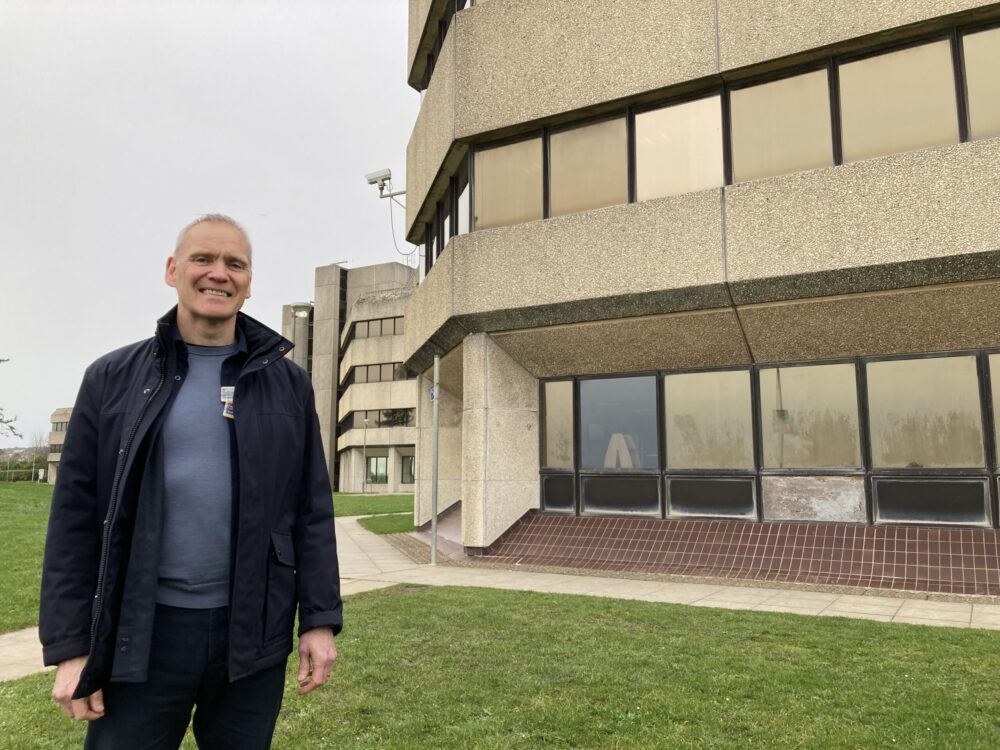
David Warburton, of property development and regeneration company Urban Splash, has got to know the pre-cast concrete building pretty well.
“It’s in really good condition,” he said. “Eminently convertible.”
Urban Splash was announced by the council in 2021 as a strategic partner to breathe new life into seven sites in and around the city. Development director Mr Warburton said the company was formally appointed the following March.
The Civic Centre’s architecture won’t appeal to everyone but Mr Warburton said “beautiful Brutalism is very much coming into vogue”. This, combined with its superb location overlooking Swansea beach and development land on either side, opens up many possibilities for what is just one of the seven sites being taken forward.
Mr Warburton grew up between Manchester and Liverpool and first visited Swansea in 2019. “It has a way of grabbing you,” he said. “The trick is to get people here.”
The latest plans to get people here envisage commercial and leisure space on the ground and lower ground floors of the Civic Centre and one, two and three-bedroom flats above. The door is also being left open for fewer flats and a 60-70-bed hotel.
The central atrium could be a food court while an aquarium – predominantly a digital one rather than large tanks of water – is proposed along a ground and lower groundfloor wing to the right of the main entrance.
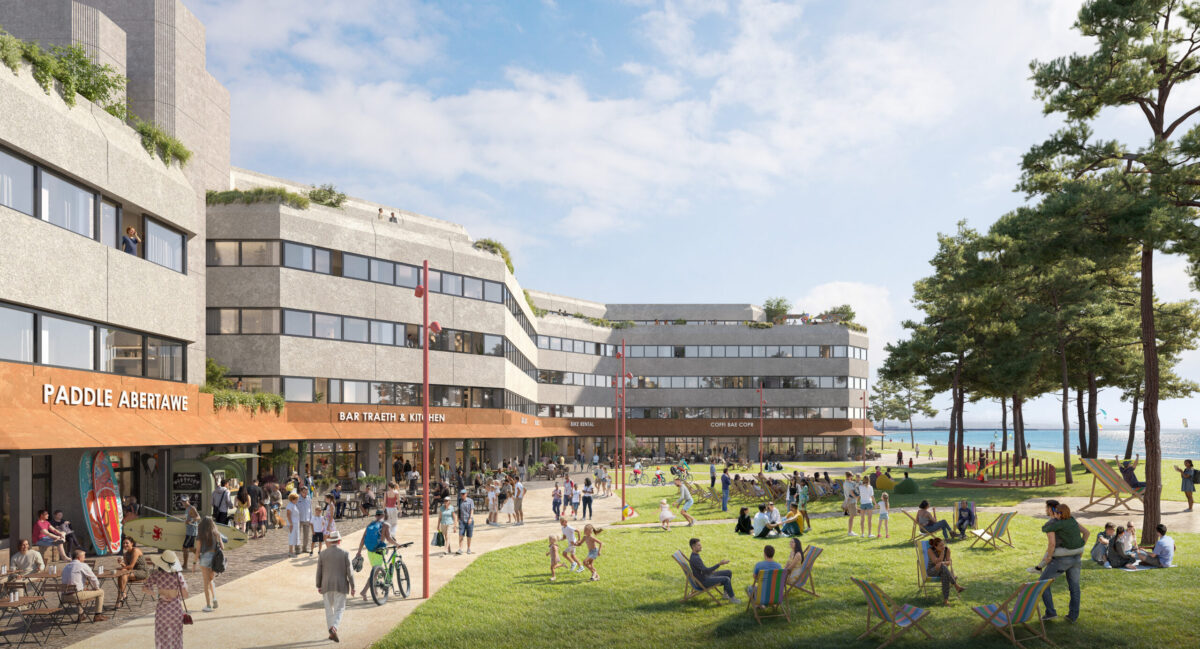
For a building synonymous with worthy civic function it’s a real shift. “Our role is to recognise the inherent value in properties like this which others don’t,” said Mr Warburton.
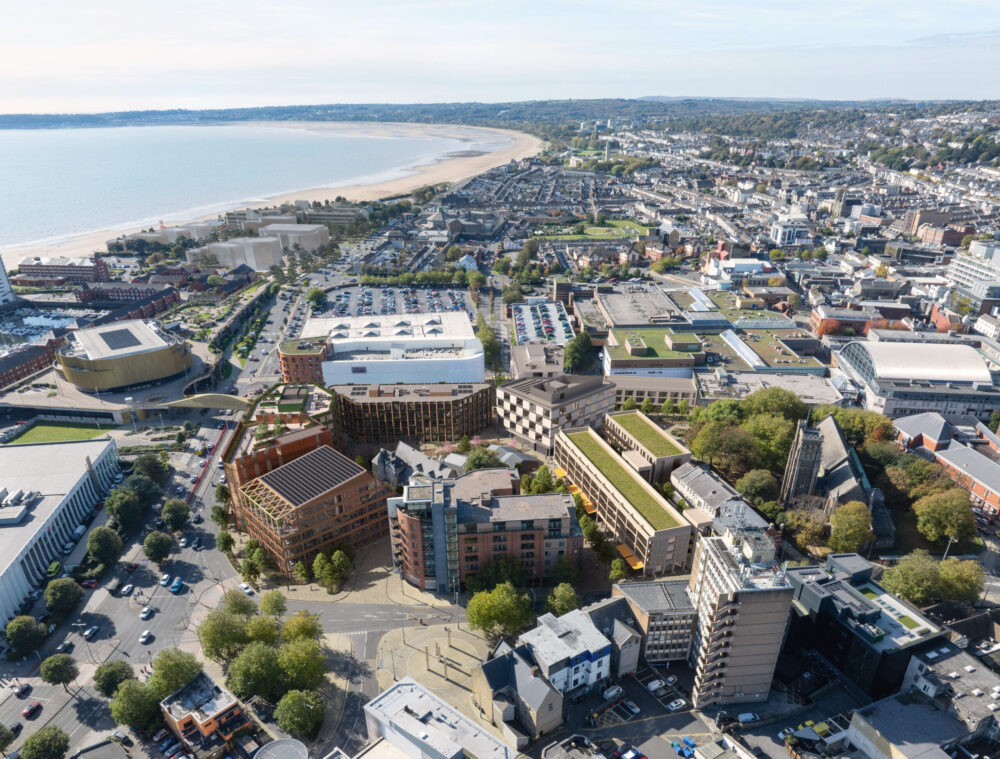
Outside, the beach-facing lawn outside would be landscaped and the adjacent prom widened. A new walkway leading from nearby Copr Bay would cut diagonally across to the prom, finishing to the right of the Civic Centre as you look from the sea. An over-arching principle is to create a stronger connection between Swansea’s central core and the sea.
New apartment blocks either side of the Civic Centre are also proposed. All told there could be up to 600 flats and 150,000 sq ft of commercial space – according to Mr Warburton that’s around 20 retail, leisure and food and beverage units of varying size.
He said the residential element was very important and that the flats would be for sale and rent at market rates, apart potentially from some affordable ones in the new blocks.
Parking, said Mr Warburton, would largely be in existing areas. As and when new blocks were built, some of that displaced parking could be accommodated at basement level or within new streets. “There is bags of surplus parking at the moment,” he said.
Other ideas for the waterfront site include a “tidal retention pool” by the bottom of the promenade steps outside and a raised walkway – or promontory – out onto the beach.
There are a lot of ideas in the regeneration mix, and Mr Warburton said public feedback has been positive.
He is keen to distinguish between redevelopment and regeneration. “Redevelopment is site-focused – it brings a specific asset back into use within its red line boundary,” he said. “Regeneration is ‘place’-focused – it uses a site asset or assets as a catalyst to deliver wider economic, social and environmental uplift across a wider area.”
Regeneration, he said, was about carefully selecting uses and occupiers for a site and creating a certain feel and spirit. In Swansea’s case Mr Warburton hoped the seven sites would work in concert to “reposition” the city.
One recent occupier of the Civic Centre, the Michael Sheen-founded Welsh National Theatre, was one that Mr Warburton would like to remain there.
The Civic Centre and waterfront plans need cabinet approval and planning permission. The funding model for the partnership with the council is that the council provides the land – and in this instance a building – and Urban Splash deploys private sector funding to turn the designs into reality.
Chartered surveyor Mr Warburton said some public sector funding would likely be required to close what’s known as the viability gap – the difference between development costs and rental and sales income – in the early phases at least.
The hope is that what Mr Warburton termed the “regeneration premium” created by the new developments would increase rental and sales yields, in turn eliminating the viability gap. “We are trying to get to a self-sustaining position,” he said.
Should values go up and up, Mr Warburton said there would be a mechanism for sharing them with the council.
He added: “We’re constantly in discussions with our investors. The smart money, I would say, is in Swansea because the inherent value is not recognised at the moment.”
He said Urban Splash remained invested in sites itself, retaining well over half the commercial space it has created and around 10% of the circa 6,000 homes it has built.
Mr Warburton said the Civic Centre scheme has parallels with an Urban Splash project at a large former naval yard in Plymouth called Royal William Yard. Both were waterfront sites and located slightly away from their respective city centres.
Royal William Yard now has local and regional businesses based there, a cinema, gallery and events space, paddle-boarding hire and flats. “That has been a really good learning experience,” said Mr Warburton.
Sarah Gibson, chief executive of business group Plymouth Waterfront Partnership, said Plymouth was benefiting hugely from the public-private sector project and the hundreds of jobs it has created. “We’re absolutely delighted with the investment, partnership and ongoing management from Urban Splash and wish them all the best with their plans for Swansea,” she said.
Another Urban Splash scheme in Swansea is Porth Copr at the former St David’s Shopping Centre. It’s a substantial plot of land between Swansea Minster – formerly St Mary’s Church – and St David’s Priory Church, and it extends beyond the latter to Oystermouth Road.
The plan is for seven new blocks featuring office, education and commercial space, plus flats, new landscaping and walkways. Outline planning permission is in place and one of the seven blocks has detailed consent and will become a public sector office hub.
Mr Warburton envisaged the two Oystermouth Road-facing blocks being head office material for companies. Another block would comprise around 60 high-quality flats with groundfloor commercial units in what he anticipated would be an “institutional-grade investment”.
He said: “Porth Copr was originally conceived as almost an exclusively commercial district. But giving people a desk is not enough. Now it has reasons for people to come to it – a gym perhaps, food and beverage, dining after work.”
Likely to make up the first batch of three Urban Splash schemes is the former St Thomas railway station site. It faces the River Tawe and is bordered by Pentreguinea Road and the northernmost Tawe bridge.
Urban Splash is planning 158 houses and flats there – around half to be affordable – to be built by Cardiff-based housebuilder Lovells. There’d also be new green spaces, walking and cycling routes, and groundfloor commercial space in the main six-storey apartment building.
Meanwhile revised proposals are being developed for a riverside site further up the Tawe at Hafod-Morfa. Also in Urban Splash’s Swansea portfolio is a plot off The Slipway, Swansea Marina, land by the Sail Bridge off East Burrows Road, and the car park flanked by Oxford Street, Singleton Street and Dillwyn Street.
All this will take time, and the level of public sector gap funding needed will be closely watched considering the council has borrowed a lot of money – although at a low cost – for its various city centre projects.
Mr Warburton said he hoped work on the Civic Centre could get under way in spring 2027. Over at Porth Copr he said construction of the public sector hub was due to start in the next couple of months. Work on the next block – the “institutional-grade” apartment building mentioned above – could begin around May 2027, with a block earmarked as education space next off the shelf.
Mr Warburton said a detailed proposal for the St Thomas site would be forwarded to the council next month, prior to a planning application being submitted.
Town and city centres are having to find new ways to survive and thrive. Ant Breach, director of policy and research at think-tank Centre for Cities, said: “What urban regeneration should aim to do is create the best possible links between places where people live and where people work.
“They should focus on creating lots of space for employment to maximise the potential for economic growth, and ensure that’s accessible to residents. City centres are the most productive parts of the UK, and urban regeneration should aim to harness that productivity to raise growth and living standards in the local economy.”
Mr Breach added that mobility and access to city centres were vital to making regeneration succeed. “The role of public transport varies between cities – in big cities, it’s essential, while smaller cities require a different mix of private vehicles like cars and public transport,” he said. And making centres more welcoming and desirable may, he said, mean steps to reduce reliance on cars.
Asked what the signs of an over-supply of leisure, hospitality, retail and office space would be, Mr Breach said a high vacancy rate and low rents. “Adapting spaces to changing patterns of demand is important for their economies to remain strong,” he said.
Cllr Rob Stewart, the leader of Swansea Council, said the regeneration proposals for the Civic Centre site “give us a fantastic chance to re-imagine one of the finest waterfront locations in the UK and deliver something truly special for Swansea”.
He added: “Cabinet recently met to discuss next steps for this scheme and more details will be released in the coming days as we continue to work closely alongside our partners at Urban Splash.”
Support our Nation today
For the price of a cup of coffee a month you can help us create an independent, not-for-profit, national news service for the people of Wales, by the people of Wales.



Redeveloping existing buildings makes sense; hopefully an engineering / construction organisation based in Swansea / nearby can be utilised for all the linked projects to create well-paid professional services jobs and construction staff. I’ve not understood the plans / other development in Swansea; but I hope that no new developments will take place until the derelict shops / offices around the Train Station are included. The economic growth point for Swansea of well-paid jobs should be the train station as then individuals can commute from Port Talbot / Neath etc by train and not car. By having a wider area… Read more »
A big part of attracting investment is ease of access for investors who all live in London. If Swansea enjoyed the same rail service as York, a similar distance from London, the journey would be an hour quicker.
Dublin is much wealthier than London based on having a Purchasing Power Parity of double UKs. Even Edinburgh now outperforms London https://www.edinburgh.gov.uk/news/article/14243/edinburgh-s-economy-outperforms-london-s
Wales should not always look to London!!
Hopefully these developments will grow gradually and new employers will relocate to Swansea for their employees to enjoy the amazing countryside and beaches close by.
Attracting inward investment is also important but access to funding in the UK capital matters, and when all else is equal Swansea is going to lose out to rival cities with better links to the UK capital.
Isn’t that fabled two hours London-Swansea journey only really possible if you cut out Neath, Port Talbot and Bridgend, and possible have a ‘Parkway’ style station in Jersey Marine/Felidre? which would need tram infrastructure into the City centre?
It’d be 1h30m with Spanish style infrastructure but just running two new limited stop express services a day would be a big improvement.