


The Short Stories of Dic Tryfan
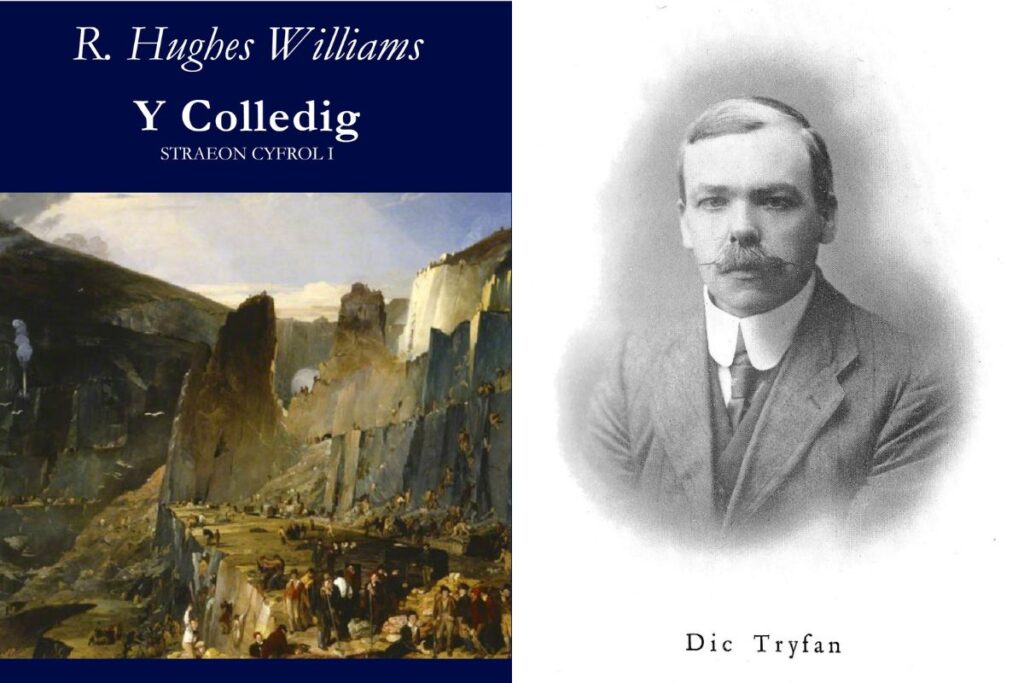
Adam Pearce, Llyfrau Melin Bapur
During the 19th-century golden age of the Welsh-language press, short stories were a staple of magazines and newspapers. Thousands were published in Welsh alone, with many more appearing in English.
There was little sense that the genre was taken particularly seriously as literature, though. It would be fair to say that the vast majority were fairly crude and forgettable, with only a small minority of genuine interest.
Tellingly, authors would only infrequently put their names to their work, perhaps because they had no wish to be associated with them; and stories could be recycled in different publications (or in the same publication a few years later) to fill space.
This began to change towards the end of the century, with O. M. Edwards’s magazine Cymru (and it’s sister publication for younger readers Cymru’r Plant) setting stricter editorial expectations.
Authors like Winnie Parry, Daniel Owen and T. Gwynn Jones began to take the form a little more seriously – Daniel Owen’s Straeon y Pentan (‘Fireside Tales’) was the first, and indeed the only dedicated volume of short stories to be published in Welsh during the 19th century, but – but in most cases the stories in question were more akin to folk-takes or even pub anecdotes (Owen claimed to have collected his stories locally, which is perfectly plausible) and it wasn’t until the twentieth century that authors, influenced by French and American authors, began to take seriously the form that would later be perfected in Welsh by Kate Roberts and D. J. Williams.
Perhaps the best known and most highly regarded of these early pioneers was Richard Hughes Williams (c.1878–1919), sometimes known as Dic Tryfan, whose stories began appearing around 1903.
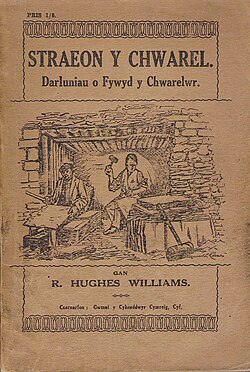
His reputation today rests on a collection of nineteen stories that was published posthumously in 1932 under the self-explanatory title Storïau Richard Hughes Williams, which incorporated the entirety of two earlier volumes, Straeon y Chwarel (‘Quarry Stories,’ 1914) and Tair Stori Fer (1916), alongside a few additions. Most of these stories had appeared in magazines as much as a decade earlier.
Hughes Williams was born in Rhosgadfan in the heart of Gwynedd’s slate quarry industry, and as Straeon y Chwarel implies, he is intractably associated with the quarries themselves, perhaps more closely so than any other literary figure in Welsh.
He was one of the few literary figures who had actually worked in them personally (albeit for only a few weeks as a teenager). His best-known stories deal with the quarry, its workers, and the wider society around them, and there are touches of Ernest Hemingway in both the tough masculinity of his subject matter but also his sparse, minimalistic prose.
Hughes Williams is not shy of portraying the harsh realities of quarry life, and many of the stories feature revolve around a death, either a quarry accident, or from the cruel poverty of an industry that maintained its workers and their families at a level barely above subsistence.
In some cases the deaths come suddenly and without warning; they are often narratively meaningless, and rarely mourned. Life goes on – by the standards of its time and context, this was a very modern approach and whilst Hughes Williams’s penchant for sentimentality showed he still had one foot firmly in the Victorian age, his role as a bridge between that age and the later work of writers like Kate Roberts is very apparent.
In fact his portrayal of the quarry workers themselves was in some senses more modern than much of what came later: as Elin Gwyn pointed out in her PhD thesis on the subject, Hughes Williams was writing just before the ‘Cult of the Worker’ had firmly established the Romantic stereotype of the Welsh quarryman.
Whilst Hughes Williams’s portrait of the Welsh worker is not unsympathetic, his quarrymen are shown lying, cheating and stealing from one another in a way that is a stark contrast to the way they would be portrayed in the work of later writers like T. Rowland Hughes.
There are criticisms to be made of Hughes Williams’s stories, particularly by contemporary standards. Women are almost entirely absent from these stories, and where present are often the subject of misogyny.
Although he focuses on the difficulty of life and work in the quarry, there is no genuine social criticism or indeed political depth to the stories: their challenges are facts to be accommodated rather than injustices to be challenged.
Nevertheless, and though his life and work has yet to be the subject of a major academic study, he has a small but acknowledged place in the Welsh canon, and is of unquestionable importance in the history of the short story in Welsh.
Kate Roberts acknowledged him as a major influence, perhaps her main Welsh influence, a fact which would make him important on its own; and he is one of the few writers selected for a volume in the short-lived ‘Clasuron Hughes’ series of the 1990s (a reprint of the 1932 collection). His stories has also been translated into English by Rob Mimpriss.
There is more to Richard Hughes Williams than many realise, however. If he is familiar to readers at all, it is for the 19 stories in Storïau Richard Hughes Williams.
In planning our own reissue, we quickly found that these are actually only a fairly small part of his total literary output. Alongside them are a number of novels and perhaps dozens more stories. Many of these, especially the novels, are earlier, throw-away efforts; but others are similar in quality to the ‘canonical’ stories and were perhaps left out of collections merely for economical reasons, or in order to preserve the image of Hughes Williams as a ‘serious’ writer about the Quarry rather than anything else.
But his actual interests were more diverse: he wrote a number of stories about the First World War, for example, of which only one, Mynd Adref, made its way into the canonical collection.
The editors of Storïau also left out several lighter, more comedic stories, feeling perhaps they undermined the image they wanted to create.
Ironically, E. M. Humphreys’ introduction to the original volume accused Hughes Williams of being repetitive – surely an unfair accusation to level at an author who had not been able to make his own choices about what to include and to leave out, having died from tuberculosis in 1919.
Our new volume, which takes its title Y Colledig (‘The Lost’) from one of the stories, is planned to be the first of two.
In it we have included the 19 ‘canonical’ stories alongside five more, of which only one, ‘Y Gath Ddu’ (The Black Cat) has previously been published in a book (the 1994 reissue of Storïau).
The other four appear here for the first time since their original publication in magazines. A future volume will consist entirely of ‘new’ material.
Y Colledig: Straeon Cyfrol I is available now from www.melinbapur.cymru and all good Welsh bookshops for £9.99+P&P.
Support our Nation today
For the price of a cup of coffee a month you can help us create an independent, not-for-profit, national news service for the people of Wales, by the people of Wales.
Get more trusted Welsh news
Choose Nation.Cymru as a preferred source in Google News to see more of our journalism.


