

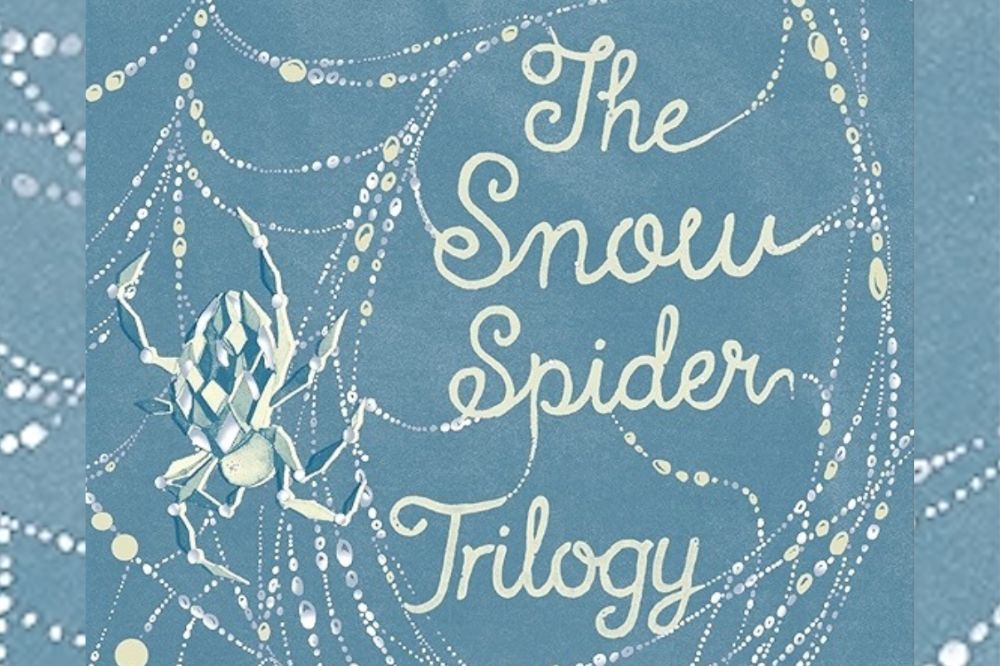
The Snow Spider at 40: The ‘children’s book’ I encourage everyone of every age to read
Stephen Price
Jenny Nimmo’s enduring Snow Spider marks its 40th anniversary this year. A novel that led to two equally superb follow-ups, spawned two TV adaptations and has gone on to inspire generations of Welsh writing ever since.
One of my goals this year, and one I’m sticking to so far, is to break away from the mobile phone as much as possible. Nature, books, DVDs, seeing people in real life.. it’s time to get back out there.
Like most readers, I’ve a pile of books that suggest my joy is in buying more than reading, and try as I might, the pile isn’t going to go down for a while yet, since all I really want to do at the moment is comfort read some old reliables.
Classics, award-winners, downright trash, there’s an unrivalled comfort, the warmest cwtshiest feeling, diving back into a book you once loved – like music or smell, its ability to conjure old memories, old selves even, is strong.
I’m not alone in my reading of books not exactly aimed at my reading age either, with young adult (or perhaps older children’s in this case) books offering an antidote, an escape, one where somehow I’m able to read at a much quicker pace, with much less ‘pressure’, or simply to reminisce, to bury my head in the sand and to make-believe.
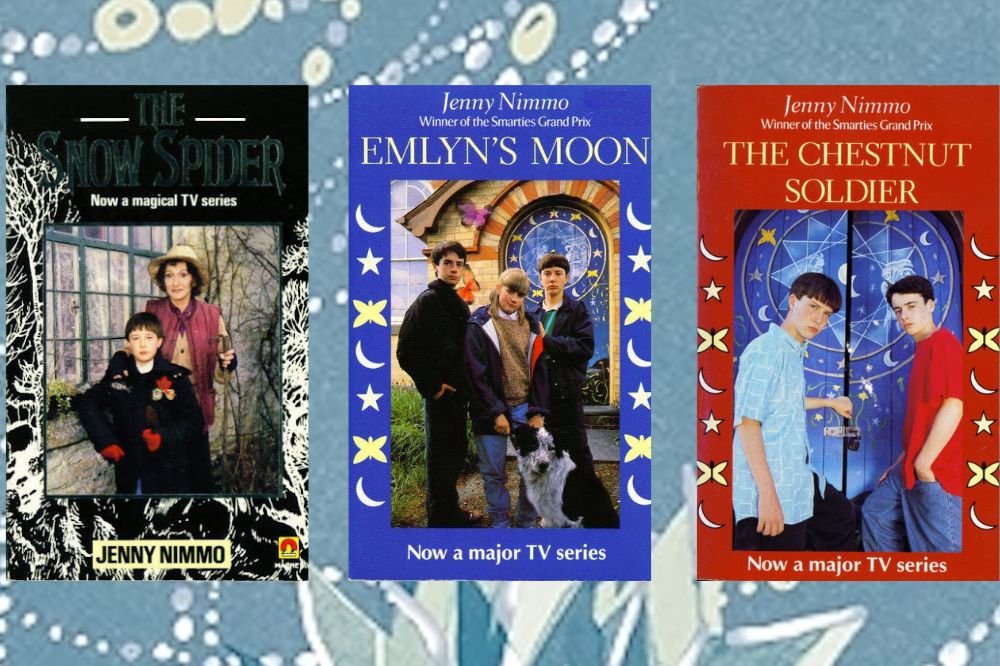
And when it comes to joy, escape and wonder, top of my list this end-of-winter, and for good reason, are The Snow Spider and its two follow-ups, Emlyn’s Moon and The Chestnut Soldier – the first of which was published all the way back in 1986.
Magic
I came to The Snow Spider later than many of its intended readers – probably my late twenties, hot on the heels of reading Alan Garner’s most-incredible The Owl Service.
I recall the TV adaptations being on during my childhood, but back then HTV and BBC were in strict competition with each other at exactly the same time, and I can only imagine the BBC was winning at that point or I was just a little too young to be interested.
The Magician Trilogy is a series of three children’s fantasy novels by Jenny Nimmo, first published by Methuen between 1986 and 1989.
The stories are set in late twentieth-century Wales and revolve around a boy named Gwyn Griffiths, who is descended from magicians, although neither parent believes that family lore.
On his ninth birthday, Gwyn is given a brooch and told to cast it into the wind. Later he discovers the wind has sent something back: the snow spider. So begins Gwyn’s journey as a magician.
Among the gifts, the only thing he recognises is the scarf, which was worn by his sister Bethan on the night she disappeared—the night of his birthday four years ago, when he convinced her to go out in a storm to find his favourite ewe.
Murray Ewing writes: “Gwyn’s father blames the boy for Bethan’s disappearance, resulting in an “unbearable emptiness” between them. But Nain’s gifts, odd as they are, have a purpose: she wants to see if Gwyn, who she says is descended from the legendary Gwydion fab Dôn, is a magician.
“He has to offer these objects, one by one, to the wind, and in return, if he is a magician, he’ll get his heart’s desire.”
The success of the first novel led to not one, but two follow-ups, all of which are also inspired by Welsh mythology – Emlyn’s Moon and The Chestnut Soldier.
The Snow Spider won the Tir na n-Og Award from the Welsh Books Council, recognising the year’s best English-language children’s book with an authentic Welsh background, and won the second annual Smarties Prize as the year’s best children’s book written by a United Kingdom citizen or resident.
Jenny Nimmo, in an interview with the BBC discussed how the Snow Spider was born from her experience working with Ray Smith on Jackanory, with Smith eventually forcing her to read the Mabinogi.
She shared: “Of all the stories in the Mabinogion the one I loved most was ‘Math, son of Mathonwy’. It was in this story that I met Gwydion, the magician, and he stayed in my mind long after I had read the myths.
“Gwydion came from a family of magicians, Math, Gwydion’s uncle, being the greatest. Gwydion was mischievous and used his magic quite cruelly at times. He loved and hated passionately, but he was also described as the best storyteller in the land. Perhaps it was this last talent that so endeared him to me. One day, I thought, I will bring him into a story of my own.
As for Arianwen, she added: “Our children found the spider. On one of our walks to the school bus we saw spiders’ webs in the hedges, glittering in an early frost. Sometimes gossamer would stretch right across the lane and we would duck our heads so that we shouldn’t break it.
“One of the children suggested that spiders must be magical. And so I had found Gwyn’s familiar, his magician’s wand, the creature that will help Gwyn to reach his lost sister and overcome Efnisien.”
Eternal youth
A report commissioned by HarperCollins has shown how uptake in YA fiction in older readers can be attributed to behavioural changes described as ‘emerging adulthood’ or delaying ‘adult’ life
Put simply, my generation and those above and beyond are refusing to grow up. And with the reality of life, of suffering at home and abroad, why wouldn’t anyone want to stick their head in the sand and absorb joy where it’s available?
Young adult fiction such as The Hunger Games, A Good Girl’s Guide to Murder and the Heartstopper graphic novels might be aimed at teenagers, but new research has shown that more than a quarter of readers of YA in the UK are over the age of 28.
The research suggests that a growing number of adult readers have been reading YA fiction since 2019. According to the report, 74% of YA readers were adults, and 28% were over the age of 28. The research suggests this is due to behavioural changes described as “emerging adulthood”: young people growing up more slowly and delaying “adult” life. The feelings of instability and “in-betweenness” this can cause has led to young adults seeking solace in young adult fiction – and for some these books remain a source of comfort as they grow older.
Writing in The Millions, Jiordan Castle shared a typical example of the reaction facing people reading ‘beneath their age’ face: “Don’t you want to write a real book?”
Jiordin writes: “This is a question that’s been posed to many of my YA author friends. It’s also a question—with its implication that real books are for adults—that betrays a fundamental misunderstanding of what YA is and why it matters.
“When you revisit a book you love later in life, don’t you find something new? Sometimes that new thing is the old you. I find that, to that end, YA books don’t exist solely for young people, even if that’s who they’re written for.
“We live in an age steeped in nostalgia, with podcasts dedicated to rewatching old TV series, remastered classic video games made available for digital download, books we loved when we were young being reprinted with new covers.
“With so much uncertainty and fear in our present reality, adult readers have every reason to seek comfort in the familiar.”
Consider me steeped in nostalgia, then.
So, before I leaf once again through The Owl Service, The Bell Jar, the timeless works of Roald Dahl and more, it’s The Snow Spider for me. An ageless book that has grown even more beautiful thanks to its 40 years of inspiring new writers, new lovers of Wales, and new interest in our once-overlooked mythology.
The original adaptation (we won’t mention the more recent BBC one from 2020 which brought the story to a modern day) is now on YouTube with its familiar backdrop of Crickhowell and star-turns from Sian Phillips, Sharon Morgan and more, but it’s disappointingly not a fixture on any streaming services. A sad loss for those who didn’t catch it the first time around.
The original take on the Snow Spider and its sequels were adapted for television by Julia Jones, as three miniseries under their original titles.
The films were directed by Pennant Roberts and broadcast 1988 to 1991 by HTV: The Snow Spider in four episodes, 1988; Emlyn’s Moon in five episodes, 1990; and The Chestnut Soldier in four episodes, 1991.
The series introduced Osian Roberts as Gwyn Griffiths with Siân Phillips as grandmother Nain Griffiths, Robert Blythe and Sharon Morgan as his parents, and Gareth Thomas as Mr. Llewellyn. And it is oh so good.
I also have high hopes for a film series one day. Now that would be something very special indeed.
But for now, I’m more than happy re-reading this outstanding book series, steeped in Welsh mythology that hasn’t aged a bit in its first 40 years.
Jenny Nimmo’s writing is proof that magic really exists.
Support our Nation today
For the price of a cup of coffee a month you can help us create an independent, not-for-profit, national news service for the people of Wales, by the people of Wales.


