


The Welsh Giant Baby
Norena Shopland
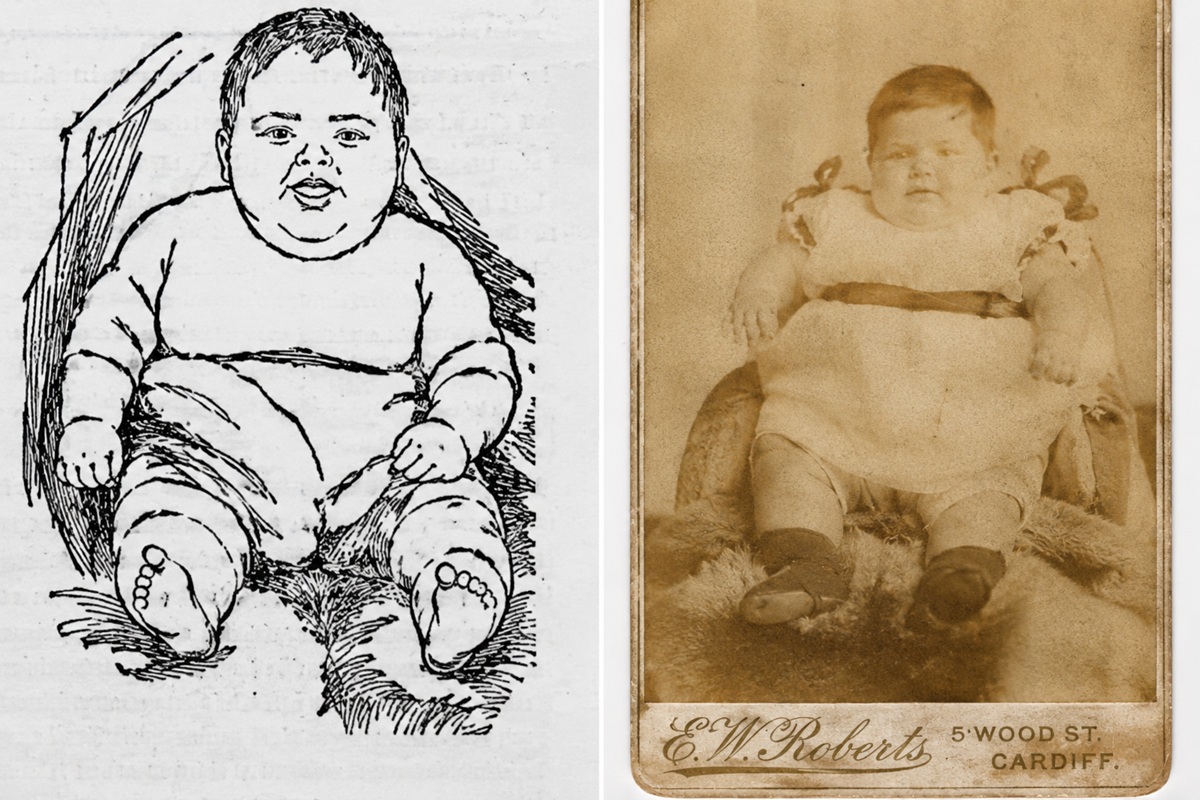
‘The mother was a pleasant little Welsh-woman, rather below the medium build, but the baby was prodigious.’
So opened a newspaper article in 1896. A journalist had come across them as he wandered through the Rhymney Valley, stopping at a little house in Cwmsymlog to ask the way.
The sight of the baby lying in its mother’s lap rooted him to the spot.
The baby was ‘as big as its mother,’ he wrote: at least, his head and limbs were as largely proportioned as an ordinary-sized man’s. Wonders of Wales: What had I found? Here was a real Welsh marvel, lying unknown and undiscovered in the heart of the Rhymney Valley, and, glory of glories, I was the discoverer!
The baby, David John Morgan, was the son of Mary and Edwin Morgan of a long-established south Wales family and their second son was born on 11 August 1895.
He was, said his mother, a very good and contented boy; although she could provide no explanation as to David’s size, there was nothing in the family chronicles of any ‘abnormities of giants.’
The reporter wrote up his story and three days later Oswald Stoll, with ‘characteristic enterprise’ and a view to exhibiting the Welsh giant baby, sent a representative to negotiate with the parents and persuade them to exhibit their prodigy, ‘which, in the Principality is absolutely unparalleled.’
Australian Oswald Stoll (1866-1942) had moved to London and established a theatre company, the Stoll Moss Group. By 1905 he had a theatre in almost every large town in the UK, and set up Stoll Pictures, a film company which soon became one of the leading British film studios of the Silent Era.
Stoll founded the Royal Variety Performance, which enjoyed enormous popularity for decades. In the 1960/70s, when it was filmed for TV, it often topped the charts as the most-watched TV program in the UK.
The Panopticon
In the 1890s, Stoll had set up the Panopticon in St Mary’s Street, Cardiff, a variety show with some remarkable performances and exhibitions. It had beauty shows for women, skating, wrestling, phrenology (study of bumps on the head), singing, dancing, magic, performing fleas and animals, gymnastics and many other amusements.
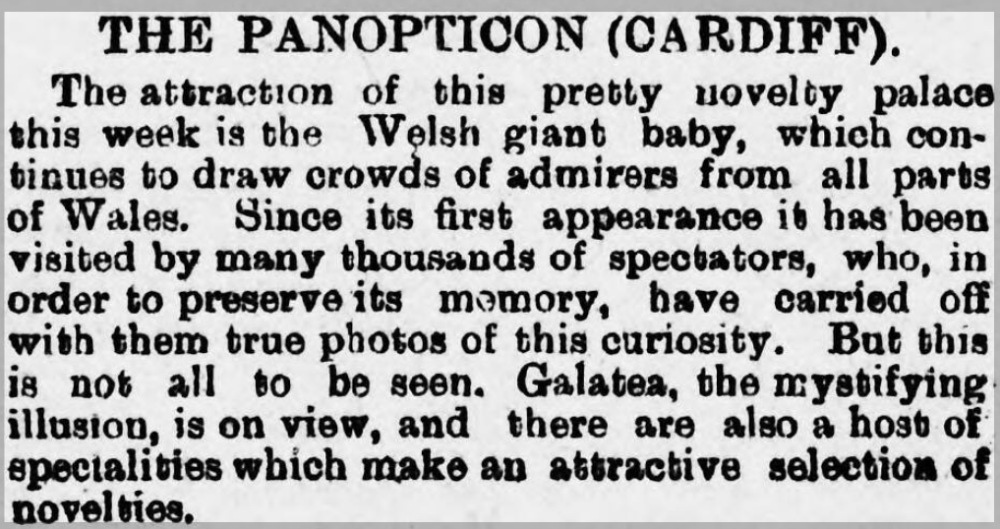
As part of this panoply of the curious and the extraordinary so loved by the Victorians, Stoll wanted baby David.
The parents struggled to decide if they should exhibit him, and only after ‘considerable difficulty’ did Stoll get his way.
Mary insisted on a clause in the agreement that if she wanted to withdraw David from exhibition, she could do so.
‘The biggest baby ever seen in Wales’ was on show every day to thousands of visitors from 2-6pm and 7-10pm — long hours for a baby. And, within a few weeks of being exhibited, the toll was beginning to tell, and David had increased in size— although one does wonder if his weight was helped along.
The Panopticon doctors were worried and suggested rest, so David was retired for a few days and returned on lesser hours, appearing Mondays and Saturdays only.
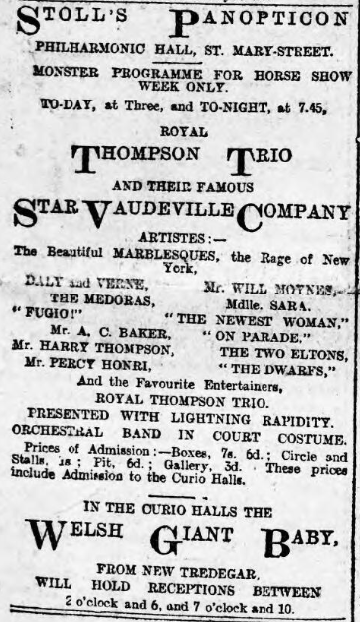
Nevertheless, so popular was the Welsh Giant Baby that Mary and Edwin signed up for a second season and bookings were coming in from all over the country, even the Continent.
E W Roberts of Cardiff produced commercial photographic cards of David to cater for his popularity, but there is no scale in the image to provide an indication of size.
Baby competitions
Large babies (who generally grow to normal size) were, and are known, and can be found in newspaper reports of fete-type events which often included baby competitions.
Prizes were offered for a range of attributes such as the prettiest, handsomest, ugliest, or heaviest.
However, by the 1880s children’s charities were beginning to complain and wanted these competitions banned as they were seen as detrimental to the babies.
The use of words such as ‘it’ and ‘monstrous’, emphasising the ‘freak’ nature of the child, served to support arguments of cruelty.
According to the Guinness Book of Records, the heaviest child born was to Canadian giantess Anna Bates. Born in 1879, the boy weighed 9.98kg (22lb) but sadly died after eleven hours. An average newborn weighs 3.2kg-3.5kg (7lbs-7.5lbs), but David’s weight was never confirmed.
Disaster
After six weeks at the Panopticon, David’s parents signed a contract to exhibit him in London, but before they could leave, disaster struck.
At fourteen months, David was teething badly and suffering from convulsions, a serious thing for a baby of such proportions. Stoll saw to it that everything medical could be done but to no avail, and sadly David died on 17 October 1896.
Victorian ‘freak shows’ declined in the early 20th century, with the traditional exhibitions of human anomalies all but dying out by the 1940s and 1950s.
Support our Nation today
For the price of a cup of coffee a month you can help us create an independent, not-for-profit, national news service for the people of Wales, by the people of Wales.
Get more trusted Welsh news
Choose Nation.Cymru as a preferred source in Google News to see more of our journalism.



Cwmsyfiog maybe, not ‘Cymsymlog’? There is a Cwmsyfiog in New Tredegar (mentioned in the article.)