


The Welsh soldier who influenced great poets
Norena Shopland
130 years ago this year, David Cuthbert Thomas was born in 1895. The son of Evan and Ethelinda Thomas of Llanedi Rectory, Pontarddulais, Glamorgan, and educated at Christ College, Brecon.
A year after the outbreak of WWI (1914-1918), Thomas was commissioned as a Second Lieutenant in the 3rd Battalion, Royal Welch Fusiliers, which included the great war poets Robert Graves and Siegfried Sassoon. Thomas shared a room with Sassoon during their officer training at Pembroke College, Cambridge until November 1915 when they were posted to the front.

On 18 March 1916, as David was leading a working party to repair wire emplacements in no man’s land at the Citadel, near Fricourt in France, he was shot in the throat. He did manage to walk to a first aid post for treatment but died soon after, aged just twenty.
Grief
The following morning, Sassoon, convulsed with grief rode up to nearby woods and wailed for his fallen companion, writing in his diary:
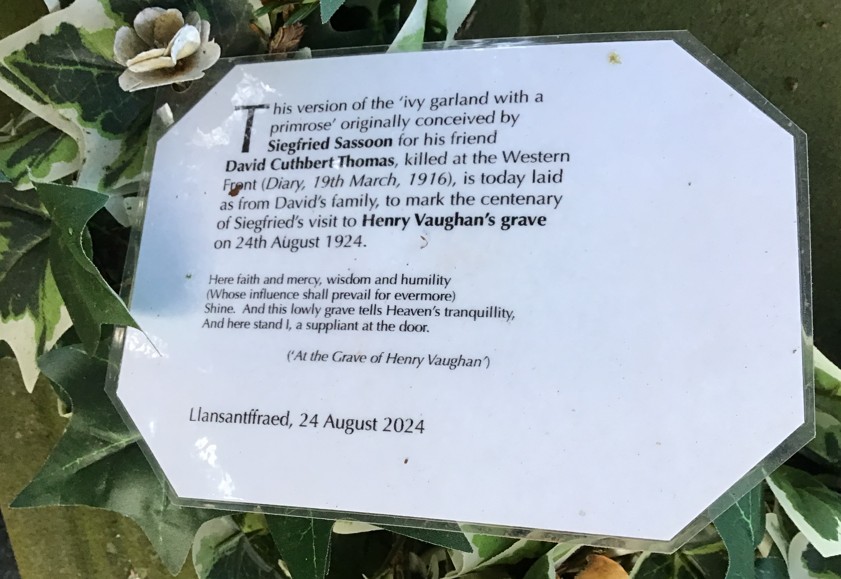
“Today I knew what it means to find the soul washed pure with tears, and the load of death was lifted from my heart. So I wrote his name in chalk on the beech-tree stem, and left a garland of ivy there, and a yellow primrose for his yellow hair and kind grey eyes, my dear, my dear.”
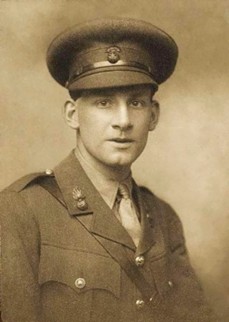
Indeed, so deeply moved by Thomas’ death, Sassoon changed his attitude towards war, and became a pacifist. Some of his greatest war poems featured Thomas, including, ‘A Subaltern,’ ‘The Last Meeting’ and ‘A Letter Home,’ to Robert Graves:
Out in Wales, you’ll say, he marches
Arm-in-arm with oaks and larches;
Hides all night in hilly nooks,
Laughs at dawn in tumbling brooks.
Yet, it’s certain, here he teaches
Outpost-schemes to groups of beeches.
And I’m sure, as here I stand,
That he shines through every land,
That he sings in every place
Where we’re thinking of his face.
Graves had remained close to Sassoon and Thomas since their training days, and he too was extremely fond of Thomas, often writing about his friend. In his autobiographical, Good-Bye to All That (1929) Graves recalls his school days in Penrallt, in the hills behind Llanbedr, where his love of poetry first began. And, he writes of memories and love for Thomas, describing him as ‘simple, gentle, fond of reading. He, Siegfreid Sassoon, and I always went about together.’
Shattered
When Thomas was shot Graves was initially relieved, hoping it meant he could go home, but when the news came through that Thomas had died, he, like Sassoon was shattered:
“I felt David’s death worse than any other since I had been in France, but it did not anger me as it did Siegfried. He was acting transport-officer and every evening, when he came up with the rations, he went out on patrol looking for Germans to kill. I just felt empty and lost.”
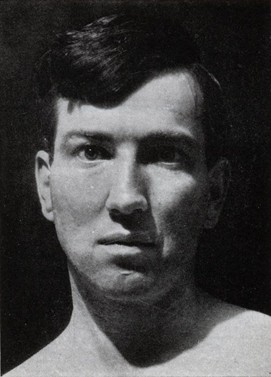
He wrote the poem ‘Not Dead,’ in which he goes searching for Thomas’ spirit.
Walking through trees to cool my heat and pain,
I know that David’s with me here again.
All that is simple, happy, strong, he is.
Caressingly I stroke
Rough bark of the friendly oak.
A brook goes bubbling by: the voice is his.
Turf burns with pleasant smoke;
I laugh at chaffinch and at primroses.
All that is simple, happy, strong, he is.
Over the whole wood in a little while
Breaks his slow smile.
After the war, on 24 August 1924, Sassoon visited the grave of the great 17th century poet Henry Vaughan (1621–1695). He was drawn to the beauty of Vaughan’s poetry and his anti-war sentiments written during the British Civil War (1642-1651). The visit was commemorated in 2024 by Thomas’ family, the ivy reference taken from Sassoon’s diary entry.
Thomas is buried in the Military Cemetery at Fricourt, but is remembered in Wales on war memorials at Llanedi and Pontardulais.
Support our Nation today
For the price of a cup of coffee a month you can help us create an independent, not-for-profit, national news service for the people of Wales, by the people of Wales.


