

Timeless children’s classic published in Welsh
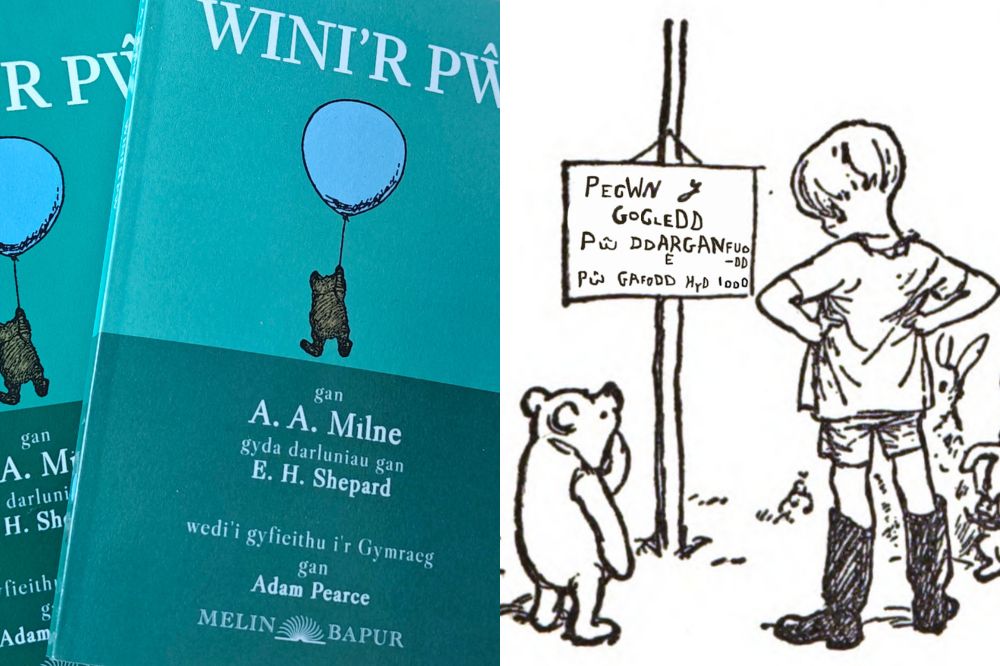
Ernest Shepard illustration: © E. H. Shepard/Melin Bapur
Stephen Price
The timeless children’s classic Winnie the Pooh, first published exactly a century ago in 1926, has been translated for the first time ever into Welsh and published by a local publisher.
Written by English playwright A. A. Milne, who based the book on his own son and his toys, Winnie the Pooh was published with illustrations by E. H. Shepard and was an overnight success, and has since been translated into over seventy languages and, starting in the 1960s, turned into a series of animated shorts and feature films by Walt Disney.
The so-called ‘Bear of Very Little Brain’ is among the most familiar and best loved of children’s characters, but although he has been has been a familiar face for a century, he has never before been translated into Welsh.
Tackling the new book was translator Adam Pearce, who has previously translated Tolkien’s The Hobbit into Welsh among other works, who also runs the independent press who have published the book. The new Welsh version features the original illustrations by E. H. Shepard, licenced from the illustrator’s estate.
“Winnie the Pooh was one of the books I grew up with and if anything it’s been even more obvious in the lives of my own children, though up till now always the English version of course; and like with so many other books I’m was surprised that there isn’t a Welsh version – before now.
“Winnie the Pooh might not, on the surface, seem a very similar book to The Hobbit, and of course they’re quite different tonally; but actually there’s a surprising number of parallels between the two books.
“Both have a map, both are illustrated – though there are far more pictures in Pooh – and both feature lots of poetry within the text.
“Tolkien’s classic was four times longer than Pooh so much more work, but word-for-word I’d say Milne is the more difficult work to translate. There are lots of things like wordplay and puns, which are the hardest things to get right; the work went through several versions and I’m indebted to Anna Gruffydd who made a lot of sensible and clever suggestions.
“The book’s got a lot of nonsense verse too, which needs to be handled creatively.”
He added: “Tolkien’s RP English translates pretty well to the kind of literary mid-century Welsh I favour when writing; though he wrote it for younger readers The Hobbit tends to be marketed as a YA (Young Adult) novel these days, or at least a work for older children.
“Winnie the Pooh, though, is definitely a children’s book, and to be read to children as well as by them, so I had to think very carefully about language to make sure I was keeping my audience on board. It was a challenge I couldn’t have taken on without having my own children as test subjects.
“That said, I was conscious that – just like Milne’s original, and all the best children’s books – I wanted the text to feel like it was taking its audience seriously, so there could be no question of ‘dumbing down’.
“As with The Hobbit I’m writing knowing that adult Welsh learners are going to use the book too, so I needed to make it real, natural language, not some kind of book-Welsh.
“I’ve based the language in the book, for the most part, on the way I speak Welsh to my own kids, so if people respond to that – whatever their age or level of Welsh – then great.
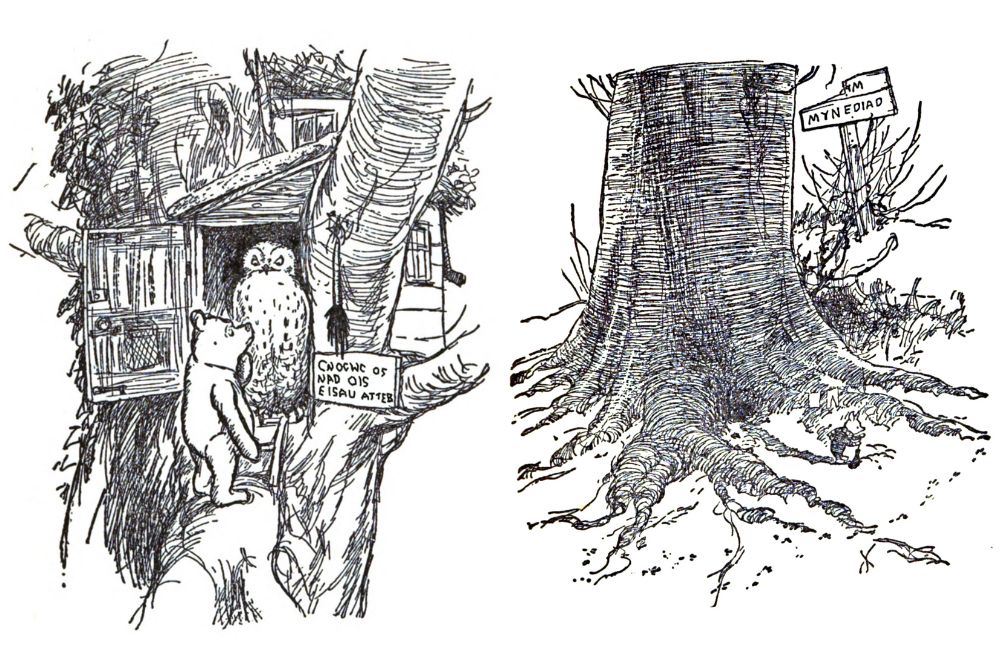
The new book features the original English illustrations by E. H. Shepard, though with some modifications to ensure they work in the new context.
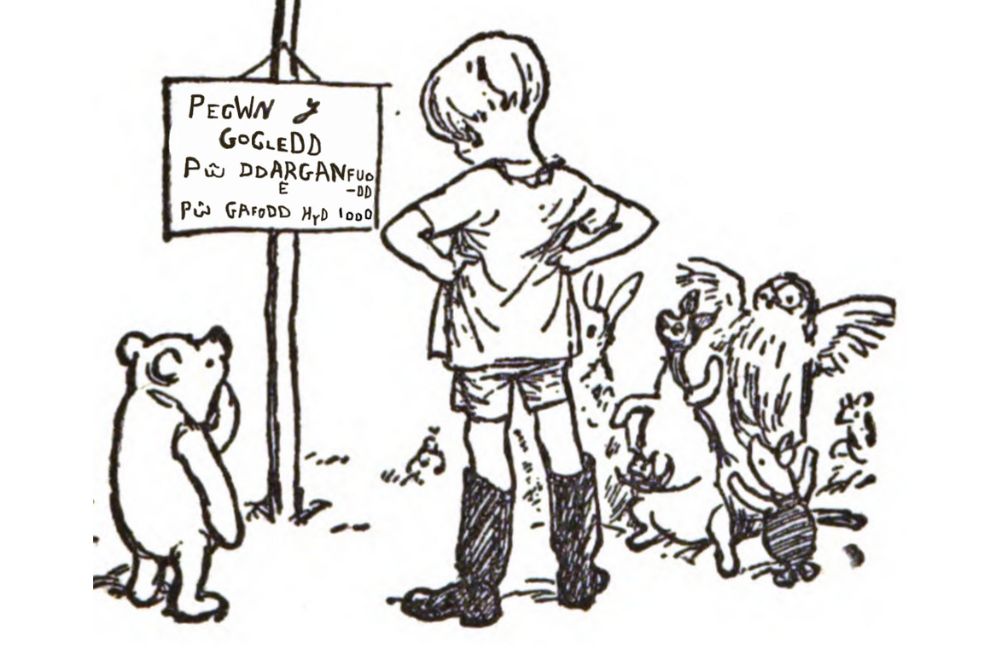
“There are visual puns in the illustrations too, like the broken sign Trespassers Will… which obviously couldn’t be left as it was. To me, Shepard’s illustrations are completely inseparable from Winnie the Pooh.
“Some might be more familiar with Stephen Slesinger’s version of the character, which became the basis for the Disney films; but to me it’s Shepard all the way.
“Milne’s work passes into the public domain in the UK next year and no doubt there will be a flood of AI ‘translations’ on the market; it was important for us to get what I’m hoping will become the definitive Welsh version out first. It’s nice too for that to happen in the centenary of the original book’s publication.
“Winnie the Pooh has taken on a bit of a life of his own in social media and it’s a shame he’s been misquoted into a rather saccharine version of the character, using kitschy platitudes to farm engagements.
“Coming back into these stories in real detail as an adult, I’m struck by how different Pooh is from the syrupy version you see in the memes: he tries to avoid sharing if he can and isn’t above a little deception. T
“hese stories are definitely characterised by gentleness and kindness, but there’s a much bigger dose than you remember of mischief and surrealism too.”
Wini’r Pŵ is available now from www.melinbapur.cymru in both paperback and hardback version (£11.99 / £15.99 respectively, +P&P), and from all good Welsh bookshops.
Support our Nation today
For the price of a cup of coffee a month you can help us create an independent, not-for-profit, national news service for the people of Wales, by the people of Wales.


