
Two new books offer readers a fresh insight into today’s Celtic Brittany
Stephen Price
Brittany is often presented to visitors as a charming holiday destination, a place of seafood, standing stones and surfer beaches.
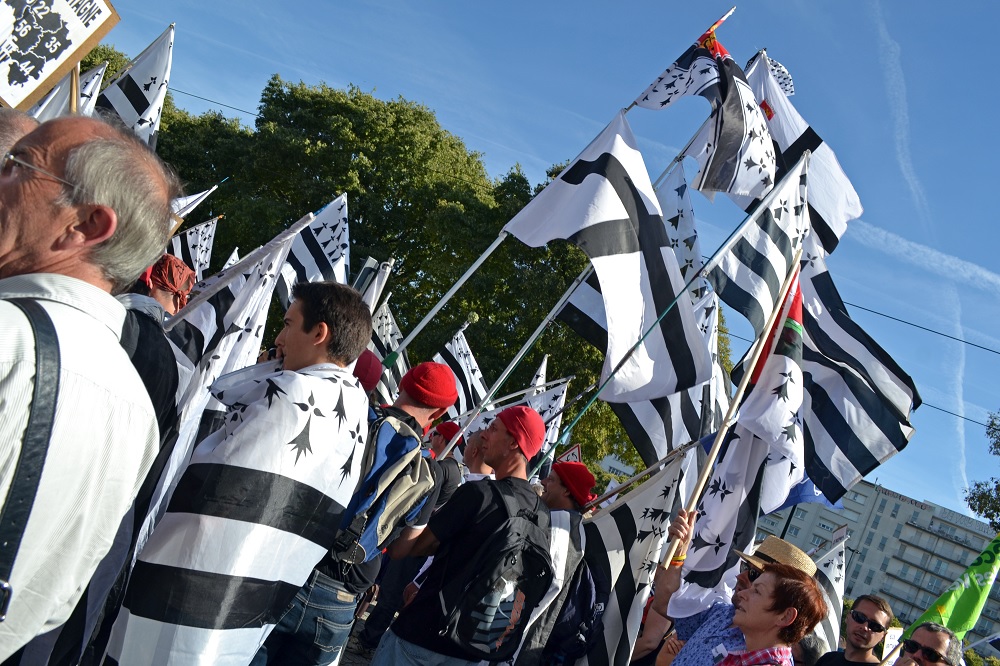
Yet for many Bretons, their country remains first and foremost a Celtic nation, with its own language, history and political aspirations.
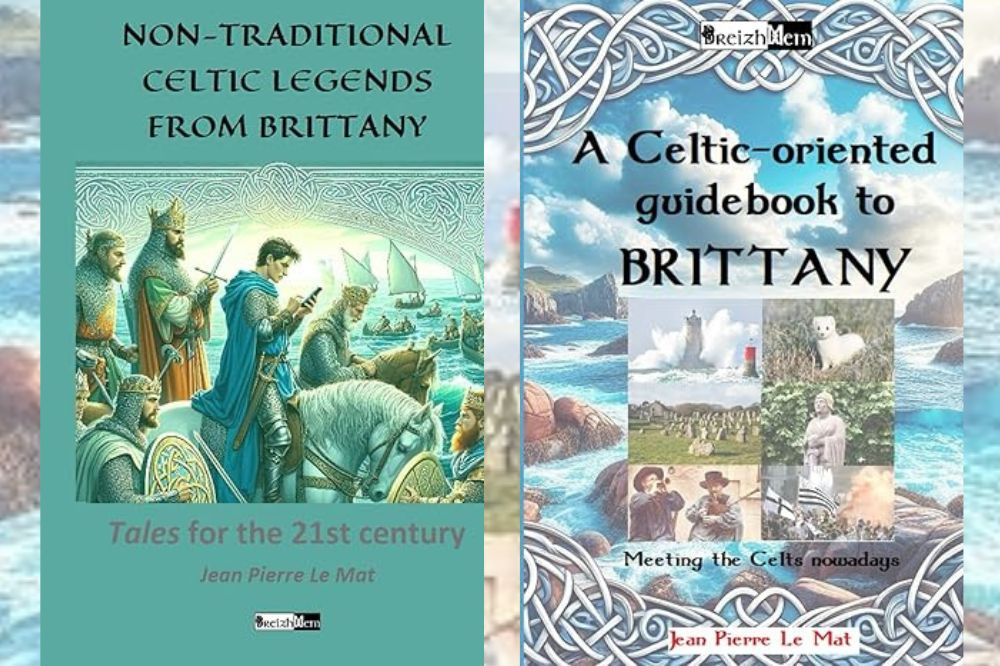
Two recent English-language books by Jean Pierre Le Mat, published by the Breton house BreizhKlem, invite British, Welsh, Scottish, Cornish and Irish readers to look beyond familiar clichés and discover a Brittany that is both ancient and strikingly contemporary.
These works arrive at a moment when interest in the relationships between Europe’s Celtic nations is growing, driven by renewed debates on language revival, cultural autonomy and the future of small nations. Le Mat’s books fit squarely into this wider conversation, where Breton myth meets the digital age
In this collection of short stories, Le Mat does something unusual: he lets the legendary figures of Brittany walk straight into the twenty-first century.
King Arthur returns to Armorica only to find a world of “managers” instead of knights. The korriganed, mischievous Breton fairies, reinvent themselves as eco-entrepreneurs. Merlin experiments with predictive algorithms.
The tone is playful, but the intention is serious. Le Mat uses myth not as decoration but as a way to question what remains of the Celtic imagination in an age defined by globalisation and technology.
Rather than romanticising the past, he asks: “What happens to a people’s myths when everything must be rational, measurable and marketable?”
His answer is neither nostalgic nor pessimistic. Through humour, irony and flashes of poetry, he suggests that the Celtic spirit — shared by Wales, Scotland, Cornwall, Ireland and Brittany — adapts more readily than it disappears. Myth becomes a tool of resistance, a reminder that imagination still has the power to challenge uniformity.
The style is sharp, modern and accessible to readers unfamiliar with Breton culture. But for those who know the broader Celtic world, the parallels will feel immediate: communities shaped by the sea, by a long memory, and by a relationship to land and language that survives despite political centralisation.
As the book’s introduction puts it: “In the Celtic countries which stretch the European coasts, from open sea and towards other worlds, anything is possible.”
A guide to Brittany that speaks to Welsh and Scottish readers
Le Mat’s second book is not a tourist guide in the usual sense.
Instead of listing museums or restaurants, he offers an insider’s view of Brittany as a living Celtic nation.
The guide invites visitors to understand the country the way many Bretons themselves do: through its language revival, its music and dance traditions, its coastline and moorlands, and its ongoing negotiations with a centralised French state.
For readers of Nation Cymru, this perspective will feel familiar. Le Mat speaks of a people rediscovering pride in their culture; of a language, Breton, that, like Welsh, is experiencing both fragility and renewal; and of a civic identity shaped not by borders on a map but by community, memory and a shared sense of destiny.
He writes: “Discovering Brittany isn’t just about photographing landscapes or folk dancers… but about experiencing Breton folklore from the inside.”
The comparison with the Welsh experience is natural. Both nations maintain bilingual education movements. Both have seen a new generation rally behind cultural revival. Both must navigate questions of devolution, identity and visibility within larger political frameworks.
Le Mat emphasises that Brittany’s future, like that of other Celtic nations, depends on its ability to combine roots and modernity. The sea, always present in Breton culture, is presented not only as landscape but as a metaphor for openness and survival. The moors symbolise freedom; the standing stones embody continuity.
Another line from the book captures this sentiment: “In this European peninsula facing America, once borne by ancient prophecies, the hope for freedom is still alive.”
This is not the rhetoric of separatism but of cultural confidence. Le Mat argues that Brittany’s distinctiveness, its Celtic identity, its language, its worldview — is not a relic but a contribution to Europe’s diversity.
Jean Pierre Le Mat is an unconventional figure in Breton writing: a philosopher, storyteller and essayist who writes with equal ease in French and English. His work bridges mythology, politics and culture, always questioning how small nations preserve meaning in a rapidly homogenising world.
Taken together, these two books form a coherent pair:
• one explores the imagination,
• the other the lived reality of a Celtic nation.
Both make the same point: that Brittany has much in common with other Celtic countries, and that these connections matter more than ever.
For Welsh, Scottish, Irish or Cornish readers, they offer an opportunity to meet a neighbour,not a tourist destination, but a sister nation whose struggles and hopes echo their own.
Both books are available in English via Amazon, published by the Breton independent house BreizhKlem.
Support our Nation today
For the price of a cup of coffee a month you can help us create an independent, not-for-profit, national news service for the people of Wales, by the people of Wales.


