

Un-Retiring Behaviour: Del Hughes lets the dust settle in Kernow
Del Hughes
There’s a tentative sniff of spring in the air: sharp sunlight, passing plump clouds, and a bracing sea breeze. It looks set to be a glorious afternoon – unless, of course, you’ve got a dead mother to dump. Sigh.
Readers of my other features will know all about my mum’s extremely specific posthumous wishes and chosen drop-zones. We began working through her itinerary three years ago, beneath Twm Shon Cati’s cave in Rhandirmwyn, where we’d deposited Dad twenty-five years earlier.
To the strains of Midnight Cowboy (inexpertly played on my uke), Tim decanted around a fifth of her into the Tywi, tossed in a bundle of daffs, and we raised a warm glass of Prosecco in her honour. It was a fitting, funny farewell, and we were poised to tackle the next stop on her maternal manifesto.
But then a cluster of deaths, dramas, and dismal health brought her final grand tour to a shuddering stop… until now. Because recently, life has semi-settled, the logjam of funerals has cleared, and my gallbladder (aka Gary) was whipped out last month.
Finally, we’re ready to resume the post-mortem pilgrimage. And amen to that.
(She’s been in her champagne bottle for way too long, and I swear that whenever I pass by, she’s giving me the evils and saying, ‘Delyth Catherine Mary Hughes, get your bloody arse in gear.’ Lol.)
Which is partly why Tim, the pups, and I have escaped to craggy Cornwall for a week of RR&R – Rest, Recuperation, and ash Relocation. It’s our first ever holiday during term time, all thanks to Tim’s Christmas retirement from the chalkface. But so far, it’s been a tad turbulent… and I don’t only mean the weather.
Because 2026 kicked off with a genuine bang, as Tim sought out ways to fill his suddenly spare hours. His first buy was an impact driver, and it’s been downhill ever since. But I’ve also discovered that he’s 100% incapable of silence – even when he’s watching Homes Under the Hammer.
And that’s not just his humming or whistling, his routine rants about the Yank-speak colonising our vernacular – mom, cookies, or the gratingly singular, math – or even how he interjects random lines from songs into conversation.
(I’ll hear a mumble from another room and, after a tedious volley of ‘What? ’s and ‘Pardon? ’s, he’ll gravely inform me that ‘MacArthur Park is, indeed, melting in the rain.’ Hard eye-roll.)
Nope. It’s that Tim’s internal monologue is now entirely external, and I’ve come to the stark, soul-crushing realisation that I’m the sole captive audience to his unfiltered stream of kaleidoscopic consciousness… 24/7… forever. Sob.
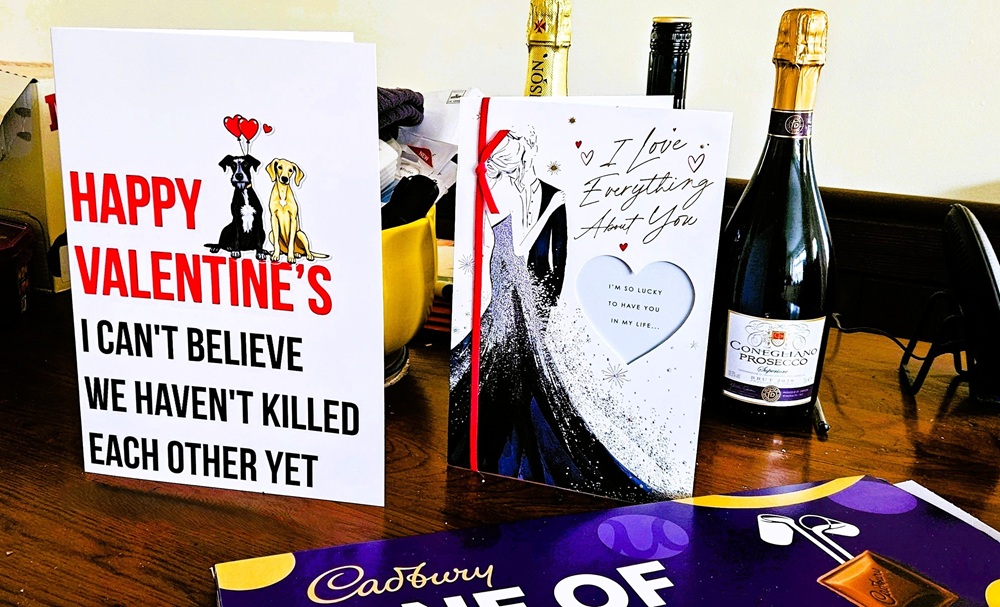
(I’ve glossed over his other audible emissions because we’re all human and, post-op, it’s a definite pot/kettle situ right now. And domestic disharmony aside, I did buy him a Valentine’s card with a message that truly captured the depth of my feelings: I can’t believe we haven’t killed each other yet. He laughed, oblivious to the faintly martial glint in my eye.)
But he’s not all bad; it was Tim who, clocking my convalescent funk, suggested, booked, and organised our week in Kernow. It would be the perfect escape – a place for healing, for maternal dispersal, and for recalibrating my tolerance levels in a land mercifully free of power tools.
And the holiday got off to a promising start. The journey down had been a motorist’s dream: no roadworks, drivers au fait with motorway etiquette, and Jamaica Inn – for once, blessedly throng-free – perfectly placed for a loo stop, lunch, and the gentle slide into a Cornwall state of mind. (Billy, take note.)
Then, with Bodmin behind us, Tim wove deftly through those labyrinthine hedge-hemmed lanes (mercifully tractor-free) to a corner of the county we’d rarely explored. Mevagissey and its environs saw us perfectly placed for a tootle around Truro and St Austell, within hexing distance of Boscastle’s infamous Witchcraft Museum (cue evil cackle), and, above all, a mere forty-minute hop across to Padstow – number three on Mum’s scatter schedule.
Time, tides, and tourism
Padstow’s a town that’s been well and truly tested by time, tides, and tourism: a chic, crowded maze of high-end shops, salt-slick cobbles, and harbour-side bustle – and Mum adored it. But more on that later; first, we had a car to unpack, dogs to untangle, and a very necessary kettle to boil.
Our home for the week was in the tranquil hamlet of Portmellon, one meandering mile from Mevagissey: an 18th-century terraced stone cottage called Sandy Cove, aptly named, with dunes massing in the back garden and the restless sea framed by each salt-speckled window.
The terrace was originally built for the pilchard-plying pyskadors (Cornish for fishermen) and featured deep stone cellars for chilling and curing the catch. But add some rapidly hewn tunnels and ta-dah… discreet storerooms for those brandy-broking gentlemen savvy enough to exploit the cove-riddled coastline.
All the houses that lined the shore featured heavy shutters in various hues of blue, making them look prettily picturesque while providing a very necessary layer of solid-wood protection against storm surges and high tides.
(The owner popped in and thrilled me with tales of waves, so high, they broke over the roof and flooded the back garden. Nothing says Cornwall quite like squally seas and, hopefully, ghostly smugglers. Eek!)
Once two dwellings, Sandy Cove now offered spacious – if oddly arranged – accommodation, which was just as well: we needed room for us, two sprawling longdogs, their clutter of paraphernalia, and Stepdad, due mid‑week for Mum’s seaside send‑off.
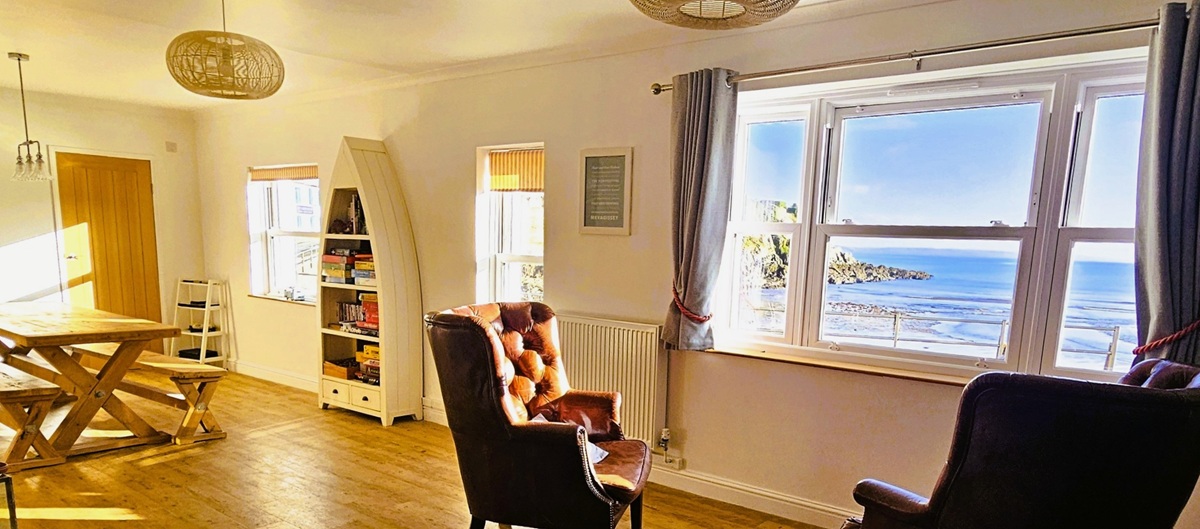
Stuffed to the gills with squashy leather sofas, fishy wall art, and bookshelves made from boats, the place came with its own navigational quirks: it genuinely took us two days to memorise the route to the kitchen.
Plus, if we fancied a drop of Cornish Rattler or Doom Bar, the nearest pub was a flat, and comfortably staggerable, twenty paces. Perfect.
On our first night, we dined in on local fish’n’chips (£29 for two!), watched the Six Nations (oh, so close), and saw Team GB get gold snatched away by some beast-level curling. Then we retired to the most comfortable bed in Christendom. (No exaggeration. I’ve texted the owner for the mattress make, so I’ll let you know.)
Full coastal immersion
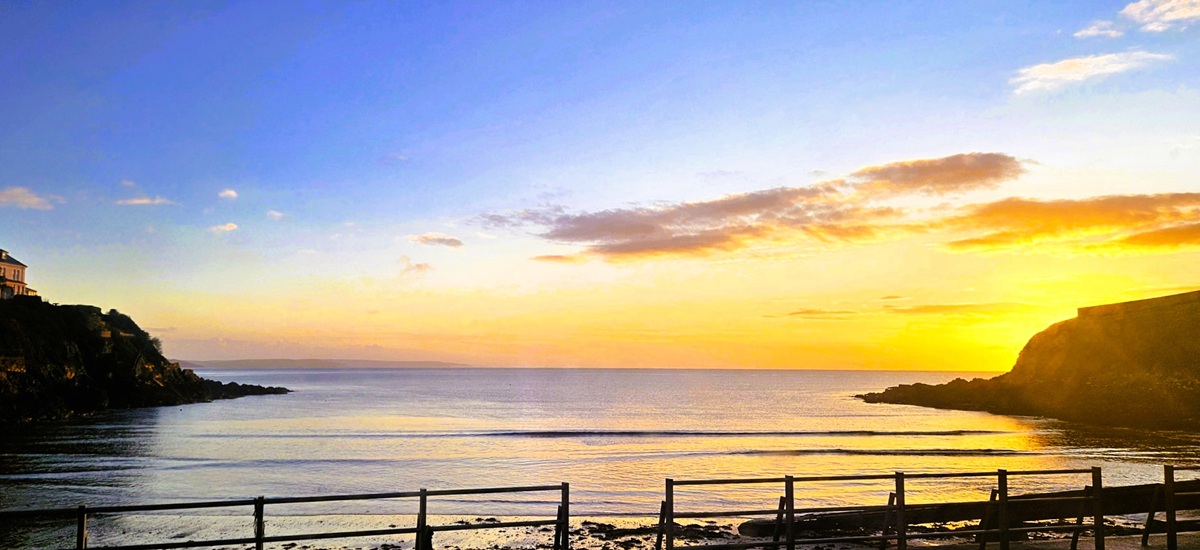
Day two, and I was up before dawn, roused by the rhythmic shushing of the tide against the seawall and the thick tang of brine in the air; we’d opted for full coastal immersion, sleeping with the curtains open and windows ajar.
With the men of the house still snoring, I snuck downstairs, curled up in a cosy armchair, and drank in both the stirring light and my morning brew. Beachside balm for the soul – and the perfect preamble to the day. And relax…
Which was interrupted all too soon by the habitual thud of Tim’s gymnastic dismount from bed, followed by the less habitual sound of a muffled yell and colourful cursing.
Seems that, eager to take in the soothing seascape, he’d rushed to the full‑length window – only to find twelve bobbing, bobble‑hatted women, staring right back. Turns out Portmellon is a wild-swimming hotspot… and that Tim should really wear PJs. Reader, I howled.
(Mind, my howling was far shriller later when – luxuriating in bubbles – karma struck with the clunk of a ladder on glass. First, a baseball cap crested the sill, inexorably followed by Andy from Bay Cleaning, whose wide eyes and horrified expression utterly mirrored mine. And… well, scenes. ‘Schadenfreude,’ quipped a smug Tim. Grr.)
Accidental flashing aside, the next few days were pretty idyllic: a top-notch Sunday roast on Mevagissey’s harbour, a leisurely car tour beneath the towering spires of Truro’s cathedral, and the laid-back vibes of the county. But while we loved the thinned-out crowds and slightly lower prices, they came with a catch.
As you might know, my mobility makes walking quite a challenge, so I’d made a brief list of accessible attractions we could enjoy during the week, ranging from witchcraft to literature to pirates. (I love the esoteric, have a long-held du Maurier obsession, and remain scandalously undone by the swashbuckling ways of pirates.) I. Could. Not. Wait.
But. I. Had. To. Because Easter is when Cornwall rolls out the pasties and red carpet to welcome the influx of tourists to the full complement of its attractions. Heavy sigh. So, with every item on my must-see list off the table, a rapid rejig was required.
Gwennap Pit
And that was why, on an inclement afternoon of horizontal rain and muffling fog, we found ourselves at Gwennap Pit. I’d chosen our destination partly for the glamorous allure of grassy subsidence, partly because it was open-air and closure-proof, but mainly because Google Maps hinted at attraction-adjacent parking. Score.
Less pit and more amphitheatre, this tufted hollow is part of the UNESCO Cornish Mining World Heritage Site and was the outcome of a ‘happy accident’ involving the collapse of an 18th-century mineshaft. The resultant depression offered a providential (heaven-sent?) opportunity for the father of Methodism – and friend of the common man – John Wesley.
His sermons sent shockwaves through the clergy, who feared his absurd focus on the ‘neglected and needy’ would lead to social unrest. And when local churches, inevitably, barred him from using their pulpits for his radical form of religion, he went al fresco – this hole in the ground, letting him take his message to the masses. (Though I suspect ‘masses’ might be doing some heavy lifting here.)
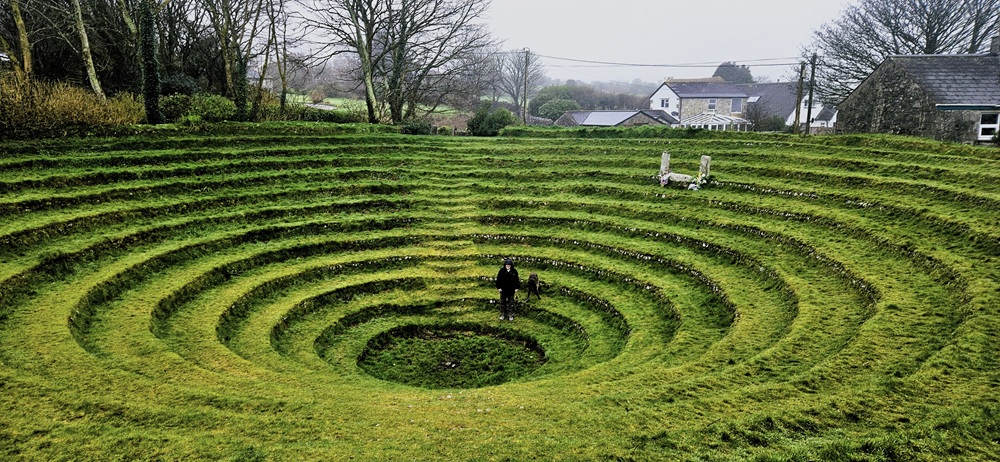
After his death, the local miners created twelve grassy terraces as a memorial to Wesley, and we gathered a few further nuggets from the helpful information board: if you walk the circumference of all twelve tiers, it’s exactly one mile; if you whisper from the bottom, you can be heard clearly at the top; and, most remarkably, given the weather, no matter the deluge, the pit never floods.
I thought it was quite impressive, but when I forced Tim to check the acoustics, whatever he was muttering was lost to the wind. Not even Wesley’s legendary sound system could compete with this Cornish monsoon.
(And no, the irony isn’t lost on me. After two months of yearning for a mute button, the one time I wanted to hear from Tim, the elements conspired to silence him.
Still, based on his expression as he squelched, dripping and despondent, back to the car, that was probably no bad thing.)
The Lost Gardens of Heligan
Given that neither Tim nor I are naturally green-fingered – or even green-curious – it was surprising that a more successful day came courtesy of the Lost Gardens of Heligan. This two-hundred-acre Victorian estate near St Austell became a truly ‘lost world’ when its twenty-two-strong workforce downed tools and left for the Western Front. Few returned, and without care, the gardens simply ran wild.
Then, in 1990, they were rediscovered, sparking Europe’s largest garden restoration. But the poignant heart of this ambitious project lay in an unlikely spot – the gardeners’ ty bach (the superbly named Thunderbox Room). On its walls, preserved in pencil, were the signatures of the original staff, dated August 1914. This revival of flowers, foliage, and long-forgotten pathways still honours their legacy.
Featuring a range of sculptures and installations, subtropical jungle, and heritage orchards – all maintained using traditional 19th-century techniques – it’s a living time capsule, as much about human history as horticulture. And, crucially, they had a tramper named Bluebell – fully charged and ready for action. Woohoo.
And boy, was she a unit. Fat pneumatic tyres, speedy as sin, with a sofa-soft seat and enough off-road muscle to make a quad-bike blush. Throw anything at this gal, and she’d take it in her… stride (roll?). So, with the pups securely on lead, off we trundled.
It was beautiful, but also February, so plenty of plants were still aslumber. Even so, there were flares of blazing rhododendrons, and the nodding white hoods of the snowdrops – ever the early risers.
But lovely as the setting was, it was actually a sculpture that drew us – okay Tim, drew me – to Heligan, and Bluebell bossed the steep slog that led to Lowanes (Cornish for vixen). And WOW! She was immense, bursting from the scrub to loom above us in a distinctly feral fashion.
(The chap in the ticket office must have muddled his measurements because this foxy lady was not the six-foot we’d been promised. But also, how refreshing for a bloke to underestimate size for a change. Ladies…)
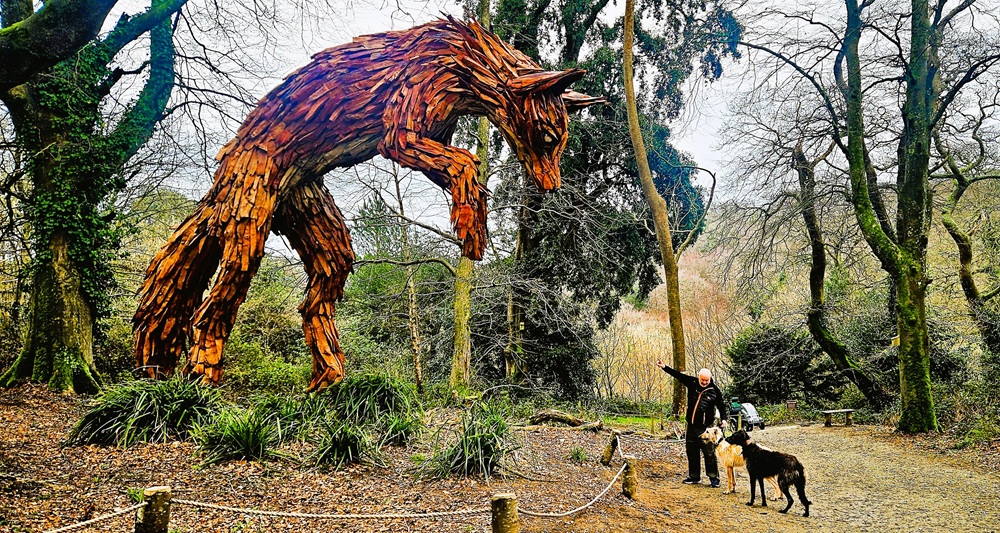
Crafted from the twisted, russet branches of an ancient Cornish Red (felled by Storm Darragh), the sculpture was shaped over a steel frame and clad in salvaged wood, skilfully mimicking the sweep of fox fur and muscle. The result is a six‑metre vixen, caught mid‑pounce, surging through the tangled trees with a near-audible Boo! And she was absolutely epic.
After snapping many, many pics, we ambled back via more sculptures – the Mud Maid, Giant’s Head, Grey Lady – then followed the farmyard trail past a puddle of rare-breed piglets, before looping back to the tea rooms for a well-earned cuppa. It was a fabulous day…
… And probably more so because, for once, I wasn’t a burden; I was moving under my own steam, keeping pace with Tim and the boys, and loving the freedom to roam with ease. The old Del was back. Wicked.
After that high, I got a double whammy of disappointment – the Witchcraft Museum was closed until… go on, guess… and the closest I’d get to the du Maurier archives would be loitering by its front door (locked, obvs).
The Birds
So instead, we drifted through the impossibly picturesque Fowey – all snaking lanes, slate roofs, and sea-scoured cottages – to visit a statue dedicated to du Maurier’s most famous work, The Birds. Sure, Hitchcock immortalised it on 35mm Eastmancolor film stock (I looked it up), but it was our girl Daphne who wrote that slow-creeping, gull-screeching tale of the natural world slyly sharpening its beak.
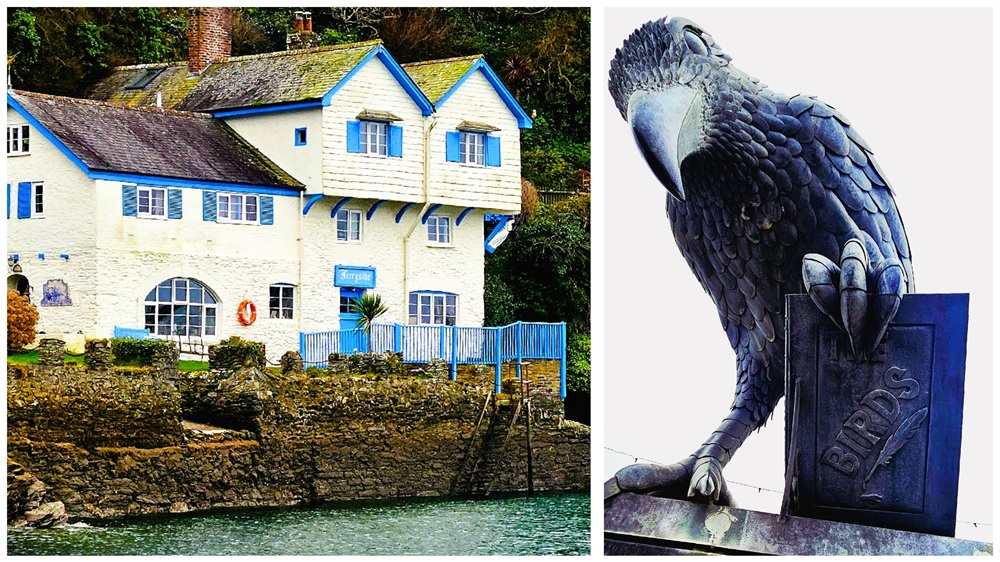
Enter Rook with a Book: this hulking bronze corvid dominates the town quay, talons tight around a hardback, pages frozen mid-flutter. From one angle, he oozed feathery menace; from another, he had a cheeky twinkle – the look of a bird deciding if you were friend, foe, or possibly lunch. Gulp. A fitting tribute, given du Maurier’s lifelong love of birds and all things uncanny.
But there’s more, because a mere stone-skim across the water sits Ferryside – du Maurier’s childhood home, all clotted‑cream walls, crooked gables, and ripple-lit windows. So, we boarded the Bodinnick Ferry, which has carried locals, tourists, and literary pilgrims there and back for decades. It’s the crossing Daphne would have taken, and, from the river, her old home appears just as she described: private, watchful, and somehow set apart from the world.
And now, with the arrival of Stepdad – and apologies for the protracted scenic detour – we’re back to the real reason for the trip: our Padstow promise.
Padstow was one of Mum’s favourite places – and no wonder. Nestled in a sheltered valley on the west bank of the Camel Estuary, the town grew from a mix of folklore, faith, and, of course, fish.
A rare deep-water haven on the rugged north coast, it was the 6th-century Welsh missionary, St Petroc, who founded the monastery that gave Padstow its name (Petroc-stow). That spiritual foothold, attracting pilgrims and trade, soon evolved into a thriving fishing port, while the treacherous nearby waters – and the infamous Doom Bar sandbank – sparked a rich seam of local legends: mermaids, shipwrecks, and the ancient May Day’ Obby-Osses. Mum loved it all.
So, there we were, perched on Padstow harbour, discussing how best to release Mum in an ‘unobtrusive, respectful manner.’ (It might have been low season, but clearly no one had told this town.)
Stepdad favoured a ‘subtle sprinkle on the pavement’; I suggested ‘in the actual water, so she can make a proper exit’; and Tim, with his usual candour, said to ‘just launch her.’ Eye-roll.
However, a handy slipway, shielded from the idling crowds, tempted Stepdad and me to shake her into the shallows. Luckily, we’d only let loose a few handfuls before realising that ashes, apparently, don’t float. Nope. They form a sludgy little clump on the seafloor, which certainly wasn’t what I’d had in mind. And with a fair amount of Mum still to go, we needed a new plan. Hmm…
Bag for Life
While Tim helpfully chipped in with a ‘knew she wouldn’t float,’ I had a bold idea. I grabbed Mum’s cardboard scatter‑tube, tipped her into Stepdad’s carrier bag, and poked a finger‑sized hole through the plastic. Then – super-casual like – I sauntered around the harbour, jauntily swinging the Bag for Life (oh, the irony), leaving a fair dusting of Mum on every cobble.
Okay, so maybe the hole was a smidgen too large, maybe I wasn’t as discreet as I’d imagined, and yes, maybe I ended up caked, top to toe, in gritty remains – damn that bracing sea breeze – but frankly, the outcome justified the dermabrasion. Ouchy.
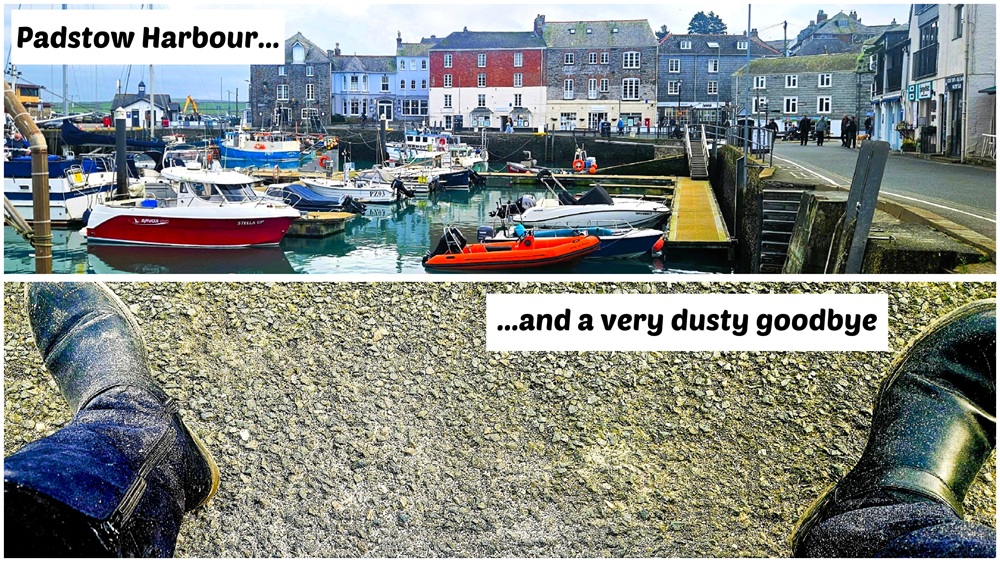
Because despite the logistical lapses, we laughed ourselves silly, certain that Mum would be looking down, or possibly up, and revelling in the chaos – as, quite literally, parts of her were. And that made it an absolutely perfect send-off. (But who’d have thought disposing of a body would be so damned difficult?)
Back at the car, I discovered that she’d found her way into my handbag too, which I could live with – and into my vape, which I really couldn’t. But needs must, and with two days to go, with my spare safe in Swansea, every puff came with a tiny crunch of memento mori. She never did like me smoking. Well played, Mum. Well played.
Back home, and into the routine rhythms of everyday life, I think we all feel a touch lighter, somehow less stifled now Mum’s farewell tour is back on track.
And as for Tim, he’s delightfully the same – except now he’s added sea shanties and seafaring knots to the mix. Still, if it diverts him from the impact driver, I can live with it… for now.
Support our Nation today
For the price of a cup of coffee a month you can help us create an independent, not-for-profit, national news service for the people of Wales, by the people of Wales.



Thank you. Excellent writing.
The only Americanism I really detest, is “Legos”, I have always understood Lego as a mass noun, not a count noun.