


Unwrapped: The nation’s ‘unhealthiest’ Easter eggs revealed

Searches for “Easter egg offers” have skyrocketed by more than 5,000% over the past month in the UK, as the nation starts preparing for one of the sweetest holidays of the year. Brits are estimated to consume a whopping 205 million eggs annually, with the average adult munching 3 to 4 eggs over the Easter period.
But just how many calories and how much sugar lurk inside these tempting eggs now gracing supermarket shelves?
To find out, experts at leading digital healthcare provider ZAVA analysed over 40 popular Easter egg chocolates on supermarket shelves to reveal which treats pack the biggest calorie punch this season.
But that doesn’t mean you have to banish them from your basket entirely. Dr Crystal Wyllie at ZAVA has shared her top tips for enjoying Easter eggs mindfully so you can indulge without the guilt.
Key findings:
Ferrero Rocher’s Golden Easter Egg tops the chart as the most calorie-dense, with a staggering 613 calories per 100g.
Three Waitrose Easter eggs sneak into the top ten most calorific treats this season
Toblerone’s Golden Edgy Egg reigns as the sugariest of all Easter eggs analysed, with a shocking 61.2g of sugar per 100g – double the NHS’s recommended daily sugar limit (30g).
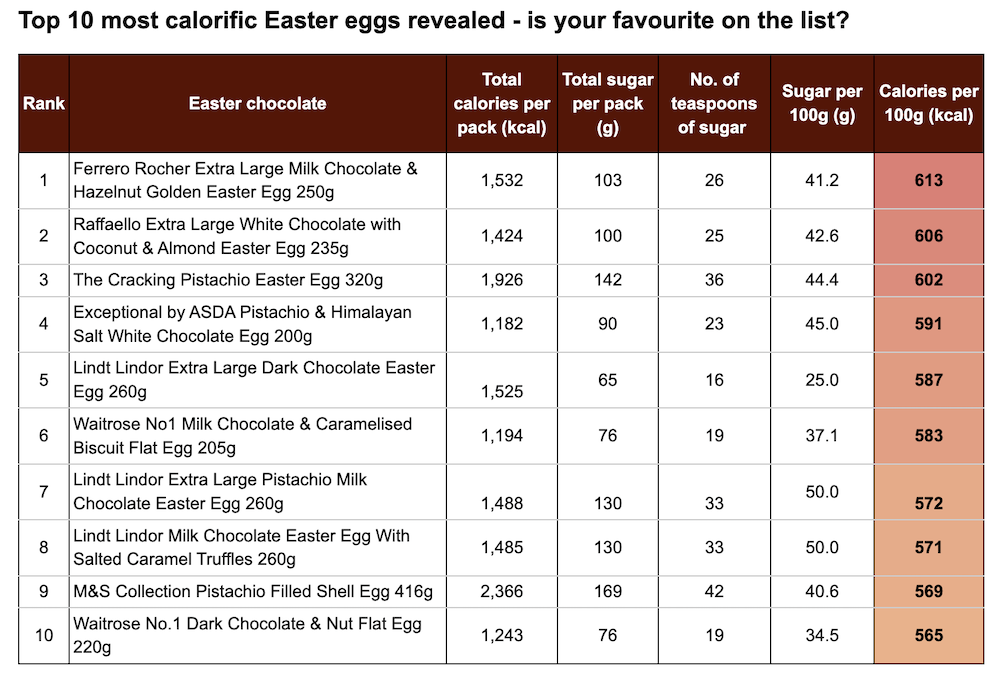
For the complete data of all 44 Easter eggs analysed, please click HERE
Topping the Easter indulgence charts is Ferrero Rocher’s Milk Chocolate and Hazelnut Golden Easter Egg, packing a jaw-dropping 613 calories per 100g. Inside its golden shell sit six Ferrero Rocher chocolates, bringing the full 250g treat to a whopping 1,532 calories – that’s over 60% of the NHS daily calorie recommendation for men (2,500 calories) and nearly 77% for women (2,000 calories). The whole treat also contains a hefty 103g of sugar, roughly 26 teaspoons.
In second place is Raffaello’s Large White Chocolate with Coconut and Almond Easter Egg, where its creamy, nutty flavour hides a staggering 606 calories per 100g. Weighing 235g and housing six Raffaello pralines, it sneaks in 100g of sugar – the equivalent of 25 teaspoons – more than three times the NHS’s daily sugar limit (30g).

Three Waitrose eggs make the top ten, led by the iconic Cracking Pistachio Easter Egg in third (602 calories per 100g). This 320g masterpiece contains 142g of sugar – nearly five times the NHS daily sugar limit – and a colossal 1,926 calories, roughly the equivalent of four Big Macs. Its siblings from the flat egg collection, the Milk Chocolate & Caramelised Biscuit Flat Egg and Dark Chocolate & Nut Flat Egg, follow in sixth and tenth place, packing 583 and 565 calories per 100g respectively.
Another Pistachio-packed contender is ASDA’s Pistachio & Himalayan Salt White Chocolate Egg, hopping in at fourth with 591 calories per 100g. This 200g festive treat delivers 45g of sugar per 100g, tipping it just above Waitrose’s pistachio egg in sweetness.
Rounding out the top five is Lindt Lindor Dark Chocolate Easter Egg. While it packs the lowest sugar content in the top ten at 25g per 100g, its calorie density remains sky-high at 587 calories per 100g, totalling 1,525 calories overall – roughly the equivalent of four Greggs sausage rolls.
Dr Crystal Wyllie at ZAVA shares her top tips for enjoying Easter egg chocolates mindfully this season – without derailing your weight-loss goals:
– Pair your Easter treats with protein or fibre-rich foods
– Chocolate alone can trigger spikes in blood sugar, creating cravings and energy crashes. Try pairing your Easter chocolates with food rich in protein or fibre, like a handful of nuts, a slice of cheese or some fresh berries. This slows sugar absorption, keeps your blood sugar steadier and prolongs satiety, making a few bites of chocolate far more satisfying.
– Eat treats after a balanced meal and plan your snack time
– Timing matters. Save your Easter egg for after a balanced and nutrient-rich meal to buffer the sugar impact and reduce fat storage. Planning dedicated snack times also prevents mindless nibbling to help you stay in control and indulge strategically.
– Practice portion control
– Out of sight, out of mind. Break off a few pieces or pre-plate a serving, and put the rest away to avoid temptation. Controlled portions help with sustained weight management and prevent impulsive binges.
– Slow down and savour every bite
– Don’t eat while scrolling on your phone or watching TV as this can trick your brain into thinking you need more to feel satisfied. Sit down, inhale the chocolate’s aroma, and focus on its taste and texture while you chew slowly. Slowing down increases pleasure and helps you notice your body’s satiety cues.
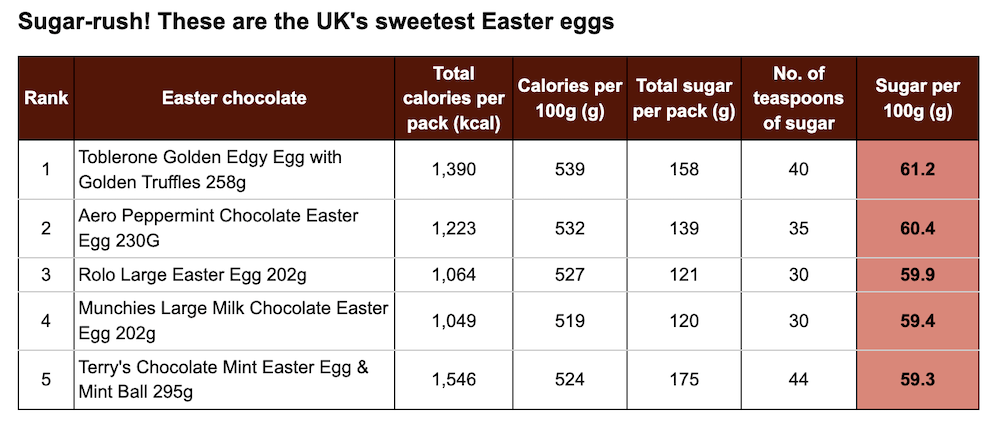
Despite relatively lower calorie counts, some Easter eggs deliver a jaw-dropping sugar punch. Toblerone’s Golden Edgy Egg with Golden Truffles leads the pack, with a striking 61.2g of sugar per 100g – that’s 40 teaspoons in the full 258g treat, roughly double the sugar of Ferrero Rocher’s Golden Easter Egg (26g per 100g).
Close behind is the bubbly, mint-infused Aero Peppermint Chocolate Easter Egg, packing a fizzy sugar punch of 60.4g per 100g. Rounding out the top three is the Rolo Large Easter Egg that contains a hefty 59.9g of sugar per 100g.
Methodology
ZAVA set out to uncover which Easter egg chocolates are the most calorie-packed this season.
To do this, the experts compiled a list of the most popular supermarket Easter eggs from Tesco, Sainsbury’s, M&S, Aldi, ASDA, Waitrose and Lidl, including only those weighing over 100g.
Nutritional information for each egg – calories and sugar content – was collected from product labels and official nutritional charts. To account for differences in size, the team calculated calories per 100g and sugar per 100g, allowing for fair comparisons across all eggs.
Each Easter egg was then ranked based on calories per 100g and sugar per 100g.
All data was collected in March 2026 and is correct as of then.
Support our Nation today
For the price of a cup of coffee a month you can help us create an independent, not-for-profit, national news service for the people of Wales, by the people of Wales.


