


Wales has cut its carbon emissions almost in half – but the hardest part is still to come

Nation.Cymru Staff
Wales has reached a milestone that would have seemed ambitious a generation ago.
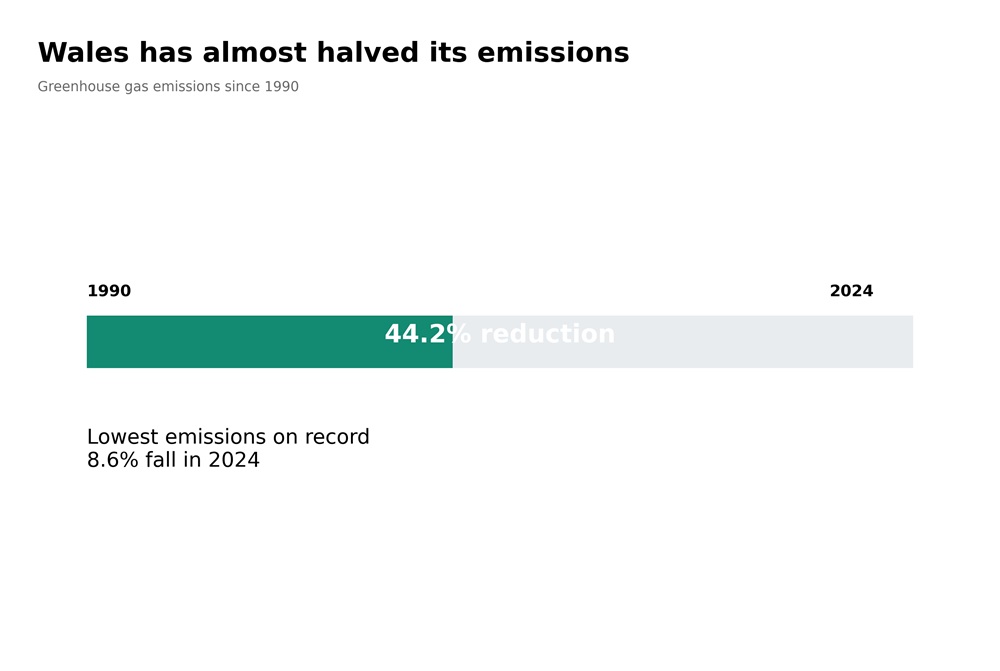
Greenhouse gas emissions are now at their lowest level since records began, having fallen by more than 44% since 1990.
It’s a remarkable achievement for a nation whose economy was built on coal, steel and heavy industry. But before anyone concludes Wales is comfortably on course to reach net zero, the latest analysis suggests a more complicated picture.
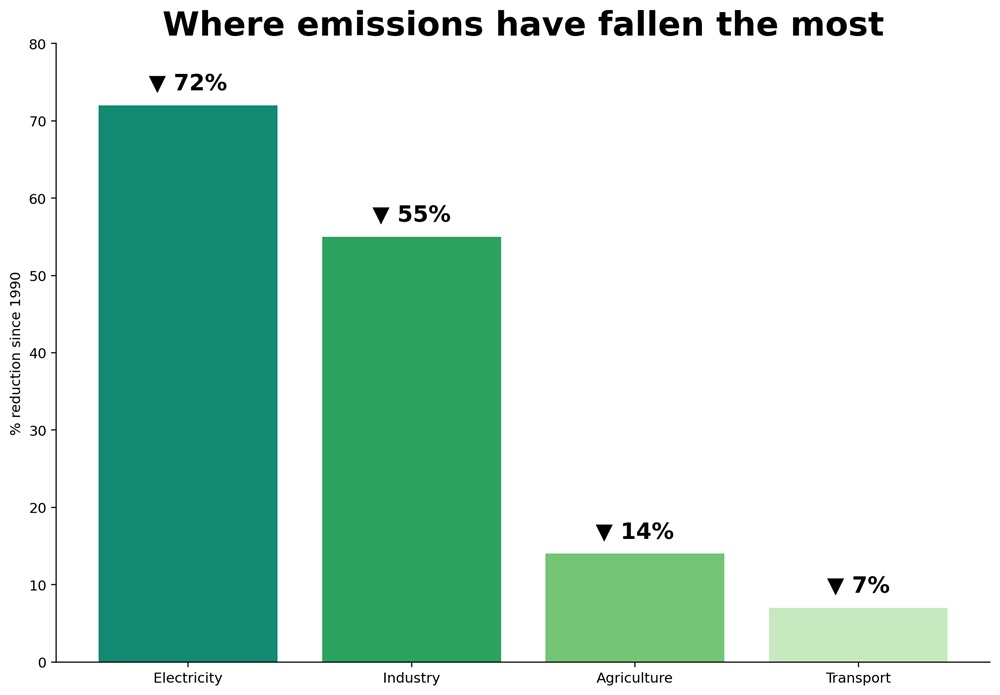
Much of the progress has come from cleaning up electricity generation and the decline of heavy industry. The sectors that affect people’s everyday lives – driving, farming and heating buildings – have proved much harder to decarbonise.
Those findings come from new analysis by Dr Matthew Sutton of Senedd Research, examining how Welsh greenhouse gas emissions have changed between 1990 and 2024.
Lowest emissions on record
The figures show Welsh greenhouse gas emissions fell by 8.6% during 2024, taking them to their lowest recorded level.
Overall emissions are now 44.2% lower than they were in 1990, meaning Wales appears on course to meet its current five-year carbon budget covering the period from 2021 to 2025.
The dramatic fall did not happen by accident.
Thirty years ago Wales was one of Europe’s most carbon-intensive economies. Coal-fired power stations generated electricity, steelmaking dominated large parts of south Wales and heavy industry produced millions of tonnes of carbon emissions every year.
Over the past three decades that picture has changed dramatically. Coal has almost disappeared from electricity generation, renewable energy has expanded rapidly and industry has become significantly more efficient.
Last year’s closure of the blast furnaces at Port Talbot accelerated that trend, contributing to one of the largest annual reductions in emissions since records began. Industrial emissions fell by around a quarter in a single year, while emissions from electricity generation continued their long-term decline.
Cars and cows remain the biggest challenge
The report shows the biggest climate challenge facing Wales is no longer heavy industry. Instead, it is the emissions produced by millions of everyday decisions.
Since 1990, emissions from domestic transport have fallen by just 7%, while agricultural emissions have reduced by only 14%.
Compare that with electricity generation, where emissions have fallen dramatically as coal-fired power stations have closed and renewable energy has expanded.
Reducing transport emissions is proving particularly difficult because there is no single solution.
Electric vehicle sales continue to grow, but petrol and diesel cars still dominate Welsh roads, particularly in rural areas where public transport is often limited. Freight traffic also remains an important part of the Welsh economy.
Unlike shutting down a power station, cutting transport emissions depends on millions of individual decisions about how people travel and the vehicles they choose to drive.
Agriculture presents a different challenge. Most farming emissions come from methane produced by livestock and nitrous oxide released from soils and fertilisers. Unlike emissions from factories or power stations, these cannot simply be eliminated through cleaner energy.
Instead, they require changes to farming practices, land management and food production – areas that have become increasingly politically sensitive in Wales over recent years.
Cardiff Bay now has a bigger role
One of the most significant findings is political rather than environmental.
For the first time, more than half of Wales’ greenhouse gas emissions now come from sectors that are largely the responsibility of the Welsh Government rather than Westminster. That shift has happened because emissions from reserved sectors, particularly heavy industry, have fallen much faster following changes at Port Talbot.
It means future progress towards net zero will increasingly depend on decisions taken in Cardiff Bay.
Transport, agriculture, buildings and land use all fall largely within devolved responsibilities, making Welsh Government policy increasingly important in determining whether Wales reaches its legally binding climate targets.
Still one of the UK’s highest emitters
Despite the progress, Wales continues to have one of the highest greenhouse gas emissions per person in the UK.
The report estimates emissions at 9.5 tonnes per person in 2024 – second only to Northern Ireland and around 65% above the global average.
That partly reflects Wales’ industrial history and the fact that it continues to host major industries, including steel production, oil refining, cement works and power generation that serve markets far beyond Wales itself.
The report also notes that Wales exports many emissions-intensive products, meaning the country’s “consumption emissions” are lower than its territorial emissions because much of what is produced here is consumed elsewhere.
The next test
The Welsh Government must publish a new emissions reduction plan before the end of the year, setting out how it intends to meet the next carbon budget covering the period to 2030.
According to Dr Sutton’s analysis, Wales will need to cut emissions by around a third (34%) from today’s levels to meet its 2030 target of reducing emissions by 63% compared with 1990.
The figures suggest Wales has already achieved many of the easier gains in decarbonisation.
Cleaning up electricity generation and reducing heavy industrial emissions has delivered dramatic progress. The next phase is likely to be slower, more expensive and more politically contentious because it reaches into almost every aspect of daily life.
Decisions about transport, farming, home heating and land use are likely to dominate climate policy during the remainder of this Senedd term and well beyond it.
The latest figures show Wales has made significant progress over the past three decades.
The challenge now is whether it can maintain that momentum as the focus shifts from power stations and steelworks to the cars people drive, the homes they heat and the food they produce.
Support our Nation today
For the price of a cup of coffee a month you can help us create an independent, not-for-profit, national news service for the people of Wales, by the people of Wales.
Get more trusted Welsh news
Choose Nation.Cymru as a preferred source in Google News to see more of our journalism.



I surprised it’s only dropped so little with NO industrial base and the senedd doing it’s best to stop tourism anymore you’d think it would be lower
Even in the transport sector most of the decisions people make are still determined by Westminster. Rail is mostly not devolved (excepting the Valley Lines) and there is no movement to electrify even to Swansea or Holyhead, NWML. Individuals deciding on electric vehicles are impacted by VAT, VED and changes coming down the line which do not exactly make the case for people to switch especially to second hand vehicles. Even in freight a large part of any decision to change is determined by how capital expenditure is dealt with by accounting and tax rules, almost all in the hands… Read more »
Took all the jobs away from wales that’s why the window lickers.
If carbon accounting assigned the carbon associated with making the stuff we consume to the folks doing the consuming not the making the madness of closing domestic production just to import from dirtier producers would be laid bare.
We need some realism here.
Carbon emissions have dropped mainly because we’ve stopped doing important things in Wales – industry, manufacturing etc. That means fewer jobs and less wealth. That is nothing to celebrate.
Its also the case that we’ve simply exported the emissions. We haven’t stopped needing steel but we now rely on India and China to make it and ship it back. All that does is shift the emissions from Wales to a foreign country. Its a paper exercise rather than anything tangible that aids the planet!
You have a point but that is a political decision made mainly in Westminster for the last 45 years. It could have been reduced at any time by imposing massive tariffs and barriers but that would have made the average person pay one heck of a lot more for everyday goods and essentials. Again that could have meant fewer jobs and less wealth. There are not easy solutions but just from a security point of view it does not make sense to lose competence in industries that we have been in since the start of the industrial revolution.
It’s not all or nothing. There’s a sliding scale of tariff and non tariff barriers that can move the dial between the two extremes of full domestic production or fully importing our needs. I think we should be targeting 40% domestic production with moderate tariffs, the proceeds of which could be used to reduce VAT helping to offset the impact on prices. It’s not just about job and growth, it’s about national security. Covid should’ve taught us the folly of getting China to make everything.
The elephant on the doorstep – and which this article somehow manages to ignore – is that energy isnt devolved to Wales. It defies belief that Wales can be realistically expected to meet the 2030 target cited when the powers over the creation of large scale renewable energy projects are in the hands of Westminster and not the govt of Wales. That energy isnt devolved also makes a nonsense of the report’s claim that the Welsh govt now has more control over carbon emissions in Wales than the UK govt.
Energy is a shared responsibility, Welsh Government has consenting and planning responsibility for onshore wind and all other energy generating stations up to 350 MW in capacity. WG also has considerable powers over policies that affect how much energy we consume, e.g. planning law.
Perhaps there is much to celebrate, but the headline figure doesn’t mean a lot if it only measures emissions, but not our carbon footprint.
If we close the steelworks, and import steel instead, we’ve done nothing beneficial at all. Any fool can chuck their rubbish over the fence.
Hopefully, the report itself is clearer on this.
It would be better to measure the carbon emitted by the production of what we consume in Wales rather than the carbon emitted by what is produced in Wales. Climate change is a global problem and there is likely to be an increase in carbon emissions from producing goods remotely then moving them halfway round the world to where they are needed.