


Wandering Odyssey, Athene, Rhiannon
Dr. Shân Morgain
Christopher Nolan’s new reinvention of Homer’s Odyssey premiers this month (17 July 2026). It offers a swashbuckling, warrior epic with plenty of battle action and heroics. Peter Bradshaw puffs it as ‘a colossal origin-myth story of postwar disillusion, an epic ordeal of anguish’. (Guardian)
The film includes the sober dismantling of Helen’s legendary romance, as the cause of the Trojan war. This Odysseus reveals to his beloved Penelope the real reason for the war is conflict about trade routes. It offers an acute parallel to our times right now, at the Strait of Hormuz.
Nolan’s Helen as an elegant, black actress (Lupita Nyong’o) is striking, innovative, inclusive, inspiring; or crass, wrong, devastating: your call.
He has been criticised for failing to include a rainbow which appeared as Odysseus (Matt Damon) finally comes home, daring to hope for reunion and peace. A divine event ignored.
Since Heinrich Schliemann’s inspired discoveries (1870s), archaeology has confirmed the existence of Troy, though debate continues which level of Troy was the mythical Ilium of Homer.
Ancestral myth
As an ancestral myth, Troy was exploited for propaganda by the mighty Roman Empire, as it spread across Europe, Asia and Africa. Aeneas the Trojan prince escaped Troy’s fall, said to found the lineage of early Roman kings. A similar project in native British lore told of another prince Brutus escaping Troy, coming to an almost empty but fertile northern land, and so named it Britain.
In Greek/ Achaean tradition, Goddesses and Gods walk the earth as our powerful allies or antagonists, just as they do among the Celts. Odysseus’ matron–patroness is Athena: strangely, Goddess of Troy, the mighty city Odysseus destroys by a fake Horse.
Athena and Rhiannon
Athena is the quintessential father’s daughter. Her mother Metis, Wisdom, was swallowed up when pregnant by Zeus to stop her son challenging his power. Instead she had daughter Athena, who crashed out of Zeus’ brain to become the new Wisdom Goddess (intelligence).
Athena has no true mothering tales, but adopts heroes such as Odysseus and Perseus. She was also matron of the Bronze Age horse nobility, inventing the bridle that made exploiting horses’ huge bodies possible.
There are strong affinities between Athena and our native Rhiannon of the First Branch of the Mabinogi. In our myth too the lady is a father’s daughter, no mention anywhere of a mother. Rhiannon is no pretty princess. She is sturdy, marchoges a powerful horse riding noble, a courtly strategist of astute intelligence.
I have speculated a family feud between her father and his noticeably absent heir, perhaps Rhiannon’s brother. This could explain why she says she was ‘compelled’ to marry a man she did not favour, yet her elderly father much indulges her. Years later (after his death?) it might explain why she does not go to her homeland when in crisis.
Speculation aside, Athena and Rhiannon are strong women, powerful female agents, but not very feminist, for they show no sign of sisterhood loyalty. They love and guide their chosen men.
Rhiannon does give birth to a much cherished, princely son. However her mothering, while central to her drama, is distant. He is abducted at birth, and the reunion when he is grown could conceivably be an imposter she adopts to restore her status. They soon separate again due to his war projects. She functions like Athena, as distant guide and support.
It might be argued that unlike Athena, Rhiannon’s key characteristic is her affinity with her marvellous horse. Her mare is canelw, pale-white or grey, never to be caught even though walking sedately. However, a lesser known tradition has Athena Hippia, Lady of Horses, the original horse tamer. She invented the bridle and bit, enabling exploitation of mighty horse bodies for warfare, trade and political dominance.
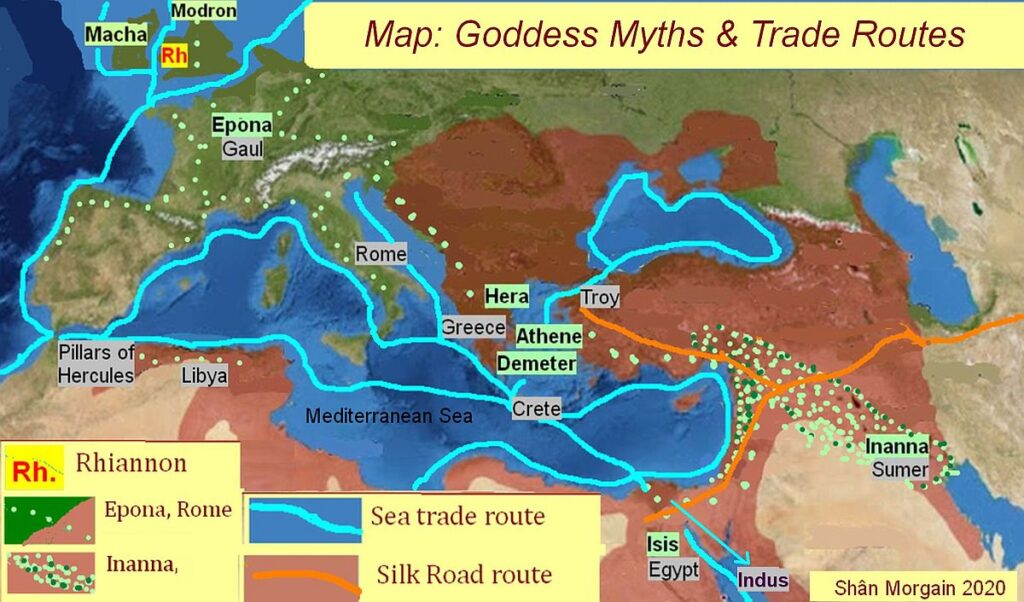
Rhiannon has been aligned with Epona, goddess of horses, the elite cavalry of Gaulish tribes in the Roman Empire. Epona/ Rhiannon does not ride sidesaddle, but on-the-side, as if seated in a chair on the back of the horse. This was the earlier mode for female riding before the sidesaddle was created by 16th century Medici, Italy.
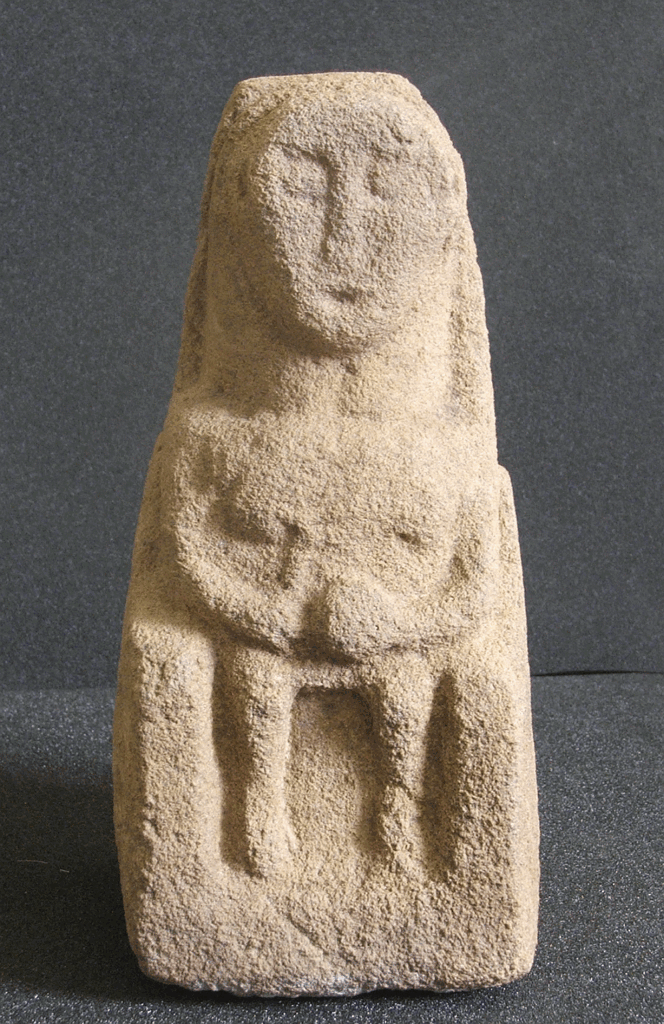
With my beloved John Davies behind the camera, and kind permission from Oliver Blackmore, curator, I made many photos of a small, local sandstone figurine in Newport museum. She sits veiled and enthroned, very like Epona, holding a plant or branch, suggesting food. Rhiannon/ Epona governs vital food supplies.
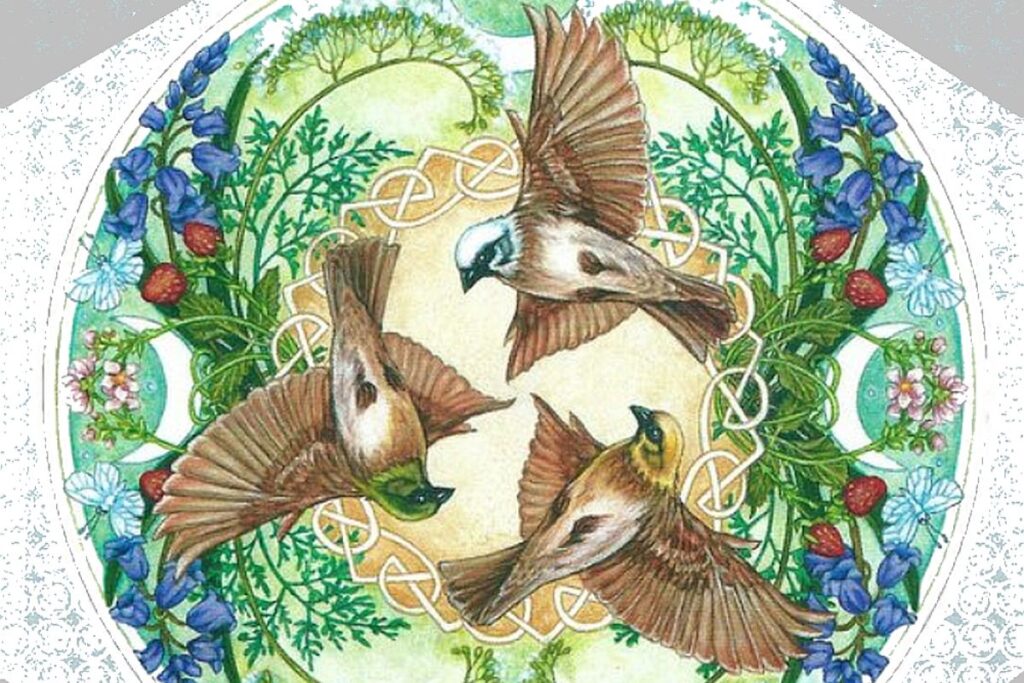
Both Rhiannon and Athena work with birds. Rhiannon has three Adar, who work trances for healing and guiding the dead. From their description in Culhwch I suggest skylarks. Athena’s famous owl is wisdom’s symbol, (not like a Mabinogi owl outsider).
Rhiannon calls her third enchantment, in satirical style, her ‘little bag’. It can contain all the mass of food and drink of Dyfed (SW Wales), so it’s highly deceptive.
I have argued against Mark Williams, who refuses to see any Mabinogi women as true Magicians. He admits Rhiannon has ‘distinct magical characteristics’.
Athena is goddess of technology, patron of smiths. She wrecks conventional assumptions about women and technology. A Wiltshire find from 4,000 years ago bears her out. Long thought to be a bearded male shaman, this misunderstood burial in Upton Lovell, has metal axes and gold jewellery. DNA analysis now reveals a female. Redoubtable Rhiannon might well have held her in mutual respect.
Medusa
While both Rhiannon and Athena have enchanted birds, and great power through horses, I could not see an Athena parallel with Rhiannon’s cod bechan, little bag. In one of those wonderful moments of research I stumbled on Perseus. Athena provides him with a protective kibisis, a wallet to hold Medusa’s decapitated head after he kills her. Even dead, her head would petrify, turn to stone, anyone it faced. Usable weapon – but needs its covering kibisis.
That was by no means all. Like Rhiannon’s son, Perseus benefits from a kindly foster father. There’s a horse princess’ wedding, where Perseus makes a rash promise, as Rhiannon’s consort does at their wedding. When Perseus decapitates Medusa a winged horse flies out of her neck.
Rhiannon’s clever strategy orders her chosen consort to hide his men in the orchard, outside the wedding hall. Later they crash in and take over. Athena sends Perseus to get the vital kibisis bag from the Hesperides ladies, in their orchard. Rhiannon’s ‘orchard’ is a curiously specific location not mentioned elsewhere in the native tales.
Of course, a golden Hesperides apple is used to cause the Trojan war.
While such an array of Perseus points seem a jumble, they are too many to be random. Perseus’ adventures take place on Atlantic coasts near Gibraltar, where the ancient sea route brought Mediterranean tin traders to Britain for thousands of years. The old seafarers really got about, long before Vikings.
Athena and Rhiannon are not mirror image sisters. Athena is fiercely virginal, while Rhiannon is fiercely maternal. But both are wisdom themed, patrons of civilised living and technology, horse whisperers, associated with magical birds and a rare magical bag. Both use male heroes to execute their strategies with little loyalty to women.
Perhaps most curious of all, both are strangers to the culture that boasts of them. Athena came from Africa to dominate Greek thealogy. Rhiannon rode to Dyfed from somewhere unnamed. Some evidence suggests she might have come from Maesyfed, in Powys, once a princely domain. That is a tale for another day.
––––––––––––––––––––––––––––––––––––––––––––––––––
DiscussingFilm. (5/07/2026: 18.49) Blogpost on the rainbow
research by Taliesin Morgan, who was disgusted at the omission.
Peter Bradshaw (15/07/2026:17.00 BST) ‘The Odyssey review’, Guardian
Mark Williams. (2019) ‘Magic and Marvels’, Ch. 3, Cambridge History of Welsh Literature.
Shân Morgain. (2025) ‘Mabinogi Rhiannon. (PhD thesis on Rhiannon of the Mabinogi, Swansea University. FULL FREE Download (3 PDF documents). Dip and skim, mostly quite readable.
Support our Nation today
For the price of a cup of coffee a month you can help us create an independent, not-for-profit, national news service for the people of Wales, by the people of Wales.
Get more trusted Welsh news
Choose Nation.Cymru as a preferred source in Google News to see more of our journalism.


