


Welsh location beats Bannau Brycheiniog to be named best spot in Wales for stargazers

Nation Cymru staff
The AA has ranked the best stargazing spots across UK national parks, naming one location the best in Wales.
New analysis by AA Car Insurance has assessed every UK national park based on the key factors that can make or break a stargazing experience, including light pollution (Bortle scale), rainfall, cloud cover and air quality – to crown New Forest National Park as the country’s number one destination to spot stars.
Thanks to the recent partial solar eclipse, which saw millions turn their eyes to the sky, stargazing is soaring in popularity. In fact, Google Trends data shows searches for “stargazing locations near me” have increased by 100% in the past year, whilst searches for “go stargazing” and “stargazing UK” are up 50% and 30% respectively.
With longer nights returning, stargazing in Autumn offers the opportunity to experience the outdoors after dark without the need for specialist equipment. From spotting familiar constellations to watching meteor showers, some of the most memorable views can be enjoyed with the naked eye – provided the clouds stay away.
Jack Cousens from AA Car Insurance highlights, “More people may be tempted to set off on a road trip to enjoy Britain’s darker evenings. Our research shows that you don’t necessarily have to travel to the most remote parts of the country to experience an impressive night sky.
“There are fantastic stargazing spots across England, Wales and Scotland, making a night under the stars an accessible adventure for many”.
The UK’s top stargazing hotspots
Wales held its own in the rankings, with two spots featured in the top 10, with Pembrokeshire Coast National Park ranking seventh (68.41) and Bannau Brycheiniog National Park taking tenth place (43.20).
Just outside the top ten at number 12 was Eryri at 33.41.
The research found that Southern England has emerged as the UK’s standout region for stargazing, with two of the country’s top three highest-ranking national parks all found in the south.
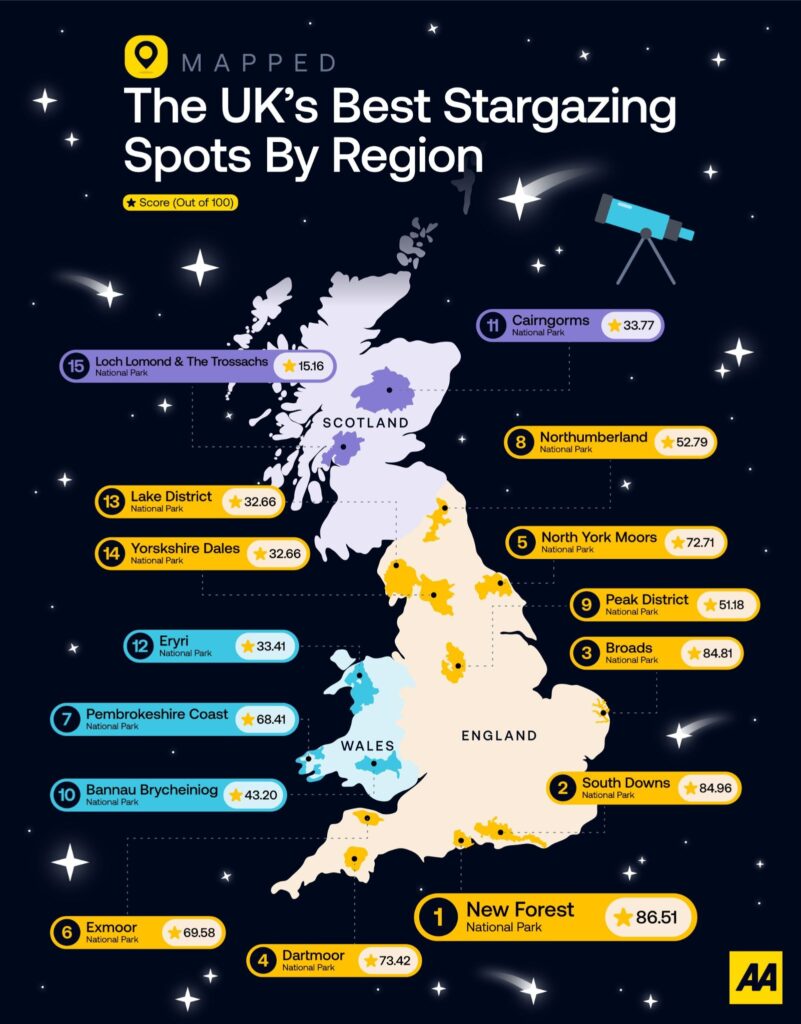
Taking the crown is New Forest National Park, which scored an impressive 86.51 out of 100. Known for its free-roaming ponies and vast ancient woodlands, the area’s combination of lower light pollution, fewer rainy days, lower cloud cover and favourable air quality helped it secure the top spot, making it the UK’s best national park for escaping urban skies and enjoying the stars.
South Downs National Park, known for dramatic white chalk cliffs, follows closely behind with a stargazing score of 84.96 out of 100, while the Broads, famous for the largest protected wetland in Britain, ranks third with 84.81. Together, the three parks highlight the standout destinations for stargazing, offering some of the most favourable conditions in the UK for clear night skies.
In fact, eight of the top 10 positions in the rankings were in England. In fourth place was Dartmoor National Park with a score of 73.42, North York Moors National Park in fifth with 72.71 and Exmoor National Park in sixth place with 69.58.
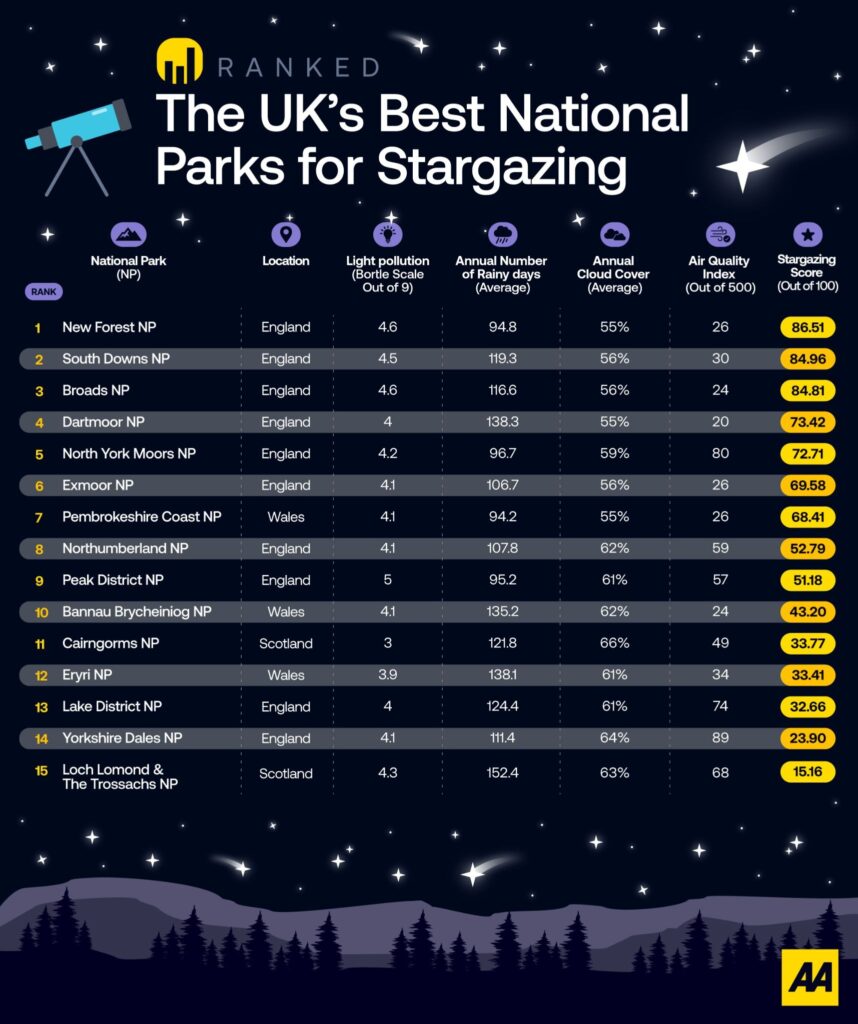
Further down the rankings, Northumberland National Park comes eighth with a stargazing score of 52.79, while Peak District National Park rounds out England’s representation in the top 10, ranking ninth with 51.18.
While Scotland is renowned for its dark skies, its national parks ranked lower overall due to the combined impact of factors including high rainfall and cloud cover, which can affect the likelihood of clear conditions for stargazing. Cairngorms National Park ranked 11th (33.77), while Loch Lomond & The Trossachs National Park placed 15th (15.16).
AA Expert: Must-do checklist for night-time travel
Jack continues: “As the nights draw in, autumn brings a different rhythm to the roads, with more journeys taking place in the dark and changing weather conditions to contend with. Reaching some of the best viewing locations can mean driving on rural roads that are unfamiliar, narrow and poorly lit.
“For anyone heading out to enjoy the night sky, it’s worth making sure the journey is part of the plan too – and you’re comfortable driving home when visibility is reduced.
“Before setting off, drivers should:
1) tell a friend or family member where they are going,
2) check the weather and road conditions,
3) pack essentials for keeping warm,
4) plan their route
5) make sure they have a safe and legal place to park.
“Allowing extra time, reducing speed and staying alert can make a significant difference, particularly on roads where visibility is limited and wildlife may be active.
“A little preparation can help drivers enjoy the night sky safely, while reducing the risk of an unexpected incident on the journey home.”
For more advice and to view the full research please visit: https://www.theaa.com/car-insurance/advice/uk-best-stargazing-spots
Support our Nation today
For the price of a cup of coffee a month you can help us create an independent, not-for-profit, national news service for the people of Wales, by the people of Wales.
Get more trusted Welsh news
Choose Nation.Cymru as a preferred source in Google News to see more of our journalism.


