

What Is Adrian Chiles Doing at People Speak Up, Llanelli?
Eric Ngalle Charles
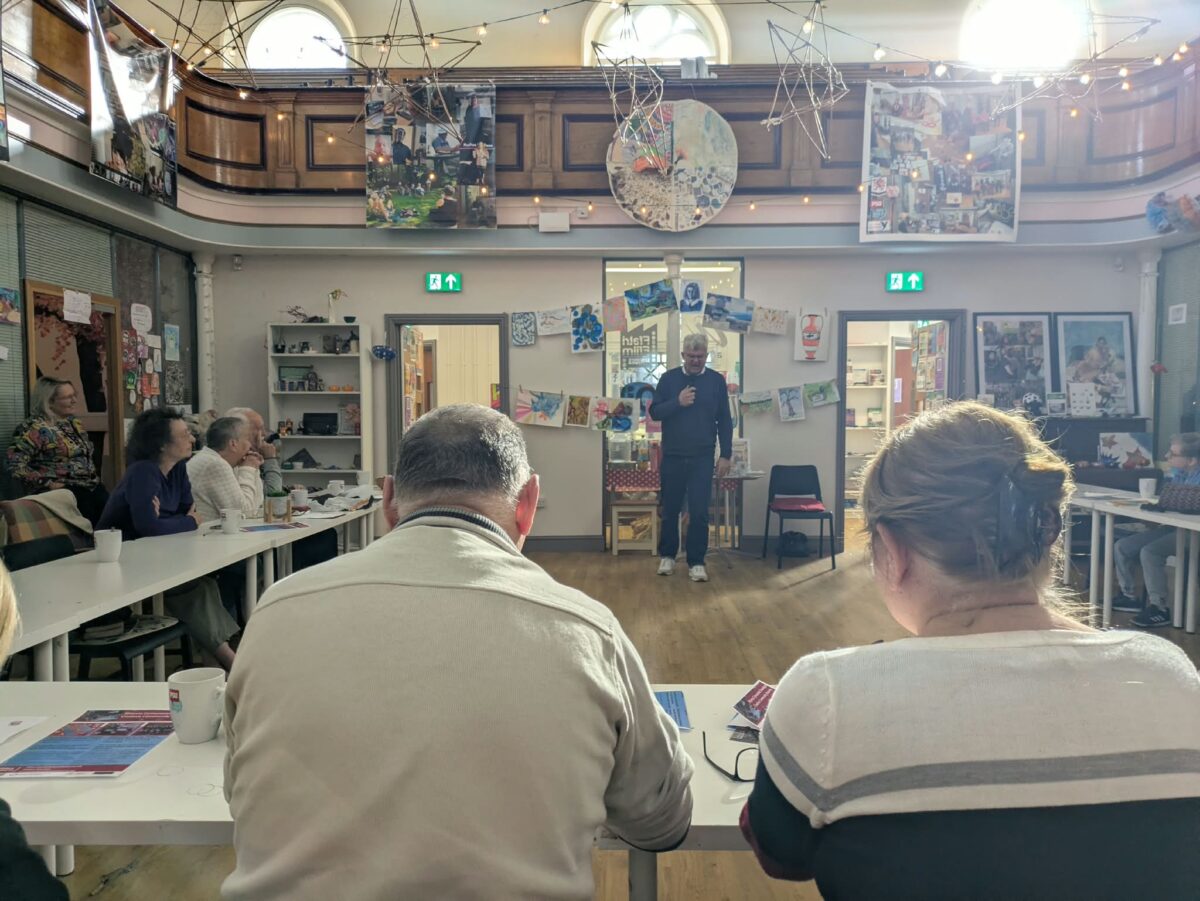
I remember the first time I was invited to the Arts, Health, and Wellbeing Hub at People Speak Up (PSU), on Park Street, Llanelli. It was around 2018, and I had been invited as a guest artist by the indefatigable Eleanor Shaw, the organisation’s founder and CEO. Over the years, Eleanor continued to welcome me back, and I have since participated in more than three of its flagship Spoken Word Saturday events.
You know that feeling when you walk into a place and immediately feel at home? Entering People Speak Up is like a mother opening her arms to embrace a child returning home after a long day. There is the comforting smell of coffee, followed by the invitation to step into the main space. Colourful paintings, drawings, and photographs adorn the walls, transporting you into a world where creativity and humanity coexist.
The atmosphere reminds me of the former National Poet of Wales, Gillian Clarke, and the way she has spoken about her childhood rug: how she would use it to cover herself and escape into a world of dreams.
For me, People Speak Up is that blanket of comfort: a place where people can come as they are, without fear of judgement, and simply be themselves. It is a space where people can feel safe enough to share their stories, discover their voices and begin to imagine new possibilities.
Many of Wales’s celebrated writers have graced the Llanelli hub. Some have left behind posters on the walls, reminders of the many voices that have passed through its doors and contributed to its growing impact. Yet the true legacy of People Speak Up is not measured by the names of those who have visited. It lives in the people who walk through its doors, sometimes carrying burdens they have struggled to articulate, and discover that there is room for their stories, too.
A New Chapter in My Journey
In the summer of 2026, while waiting for the Research and Degrees Committee to make a decision on my PhD thesis, I received an email from Eleanor about two vacancies at People Speak Up. I applied and was fortunate enough to secure one of the positions, working as a Project Coordinator alongside Suzanne Griffiths-Rees.
The opportunity came at just the right time. I had begun to wonder how I would fill my days while waiting for the outcome of my doctoral research. For five years, I had undertaken a self-funded PhD exploring Cameroonian history and literature through the experiences of three child protagonists, tracing a period from 1900 to 2016.
My research led me to fascinating historical connections between Wales and Cameroon. I became interested in Welsh missionaries who travelled to Cameroon, including Reverend W. Hughes, and the role they played in introducing Christianity, conducting baptisms, and giving European names to Cameroonians.
These encounters opened a window onto the complex relationship between religion, colonialism, identity, and cultural exchange. They also revealed how the histories of two places, separated by geography, could become intertwined through the movement of people, beliefs, and ideas.
I undertook my research at King’s College London under the supervision of Professor Ruth Padel and Dr Benjamin Wood.
After years of academic research, I found myself stepping into a different kind of work: one that brought me closer to people, their experiences and the stories that shape their lives.
Looking back, I realise that my journey to People Speak Up was not simply a matter of finding employment. It was another step in putting the pieces of my life back together.
The Power of Storytelling
In 2018, I published the first part of my autobiography, I, Eric Ngalle. It recounts some of the harrowing experiences I endured at the hands of members of my father’s family. It tells the story of some of the darkest moments of my life, including the time I stood outside my father’s house contemplating burning it down.
At that moment, I believe my ancestors intervened, and my life took an unexpected turn. I became a victim of human trafficking and was taken to Russia.
Since arriving in Wales, I have been working to rebuild my life, piece by piece. My experiences have taught me that survival is not simply about escaping the past; it is also about finding ways to make sense of it.
Writing became one of the ways I could confront my experiences. Telling my story allowed me to revisit painful memories, examine the forces that had shaped my life and begin to understand the person I was becoming.
Working at People Speak Up has deepened my understanding of the transformative power of storytelling. Stories allow us to confront difficult experiences, connect with others, and recognise that, however different our journeys may be, there are threads of humanity that bind us together.
One chapter of my autobiography recounts my encounter with the musical group Boney M in Stavropol, Russia. It is a remarkable episode in a life that has taken me across continents and through experiences I could never have imagined.
In September 2026, I was invited onto BBC Radio 4 to share my experiences of meeting Boney M with Maggie Ayre. The following week, I was contacted again, this time to appear on the flagship programme Saturday Live, alongside presenter Adrian Chiles, Alan Cumming, and Mel Giedroyc.
We spoke about my experiences in Russia, my journey to Wales and the completion of my PhD at King’s College London.
But beyond the memories and the conversation, something else struck me. My life had come full circle.
Here I was, sharing my story on national radio, reflecting on a journey that had brought me from Cameroon to Russia and eventually to Wales. And at the heart of that journey was an organisation I had come to know not only as a workplace but also as a community: People Speak Up.
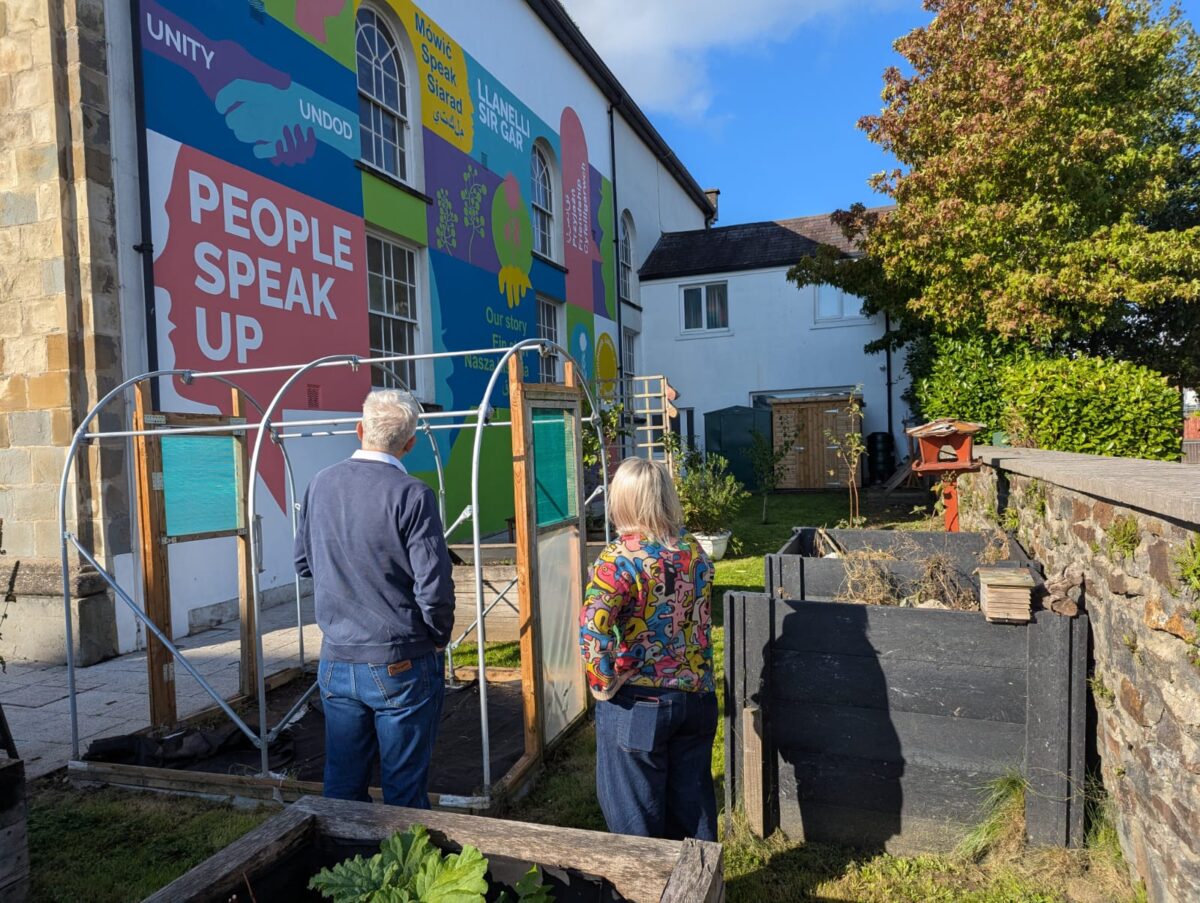
During the programme, I told Adrian about PSU and the work it does to create safe spaces where people can come together, express themselves and be heard. I spoke about an organisation that, in its simplicity, offers something profoundly transformative.
People Speak Up reminds us that when people are given the space, encouragement, and freedom to tell their stories, they can begin to blossom like seeds given the right conditions to grow.
This is a model that deserves to be replicated across the country and around the world.
Little did I know that my conversation with Adrian would lead to an encounter in Llanelli.
An Unexpected Visitor in Llanelli
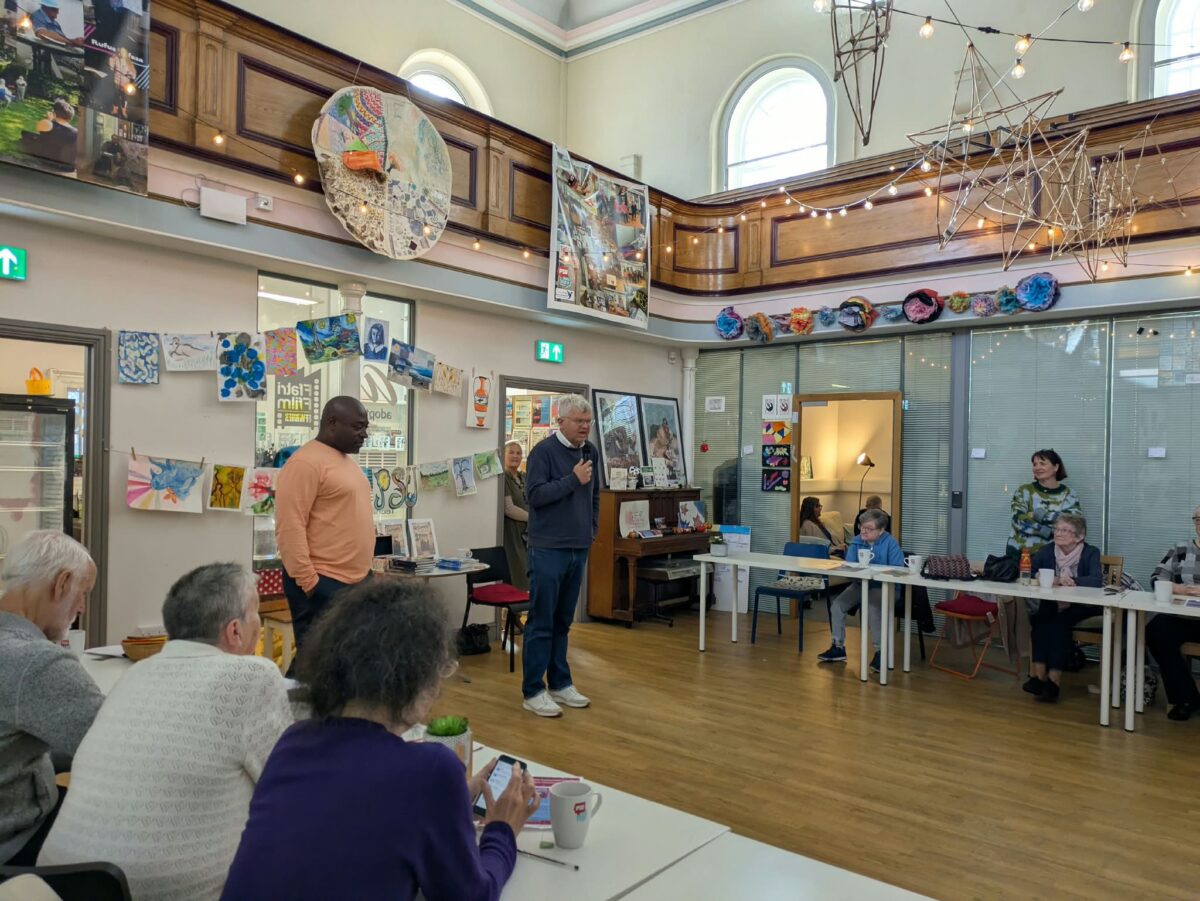
On Monday, 19 October 2026, the Llanelli hub was doing what it does best: bringing people together through creativity, conversation, and shared experience.
We had welcomed artist Elaine Jenkins, who was speaking to our over-fifties group about her latest book, Unbreakable. It was another opportunity for people to gather, listen, ask questions, and find inspiration in someone else’s story.
Then, at around 11.05 am, something unexpected happened.
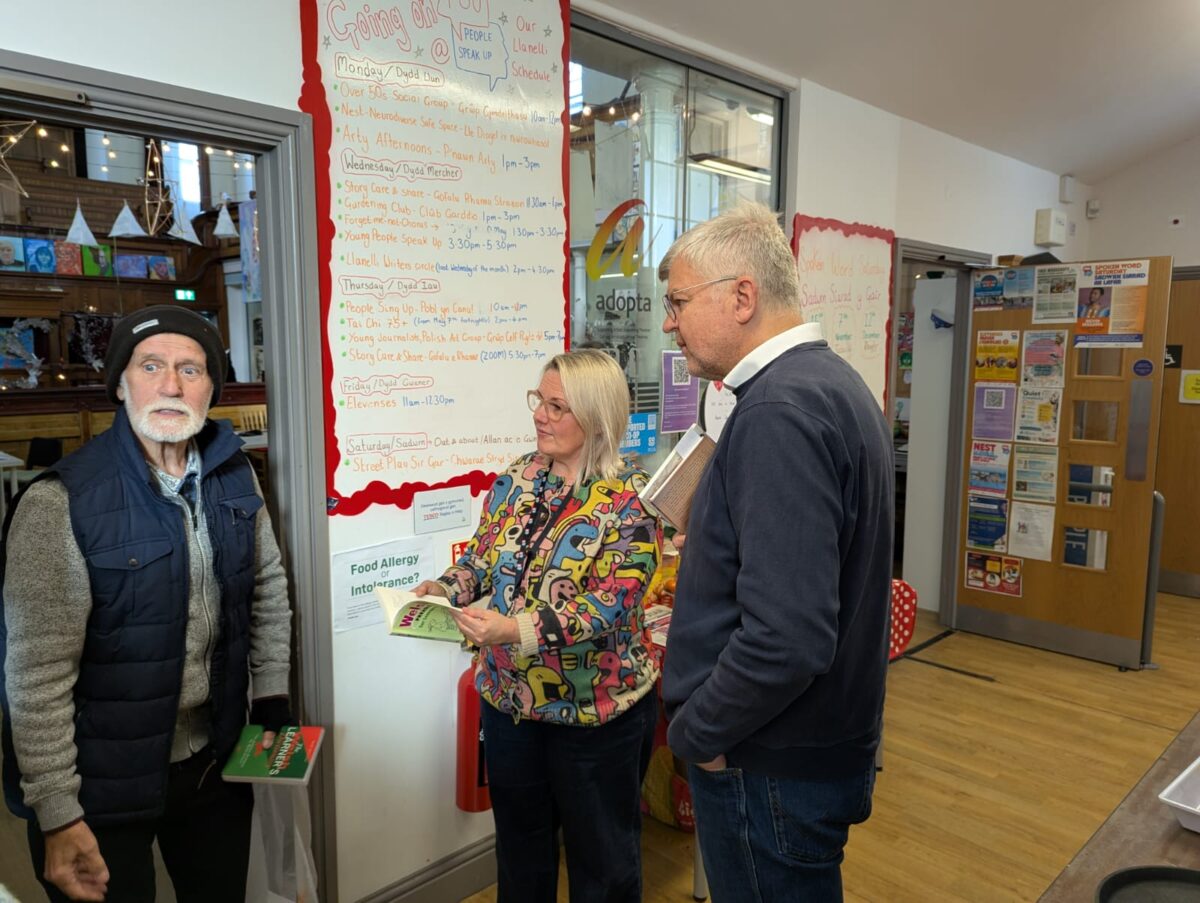
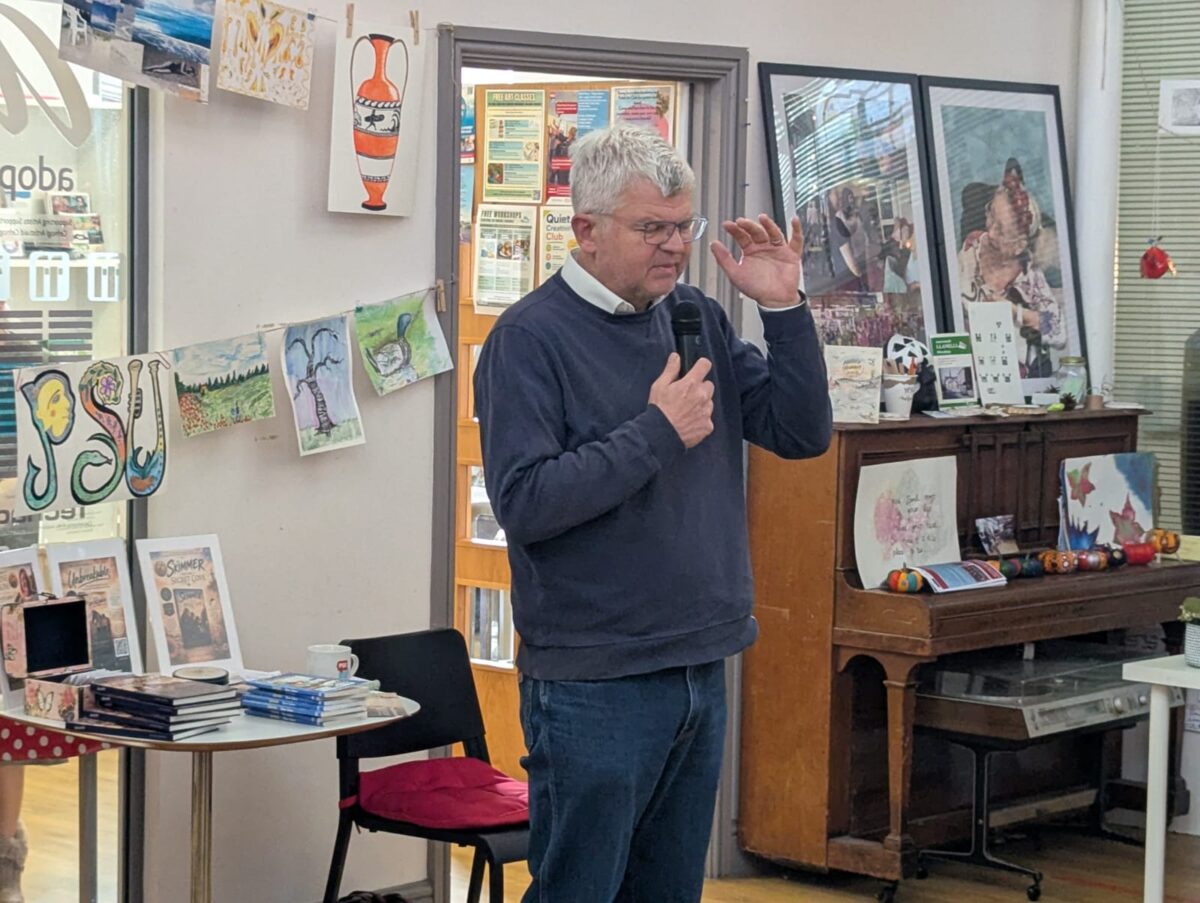
The one and only Adrian Chiles walked through the doors of our Llanelli hub on a surprise visit.
And suddenly, the question practically asked itself:
What is Adrian Chiles doing at PSU, Llanelli?
For me, the answer was both simple and profound.
He was visiting a place I had told him about on national radio: a place that has played a significant role in my own journey and continues to make a difference in the lives of others.
There was something particularly moving about seeing Adrian in this setting. Only a few weeks earlier, we had been speaking on a national platform about my life and experiences. Now, he was standing inside the very community space I had described to him. The worlds of broadcasting and community storytelling had unexpectedly converged. But this was not simply a celebrity dropping in for a photograph or a brief look around. Adrian took the time to engage with the people who make PSU what it is.
He shared something of his own family background, telling the group about his Croatian heritage and his mother’s origins. His willingness to speak about his own story helped create a sense of openness, reminding us that behind every public personality is a person with a family, a history and experiences that have helped shape who they are.
The group had plenty of questions for him, and he answered them with humility and good humour. There was no sense of distance between the familiar voice and face from the radio and television programmes and the people gathered around him. He listened, responded thoughtfully, and met people’s curiosity with warmth and modesty.
It was a lovely reminder that storytelling is not a one-way exchange. It is not only about one person standing before an audience and sharing their experiences. It is also about listening, asking questions, discovering common ground, and allowing ourselves to be surprised by what we learn about one another.
Adrian’s visit embodied that spirit.
He had come to see for himself the place I had spoken about on Saturday Live, but he also became part of the conversation that defines our work at People Speak Up.
And there was more.
Adrian expressed his willingness to return as a guest at our Wednesday Story Care and Share session, where people come together to talk, listen and share their experiences in a welcoming environment.
The thought of welcoming him back to sit with the group and take part in those conversations was particularly exciting. Story Care and Share is not about performance or celebrity. It is about making room for people to be heard, often in ways that everyday life does not always allow.
Having someone whose professional life has involved speaking to audiences across the country join such a session would offer another opportunity to explore the simple but powerful act of sharing our stories. It would also reinforce something I have come to believe deeply: storytelling belongs to everyone. You do not need to be a published author, a broadcaster, or a celebrated artist to have a story worth telling. You need only to be human.
Where Every Story Matters
Adrian’s visit brought together two seemingly different worlds: the national broadcasting stage, where stories are shared with audiences across the country, and a community hub in Llanelli, where stories are nurtured every day through conversations, creative workshops, shared laughter, and moments of quiet understanding.
At People Speak Up, storytelling is not reserved for celebrated writers, broadcasters, or artists. Everyone has a story. Everyone deserves to be heard. And everyone should have somewhere they can go without feeling the need to pretend to be someone else.
That is what makes People Speak Up special.
It is not simply about the people who visit, the events it hosts, or the artwork displayed on its walls. It is about the lives touched, the confidence restored and the sense of belonging created. For someone like me, whose life has been shaped by displacement, trauma, survival and the home search, this work resonates deeply.
I know what it means to carry stories that are difficult to tell. I know what it means to feel displaced, to struggle to understand where you belong and to search for a place where you can begin again.
I also know the importance of being allowed to speak and, just as importantly, to be heard.
When I first walked through the doors of People Speak Up in 2018, I came as a guest artist. In 2026, I returned as a Project Coordinator. Later that year, I found myself speaking about the organisation on BBC Radio 4, explaining to Adrian Chiles why places like PSU matter.
And now, here was Adrian himself, standing inside the very space I had described to him.
Life has a way of bringing us full circle.
Perhaps that is the real answer to the question: what is Adrian Chiles doing at People Speak Up, Llanelli?
He was discovering first-hand the power of a place where people are welcomed, stories are valued, and lives can begin to change. He was meeting the people behind the work, listening to their questions, sharing something of his own background, and discovering a community in which no one needs to be famous to matter.
For me, his visit was also a reminder that we never really know where our stories will take us. A conversation on the radio can lead to a visit to a community centre. A painful memory, once written down, can become a bridge between strangers. A place that once welcomed you as a guest can become somewhere you help others feel at home.
For all these reasons, People Speak Up will always be more than a workplace or a community arts, health and well-being hub to me. It is that childhood blanket Gillian Clarke reminds us of a place of comfort, imagination, and refuge.
It is a place where people can come in from the cold, take a breath, share their stories and, in time, find the courage to spread their wings. And sometimes, when the stories we tell travel far enough, they bring unexpected visitors through our doors.
Dr Eric Ngalle Charles is a Cameroonian-born writer, poet, playwright, and human rights activist based in Wales. Holding a PhD in Creative Writing from King’s College London, his work explores colonialism, postcolonial literature, migration, identity, and belonging. He is the author of I, Eric Ngalle: One Man’s Journey Crossing Continents from Africa to Europe (2019) and works as a Project Coordinator for People Speak Up in Llanelli, contributing to Wales’s literary and community arts landscape.
Support our Nation today
For the price of a cup of coffee a month you can help us create an independent, not-for-profit, national news service for the people of Wales, by the people of Wales.
Get more trusted Welsh news
Choose Nation.Cymru as a preferred source in Google News to see more of our journalism.


