


What new data tells us about Welsh prisoners
Mark Mansfield
New analysis by Senedd Research has provided one of the clearest pictures yet of who from Wales is behind bars, where they are being held and the offences that put them there.
The research, by Sarah Hatherley of Senedd Research, examines newly published Welsh-specific justice data and highlights a particularly striking finding: people from Wales appear more likely to be imprisoned than those from England.
Almost 4,900 people recorded as living in Wales before entering custody were in prisons across England and Wales at the end of June.
That is equivalent to around 154 prisoners for every 100,000 people in Wales, compared with an estimated 138 per 100,000 for England.
But the figures raise a question they cannot themselves answer: why?
For decades Wales and England have shared a criminal justice system, with prisons and sentencing controlled from Westminster while many of the services that can prevent offending or help people rebuild their lives – including health, housing and social care – are devolved.
The new Welsh-specific data published by His Majesty’s Prisons and Probation Service, and examined by Hatherley, is beginning to reveal what that arrangement looks like in practice.
It shows who from Wales is behind bars, the offences for which they are being held and where they are serving their sentences.
And it highlights some striking differences – including hundreds of Welsh prisoners being held in England while one of Wales’ largest prisons holds considerably more people from England than from Wales.
The figures use a person’s address before entering custody rather than their nationality, birthplace or identity.
The number of prisoners with a Welsh-origin address has remained relatively stable over the period covered by the latest data.
There were 4,901 in September 2025, rising to a peak of 5,045 in March before falling to 4,887 by June 30.
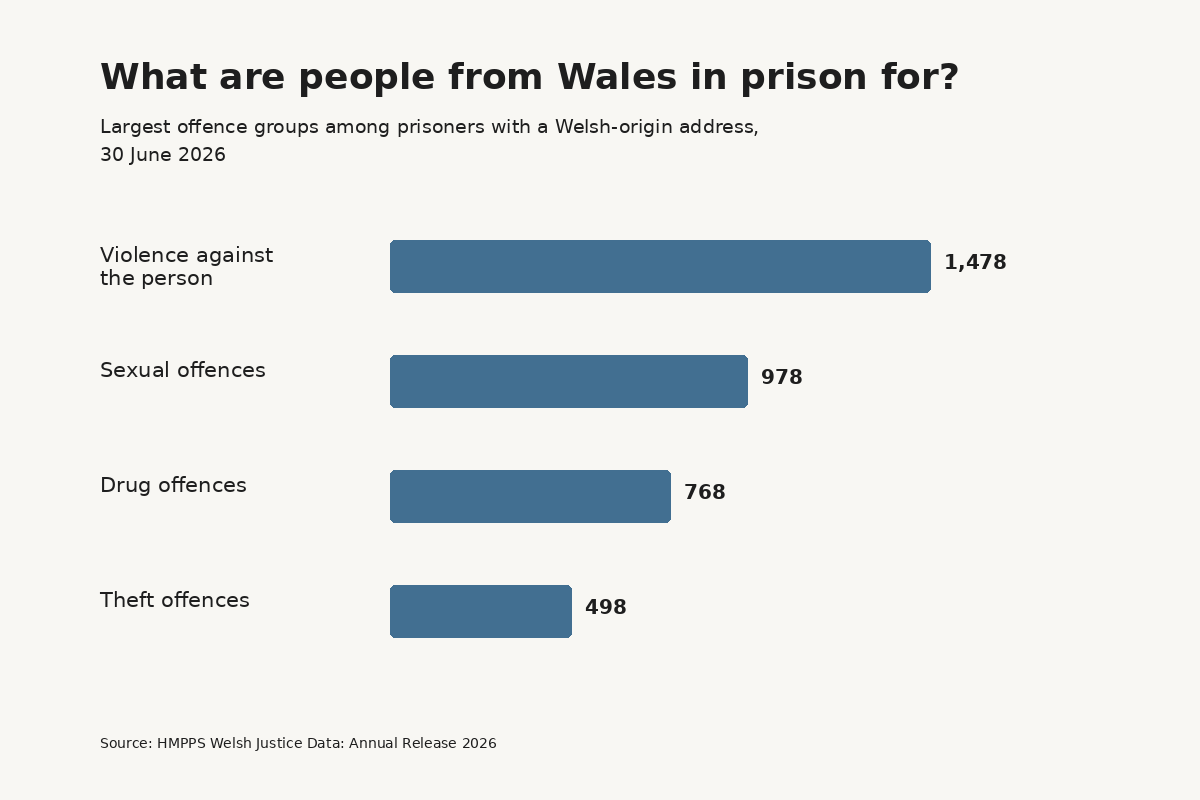
Violence against the person accounted for the largest group, with 1,478 prisoners – around three in every 10.
A further 978, or around one in five, were being held for sexual offences.
Drug offences accounted for 768 prisoners, while another 498 were held for theft offences.
The overall pattern is broadly similar to that among prisoners from England, although there are differences.
Welsh-origin prisoners have a lower proportion of people held for violence, robbery and possession of weapons, but higher proportions for drug and theft offences.
That could have implications for Welsh policy in areas such as substance misuse treatment and efforts to tackle the underlying causes of acquisitive crime.
Is Wales more dangerous?
The higher imprisonment rate doesn’t necessarily mean Wales has a higher crime rate.
Using a population of around 3.18 million, the 4,887 Welsh-origin prisoners equate to approximately 154 people per 100,000.
Removing them from the overall England and Wales prison population gives an estimated rate for England of around 138 per 100,000.
The difference isn’t new.
The House of Commons Welsh Affairs Committee concluded earlier this year that the imprisonment rate in Wales has “consistently been shown” to be higher than in England.
It recommended that the Ministry of Justice and Welsh Government jointly investigate why.
But imprisonment is affected by much more than the number of crimes committed.
Sentencing decisions, the number of people held on remand, recalls to prison and the availability of community alternatives can all affect how many people end up behind bars.
That means the figures establish that Wales has a higher imprisonment rate, but not what is causing it.
Where are Welsh prisoners held?
The data also provides a revealing picture of where people from Wales serve their sentences.
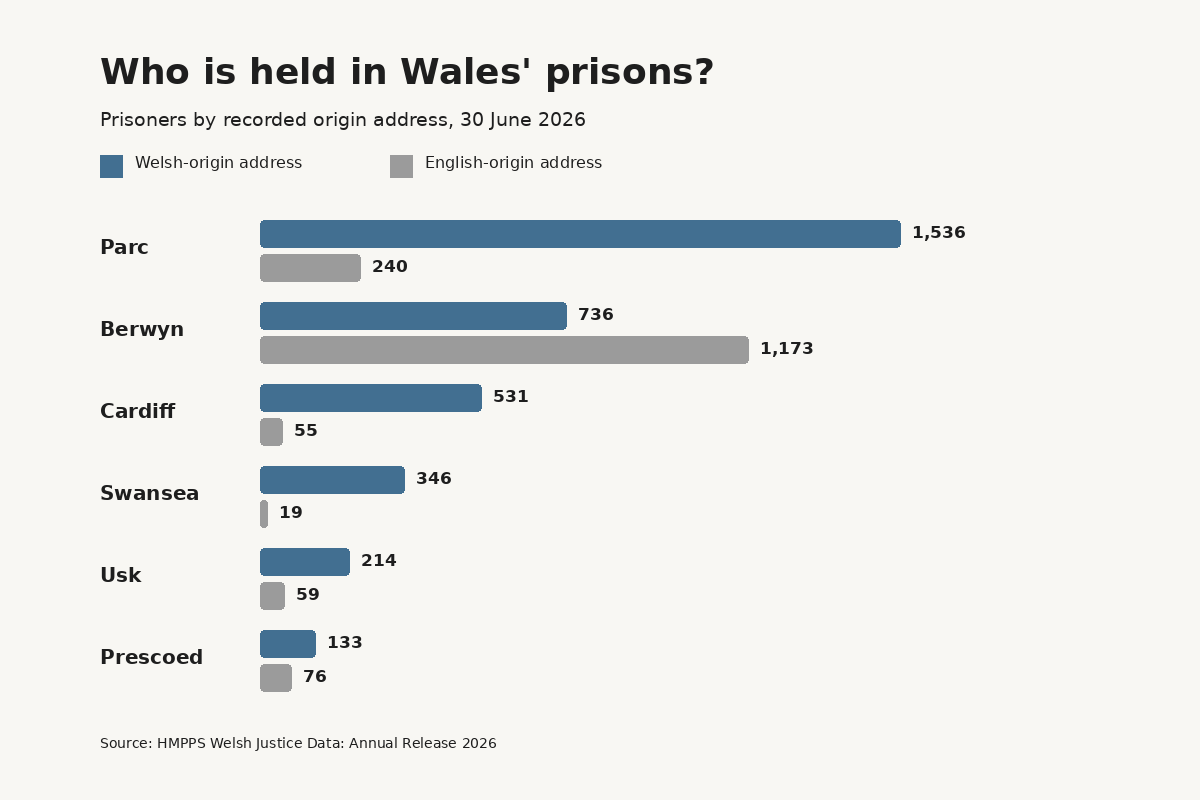
At the end of June, HMP/YOI Parc held 1,536 prisoners with Welsh-origin addresses – by far the largest number at any institution.
Cardiff held 531, Swansea 346, Usk 214 and Prescoed 133.
But Berwyn presents a very different picture.
The north Wales prison held 736 Welsh-origin prisoners and 1,173 prisoners from England.
Across prisons in Wales, there were at least 3,496 Welsh-origin prisoners and 1,622 with English-origin addresses.
The shared prison estate also means significant numbers of people from Wales are serving sentences across the border.
That can have consequences beyond simply being further from home.
Distance can make visits and maintaining family relationships more difficult and can complicate access to Welsh-language provision and links with health, housing and social care services that prisoners may depend on when they return home.
For one group, imprisonment outside Wales isn’t merely a possibility.
No women’s prison in Wales
Of the 4,887 Welsh-origin prisoners recorded in June, 222 were women.
There is no women’s prison in Wales, meaning every one of them must be held in England.
HMP Eastwood Park, near Bristol, was the main destination for Welsh women in the latest figures.
The geographical divide has long prompted concerns about maintaining family relationships and ensuring women can access Welsh services while in custody and when preparing for release.
The Welsh-origin prison population is overwhelmingly male and heavily concentrated among people in middle age.
There were 1,682 prisoners aged between 30 and 39 and another 1,123 aged 40 to 49.
But there is also a sizeable older population, with 940 prisoners aged 50 or above – bringing different demands for healthcare, disability support and social care.
Around 89% of Welsh-origin prisoners were recorded as White.
What happens when prisoners come home?
Perhaps the biggest challenge exposed by the figures is what happens beyond the prison gates.
Justice itself isn’t devolved, but many of the services prisoners need before and after their release are.
Someone can be sentenced under an England-and-Wales justice system, imprisoned hundreds of miles from their Welsh home, and eventually return to a community where their healthcare, housing, social care and substance misuse support are largely the responsibility of Welsh institutions.
The latest figures also show that people serving sentences of four years or longer make up the largest sentence group, while recalls to prison remain significant.
That puts greater emphasis on what happens during sentences and after release – from education and mental health treatment to finding somewhere to live and securing employment.
Without those services working together, release from prison can be followed by a return to the circumstances that contributed to offending in the first place.
The location of prisoners matters for another reason.
Evidence presented to MPs investigating prisons in Wales has raised concerns over deaths, self-harm, assaults and drugs, particularly at Parc.
The Welsh Affairs Committee has also warned that overcrowding and workforce pressures are undermining safety and rehabilitation.
Justice statistics
Campaigners, academics and politicians have long argued that Wales needs its own detailed justice statistics if the consequences of sharing a criminal justice system with England are to be properly understood.
This is only the second annual release of Welsh-specific justice data from HMPPS.
It doesn’t establish why Wales imprisons a greater proportion of its population than England.
Nor does it tell policymakers whether the explanation lies in patterns of offending, sentencing, poverty and deprivation, substance misuse, the use of alternatives to custody or a combination of those factors.
What it does provide is a much clearer picture of the people behind the headline prison population.
Nearly 5,000 people who were living in Wales are behind bars. Around half are imprisoned for violent or sexual offences, hundreds are held for drug and theft offences, all Welsh-origin female prisoners are incarcerated outside Wales, and significant numbers of Welsh men are also serving sentences across the border.
At the same time, Wales accommodates more than 1,600 prisoners from England.
The unanswered question is why Wales continues to have a higher imprisonment rate in the first place.
And with MPs already calling for the UK and Welsh governments to investigate, the new figures provide considerably more evidence with which to start looking for an answer.
Support our Nation today
For the price of a cup of coffee a month you can help us create an independent, not-for-profit, national news service for the people of Wales, by the people of Wales.
Get more trusted Welsh news
Choose Nation.Cymru as a preferred source in Google News to see more of our journalism.



Transferring remand or convicted prisoners across the border is a violation of their human rights. No prisoners should be transported across the border unless part of a serve your sentence in your home country scheme.. Clearly something is wrong with the Welsh justice system and it must be devolved now.
How about the victims human rights when they are raped attacked or robbed
Human rights are just that and while you may not like it, a prisoner’s fundmental human rights are as important as anyone else’s human rights.
Besides which, acknowledging a prisoner’s human rights does not logically mean that the human rights of survivors of crime are any less important.
These figures only highlight the effects of social injustice in Wales and of a criminal justice system made in England, for England, a system that is clearly not working for Wales. Our justice system and policing should be devolved, as they are in Scotland and Northern Ireland, so we can tailor both to Welsh needs, not to what others think we need. Figures show that a higher percentage of those incarcerated are from Wales than England. This is an ongoing failure by successive Tory & Labour UK Government policies. I wonder if Reform UK will abolish the Home Office and… Read more »