


What the latest polls tell us about Wales’ shifting political landscape

Mark Mansfield
The latest polling in Wales shows Plaid Cymru maintaining a clear lead, but some significant movement is taking place beneath the headline figures.
Labour has recovered sharply in Westminster voting intention while Reform UK has fallen seven points since May.
But there has been far less movement when voters are asked how they would vote in a Senedd election, where Reform remains much closer to Plaid and Labour’s recovery is considerably more modest.
The figures also reveal significant differences in the choices some voters are making depending on whether they are being asked about Westminster or the Senedd.
And the timing of the poll is important. Fieldwork was completed before the turmoil which engulfed Reform’s Welsh operation this week.
The latest YouGov/Barn Cymru poll for ITV Cymru Wales puts Plaid on 32% in Senedd voting intention, followed by Reform on 27%.
Labour is on 13%, the Conservatives 11%, the Greens 7% and Liberal Democrats 5%.
Those figures are remarkably close to the result of May’s Senedd election, when Plaid won 35.4% of the vote and 43 seats, while Reform took 29.3% and 34 seats.
But ask Welsh voters how they would vote in a Westminster election and the figures look considerably different.
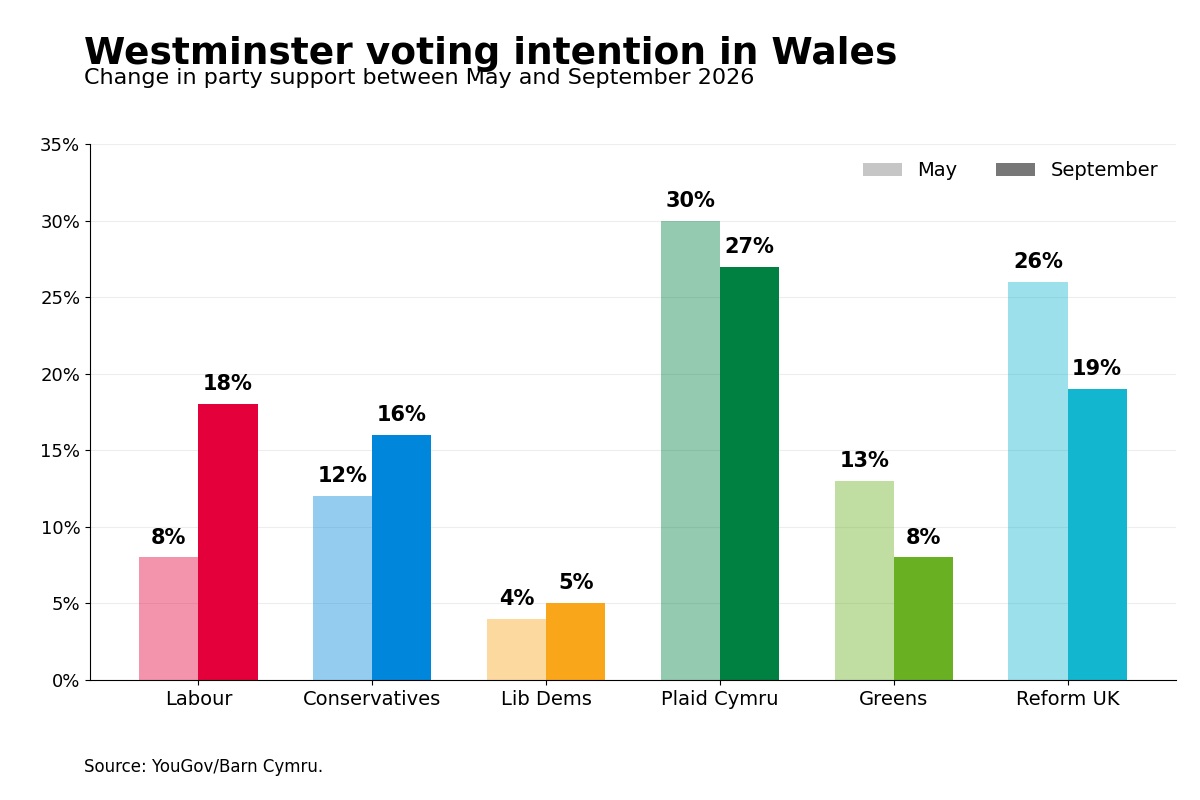
Plaid remains in first place on 27%, but Reform has fallen to 19%, just one point ahead of Labour on 18%.
The Conservatives are on 16%, the Greens 8% and Liberal Democrats 5%.
Plaid’s Westminster figure is particularly notable when compared with its performance at previous general elections.
The party won 11.3% of the Welsh vote in 2010, 12.1% in 2015, 10.4% in 2017 and 9.9% in 2019, before climbing to a record 14.8% in 2024.
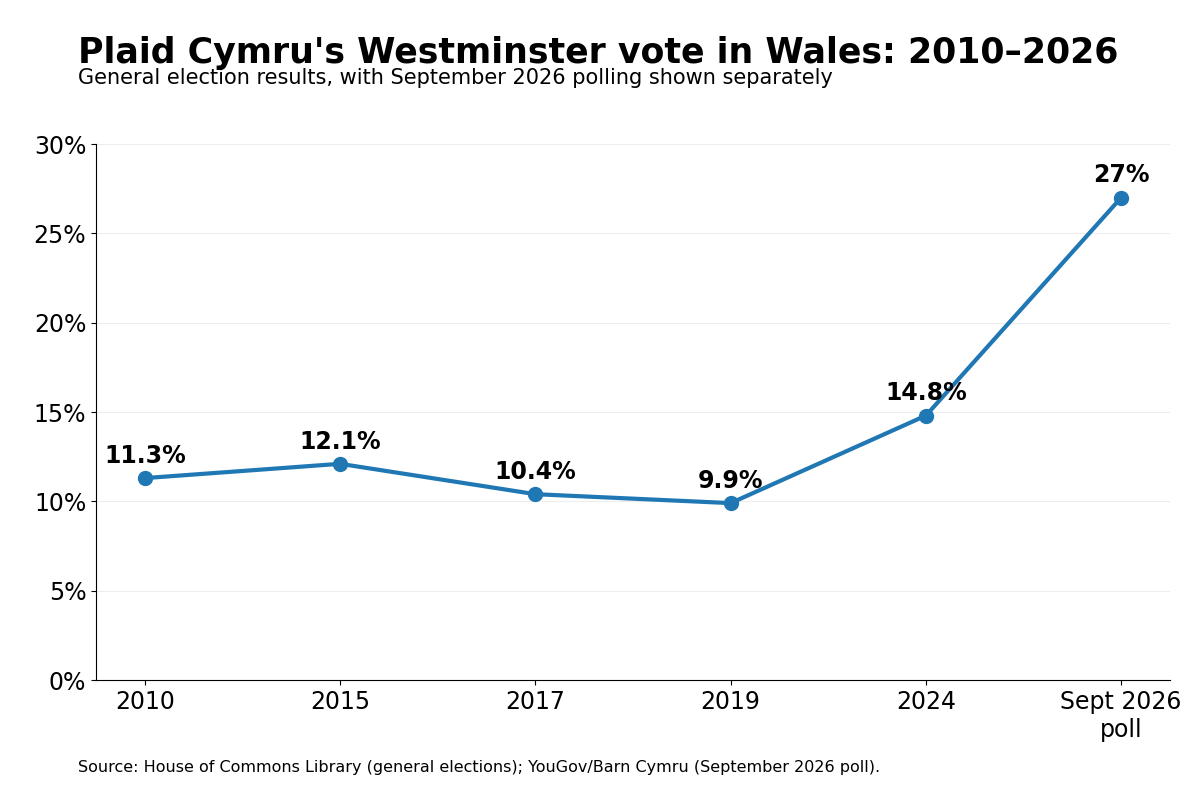
Its current 27% Westminster rating is almost twice the share it achieved at the last general election and only five points below its current Senedd polling.
While polling cannot be directly compared with an election result, the figure underlines how much Plaid’s Westminster support has grown from its historical levels.
Compared with YouGov’s previous Westminster poll in May, Labour has risen 10 points from 8%, while Reform has fallen seven from 26%.
The Conservatives have gained four points, Plaid has fallen three and the Greens are down five.
It is the movement between the two largest UK-wide parties in Wales – Labour and Reform – which represents one of the most striking changes since the Senedd election.
Burnham bounce
Labour’s recovery coincides with Andy Burnham replacing Keir Starmer as Prime Minister, and the new PM received encouraging personal ratings in the poll.
Some 45% of those questioned said Mr Burnham was doing a good job.
But there is little evidence so far that the improvement in Labour’s fortunes at Westminster is being replicated at Senedd level.
Labour’s 13% Senedd rating is only slightly higher than the 11.1% it secured in May’s election.
Dr Jac Larner, of Cardiff University’s Wales Governance Centre, made that distinction when the initial poll results were published last week.
He said: “The more striking movement is in Westminster voting intention. Reform UK has lost over a quarter of its support at Westminster level, while Labour’s has more than doubled – though this isn’t a direct swap between the two.”
Dr Larner added: “Labour will take heart from generally positive views of Andy Burnham, likely fuelling their Westminster gains, but the party’s Senedd group may be less pleased: that boost shows little sign of transferring to devolved-level support during what should be a honeymoon period for the new Prime Minister.”
The detailed figures also show where some of that movement is taking place.
Where Labour’s voters went
Despite its recovery, Labour is still retaining only 35% of the people in Wales who voted for the party at the 2024 general election.
That is an improvement on the 24% it was retaining in YouGov’s previous poll, but it illustrates the scale of the electoral coalition Labour lost following its landslide UK victory two years ago.
Almost a quarter – 24% – of its 2024 Welsh voters now say they would vote Plaid at the next general election.
Another 8% would vote Reform and 7% Conservative, while 12% are undecided.
But Labour is now attracting support from elsewhere too.
Among people who voted Plaid in May’s Senedd election, 15% say they would vote Labour in a Westminster election.
Only 59% of Plaid’s May voters currently say they would also support the party at Westminster, while 9% are undecided.
That does not necessarily represent a loss of support for Plaid in Welsh politics.
Its Senedd polling remains considerably stronger.
The figures instead suggest a section of the electorate which backed Plaid to govern Wales is currently prepared to make a different choice when asked who should represent it at Westminster.
Reform loses ground
Reform emerged from May’s election as the second-largest party in the Senedd after securing almost three in 10 votes.
Its Senedd support has proved relatively resilient since then.
The latest poll puts the party on 27%, just two points below the 29% it recorded in YouGov’s May poll and close to its eventual election result.
Among those who voted Reform in May, 78% say they would do so again in another Senedd election – a higher retention rate than Plaid, Labour or the Conservatives.
At Westminster, however, Reform’s support has fallen from 26% in May to 19%, leaving it virtually level with Labour and well behind Plaid.
The voter movements show that the seven-point fall has not simply transferred to Labour.
Among Reform’s May Senedd voters, 66% say they would vote for the party at Westminster. Nine per cent would vote Conservative and 10% would choose another party, with YouGov suggesting Restore Britain is likely to account for much of the latter group.
Among those who voted Reform at the 2024 general election, 72% still intend to support Nigel Farage’s party at the next Westminster election – the highest retention rate of any of the major parties.
That suggests Reform retains a substantial core vote even as its overall Westminster support has fallen.
Reform’s turbulent week
YouGov carried out the Westminster polling between September 7 and 14.
It therefore predates the events which subsequently threw Reform’s Welsh operation into turmoil.
On September 15, Dan Thomas stood down as Reform’s Welsh leader after being arrested on suspicion of assault and engaging in controlling or coercive behaviour.
Mr Thomas was bailed pending further enquiries and has stressed that he has done nothing wrong. He remains a Reform MS.
The same day, Sarah Cooper-Lesadd, who had been elected for Reform just four months earlier, defected to Plaid Cymru, reducing Reform’s Senedd group from 34 to 33 and increasing Plaid’s to 44.
Reform’s chief whip Llŷr Powell has rejected suggestions that the party is in crisis, while the process of choosing Mr Thomas’s successor has begun.
The timing means Reform’s seven-point decline in Westminster voting intention had already taken place before either Mr Thomas’s departure as leader or Ms Cooper-Lesadd’s defection.
There is not yet polling evidence to show what, if any, effect those events have subsequently had on Reform’s support.
Two different political contests
Senedd voting intention cannot simply be read across to Westminster – or vice versa.
Reform receives eight points more support when people are asked about a Senedd election than when they are asked about Westminster.
For Plaid, the difference is five points in favour of the Senedd.
Labour moves five points in the opposite direction, from 13% for the Senedd to 18% for Westminster, while the Conservatives also rise five points, from 11% to 16%.
There are caveats to making a direct comparison. The Westminster survey covers adults aged 18 and over, while the Senedd survey includes those aged 16 and 17, and YouGov’s headline voting intention figures are produced using MRP modelling.
The Westminster poll surveyed 1,102 adults, while the Senedd survey had a sample of 1,114. Both were conducted between September 7 and 14.
Four months after an election which transformed the Senedd, Plaid remains clearly ahead and has so far largely retained the support which brought it to government.
Reform also continues to command substantial support at Senedd level, although its Westminster support has fallen sharply since May.
Labour has begun recovering some of the ground it lost in Wales, but so far that improvement is much more apparent in Westminster voting intention than it is for the Senedd.
And the differences between the two sets of figures suggest an increasingly important feature of Welsh politics: a significant number of voters are prepared to make different choices at Westminster and Senedd elections.
Support our Nation today
For the price of a cup of coffee a month you can help us create an independent, not-for-profit, national news service for the people of Wales, by the people of Wales.
Get more trusted Welsh news
Choose Nation.Cymru as a preferred source in Google News to see more of our journalism.



Reform will be going all out for the local elections,
The financial resources allocated to back an intensive campaign.
.A saturation bombing campaign awaits similar to their very first by -election won by Refom in the local council in Trevethin.Torfaen
Spearheaded by the indefategable. Cllr Thomas who bussed supporters in
The residents hadn’t seen anything like it before.
The local elections are a real opportunity for the other parties to stress the local connection rather than Farge lickspittles
One thing for sure.
I’;s going to be dirty.
Those figures do show a very real hatred for Wales from some.