


‘When Irish eyes are rolling …’ – notes from an unusual election
Lila Haines
Two days in October: two elections, both unusual, both possibly game changing.
The Caerffili by-election on 23 October – with eight men slogging it out for a six-month stint as Member of the Senedd for Caerffili – may be a critical bellwether for the direction of democracy in Wales and beyond.
And on 24 October in Ireland two women vie for a seven-year term as Uachtarán na hÉireann, the 10th President of the Republic of Ireland – a Head of State role more akin to that of King Charles than the Trumpian concept of presidency.
Choosing a president is not what makes this election unusual – that’s a seven–yearly constitutional requirement – but aspects of the process have had Irish eyes rolling in disbelief.
The outcome may be a wake up call to parties across the political spectrum, those backing leftist frontrunner Catherine Connolly as well as the historic parties currently in coalition government – who should all analyse how Team Connolly made hugely effective use of online campaigning.
Trump’s candidate
The eye rolling, groans and head scratching (and some cheering) started back in the spring, when independents began announcing that they fancied filling the vacancy that comes with a lovely big house – Áras an Uachtaráin – in the Phoenix Park.
One of the first to throw his hat into the ring was Donald Trump’s anointed candidate, Conor McGregor, a MMA (mixed martial arts) fighter and convicted rapist.
In a calculated provocation, Trump invited McGregor to the White House on St Patrick’s Day (17 March), the day on which by long tradition the Taoiseach, as Ireland’s head of government, has been the US President’s guest.
McGregor later pulled out – perhaps because he and his US friends eventually read the correct constitution (1937 not 1922) and discovered the limits of Irish presidential powers.
Various other independents caused a flurry of media excitement over the months but none made the final cut.
With just weeks to go to close of nominations, as various independents dashed from one County Council to another seeking nominations, Maria Steen – an articulate, highly educated, conservative Catholic – tried to join the race for a place on the ballot paper.
Steen would likely have brought a different vibe to the campaign, as well as offering an option to a significant, if diminishing, segment of Irish society. But she started too late and failed to attract sufficient backers, even though some TDs and Senators who did not intend to vote for her offered to sign her papers in the interests of democratic choice.
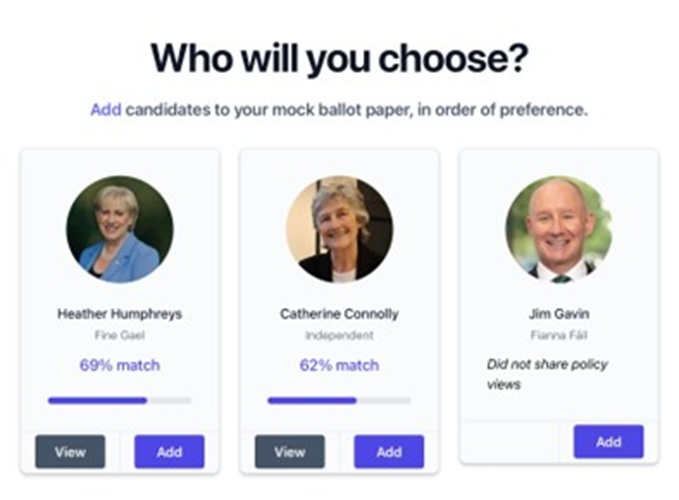
And so, when nominations closed, there were only three names on the ballot paper – Catherine Connelly, Heather Humphreys and Jim Gavin.
Why so few candidates?
Bunreacht na Éireann, dear reader!
Section 12 of the Constitution clearly sets out how to gain a place in the race: basically, be an Irish citizen aged at least 35, and gain the backing of at least 20 members of the Oireachtas (Dáil and Seanad) or four County or City Councils.
The larger parties have the obvious advantage of sufficient TDs or Senators to nominate a candidate, which Fianna Fáil and Fine Gael duly did, though fate had surprises in store.
Sinn Féin deferred a decision until near the deadline, then announced they would back Catherine Connelly – presumably believing she will test presidential powers to the limit and possibly beyond, and presumably after prolonged discussions with her/her team.
Fianna Fáil’s choice
Taoiseach and Fianna Fáil leader Micheál Martin championed Jim Gavin, a political neophyte, as his party’s candidate, perhaps partly because the former Irish defence forces pilot and successful Gaelic football manager seemed to have no political baggage that could derail the campaign.
But something else did: Mr Gavin’s failure to repay €3,300 in rent (less than £3,000) accidentally paid by a former tenant 16 years earlier.
That’s an amount an average voter can relate to; it also revived memories of political corruption during the Celtic Tiger boom years – and sparked a frenzy that led to Gavin withdrawing from the contest.
Madame President
In all that’s been written, broadcast or shouted about this presidential campaign there’s been barely a mention of one historic fact: that, for the first time, it’s a choice between two women, Catherine Connelly and Heather Humphreys.
Yes, there is a man’s name on the ballot paper, because Jim Gavin withdrew after nominations had closed – and some punters are wondering how many electors will vote for him anyway.
A Presbyterian President?
If elected Heather Humphreys would be the first Presbyterian to hold the office, but not the first Protestant – that was the first president, Gaelic scholar Dubhghlas de hÍde/Douglas Hyde – nor the second: Erskine Hamilton Childers.
Ms Humphreys was persuaded to run as Fine Gael’s presidential candidate when Mairéad McGuinness, a former European Commissioner, pulled out for health reasons.
She held several ministerial positions between 2014 and 2025, served as deputy leader of Fine Gael, and led the 2016 Easter Rising centenary celebrations.
In a contest that otherwise suffered from a paucity of policy ideas, she had one seriously interesting proposal that failed to gain traction: to use her own Presbyterian and Ulster background to build bridges across divides in Northern Ireland, reaching out to unionists as Presidents Mary Robinson and Mary McAleese had done between 1990 and 2011.
Ms Humphreys was not well served by her campaign tacticians, who marketed her as relatable and reliable, but in reality shunted her down a safe but boring cul-de-sac, before going on to use attack points against Ms Connelly that may have rebounded against their own candidate.
Frontrunner
Catherine Connelly, an independent TD for Galway West, started early, made the running, dodged questions about dubious connections at home and abroad, and about working as a barrister for banks repossessing homes while condemning the same banks as a politician.
Marketed as the natural successor to President Michael D Higgins, Connolly has little in common with him intellectually or personality-wise – they were both Labour activists once, but Connelly left the party after failing to get selected as Higgins’ running mate for the 2007 general election.
She then contested several elections as an independent, finally becoming a TD in 2016, and was re-elected on the 11th count in 2024.
Modern neutrality
She has expressed views out of synch with majority Irish opinion to date, views that can be interpreted as anti-EU and pro-Russian, for example.
Her understanding of neutrality is ‘interesting’, seeing nothing wrong with letting China, Russia or the USA have a veto (via the UN Security Council) on Irish decisions about deploying peacekeeping troops – while vociferously championing a narrow neutrality that takes little account of a fast-changing world.
And yet she looked likely to romp home barring a truly major last minute upset.
The Connelly crusade
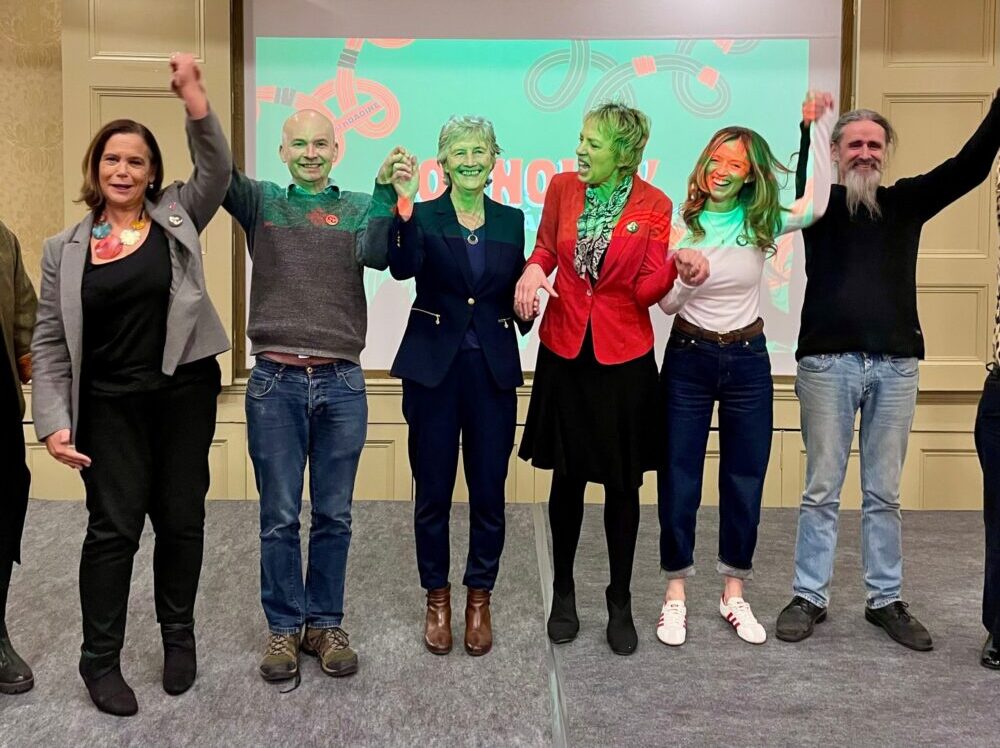
Ms Connelly has the support of Sinn Féin, Labour, the Social Democrats, the Green Party, People Before Profit-Solidarity and some other independent TDs. Some of the smaller parties have suffered resignations and internal strife because of supporting her.
Speculation continues about how and why Sinn Féin decided to back her rather than standing their own candidate, but it was likely a case of ‘realpolitik’ – recognising that a Sinn Féin candidate was unlikely to win but that Connelly could help them advance their prime policy of Irish reunification.
Weaponising the Irish language
As well as recruiting an army of canvassers from left-leaning small parties Connelly and her team targeted specific demographics and minorities.
A novel move was to weaponise the Irish language, insisting that Uachtarán na hÉireann should be a fluent Irish speaker, which she is. The language is ‘having a moment’ among younger people and a late endorsement by the controversial rap group Kneecap may have won her some extra youth votes.
But if more politicians take the first language seriously Ms Connelly will have made a positive contribution, even if unplanned. (When the new British Ambassador Kara Owen presented her credentials to President Higgins recently, she spoke in Irish – if she can, can Irish politicians afford to be far behind?)
Political fallout?
The Irish presidency is a non-political role with clear constitutional limits, although Presidents Robinson, McAleese and Higgins have tested the boundaries intelligently and positively, setting precedents a newcomer might be tempted to exceed.
Having won a confidence vote in Tánaiste Simon Harris on 15 Oct, by 94 votes to 65, the current coalition government looks safe for now, but extra headaches emanating from the Áras may be on the agenda over coming months and years.
Taoiseach Micheál Martin’s vaunted political nous and control of his Fianna Fáil party took a hard knock from the Jim Gavin affair, but an attempted putsch this side of Dublin’s EU Presidency (from 1 July 2026) is highly unlikely.
Sinn Féin may be satisfied with its tactical backing of Connelly – if only because, having earlier failed to forge a formal united opposition bloc of left-leaning parties in the Dáil, the campaign probably strengthened its chances of achieving that.
Over time, Heather Humphreys’ ‘hand of friendship’ approach could achieve more progress towards reunifying Ireland – Sinn Féin’s professed primary objective – than Catherine Connelly can.
Such a presidential mission would be a good fit with the current coalition’s interpretation of the 1998 Belfast/Good Friday Agreement, under which considerable resources have been invested in cross-border projects.
Perhaps Fine Gael intends anyway to focus more on its roots as ‘The United Ireland Party’, strongly advocated by ex-Taoiseach Leo Varadkar and increasingly by current Minister for the Diaspora Neale Richmond (who often references his own Church of Ireland heritage).
Might an astute new president engage with the Taoiseach in support of the northern opposition SDLP’s call for the Irish government to create a dedicated ministry to prepare for a “new Ireland”? That might help earn her the ancient Irish title of ‘bean feasa’ – a wise woman in the Áras.
Lila Haines is the author of ‘Radicals & Realists: Political Parties in Ireland’, published by Welsh Academic Press, which is widely available in bookshops and online or on Kindle.
Foclóir / Irish terms
Bunreacht = Constitution
Uachtarán = President
Taoiseach = The Prime Minister / Head of Government
Tánaiste = Deputy Prime Minister
TD = Teachta Dála = a member of parliament
Lila Haines is the author of ‘Radicals & Realists: Political Parties in Ireland’, published by Welsh Academic Press, which is widely available in bookshops and online or on Kindle.
Support our Nation today
For the price of a cup of coffee a month you can help us create an independent, not-for-profit, national news service for the people of Wales, by the people of Wales.
Get more trusted Welsh news
Choose Nation.Cymru as a preferred source in Google News to see more of our journalism.



Roll on the day when we can elect our own president in an independent state.