

When the iconic Desert Hearts returned to Wales
Norena Shopland
The 20th anniversary of the Iris Prize Film Festival took place in Cardiff this month. The festival showcases and encourages international queer filmmaking and awards annual prizes for short films, with the top prize being £40,000 towards the winner’s next film.
The Iris Prize, though, is more than just films; it fights discrimination, supports community films, promotes Welsh films and, at the week-long event, includes talks, panel discussions, interviews and more.
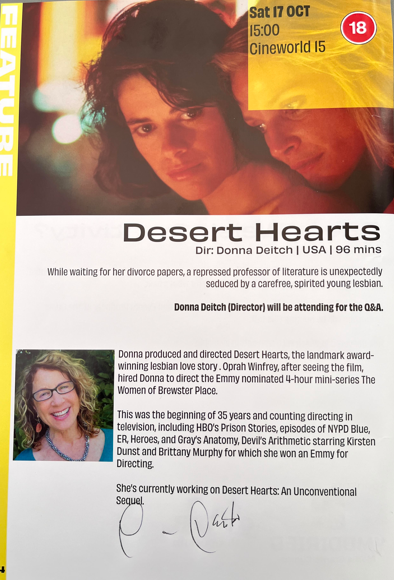
Founder Berwyn Rowlands believes Iris is also an ideal place to showcase historic queer cinema. So this year, he included that iconic lesbian film, Desert Hearts, which is celebrating its 40th anniversary.
The film was groundbreaking in 1986. Earlier portrayals of lesbians were deeply flawed, often relying on the perpetual trope of a mannish, controlling older woman seducing a pretty, innocent young woman – think The Killing of Sister George. It was a time when LGBTQ+ people despaired of watching their screen brethren dying off or ending miserably.
Desert Hearts broke that mould.
On its release, the media often avoided the ‘L’ word, instead calling it a ‘friendship’ or ‘relationship’. The Welsh media were particularly quiet, with only five notable comments.
The Merthyr Express and the South Wales Echo wrote of a ‘candid’ and ‘sensitive’ ‘lesbian affair or relationship’. The South Wales Daily Post thought it a ‘splendid’ adaptation of ‘a sort of lesbian love story, which will have you discussing it in whispers’ – what was ‘sort of’ about it?
The Liverpool Daily Post (Welsh edition) called it a ‘soapy tale of gay girls’ who ‘strike up a pretty intense relationship. Sensitively handled if a little on the glossy side.’
The South Wales Echo acknowledged: ‘Sensitive films exploring lesbian relationships are at last being made. Yet you still have the uncomfortable feeling that screen affairs between working class women which would help root such relationships in “ordinary” experience, are taboo’.
Anthony Harris in the South Wales Daily Post, describing it as ‘the controversial film of the week’, added that the story is ‘deep and highly complex, but simplified… There is a lesbian love scene, but it is handled with extreme taste and could be seen as being beautiful, if you like that sort of thing.’
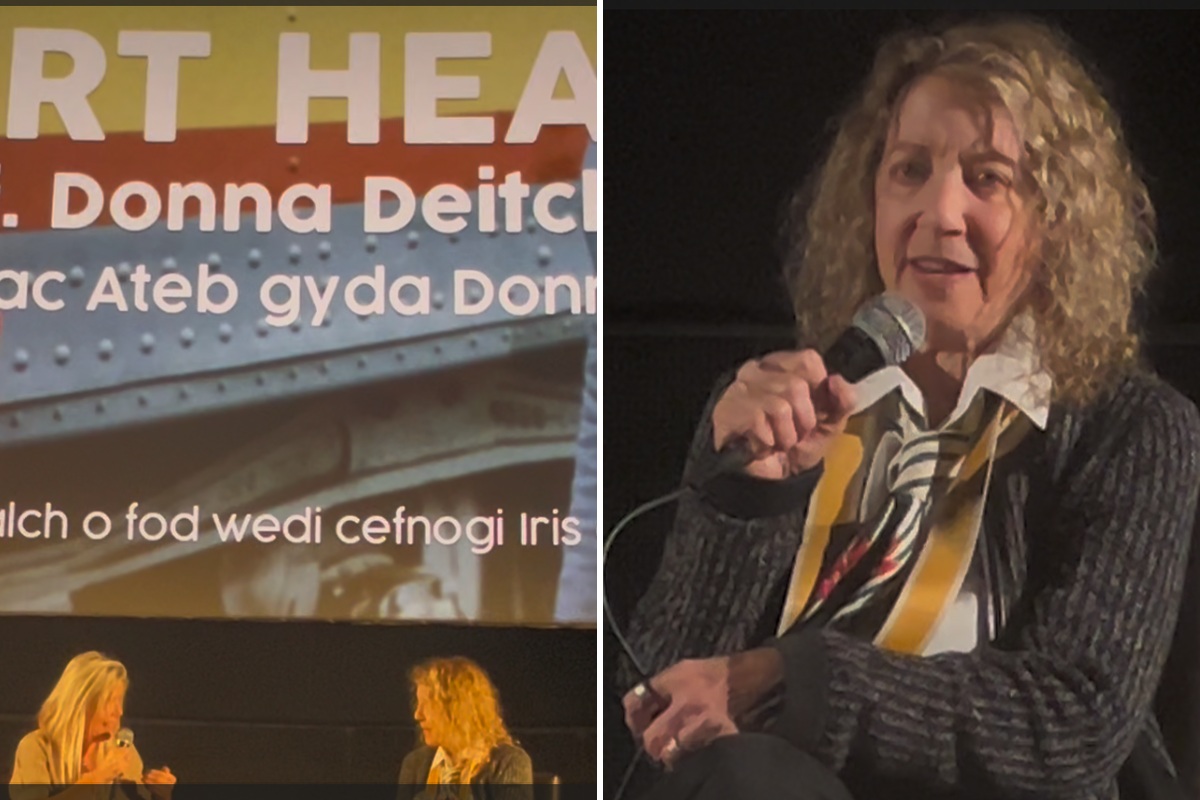
Many of us do like ‘that sort of thing’, so I went off to have a chat with director Donna Deitch to find out how the film came about. Iris Prize trustee, writer, producer and director Jacquie Lawrence also interviewed Donna after a screening of the film.
Donna had, she said, been trying to find a lesbian story to film until she read Canadian author Jane Rule’s novel, Desert of the Heart (1964), and knew that was the one.
‘But why,’ I asked, ‘did you make the film amid the dark clouds of the HIV/AIDS crisis and the backlash against LGBTQ+ people?’
‘I made it for me,’ she said. ‘I made the film I wanted to see.’
Funding
However, funding did not come easily. After hosting many backing parties across the States – a bit like crowdfunding today – Donna went on a mission in 1980 to find Gloria Steinem, an American journalist and activist associated with second-wave feminism in the late 1960s and early 1970s.
Steinem became the first person to help Donna, followed by Lily Tomlin. Shares in the film cost $15,000, and Donna raised a million dollars over two years.
However, some potential backers were not happy and wanted the ending changed to the perpetual trope of misery or death. They weren’t invited back.
Furthermore, every agent in Hollywood told clients not to get involved, even crew members. Donna sees this as a blessing, as she was left with those who really believed in the film.
At its core, if you ‘like that sort of thing’, was the love scene. The first major lesbian sex scene was in The Killing of Sister George, but, directed by a misogynistic man, it is clumsy and difficult to watch.
I asked Donna if she had seen it before making Desert Hearts, but she, like many others, was not even aware of it because the scene had been cut. That made hers the first major, truly positive lesbian sex scene.
At the end of her interview with Donna, Jacquie Lawrence drew attention to the difficulty of getting lesbian films made today, despite this year’s anniversary festival featuring a notably high number.
See herself
Donna made her film because she longed to see herself, but that’s still true today. In 2025, of the 225 major studio films released globally, according to GLAAD, the American media monitoring organisation, 18 – or 8% – featured a lesbian somewhere in the film.
Today, roughly 13–23% of major studio films are directed by women: a slow climb since Donna’s time, when around 4% of directors were female. A damning statistic after more than half a century.
After 1988, Desert Hearts was rarely seen, but Criterion is now re-releasing it. As for Donna, she’s working on a new film set in New York during the women’s liberation movement.
Can’t wait to see it.
Support our Nation today
For the price of a cup of coffee a month you can help us create an independent, not-for-profit, national news service for the people of Wales, by the people of Wales.
Get more trusted Welsh news
Choose Nation.Cymru as a preferred source in Google News to see more of our journalism.


