


Why did the polls get the Caerphilly byelection wrong? They ignored the fact Reform is an English nationalist party
Paul Whiteley, Professor, Department of Government, University of Essex
The results of the Caerphilly Senedd byelection held on October 23 were certainly a shock to Labour and to the Conservatives, but they also cast doubt on the reliability of polling as well. It had for some time appeared that Reform was in the running to win the seat but it ended up trailing some way behind Plaid Cymru.
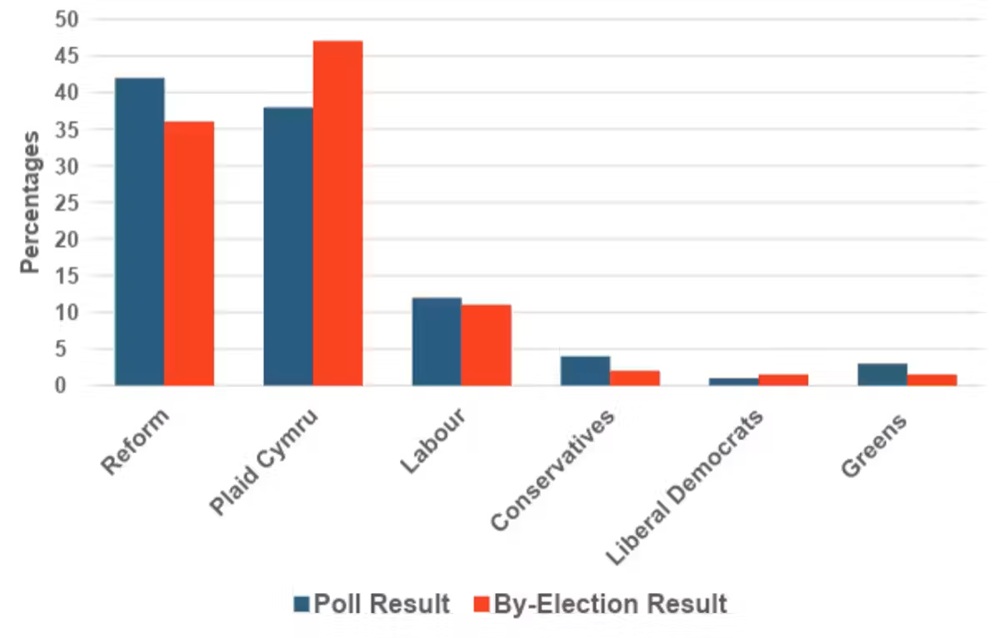
A Survation telephone poll published on October 16 suggested Plaid Cymru would come second with 38%, and the election would be won by Reform with 42%. The actual results after the October 23 vote were Plaid Cymru first on 47% and Reform second on 36%.
Labour obtained 12% in the poll and 11% in the election, which is fairly accurate. The Conservatives received 4% in the polling and got half of that with 2%. Similarly, the Greens also got half of their predicted share of 3% and the Liberal Democrats got 1.5% following a prediction of 1%.
Voting in Caerphilly – Poll vs Results:
So what went wrong? The small sample telephone poll in the constituency which Survation used does not have a good track record. Surprisingly, national polls are more likely to be accurate than constituency polls.
There are a number of reasons why this is true, chiefly that it is harder to get an accurate sample of respondents at the constituency level than it is nationally. This is particularly true of telephone polls, where the great majority of people approached will not respond.
But there is another important reason why Reform did worse than expected in the byelection and it relates to national identity. The 2021 census asked questions about people’s national identities – that is, did they feel British, English, Welsh, Scottish, and so on.
Overall, 90% of the population (53.8 million people) in England and Wales identified with at least one UK national identity. This makes it possible to investigate identities at the constituency level.
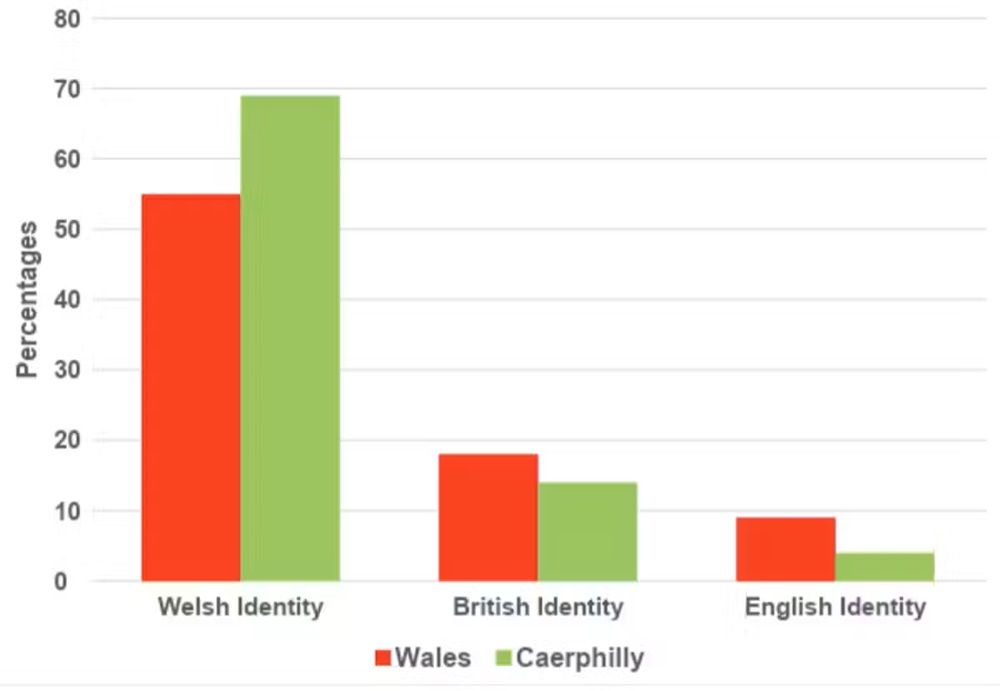
Some 55% of the population in Wales described themselves as Welsh in the census, but in Caerphilly it was 69% – a far higher figure. Equally, 18% described themselves as British in Wales but in Caerphilly it was 14%. Finally, 9% of the Welsh population described themselves as English, but only 4% of the population in Caerphilly did so.
Census National Identity Data, Comparing Wales and Caerphilly:
It’s also revealing to compare the constituency and the rest of Wales when it comes to voting in the general election of 2024. Plaid took just under 15% of the vote in Wales but it took 21% in Caerphilly. Reform took 17% in Wales and 20% in Caerphilly.
This is why many thought that Reform would win the byelection. So why did Plaid get 11% more of the vote share than Reform in the byelection?
The main reason is that Reform is fundamentally an English nationalist party, as the chart below reveals.
There is a very strong correlation between English identity in the census and voting Reform across the 543 constituencies in England. The more people think of themselves as English rather than British or something else, the more they were likely to vote Reform in the 2024 election.
English Identity and Reform Voting in 2024:
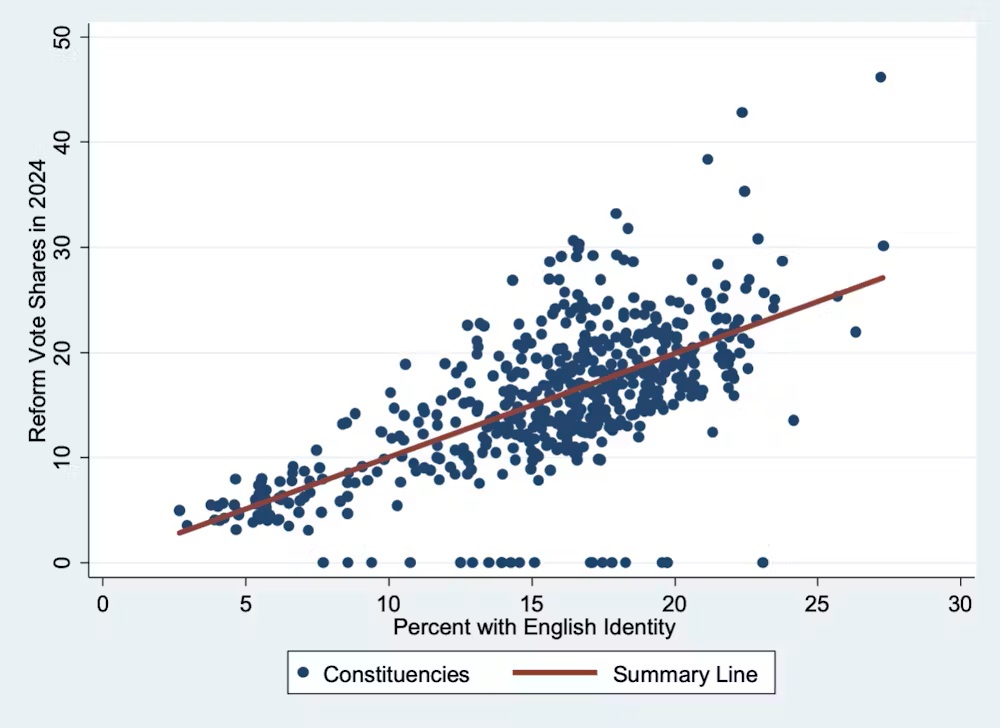
Because English identity is low in Caerphilly, even by Welsh standards, Reform struggled to get the support it would have received in a comparable constituency containing a lot more English identifiers.
It did well in the general election because this was focused on the entire UK, but when the focus is on Wales in a byelection, English identity is a problem for the party.

More generally Reform will face difficulties in the future winning seats in both Wales and Scotland, since English identifiers in these countries are few and far between.
This is going to be an issue in the Welsh Senedd elections and also the Scottish Parliamentary elections next year, since Plaid Cymru and the SNP are likely to be more successful against an unpopular Labour party in their respective countries than is Reform.
For next year’s local government and devolved parliamentary elections, there is something the pollsters can do to correct for the national identity effects.
All pollsters weight their data, that is, they attach more importance to some respondents than others in order to get an unbiased sample. They should weight for national identity using the census data and this will help to make the estimates more accurate.
Reform is in part a product of the incomplete devolution experiment introduced by Tony Blair’s government in the 1990s and 2000s. This exercise provided a powerful parliament for Scotland and a less powerful but important parliament for Wales.
The missing element was a parliament for England. It was thought at the time that this was unnecessary since the Westminster parliament would take care of English issues, but with English nationalism on the rise, it may well be time to reconsider this arrangement.
This article was first published on The Conversation

Support our Nation today
For the price of a cup of coffee a month you can help us create an independent, not-for-profit, national news service for the people of Wales, by the people of Wales.



A primarily English identity was always going to make it harder for Reform. Not announcing a Welsh leader is also beginning to make many suspicious – if – though unlikely – the party gains enough seats to take full control of the Senedd, who will be the First Minister? Reform are dominated by Farage, if a Welsh leader is found, how charismatic would that person be. In comparison? Recent interviews with Reform candidates have mostly been a car crash. We can not write Reform off but they are far more toxic and associated with English nationalism than the polls have… Read more »
True I suspect Reform have held off with the appointment to ensure the loyalty of characters like Cllr.Thomas who is present at the opening of a Reform envelope
Any hope of Reform parachuting in someone from across the bridge has gone.
That wouldn’t sit well at all
Andrew Davies was conspicuous by his absence during the campaign
Perhaps they have him lined up? Although he has been a bit of a Jonah generally
Nobody really stands out head and shoulders. All carrying a bit of baggage
It also didn’t help their cause when Laura Jones expressed a desire to have support for the Welsh language put on the back burner. And since immigration control (their main issue) is outside the remit of any Welsh Government, it’s hard to see in what way Reform UK are relevant to Wales. It’s also possible that their plans for the Welsh NHS caused some would-be supporters to have second thoughts.
So watch out places like Conwy which is full of colonists and settlers!
I agree. I think that there’s a distinct possibility that Reform candidates could be elected in constituencies along the north coast where significant numbers of elderly English retirees from Merseyside and Greater Manchester have opted to end their days. The other possibility with potential for some Reform success is in at least some of the constituencies covering the economically depressed post-industrial communities down in the calleys of the south. Populist political parties have showed that they can appeal to electorates like these in various other countries across Europe. But I still think that Reform has no hope of winning a… Read more »
Not necessarily, this English born retiree will be voting Plaid. I’ve seen what slashing services does in a Tory voting area in England. No thanks!
Nice to hear that an English voter can lend their vote to Plaid Cymru. Diolch yn fawr i chi!
Half of the people in my dysgu cymraeg course are English, and many of them support plaid, I think it’s a little dangerous and counterproductive to tar them all with the same brush.
Point taken 👍🏻
From experience, in Cymru the self-identifier ‘British’ is also used by a significant number of people who would self identify as ‘English’ if [and when] they lived in England.
It’s used to lump us all as British, then by definition they cannot really be incomers.
Also it can be used to distinguish themselves from other incomers who they consider not really British.
‘But there is another important reason why Reform did worse than expected in the by-election and it relates to national identity. … Some 55% of the population in Wales described themselves as Welsh in the census, but in Caerphilly it was 69% – a far higher figure.’ I think that’s the significant point. I listened to a pre-election TV interview in which the host concluded by asking the guests if they’d care to venture a prediction as to what the actual outcome would likely be. One of the participants was the editor of the Caerphilly Observer, who, while modestly acknowledging… Read more »
“There is something about me that makes people giggle”…
So true, a few years before he died I was in The Ship, our local on Wardour St, Soho. Tommy was having a quiet chat with his agent early doors, the place was near full. Necks bent, nothing of their conversation could be heard but over several minutes the giggling began until the whole pub was at it…
Tommy paid no heed, just like that, it was magic …
Pity about the scumbags getting in the way…
Useful press. BBC, Mail, Telegraph etc. they never hold a reform type to account.
Most of the UK press is owned by wealthy plutocrats who tend to favour Reform.
While the BBC – at least in London, it’s less apparent with BBC Cymru – was rendered cowed as a consequence of Alistair Campbell’s rampages in the context of Andrew Gilligan and the strange affair of Dr David Kelly’s death.
With the consequence that it now makes sure that it does nothing of significance to rattle the cage of whatever government currently exercises power in Westminster.
The people of Caerffili spotted these dangerous clowns a mile off. All brexiteers which has been an absolute disaster, all racist Unionists who despise anyone who isn’t a little Englander. The youngsters in Wales have seen what the Union has to offer and increasingly want to get away from it and it’s sad, tired institutions, economic and public service failure and 3 trillion pound debt and it’s completely unequal in terms of class and where you are born and live. Look what Ireland has done compared to Wales and all whilst being a country in its own right and part… Read more »