


Why Wales is getting hotter – and what it could mean for the future

Mark Mansfield
Wales is experiencing another spell of hot weather following a spring and summer which have already broken a string of temperature records.
But this year’s extreme heat is part of a longer-term trend, with evidence showing the number of hot days experienced in Wales has doubled in recent decades.
New analysis by Dr Matthew Sutton of Senedd Research brings together data showing how the country’s climate is changing, the effects already being felt and how Wales may have to adapt to considerably hotter summers in the future.
Welsh temperature records stretch back more than 140 years, but 2026 has proved remarkable.
By the end of July, Wales had recorded its hottest spring, its highest-ever May maximum and minimum temperatures and its highest-ever June maximum and minimum temperatures.
July was the driest and joint-hottest on record by average temperature, while June was the second hottest and May the equal third hottest.
Wales also experienced its first red “take action” weather warning for extreme heat, covering most of the south of the country.
What counts as a heatwave?
Despite the term being widely used whenever temperatures soar, a heatwave has a specific meteorological definition.
The Met Office defines one as a period of at least three consecutive days when the maximum daily temperature meets or exceeds a set threshold.
Across most of Wales that threshold is 25C, although it rises to 26C in the warmer southeast.
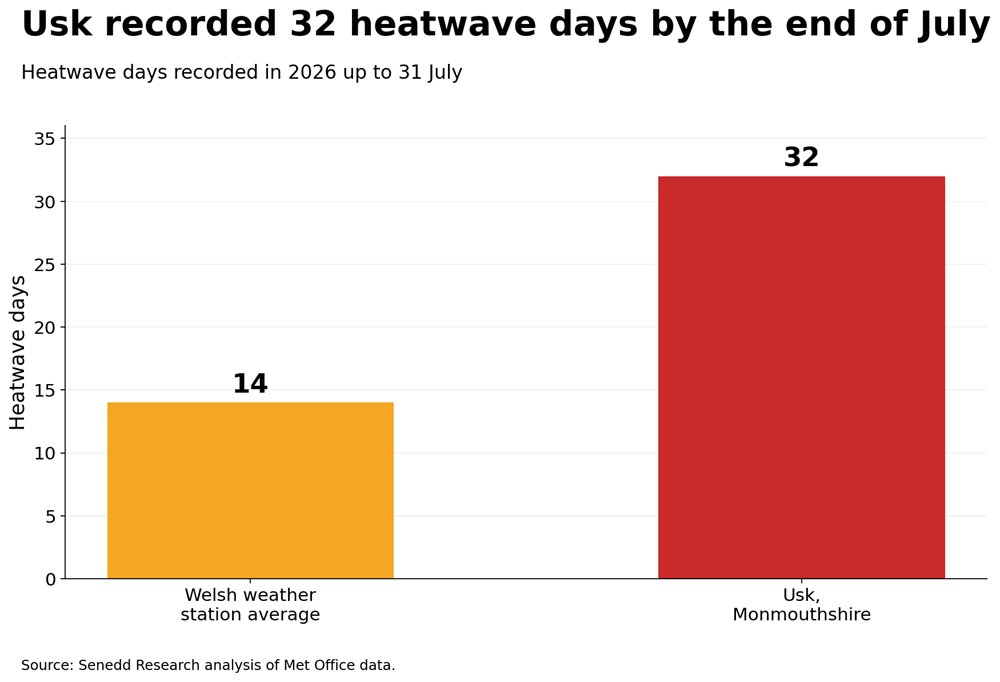
By the end of July, Welsh weather stations had recorded an average of 14 heatwave days during 2026, although there were significant differences around the country.
Usk in Monmouthshire had experienced 32 heatwave days – the highest recorded anywhere in Wales.
Heatwave days in Wales graphic
Why is Wales getting hotter?
Heatwaves in the UK generally develop when slow-moving high-pressure systems dominate the weather, allowing hot air to remain in place for days or even weeks.
Heatwaves are a natural phenomenon, but scientists say human-induced climate change is making them more frequent, more intense and longer-lasting.
Dr Sutton’s analysis points to Europe’s record-breaking June 2026 heatwave, which researchers concluded would have been “virtually impossible” without global warming caused by human greenhouse gas emissions.
There is already evidence of a long-term shift in Welsh summers.
The highest temperature ever recorded in Wales remains the 37.1C measured at Hawarden in Flintshire in July 2022.
Summer 2025 was the hottest on record in Wales when measured by average temperature between June and August, while the analysis says 2026 could surpass it. That will not be known until the end of the summer.
What impact is the heat having?
The consequences go considerably further than uncomfortable nights and parched gardens.
Extreme heat can cause dehydration and heat stress, while high temperatures are associated with increased deaths from heart attacks, strokes and lung disease. Older and disabled people are among those particularly at risk.
An assessment of the May and June 2026 heatwaves led by Imperial College London estimated there were around 128 heat-related deaths in Wales.
During the June heatwave, the Welsh Ambulance Service and Aneurin Bevan University Health Board both declared critical incidents following sharp increases in demand.
Schools and other public buildings are also having to contend with higher temperatures.
More than 700 Welsh schools closed during the June heatwave, although there is no statutory requirement for schools to close because of extreme heat and decisions are made by headteachers.
The rail network has also been affected. Transport for Wales advised against non-essential travel during the peak of the June heatwave, with some trains cancelled and others forced to run at lower speeds to reduce the risk of heat damaging tracks.
Farms, wildlife and wildfires
The combination of heat and prolonged dry weather has created particular problems in rural Wales.
Natural Resources Wales says conditions have reduced grass growth and the availability of forage, as well as creating concerns about livestock welfare.
NFU Cymru has reported effects on crop yields and said some farmers have had to use forage stocks which had been set aside for winter.
The effects are also being felt at sea, with marine heatwave conditions persisting in Welsh waters for much of the summer.
On land, dry vegetation combined with high temperatures has increased the risk of wildfires.
Major incidents were declared following fires on Conwy Mountain in late July and Llanwonno Mountain in Rhondda Cynon Taf in early August, while significant fires have also occurred near Harlech and Blaenavon.
Is this the new normal?
Perhaps the most striking figures concern the longer-term direction in which Wales is heading.
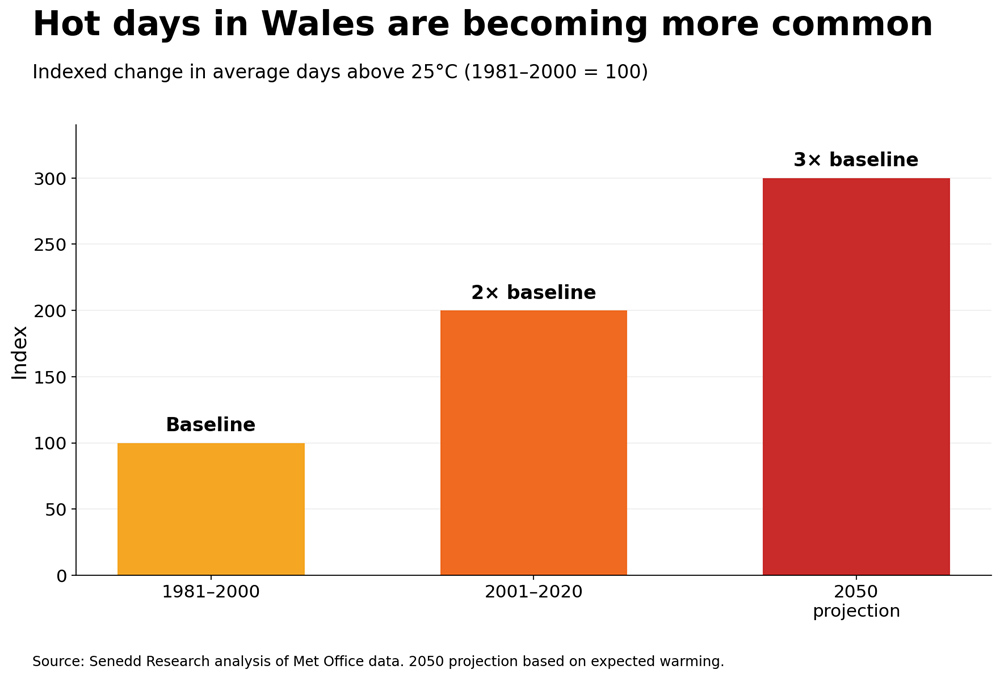
The average number of hot days in Wales doubled between the periods 1981-2000 and 2001-2020.
Under the level of global warming expected by 2050, the number is projected to increase by another 50%.
That doesn’t mean every Welsh summer will be hotter than the one before it. Weather will continue to vary from year to year, but the underlying climate is shifting towards conditions in which extreme heat becomes increasingly likely.
Is Wales prepared?
The growing risks have raised questions about how Wales adapts to a climate in which temperatures once considered exceptional become increasingly common.
The independent Climate Change Committee has identified intensifying heat and drought as two of the UK’s priority climate risks.
Among its recommendations are investment in active and passive cooling in hospitals, schools, prisons and care homes, the introduction of maximum working-temperature regulations and faster provision of cooling for people particularly vulnerable to heat.
The previous Welsh Government set out measures for dealing with extreme heat in its Climate Adaptation Strategy, while the National Infrastructure Commission for Wales has called for a legal climate adaptation framework.
Climate scientists say global warming will continue until the world reaches net-zero greenhouse gas emissions.
That means adapting to heatwaves, as well as drought and flooding, is likely to become an increasingly significant challenge for Wales in the decades ahead.
Support our Nation today
For the price of a cup of coffee a month you can help us create an independent, not-for-profit, national news service for the people of Wales, by the people of Wales.
Get more trusted Welsh news
Choose Nation.Cymru as a preferred source in Google News to see more of our journalism.



With the increase in temperatures and drought becoming the norm throughout Britain, especially the English Southeast, I fear Wales will once again be in the cross-hairs of Whitehall. #Tryweryn