


Your vote, your choice: tactical voting in Wales’s new electoral system
Dr Jac Larner & Professor Laura McAllister, Wales Governance Centre, Cardiff University
There has been a lot of discussion in this Senedd election about tactical voting: which party to back, which to avoid, and how the new system changes the calculation.
In this discussion there has been a lot of misunderstanding about how the system works and whether it is even possible to vote tactically.
The truth is straightforward: tactical voting is possible under the new system, as it is under any electoral system. But you do not have to vote tactically. Voting for the party you most want to win remains a perfectly legitimate choice.
Yet given the increasingly polarised political environment in Wales and the level of discussion, we thought it was worth addressing some fundamentals.
We explain how the system works, what tactical thinking actually looks like under it, and what one need to know to make a decision.
How the new system works
Wales is now divided into 16 larger constituencies, each electing six Members of the Senedd (MSs). Rather than one representative winning with a simple majority, seats are shared out in proportion to the votes each party receives using a counting method called D’Hondt.
The mechanics work like this. Parties are awarded seats one at a time. Each time a party wins a seat, its vote total is divided by the number of seats it has already won, plus one. The party with the highest figure at that point wins the next seat. The process repeats until all six seats are filled.
In broad terms, this means votes are distributed a bit more fairly across parties than under the old system. You do not need to back the winning party to win representation. Smaller parties can, and probably will, win a handful of seats. But there are important caveats and some widely repeated claims about the new system and how seats are won that need correcting.
Four things some people are getting wrong
“There is no point voting tactically in this system.” This is false. Every electoral system allows for tactical voting, because votes can be cast both for parties and against them.
With two parties clearly out in front in this election, and significant anti-party sentiment apparent among voters, the possibility of tactical thinking is very much alive.
“If you vote for a party, you will get one of their candidates elected.” This is also false. Whether your vote translates into a seat depends on several factors: how many parties are competing in your constituency, how evenly the vote is split between them, and crucially, whether your party clears the effective threshold needed to win a seat in that constituency.
Though proportional, the system we are using also favours larger parties by often giving them a higher share of the seats than their vote share.
“There are no wasted votes in this system.” Not quite right. There are likely to be fewer wasted votes than under first-past-the-post — and that is a genuine improvement — but votes for parties that fall well short of the threshold in a constituency can still fail to elect anyone, and therefore might be deemed ‘wasted’.
“This election is a straightforward choice between two parties.” This is almost certainly the case in terms of the contest for the largest party, with all polls pointing towards either Reform UK or Plaid Cymru.
It is not necessarily true for government formation. This will depend on which parties are willing to work together, and what counts as “winning” is less obvious than in a first-past-the-post election. It is quite possible for the party with the most seats or largest vote share to be excluded from government, something that is relatively common in proportional systems across Europe.
Where does the threshold actually sit?
This is the most important practical question. Based on analysis of how D’Hondt operates across Wales’s constituencies, the approximate vote shares needed to win each seat look like this:
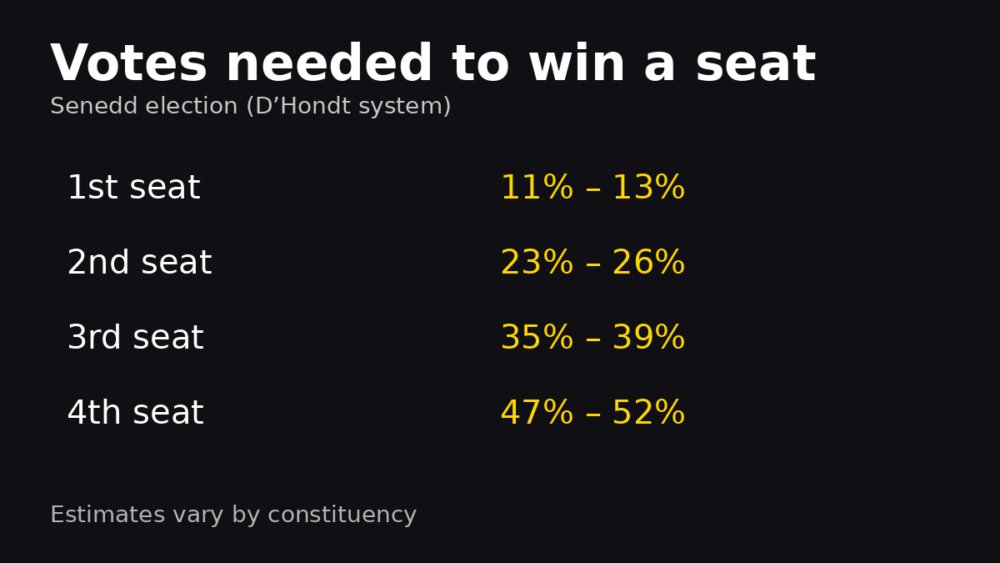
But note, these figures are estimates, not guarantees. The precise threshold in any constituency shifts depending on how fragmented the vote is there — where votes are spread thinly across many parties, the threshold rises; where one or two parties dominate, it falls.
The sharpest cliff-edge is around that first seat: a party on 10% has a very low chance of winning any representation at all.
What does tactical voting look like under D’Hondt?
The question is no longer simply “which candidate can beat the one I least want?” It becomes: “where are votes most likely to convert into seats?”
If one party you broadly support is comfortably on course to win three seats, additional votes for it there may not change the outcome. If another party you could support is hovering near a threshold — close to winning an extra seat — your vote there might be impactful.
There is, however, an important practical limit on this reasoning. Acting on it requires reliable local polling data knowing roughly how well the different parties are likely to be doing in your constituency.
Unsurprisingly, that information is rarely available with the precision the logic demands before polling day. Add to that, we have new, largely unknown constituencies with very different conglomerations of voting histories and this task becomes very difficult indeed.
Larger parties
In that low-information environment, there is a reasonable case for focusing on larger parties within a broad political grouping.
D’Hondt itself provides a structural bonus to larger parties: once a party has already won seats, it takes fewer votes per seat than a smaller party starting from scratch.
To explain: two parties each winning 20% of the vote in a constituency will typically win fewer seats between them than one party winning 40%. Concentrating votes, rather than splitting them across similar parties, is how blocs maximise their representation under this system.
If there is uncertainty whether a smaller party will clear the threshold in your particular constituency, a vote for the larger party of a similar political perspective is a lower-risk way to ensure your vote converts into representation.
The bottom line
The new system is more proportional than what came before. Votes that would have been stranded under first-past-the-post will, in many cases, now count. Remember FPTP generated 84% of seats for Labour with a 37% vote share in Wales in the 2024 UK General Election.
Tactical voting remains possible — as it does under any electoral system — but whether the choice to vote tactically, and how, is entirely up to you.
Whatever the decision, understanding how the system works is the best foundation for making that choice with purpose and with confidence..
Support our Nation today
For the price of a cup of coffee a month you can help us create an independent, not-for-profit, national news service for the people of Wales, by the people of Wales.
Get more trusted Welsh news
Choose Nation.Cymru as a preferred source in Google News to see more of our journalism.



Many countries ban opinions polls in the run up to elections. Wales should do the same. That way, politicians might have to defend policies rather than asking for tactical votes.
Thank you Jac your polling has given me insights and guided my vote. I suspect that over 80% of the seats will go as predicted.
What if an independent wins 40% of the votes and two other parties each win 30%
Does that mean that one seat goes to the independent and the rest of the seats are shared by the two parties? Seems wrong to me.