


Yr Hen Iaith part 100: Satire, Politics and the Eisteddfod at the End of the Century
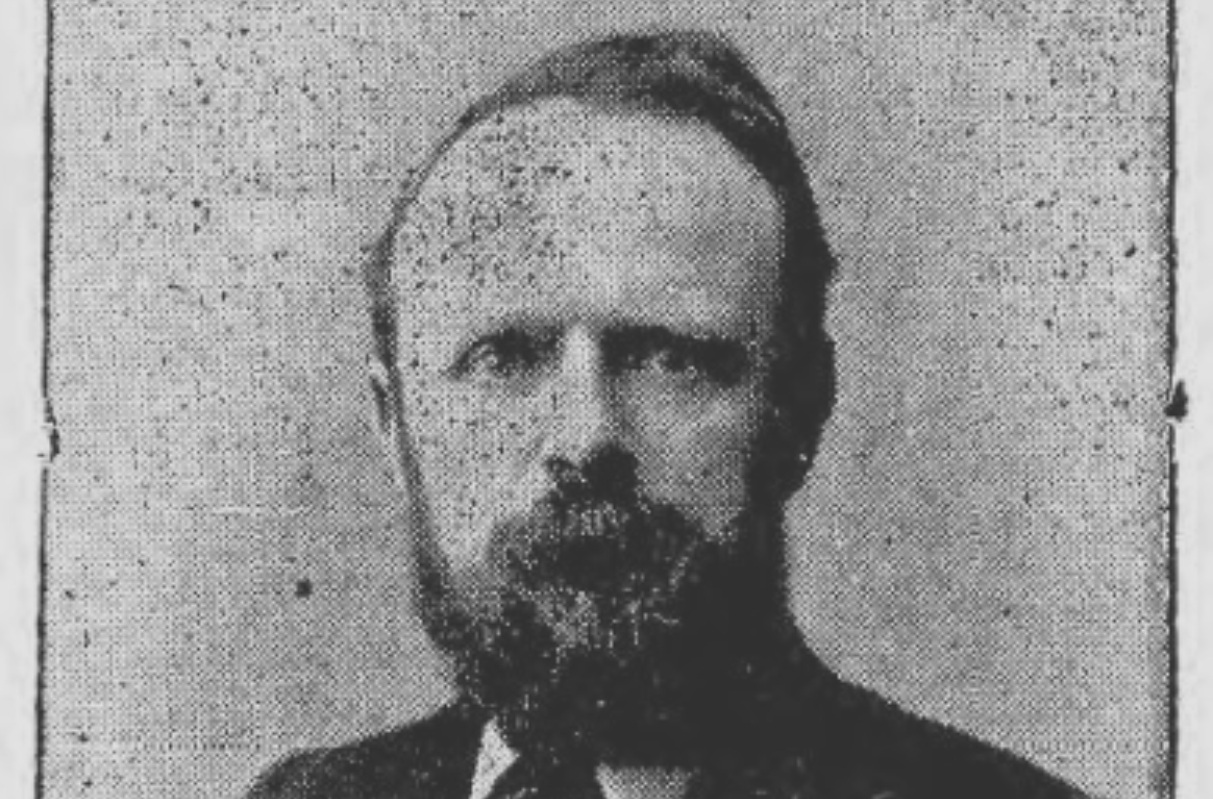
Jerry Hunter
With this, our hundredth episode, we reach the end of series 3 and the end of the nineteenth century.
As the episode itself was recorded in front of a live audience in Y Babell Lên (The Literature Tent) at this year’s National Eisteddfod, it seemed fitting to begin by taking a passing look at the state of the festival in the period we’re discussing.
The National Eisteddfod was held in Liverpool in 1900. A description of the cultural ‘feast’ (gwledd) published in Y Cymro contains a great deal which will be familiar to eisteddfod-goers today: Canu, beirniadu, adrodd, cadeirio, coroni – y naill gwrs ar ôl y llall, a’r danteithion yn parhau mor flasus ar ddiwedd y wledd ag oeddynt ar ei dechrau (‘Singing, adjudicating, reciting, chairing, crowning – each course following the previous one, and the delicacies continuing to be as tasty at the end of the feast as they were at its beginning’).
One of the other claims to success fuelling this report’s jubilant tone will sit less comfortably with most of Nation.Cymru’s readers: Y Cymro notes that ‘thousands gathered from Wales’ (Miloedd wedi gymgynnull o Gymru) and that ‘thousands more from England’ (miloedd mwy o Loegr), rejoicing that the festival earned ‘the foreign nation’s unadulterated praise for the Welsh’ ([ch]anmoliaeth ddigymysg yr estron genedl i’r Cymry).
More than half a century after the 1847 ‘Blue Books’, we find the inferiority complex engendered by heavy-handed British-English condescension alive and well. Even the National Eisteddfod could be used as a vehicle to persuade the big brother over the border that Wales was a decent and worthy nation.
Whatever the implications in terms of Welsh identity and nationhood, the literature produced for the 1900 Eisteddfod was in keeping with the tastes of the times.
The Crown was awarded for a poem on ‘Williams Pantycelyn’. It was only a few years since the novelist Daniel Owen had exposed the transformation of the Methodist Revival’s spiritual energy into a fossilized and unthinking superficial religiosity, yet the religious movement’s premier poet still enjoyed an unquestioned canonical status.
The winning poet, J. T. Job, was a Calvinistic Methodist minister and one of the beirdd newydd or ‘new poets’ discussed in recent episodes. The chair was won by another of the new poets, Pedrog (John Owen Williams), also a Nonconformist minister, and the subject, ‘Y Bugail’ (‘The Shepherd’), easily evoked the kind of septimal poetry romanticizing and idealizing rural Welsh life which was so popular during the later half of the nineteenth century.
The National Eisteddfod had been held in Cardiff the previous year. One of the most significant things which happened in 1899 took place not on stage but rather in the mundane confines of a business meeting.
Professionalisation
When Cymdeithas yr Eisteddfod Genedlaethol (‘The Society of the National Eisteddfod’) met in Cardiff in 1899, they discussed the professionalisation of the festival. It was suggested that a job be created, that of a permanent secretary, and one person who argued vigorously in favour of that idea in the meeting was Beriah Gwynfe Evans.
Born in Nanty Glo, Monmouthshire, in 1848, Evans worked for a while as a teacher in Llangadog and Gwynfe in Carmarthenshire. He started a periodical, Cyfaill yr Aelwyd (‘the Friend of the Hearth/Home’), and left teaching for a career in publishing, moving to Caernarfon in order to edit Y Genedl Gymreig (‘The Welsh Nation’), a venture part-owned by Lloyd George.
Like Lloyd George, Beriah Gwynfe Evans was a Liberal and a passionate supporter of Cymru Fydd, serving as national secretary for that nationalist movement. (My co-presenter, Richard Wyn Jones, would add here that Lloyd George found Evans to be woefully disorganized; one wonders if he was perhaps a more effective administrator in the context of the National Eisteddfod than he was in that of Cymru Fydd.)
Drama
Evans earned a reputation as a playwright, and he played an important role in connecting drama to the Eisteddfod. He also published novels in both English and Welsh. To my mind, the most interesting of them is Dafydd Dafis, published serially in Y Genedl Gymreig from 1895 onwards and in book form in 1898. The subtitle is Hunangofiant Ymgeisydd Seneddol, ‘the Autobiography of a Candidate for Parliament’.
As was discussed in episode 93, when Daniel Owen expanded the Welsh novel’s foothold with Hunangofiant Rhys Lewis, Gweinidog Bethel (‘The Autobiography of Rhys Lewis, Minister of Bethel’), he did that in part by providing a fictional version of a popular nonfiction genre, the Nonconformist minister’s autobiography. Dafydd Dafis might be seen as a secularization of that fictional autobiographical turn, for the eponymous main character relates his attempts at becoming a Member of Parliament.
This work of rollicking social and political satire begins in the domestic sphere. Dafydd Dafis opens Chapter 1, entitled ‘Dechreu’r Helynt’ (‘The Beginning of the Fuss’), by relating an exchange with his wife Claudia.
Dafydd is a Welshman who has done well in the London milk trade, and his wife now wants him to go into politics. Using Welsh orthography to write English provides a humorous medium for satirizing the drive for assimilation, and aspects of this novel reflect the way Jac Glan-y-Gors lampooned the London Welshman’s self-Anglicization a century earlier.
“David,” ebe’r wraig yn sydyn, “Ei want iw two get intw ddi hows!”
Codais fy llygaid mewn syndod a phenbleth. [ . . . .]
“Ies, David, diar,” ebe’r wraig eilwaith, “Ei wont tw get iw intw ddi hows!”
“Be andros,” ebe fi wrthyf fy hun, “sy ar Claudia rwan?”
“David,” said my wife suddenly, “I want you to get into the house!”
I raised my eyes in surprise and confusion. [ . . . .]
“Yes, David, dear,” my wife said again, “I want you to get into the house!”
“What the devil,” I thought to myself, “is Claudia up to now?”
He is confused because they are at home and thus ‘in the house’ already, but he soon learns that Claudia is talking about the House of Commons. The conversation ends with Claudia sending the hapless Dafydd to talk to Tom Ellis.
Yes, the famous Liberal politician, T. E. Ellis, appears as a character in this novel, as does none other than Lloyd George himself. In Chapter 4 Dafydd tells us about his first foray into the House of Commons:
Wel mi gyrheiddis i’r lobi o’r diwedd, ac yno mi ‘rodd gryn haner cant o ddynion yn sefyll yn ddwy res fawr, fel plant yn yr ysgol, a phedwar plisman, fel pedwar meistar wrth i penau nhw yn eu cadw “in line.” Wyddwn i yn y byd mawr sut ‘roedd myned yn mlaen ddim pellach; ac yn fy ffwdan buaswn wedi gwneud rhyw lol, oni basa i ragluniaeth droi o’m tu.
‘Well, I arrived in the lobby at last, and there were some fifty men standing in two big lines, like children in school, and four policemen, like four masters at the ends in order to keep them in line. I had no idea how to go on any further, and in my confusion I would surely have made some kind of a scene, if providence hadn’t turned in my favour.’
In this case, ‘providence’ came in the form of Vincent Evans, a politician whom he knew:
Wel, mi wyddwn fod Vinsent law yn llawas a’r gwŷr mawr i gyd, a chan i fod o wedi cymyd dau gini o’m mhocad i ddechrau’r flwyddyn, mi ddylies i baswn i’n mynu rhywbeth am dani nhw bellach. Nid wedi cymyd nhw fel lleidar rodd o chwaith, chwareu teg iddo fo, ond fel begar, – ac o bob begar welis i hyd yma Vinsent ydi’r pena. [ . . . .] Felly ato fo mi eis yn syth.
‘Well, I knew that Vincent was hand-in-glove with all of the important men, and since he had taken two guineas from my pocket at the start of the year, I figured that I’d demand something for them now. Not that he took them as a thief, fair play to him, but rather as a beggar, – and he is the greatest beggar I’ve ever seen up to this point. [ . . . .] So I went up to him.’
Political favours
This is a world in which political favours are bought with hard cash, and so Dafydd Dafis gains access to the inner sanctum of the House of Commons where he meets Tom Ellis and Lloyd George. (It’s worth noting that this novel contains a considerable number of illustrations as well, making it an important milestone in the history of the Welsh political cartoon.)
Dafydd is a picaresque comical antihero, often more a hostage to circumstances than a master of his own fate. At one point, he is exhausted from overworking and finds himself sick in bed. His fever dreams constitute Chapter 34, entitled ‘Dafydd fel Bardd Cwsg’, ‘Dafydd as Sleeping Bard’.
Reworking the literary mechanism of Ellis Wynne’s 1703 classic, Gweledigaethau’r Bardd Cwsg (‘The Visions of the Sleeping Bard’), Evans has his hapless protagonist experience visions which are burlesque jumbles of cultural icons, literary topoi and political figures.
Yr olygfa gyntaf gefis oedd ar hynafgwr urddasol a pharchedigol yr olwg arno yn eistedd ar ben craig ucha’r Wyddfa, a thelyn Gymreig yn ei freichiau. Mi roedd rhwbath yn gynefin ac eto yn ddiarth imi yn ei ymddangosiad, a phan ofynis i’r ysbryd a’m harweiniai, atebai mai’r bardd enwog, Syr Gwilym ap Harddgot, ydoedd, yn practeisio erbyn ‘Steddfod Casnewydd; ac wedi imi wrandaw’n ofalus, dyma’r geiriau a ganai efe :
“Nid hen Wlad fy Nhadau, ond anwyl imi,
Gwlad Beirdd a Phregethwyr, Rhyddfrydwyr o fri;
Ei gwrol Ddirwestwyr roes i’m groesaw i’w gwlad [ . . .].”
The first look I had was of an old man of dignified and respectable appearance sitting on top of Yr Wyddfa’s highest rock with a Welsh harp in his arms. There was something familiar about him and yet his appearance was strange to me, and when I asked the spirit which was guiding me, it answered that he was the famous bard, Sir Gwilym ap Harddgot, practicing for the Newport Eisteddfod, and after I listened carefully, these were the words which he sang:
“It is not the old Land of my Fathers, but [it is] dear to me,
Land of Bards and Preachers, famous Liberals,
Its heroic Teetotallers welcomed me to their land,
When in Derby I lost my blood.”
Evans thus twists the national anthem in order to satirize Welsh politicians holding seats in English constituencies. Nothing is sacred here.
This chapter can also be read as satirizing the allegorical dream tradition itself:
Y nesaf a welais oedd yn nghanol Dyffryn prydferth Tywi. Yn fy mreuddwyd – os breuddwyd ydoedd – gwelwn yr Hybarch Davies, Llandilo, yn ceisio gyrru ei anifail ar hyd llwybr a arweiniai i gyfeiriad Cymru Fydd, tra hwnw am droi yn ei ol tua phorfeydd gwelltog Rhyddfrydiaeth Swyddogol. Am wn i na fuasai wedi llwyddo i wneud, oni bai i hogyn troednoeth, a ymddangosai yn hynod debyg i Towyn Jones, ‘maflyd yn ei gynffon, a dechreu ei lachio a phastwn mawr o goedwig Cymdeithas Dyffryn Aman.
‘The next scene I saw was in the middle of the beautiful Tywi valley. In my dream – if it was a dream – I saw the Honourable Davies, Llandeilo, trying to drive his animal along a path which led in the direction of Cymru Fydd [Future Wales], while it insisted on turning back towards the grassy pastures of Official Liberalism. As far as I can tell, he wouldn’t have succeeded if it weren’t for a barefooted lad, who looked very much like Towyn Jones, who grabbed its tail and started beating it with a big club from the Ammanford Society.’
Dream vision
In another dream vision, the feverish Dafydd Dafis witnesses a scene in which representatives of different Welsh cities and towns compete to become the home of the University of Wales.
. . . wele nifer o drefi Cymru yn rhuthro yn mlaen gydag offrymau o aur, a thus, a myrrh, ac yn cynyg Castell a Phalas, Eglwys Gadeiriol a Bêdding Mashîn, a phob rhyw fath o rodd ac offrwm.
‘. . . and then a number of Welsh towns rushed forward with offerings of gold, frankincense and myrrh, offering Castle and Palace, Cathedral and Bathing Machine, and all kinds of gifts and offerings.’
Satire is only directed at people, institutions or traditions significant enough to draw the satirist’s fire, and reading this novel provides a good indication as to what was being talked about in certain Welsh circles at the end of the nineteenth century.
Considering the targets of his satire as well as the various spheres in which Beriah Gwynfe Evans operated helps us take stock of Welsh literary culture at the end of the nineteenth century. There was a lively Welsh-language periodical press, the National Eisteddfod (as well as many local eisteddfodau), and Welsh universities which provided an institutional home for those who were professionalizing the study of the Welsh language and its literature.
By the dawn of the twentieth century, there was a considerable infrastructure in place which would help support, inspire and employ Welsh poets and writers.
Further Reading
Richard Wyn Jones, Rhoi Cymru’n Gyntaf [:] Syniadaeth Wleidyddol Plaid Cymru, cyfrol 2 (2007). To be published as Putting Wales First: the Political Thought of Plaid Cymru, volume 2.
Two novels by Beriah Gwynfe Evans, Bronwen and Llywelyn, have been reprinted by Melin Bapur, and we understand that Melin Bapur intends to reprint Dafydd Dafis soon.
Support our Nation today
For the price of a cup of coffee a month you can help us create an independent, not-for-profit, national news service for the people of Wales, by the people of Wales.
Get more trusted Welsh news
Choose Nation.Cymru as a preferred source in Google News to see more of our journalism.


