
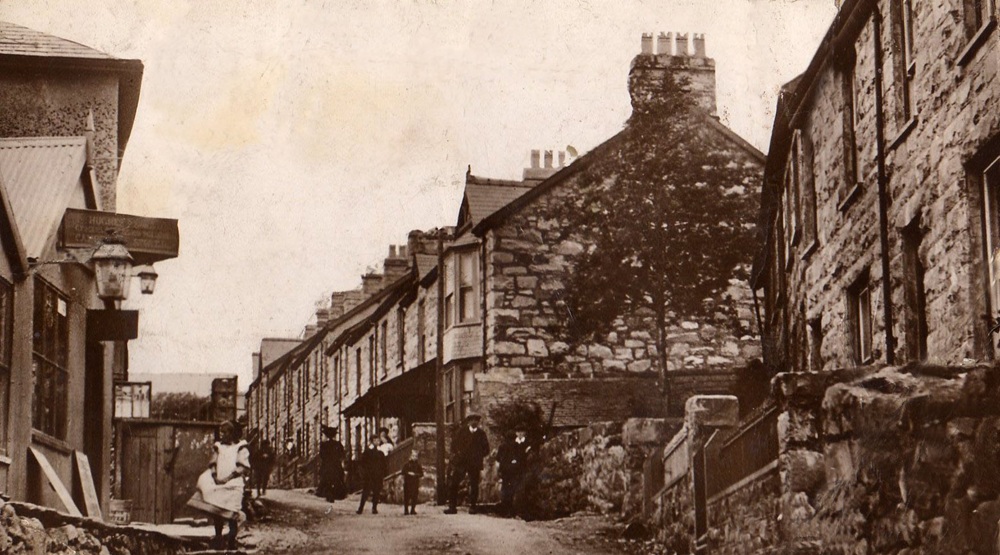
Yr Hen Iaith part 77: Marged Dafydd – poet, teacher and scholarly pioneer
Jerry Hunter
An aspiring poet named Michael Pritchard wrote a letter on the 14th of December, 1728. As he was only eighteen or nineteen years old at the time, it is no surprise that he sought advice from somebody who was about ten years his senior.
Interestingly, while the teenager lived in Llanllyfni, Caernarfonshire, the bardic authority to whom he turned for instruction in cynghanedd lived many miles away in Merionethshire. Her name was Marged Dafydd (or Margaret Davies). Her pupil’s letter suggests that he was nearly overwhelmed by his respect for her.
He addresses her as Yr odidawg-ferch awenyddgar, ‘the excellent poetic woman’, and goes on to thank her for the earlier instruction which she provided:
. . . yr wyf yn bendifaddef yn gwbl rwymedig ddiolchgar i chwi am y cynghorion cynghaneddgar perffeithgu a anfonasach i mi, er athrawiaeth im yn rheolau prydyddiaeth.
‘I am indubitably completely obligingly thankful to you for the precious and perfect instructions relating to cynghanedd which you sent to me, in order to school me in the rules of poetry.’
He writes that ‘[he] can’t but wonder at thinking’ (Ni fedraf ond rhyfeddu wrth feddwl) about her ‘expertly wise discourses’ (cywreinddoeth ymadroddion), which are ‘outstanding’ (gorchestol) and delivered in a ‘pleasant, masterly manner’ (pereidd-ddull penigamp). The poetic disciple heaps more praise on his teacher’s mastery of the craft, describing it as ‘perfect’ ([p]erffaith) and ‘complete’ ([c]yfan).
It’s not known exactly how the bardic pupil from Caernarfonshire first came into contact with his Merionethshire-based instructor, but as Marged Dafydd was a highly respected member of several literary networks, we can assume that another literary-minded acquaintance put the teenager in touch with her.
Born at Y Coetgae-du, Trawsfynydd, there is evidence that both her mother and her aunt composed poetry.
Born into a family noted for its female poets, she was also born into a family of means and afforded a comfortable and independent life.
Marged Dafydd never married, providing an eighteenth-century Welsh example of a woman who managed to create for herself what Virginia Woolf would call ‘A Room of One’s Own’.
While she seems to have used the cywydd as well, the surviving body of her work suggests that she preferred the discipline of that popular four-line strict metre, the englyn unodol union. The subject matter of her poetry ranges widely and includes occasional poems addressed to acquaintances.
Musicianship
One englyn praises the musicianship of a crowther named Rolant, reminding us of the deeply symbiotic relationship enjoyed by cerdd dafod (strict-metre Welsh poetry) and cerdd dant (Welsh string music).
She describes the instrument as aurlais, ‘golden-voiced’, and the musician playing it as cry’ athrylith, ‘a powerful talent’. A more sombre englyn by her provides a unique inflection of the age-old memento mori theme:
Meirwon fu’r dewrion dyna – eiriau gwir.
Ymroi gyd i’r angau;
Diwedd pob dyn sy’n nesáu:
Meirw `wnawn, ymrown ninnau.
‘All of the brave ones became dead men, those are true words,
All submitting to death;
Every person’s end draws near:
We will die, we too will submit.’
Making great use of the compact form, she moves adeptly from famous heroes of the past indexed in the englyn’s first line to the personal and immediate ‘you-and-I’ in the fourth and final line. Visual artists and poets from many countries and many centuries have produced examples of the memento mori theme, but it’s difficult to find any work which matches this englyn as a succinct and powerful reminder of death’s inevitability.
When she turned 60 years old, Marged Dafydd composed this englyn entitled ‘Considering her age, [in the year] 1760’ (‘Ystyried ei hoedran, 1760’):
Tri ugain rhwyddlain mewn rhôl – cyfain;
Er cofio Duw nefol,
Bwriais hon yn bresennol;
Iesu ŵyr beth sy ar ôl.
Using phrasing which is both economical and witty, she notes that her ‘full three score’ years (tri ugain . . . cyfain) have been set down in ‘a record’ (rhôl) like a ‘strip’ or ‘row’ (‘[ll]ain’) of something laid down ‘easily’ or ‘quickly’ (rhwydd).
This captures nicely the very human shock which comes when one realizes how quickly life passes. The next two lines describe that shock doubly as the reason for composing the poem and for yielding to a higher power: ‘For the sake of remembering heavenly God / I jotted this [poem] down now’.
The final line maintains the religious theme – ‘Jesus only knows what is left’ – while tempering it with a tone which is either cynically fatalistic or devoutly resigned, depending on how we take it.
This is not the only versified meditation on ageing which she composed. A series of Englynion written when she was 75 or 76 lists the physical ailments which age had brought her, leading her to turn to Jesus as the only meddyg da or ‘good physician’ who can ease her pain.
It’s tempting to read these meditations on aging in the context of the very long and productive life which Marged Dafydd lived. She certainly spent a great deal of her time in the service of Welsh-language literary culture.
In addition to composing her own poetry and volunteering to teach Michael Pritchard (and, presumably, others), she played an extremely active role in Welsh manuscript culture.
There are Welsh poems – including, significantly, poems by other women – which have only survived because Marged Dafydd copied and preserved them.
Manuscripts
Five manuscripts which she created are still extant today, and she also wrote parts of several other manuscripts.
And they are substantial ones, containing large collections of verse. One of them – in the Cardiff Central Library collection – contains nearly 800 pages. It is a remarkable creation, as all of the many poems in this manuscript are in the strict-metre cywydd form.
And it includes poems spanning the history of the form, from the fourteenth century when the cywydd first emerged, up to eighteenth-century examples.
Not only is it a huge collection, it is also an organised anthology, with cywyddau arranged in sections according to theme or sub-genre (love poems, elegies, request poems, etc.).
Marged Dafydd had a scholarly drive as well. Her work was well known to contemporaries with similar interests, and she was clearly respected greatly for her knowledge and endeavour.
The first Welsh universities with their Welsh departments would not be founded until a century or so after her death.
Belonging to the period before the field was set on modern professional foundations, Marged Dafydd should be recognised as a pioneer in the study of the history of Welsh poetry.
Further Reading:
Cathryn Charnell-White (ed.), Beirdd Ceridwen: Blodeugerdd Barddas o Ganu
Menywod hyd tua 1800 (2005).
Katie Gramich a Catherine Brennan (eds.), Welsh Women’s Poetry 1460-2001 (2003).
For Michael Pritchard’s correspondence with Marged Davies, see Cymru , 25 (1903), 93-98.
Virginia Woolf, A Room of One’s Own (1929).
Support our Nation today
For the price of a cup of coffee a month you can help us create an independent, not-for-profit, national news service for the people of Wales, by the people of Wales.



Interesting but curiously ill-informed about Marged Dafydd’s links with Dyffryn Nantlle during the eighteenth century.