


Yr Hen Iaith part 78: Jac Glan-y-Gors: Satirical Poet and Republican Publican
Jerry Hunter
Many Nation.Cymru readers will have heard the term ‘Dic Siôn Dafydd’ used to describe a Welshman who pretends that he’s English. Some will have used it themselves.
The pejorative label has even enjoyed some international currency during the past decade, thanks to the popularity of Dafydd Iwan’s song ‘Yma o Hyd’ in footballing circles. Iwan cites Pob Dic Siôn Dafydd (‘every Dic Siôn Dafydd’) among the obstacles which the Welsh nation has had to overcome in order to survive.
The expression was first coined by the poet John Jones (1766-1821) some two hundred and twenty-five years ago. This is a striking example of how creative literary endeavour can have a lasting impact on language, culture and national identity.
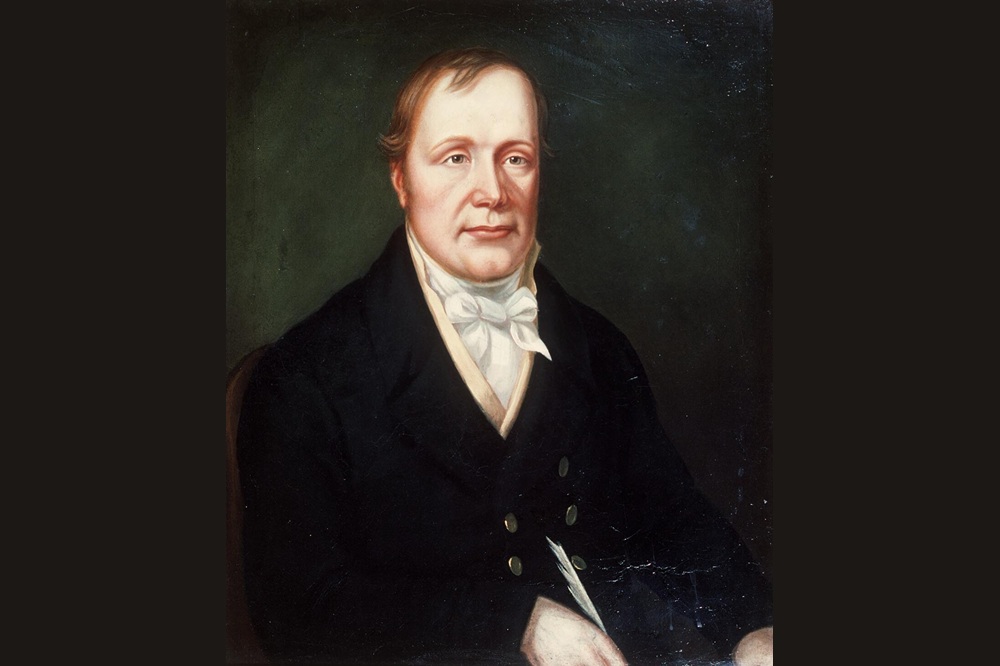
Better known as Jac Glan-y-Gors, Jones was from Cerrigydrudion, Denbighshire. In 1789 the twenty-three-year-old Jac moved to London, apparently working in a grocer’s shop initially. He became a publican at some point, and was running the King’s Head in Ludgate Hill by 1818.
Jac kept in contact with friends and family back and Wales, and is known to have travelled home on several occasions. He also lived a very Welsh life in London, joining the Gwyneddigion society soon after settling in the city.
It’s worth noting that, though the name refers to natives of Gwynedd, the group included Iolo Morganwg, perhaps the most promethean character contemporary Welsh culture had to offer. In 1795 Jac helped establish a new London Welsh society, the Cymreigyddion, and he would play a central role in its operations.
Like Iolo Morganwg, Jac Glan-y-Gors embraced the radical politics of the age of revolution. The year he moved from Cerrigydrudion to London, 1789, saw the start of the French Revolution, and it was only six years since the Americans had won their revolution.
Jac was an ardent admirer of the English-born American revolutionary Tom Paine, and the political concepts presented by Pain in Common Sense (1776) and Rights of Man (1791) were given a Welsh articulation by Jac Glan-y-Gors in two publications, Seren Tan Gwmwl (‘A Star Beneath a Cloud’, 1795) and Toriad y Dydd (‘The Break of Day’, 1797). This kind of republicanism was tantamount to treason, and, like Tom Paine, the Welsh republican had to flee from the authorities and go into hiding for a time.
Jac Glan-y-Gors was a talented prose stylist, and his Welsh prose is fiery, beguiling and memorable. Take, for example, Seren Tan Gwmwl’s opening paragraph:
Gan fod cymaint trwst yn y byd ar yr amser yma ynghylch brenhinoedd, byddinoedd a rhyfeloedd, ac amryw o bethau eraill ac sydd yn ddychrynadwy i feddyliau pobl ac sydd am fyw mewn undeb a brawdgarwch â’u gilydd, meddyliais mai cymwys a fyddai dweud gair wrth fy nghydwladwyr yn yr achos pwysfawr yma, rhag ofn iddynt gael eu galw i arfau i ladd eu cyd-greaduriaid heb wybod am ba achos mae’n rhaid iddynt wneuthur y fath orchwyl gwaedlyd a chigyddlyd.
‘As there is so much commotion in the world at this time about kings, armies and wars, and various other things which are frighten the minds of people who seek to live in harmony and brotherhood with each other, I thought that it would be fitting to say a word to my fellow countrymen about this weighty issue, in case they be called to arms to kill their fellow creatures without knowing for what reason they must do such a bloody and murderous task.’
Political action
This is a blatant call for radical political action; he is urging Welsh readers to refuse to fight in the British army and navy and avoid taking part in the English king’s counter-revolutionary campaigns.
Note that ‘kings’ are listed first in the list of things which are frightening to contemplate – a list which equates monarchs with militarism and warfare. The next paragraph elaborates on the connection between monarchy, oppression and violence: Yn gyntaf, chwenychwn ddal ychydig sylw gymaint o erchylldod a ddioddefodd dynolryw o herwydd brenhinoedd, er amser Nimrod hyd amser Louis XVI o Ffraingc . . . (‘First of all, I want to draw some attention to the amount of terror with humankind has suffered because of kings, from the time of Nimrod until the time of Louis XVI of France’). Republicanism is presented as unquestionable ‘common sense’.
Jac’s radicalism was directed at other targets as well, including the established Church as well as the Methodists who had achieved considerable hegemony in Wales by this time. He was even too radical for Iolo Morganwg, who accused him of being ‘one of the rankest infidels of all the Gwyneddigion’.
Others would accuse the republican publican of being an atheist, a charge which Jones denied, claiming that he was against religious sectarianism, not religion itself. Though capable of penning weighty Welsh prose, Jac Glan-y-Gors turned to satirical verse more often than not when addressing the problems he saw in society and human nature.
Songs
Jones composed many songs which he performed in meetings of the Cymreigyddion society (and, while there is no hard evidence for this, I can’t help imagining him entertaining Welsh customers in his London pub with a song once and a while).
Jac composed his song ‘Dic Siôn Dafydd’ shortly before or after the turn of the century. As his editor, E. G. Millward notes, it was already circulating – perhaps orally as well as in manuscript – by the time the Cymreigyddion Society arranged for 1,000 copies to be printed in 1801.[1]
The printed sheet states that it is to be sung to the tune ‘Person Paris’, and the opening line invites us to imagine an audience gathering around the singer: ‘Gwrandewch ar hanes Dic Siôn Dafydd’, ‘Listen to the story of Dic Siôn Dafydd’. The next line describes Dic as ‘Mab Hafoty’r Mynydd Mawr’, ‘The Son of Hafoty of the Big Mountain’, and the rest of the verse tells us that his grandfather boasted that the poor family had a great lineage.
Welsh literacy
As we have noted repeatedly in various episodes of Yr Hen Iaith, Welsh literacy was steadily increasing during the early modern period. Indeed, in his 1703 classic, Gweleidgaethau’r Bardd Cwsg (‘Visions of the Sleeping Bard’), Ellis Wynne described illiteracy as an inexcusable sin. Nearly a century later, Jac Glan-y-Gors presented his fictional Welshman as somebody brought up in the ignorance which should’ve been consigned to the past:
Ni wyddai Dic fawr am lythrennau,
Na’r modd i ddarllen llyfrau’n llawn;
Yr holl addysg gadd e gartra
Oedd gwau a chardio a chodi mawn.
‘Dic didn’t know much about letters,
Or how to read books properly;
All of the education he had at home
Concerned weaving, carding wool and digging peat.’
We have no sympathy for him, however; Dic is portrayed as a braggart and a bully, ‘swaggering’ (swagro) ‘in fairs’ (mewn ffeiriau), and ‘threatening to fight’ (bygwth paffio) while gwneuthur siot or ‘running up a debt’ in the pub.
Jac Glan-y-Gors weaves a lively narrative, describing how Dic – like the poet himself – moved from Wales to London, working as a drover’s servant: O’r diwedd Dic a ddaeth i Lunden, / A’i drwyn fewn llathen at gynffon llo (‘At last Dic went to London, / With his nose within a yard of a calf’s tail’).
While certainly anchored in socio-economic reality linking North Wales to London, the exact way in which the drover’s work is described here is humorous, placing Dic uncomfortably close to the animal’s rear end.
The next verse describes how Dic stayed in the city, getting work in a haberdasher’s shop and performing menial tasks for his employer. Succinctly conveying the passage of time, the poet tells us that Dic grew older in London, and the exact phrase chosen to express this strengthens the humorous animal association: Dechreuodd yno fwrw ei henflew, ‘there he started to shed his old coat of hair’.
If described to us as a maturing animal, Dic fashions himself into a new man, wearing ‘a blue overcoat and a white waiste coat’ (sipog las a gwasgod wen), and topping his self-presentation off thus: Ac i wneud ei hun yn gryno, / Dechreuodd hwylio i bowdro ei ben (‘And to make himself complete, / He went to powdering his head’).
Boasting
Adopting the fashion of a well-to-do Londoner, Dic insists on having his own shop rather than working for others, even though he is already in debt. Like his youthful boasting in the fairs and pubs back in Wales, he presents himself as a player in the city, claiming to ‘know about the market’ ([g]wybod am y farchnad), while ‘putting himself about’ (ymledu), ‘talking’ (siarad) and ‘making noise’ ([c]adw sŵn).
Then, confident that he in every way appears to be an English gentleman, Dic Siôn Dafydd returns home in pompous triumph:
Ac wedi gwneud ei hun i fyny,
I wlad Cymru aeth bob cam,
Yn ei gadair yn ergydio,
Yn gweiddi “Holo” wrth Foty ei fam.
‘And after making himself up,
To the land of Wales we went every step,
Calling “Hello” outside of his mother’s Hafoty,
[while sitting] in his seat.’
This comically outrageous image sets up the story’s climax; Dic, dressed up and sitting in a carriage seat, pulls up outside his mother’s simple mountain cottage and calls in English for her to come out. She obliges, confused at the sight: Lowri Dafydd dd’wedai ar fyrder, / “Ai `machgen annwyl i wyt ti?” (‘Lowri Dafydd came out shortly / [and said] “Are you my dear boy?”).
The final couplet of the stanza is put in Dic’s mouth: “Bachgen – Tim Cymra’g – hold your bother, / Mother, you can’t speak with me.” He begins with one Welsh word, bachgen (‘boy’), parroting what his mother has just said, and then proceeds to chastise her in mangled Welsh (Tim Cymra’g, for Dim Cymraeg, ‘No Welsh’) before turning to English.
The majority of Welsh people were monological Welsh speakers at this time, and it is thus entirely believable that his mother can’t speak English. She sends for the person, the ‘parson’, another believable development, as the local vicar was often the most accessible bilingual neighbour in a rural Welsh parish. Continuing the story’s rollicking pace, the absurd scene degenerates quickly as the clergyman tires of needlessly translating the son’s conversation with his own mother:
Yna’r person `n ôl ymbleidio
A’i tarawodd gyda’i ffon,
Nes oedd Dic yn dechrau bloeddio,
“O! iaith fy mam, mi fedraf hon.”
Then the parson after growing angry
Struck him with his walking stick,
Until Dic started yelling,
“Oh! My mother’s language – I can speak it.”
Having hit a Welsh nerve so effectively with this song, Jac Glan-y-Gors continued to mine this satirical vein. For example, another of his satirical ballads published early in the nineteenth century bears this title: ‘Plant Dic Siôn Dafydd, Cân Ddigrif am y Cymry Seisnig (‘The Children of Dic Siôn Dafydd, A Humours Song about the English Welsh’). Few Welsh people today even know about these songs, but their lasting influence lingers in the currency of that powerful pejorative phrase, ‘Dic Siôn Dafydd’.
Further Reading:
- G. Millward (ed.), Cerddi Jac Glan-y-Gors (2003).
You can read Seren Tan Gwmwl and Toriad y Dydd on the website of the National Library of Wales:
https://viewer.library.wales/4789818#?xywh=-3760%2C-966%2C9796%2C5459
https://viewer.library.wales/4789875#?xywh=-3895%2C-985%2C10285%2C5732
[1] E. G. Millward, ‘Rhagymadrodd’ (‘Introduction’), Cerddi Jac Glan-y-Gors (2003), page 16.
Support our Nation today
For the price of a cup of coffee a month you can help us create an independent, not-for-profit, national news service for the people of Wales, by the people of Wales.


