

Yr Hen Iaith part 81: Increasing Knowledge – the Welsh-language periodical press in the early nineteenth century
Jerry Hunter
The nineteenth century brought many developments which effected Welsh-language literary culture. Perhaps the single most important one was the growth of the periodical press.
Once there were reliable journals, magazines and papers coming out every month or even every week, writers had a robust vehicle for carrying their work to an increasing number of readers.
To state the obvious, a literary culture needs writers and readers. Nothing did more to connect writers with readers in the nineteenth century than the periodical press.
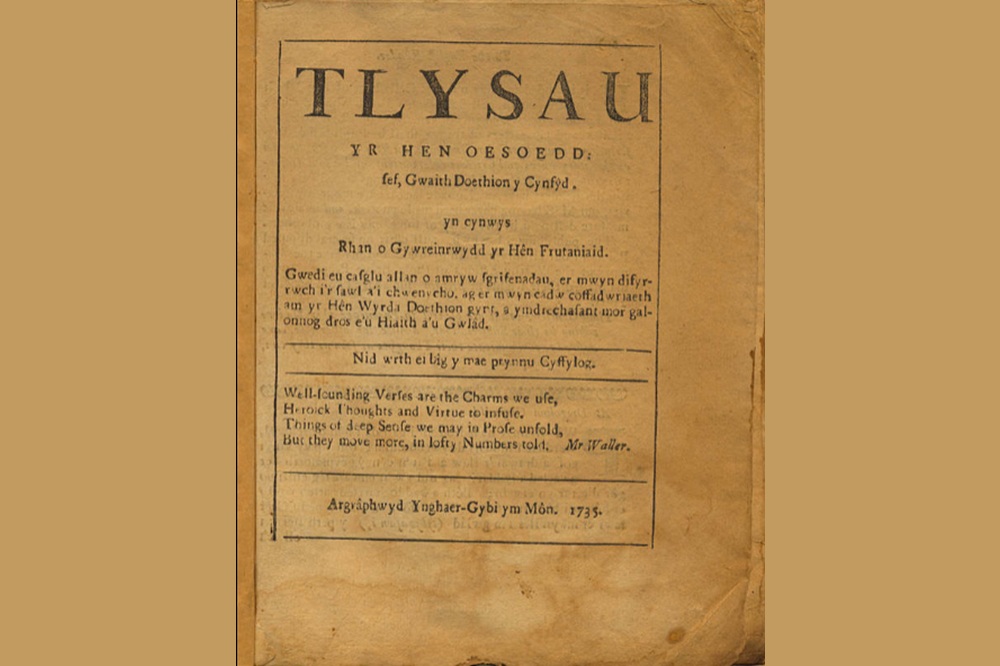
When Lewis Morris published Tlysau yr Hen Oesoedd (‘The Treasures of the Old Ages’) in Holyhead back in 1735, he was apparently hoping to establish a periodical. But only one number was produced, and so it appears in hindsight more as a one-off pamphlet rather than the start of a magazine.
A unitarian minister, Josiah Rees, launched Trysorfa gwybodaeth, neu eurgrawn Cymraeg (‘A Treasury of knowledge, or a Welsh magazine’) in 1770. It appeared fortnightly but ended before the end of the year having seen the publication of fifteen numbers.
The 1790s witnessed several new attempts, starting with Y Cylch-grawn Cynmraeg (‘The Welsh Journal’), but the energetic Welshmen behind it – including Morgan John Rhys and Dafydd Ddu Eryri – only managed to produce five numbers in 1793 and 1794.
Only three numbers of Y Drysorfa Gymysgedig (‘The Miscellaneous Treasury’) appeared in 1795, while Y Geirgrawn (‘The Thesaurus’ or ‘The Magazine’) reached a total of nine numbers in 1796 before dying.
A new attempt at the very end of the century would herald a new age in Welsh publishing. Two Calvinistic Methodist stalwarts, Thomas Jones of Denbigh and Thomas Charles of Y Bala, began producing a denominational periodical, Trysorfa Ysprydol (‘A Spiritual Treasury’), in 1799.
More than forty numbers would appear by the time publication ceased in 1827. It would soon be reborn as Y Drysorfa, but another Calvinisic Methodist periodical – variously named Goleuad Gwynedd (‘Light of Gwynedd’), Goleuad Cymru (‘Light of Wales’) and Y Goleuad (‘The Light’) – was already competing with it in the growing print market.
There was no lack of Welsh denominational periodicals by the second quarter of the century. Yr Eugrawn Wesleyaidd (‘The Wesleyan Magazine’) began appearing monthly in 1809 and the Baptist weekly Seren Gomer (‘Gomer’s Star’) emerged in 1814.
Welsh Congrationalists had their own monthly once Y Dysgedydd (‘The Teacher’) began publilcation in 1821.
Non-denominational newspapers
The next big development would come with the appearance of non-denominational Welsh newspapers around mid-century (Yr Amserau in 1843, Seren Cymru in 1851, Yr Herald Cymraeg in 1855 and Baner Cymru in 1857). However, we’ll keep our focus for now on those pioneering denominational journals.
This is how Thomas Charles and Thomas Jones presented Trysorfa Ysbrydol to their readers in 1799.
Annwyl Gyd-wladwyr,
Ein dymuniad hiraethlawn a pharhâus yw lles eich eneidiau anfarwol. A thra chysurus yw gennym weled arwyddion fod cynnifer ohonoch yn dwys-feddwl am yr achos mwyaf ei bwys, sef cyflwr eich eneidiau a’ch sefyllfa yn y byd tragwyddol. Pwy ni lwenhâi (oddieithr y sawl a garant y tywyllwch) wrth weled gwybodaeth yn amlhau, miloedd o ieunctid ein gwlad yn ymroddi yn awyddus i ddysgu darllen gair Duw, yn grandaw ei bregethu gydag awyddfryd a llawenydd, ac yn dangos arwyddion hefyd o’i effeithiau iachusol yn eu bucheddau?
‘Dear Fellow countrymen,
Our hankering and constant desire is for the benefit of your immortal souls. And it is very comforting for us to see signs that so many of you are thinking deeply about the matter of greatest import, namely the condition of your souls and your situation in the eternal world. Who (other than the ones who love darkness) does not take joy at seeing knowledge increasing, thousands of the youth of our country committing themselves eagerly to learn to read God’s word, listening to His preaching with eagerness and joy, and showing signs also of the beneficial effects in their lives?’
The growth of Welsh print culture gives the editors ‘joy’, for it is a means of ‘increasing knowledge’. They then stress their own decision to join in this good work, casting themselves as their readers’ ‘humble and unworthy servants’ (gweision gwael ac annheilwng) and stressing that they are taking advantage of the periodical format in order to ‘spread knowledge further amongst [them]’ ([t]aenu gwybodaeth eto fwy-fwy yn eich plith).
Certainly important in terms of Welsh religious history, this address is also significant in terms of Welsh literary history. Thomas Charles and Thomas Jones were helping to create the very readership which they sought to serve. A similar relationship between periodical, editor and readership is articulated again and again in other addresses heralding the birth of other periodicals. To take just one more example, readers of the first number of Y Dysgedydd were addressed thus in 1821:
Y mae yn gysur gennym feddwl fod syched am wybodaeth yn gyffredinol, ac am wybodaeth grefyddol yn cynyddu ymhlith ein cenedl, yn neilltuol ymysg ieuengctyd. A dywenydd gennym feddwl fod cymaint o ymdrech yn bod am dori eu syched, trwy gyhoeddiadau o’r argraffwasg. A dymuniad ein calonnau ydyw fod llwyddiant ar bob cyhoeddiad ag sydd yn tueddu at ogoniant Duw a llesâd dynion.
‘It is a comfort for us to think that a thirst for knowledge in general, and for religious knowledge specifically, is increasingly in our nation, especially amongst the youth. And it makes us glad to think that there is so much effort aimed at quenching their thirst, by means publications from the printing press. And it is our heart’s desire that each publication inclined to God’s glory and man’s benefit enjoys success.’
‘The youth’
Like the 1799 piece, this 1821 address tells us that the editors are targeting the ‘youth’ of Wales specifically. The future is what is at stake here. It is a future characterized by an engaged community of Welsh readers – the very community which these journals were helping to bring into being.
Further Reading:
Huw Walters, The Welsh Periodical Press, 1735-1900 (1987).
You can read many of these periodicals on the National Library of Wales’s website:
https://cylchgronau.llyfrgell.cymru/
https://papuraunewydd.llyfrgell.cymru/
Support our Nation today
For the price of a cup of coffee a month you can help us create an independent, not-for-profit, national news service for the people of Wales, by the people of Wales.


