


Yr Hen Iaith part 82: Eben Fardd (1802-1863)
Jerry Hunter
Mae’n gaethder bod mewn gweithdy – ar hyd nos,
Gwared ni rhag hynny!
Gwell man teg a lle mewn tŷ,
Rhyw gilan fer, a gwely.
It’s [like being in] captivity to be in a workshop all through the night,
Preserve us from that!
Better a nice spot and a place in a house,
A little nook, and a bed.
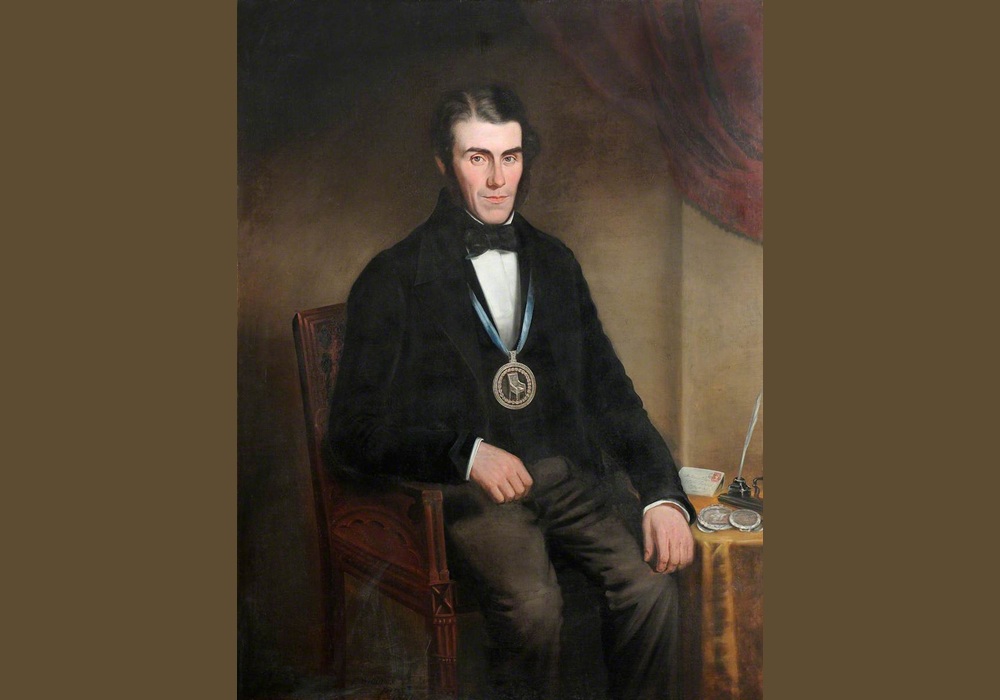
Ebenezer Thomas was born in 1802 near the village of Llangybi in Eifionydd. His father was a weaver, and the young Ebenezer got more than a small taste of the family trade.
He composed this englyn when, as a teenager, he was forced to stay awake while working for two nights in a row. It’s no surprise that he decided not to follow in his father’s footsteps. Having been educated at a series of local schools, he became a schoolmaster himself.
However, it is his bardic career which interests us here. Providing a brief look at the cultural context in which the young Ebenezer Thomas thrived is a nice way of getting to understand something about Welsh bardic culture during the first half of the nineteenth century in general.
There was more than one Cymdeithas Gymroawl or ‘Welsh Society’ in the region and they provided fertile ground for the young bard’s development.
In 1823 he composed a poem ‘addressing’ (annerch) one of these societies, greeting it’s members as ‘[ll]on weis o Lanystumdwy’, the ‘joyous lads of Llanystumdwy’, and praising them for their ‘gwaith clodadwy’, ‘praise-worthy work’, and their ‘mawr ymdrech’, ‘great effort’, on behalf of ‘[ei]n iaith lon’, ‘our joyous language’. In the same year he composed a series of englynion to Llangybi’s Cymdeithas Gymroawl. It begins by praising those who established the local society:
Mad waith fu gwneud Cymdeithas – gyda ni,
I gadw’n hiaith mewn urddas;
Na fo blwy heb brofi ei blas
Mwyneiddiawl, cymen, addas.
‘It was good work to establish a Society among us
In order to keep our language dignified;
Let no parish go without experiencing its
Gentle, elegant, fitting relish.’
He then names Aneirin and Taliesin in order to stress the antiquity of the Welsh bardic tradition, reminding contemporary poets that they are charged with continuing this ancient art and upholding the language of which it is a part:
Ninnau’n awr na fyddwn yn ôl – i’r rhain
Yn yr heniaith freiniol;
Gorhoffi iaith, – pob gair ffol
Chwynnwn yn llwyr o’i chanol.
‘For our part, let us not do less than they did
In [using] the privileged old language;
Cherrishing language, [and] every silly word
We will weed out from its midst.’
This poem employs an extended metaphor to describe poets as linguistic guardians, weeding out unsuitable words ‘in order that a tender improvement of the language’ (i dyner wellhad – yr iaith) can be ‘brought forth from the earth’ (dwyn o’r llwch).
If gardeners, Eifionydd’s poets are also champions, for ‘by means of extreme commitment’ (drwy eithaf ymroad), they will defeat ‘dispair’ (anobaith) over the fate the language and exile ‘opposition’(gwrth’nebiad) ‘from our country’ (o’n gwlad).
It was through his engagement with these local societies that Ebenezer Thomas earned the name Eben Fardd (‘Eben the Bard’). Associating with older and more experienced poets gave him an opportunity to hone his own craft. Some of the bards whom he got to know during these early years had national reputations, including Robert ap Gwilym Ddu (1766-1850) and Dewi Wyn (1784-1841).
As has been the case with so many Welsh poets over the centuries, it was winning an eisteddfod competition which launched Eben Fardd as a poet of national significance.
Eisteddfodau
While the National Eisteddfod would not be established for several decades, increasingly grand eisteddfodau were held in various places during the first half of the nineteenth century. Such was the 1824 Powys Eisteddfod in Welshpool, described in the periodical press at the time as ardderchog, ‘excellent’.
The theme for the awdl was set as ‘Dinistr Jerusalem gan y Rhufeiniaid’, ‘The Destruction of Jerusalem by the Romans’, and Eben Fardd’s victorious composition would become one of the most popular awdlau of the century. An awdl is a long poem employing a combination of the strict metres. Like many successful eisteddfodic awdlau, Eben Fardd’s ‘Dinistr Jerusalem’ moves between fast-paced exciting narrative segments and deeper, meditative sections.
It’s divided into three parts, the first describing Jerusalem in all its glory, the second narrating the Roman army’s attack upon and destruction of the city in the year 70 C.E., and the final constituting a meditation on the ruins.
The poet’s persona travels through time, witnessing the various periods in Jerusalem’s life and death and thus allowing us to see these scenes as well. He is camped outside of the city’s walls when the Romans attack and sees the approach of the enemy. For this section Eben Fardd uses the cywydd metre, often employed by eisteddfodic poets as the awdl’s workhorse and used to carry most of the narrative’s weight:
I’r ddinas mae myrddiynau
Megis seirph am agosâu
Gwelaf, debygaf o bell,
Ymwibiant ger fy mhabell;
A’u edrychiad yn drachwyrn,
Dewrllu yn canu eu cyrn!
‘Legions draw near to
The city, like serpents;
I see, I make it out from afar,
[And then] they move swiftly past my tent;
Their appearance furious,
A fearless host blowing their horns!’
The seeing is augmented by hearing; in addition to the battle horns leading the long columns of Roman troops snaking towards Jerusalem, we are asked to hear ‘the clanking of bright weapons’ (tincian eirf glân).
Assault
The assault is described in detail, and then, switching to the englyn unodl union metre, Eben Fardd crystalizes the scene when the Roman host invades the city itself:
Hyf lueddwyr, hwy a floeddiant – i’r frwydr
Ar frys y goruthrant;
Y Ddinas a feddiannant,
Â’u holl nerth ei dryllio wnânt.
‘Bold warriors, they cry [and] to the battle
They charge swiftly;
They capture the city,
And they will shatter it with all of their might.’
Unlike those nineteenth-century histories which describe the Roman Empire as a civilizing force, Eben Fardd paints these legions as the very opposite. They are barbarians sacking a cultured city, anwar filwyr, ‘uncivilized soldiers’, who delight in burning beautiful buildings.
That archetictural anchor of the Judaism, the Temple of Jerusalem, most yield to the flames as well: Y gampus Deml a gwympa – cyn pen hir, / Ac O! malurir gem o liw eira (‘The splendid Temple will fall soon, And Oh! A snow-coloured gem [of a building] is smashed’).
Burning
It’s impossible to read these lines without letting our imagination see and hear a great building burning down: there is ‘an unnatural hissing ‘(si annaturiol) as the fire consumes it, and a great cracking like ‘the sound of a thunderclap’ (sŵn taran), and then we hear ‘the beams crackling’ (trawstiau’n clecian).
As the remnants fall in the conflagration, the dying building ‘vomits from its innards its wood and its stones’ (chwyda o’i mynwes ei choed a’i meini).
Beholding the aftermath of this ruination is quite an experience, and that experience is summarized in a powerful line which translates as ‘And beholding it is a mirror of sadness’. Note how the cynghanedd internal line ornamentation ensares the ear while using the repetition of consonants to yoke words together in a way which intensifies meaning: A drych o dristwch yw edrych drosti.
The third and final section of the awdl is driven by the ubi sunt theme (Latin for ‘where are they?’), a theme central to so much poetry from so many eras and cultures which meditates on people, communities and civilizations lost.
Caersalem, deg em, digymar – oeddit,
Addurn yr holl ddaear;
Wedi’th gwymp pwy gwyd a’th gâr?
Ymgelant ym mhau galar.
‘Jerusalem, you were a fair gem, unparalled,
An adornment for the entire earth;
After your fall who will arise who will love you?
They hide in the land of grief.’
The closing verse begins with the line Ah! Wylaf, ac af o’i gwydd, ‘Ah! I cry, ac I go from its sight’; the poet’s persona, having surveyed the ruins, turns and leaves, marking the place as forever annedwydd, ‘wretched’, and lamenting the ‘destruction and judgement which came upon it’ (Distryw a barn ddaeth arni).
Praise
Eben Fardd would go on to compose many more poems, some of which enjoyed popularity in their day as well as the praise of critics in subsequent periods. However, he would always be known first and foremost for the eisteddfodic awdl on ‘The Destruction of Jerusalem’ which he composed when he was only twenty-two years old.
Further reading:
G. Millward, Eben Fardd (Gwasg Pantycelyn, 1988).
Ebenezer Thomas, Eben Fardd (Dalen Newydd, 2014).
Eben Fardd, Dinistr Jerusalem a Cherddi Eraill (Melin Bapur, 2024).
Support our Nation today
For the price of a cup of coffee a month you can help us create an independent, not-for-profit, national news service for the people of Wales, by the people of Wales.


