

Yr Hen Iaith part 83: The exiled Welshman’s hiraeth and a proto-novel: Cawrdaf
Jerry Hunter
In the last instalment we discussed Eben Fardd’s awdl on ‘The Destruction of Jerusalem’, one of the most popular awdlau of the nineteenth century. (Remember that, in this context, an awdl is defined as a long poem employing a combination of the traditional strict metres.)
Before diving into another eisteddfodic awdl, it’s worth providing a little context.
Although the inaugural National Eisteddfod would not be held until 1861, the first half of the nineteenth century was punctuated by a series of well-publicized eisteddfodau, some held under the auspices of one of two societies, the Gwyneddigion or the Cymreigyddion, and some billed as eisteddfodau taleithiol (‘regional eisteddfodau’).
While these festivals generated a considerable amount of interest and energy, the poetry which they generated often contain little to inspire readers today.
In addition to the sentimental tones and stilted turns of phrase, the subject matter was often dictated by British imperial hubris and the dead hand of monarchy. There is not much in these long poems which Nation.Cymru’s readers would appreciate today.
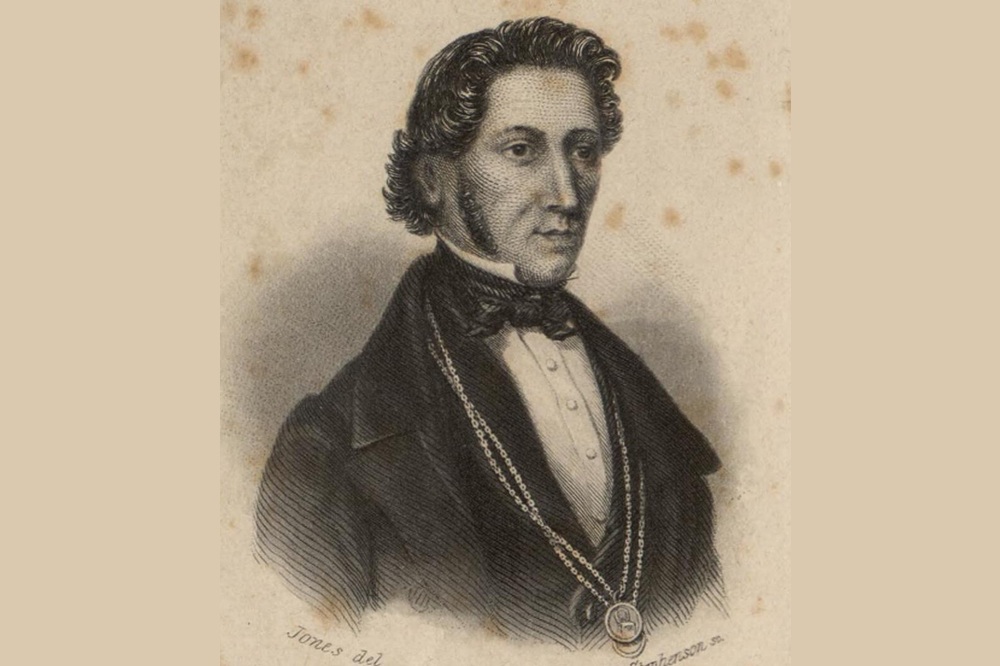
Compositions by William Ellis Jones (1795-1848) provide good examples of eisteddfodic awdlau from the period. A native of Abererch in Eifionydd, Jones borrowed his bardic name, Cawrdaf, from the saint to whom the local church was dedicated. He spent time in London and other English cities before returning to Wales, working as a printer and an illustrator. He was also employed as an artist by a wealthy patron who took him on a European tour.
Cawrdaf won in the 1824 Gwent Eisteddfod with his awdl on ‘The Regency of George IV’ (‘Rhaglywiaeth Sior y Pedwerydd’).
Despite his mastery of cynghanedd and the strict metres, the obsequious tone engendered by the subject matter make it one of the many eisteddfodic compositions from the period which are eminently forgetable.
Other awdlau produced by Cawrdaf for eisteddfodau include one on the ‘Druids’ (‘Derwyddon’) of the Island of Britain (1834) and one on ‘Job’ (1840).
Cawrdaf’s most successful eisteddfodic awdl – if we measure success in terms of its popularity during the rest of the ninenteenth century and its subsequent place in Welsh literary canons, not to mention this critic’s subjective analysis – was the first one he composed after returning to Wales, ‘Hiraeth Cymro am ei Wlad mewn Bro Estronol’, ‘A Welshman’s Longing for his Country in a Foreign Land’, composed for the 1820 Wrexham Eisteddfod (the competition was actually won by Ieuan Glan Geirionydd, whom we’ll meet next time).
The title set by the eisteddfod organizers was appealing for two obvious reasons: hiraeth was becoming an increasingly popular theme for Welsh poets, and meditations on the fate of an expatriate was sure to touch a chord with a great many Welsh readers.
Migration
People were leaving Wales in increasing numbers: in addition to migration for work in English cities,
Welsh emigration to America was steadily increasing. (The 1850 United States census would record nearly 30,000 people born in Wales).
Like many of the best eisteddfodic awdlau, this one is driven by a strong narrative impulse. Cawrdaf begins with an englyn unodl union in which we hear his poem’s persona bemoaning his fate:
Hiraethais, cwynais acenion – ganwaith,
O gyni Bro Estron;
Yn gaeth, ac alaeth calon,
Am ryw le yn Nghymru lon!
‘I longed, I voiced complaining tones a hundred times
from the anguish of captivity in a Foreign Land
and [from my] heart’s sorrow,
for a place in happy Wales!’
In the next englyn he claims that his emigration has made him estron, ‘foreign’, to his home, Gwynedd, stating powerfully that his heart is captive yng nghyffion oerion Hiraeth (‘in the cold shackles of hiraeth [longing]’).
The Welsh expatriate’s fate is described repeatedly as imprisonment, suggesting the economic circumstances which drove many to leave the land of their birth rather than a free soul who has chosen to leave home for the sake of adventure.
In a well-crafted awdl, the poet’s choice of metres enhances the flow of meaning. In other words, formal structure works together with thematic development.
The cywydd metre, couplet-based and thus flexible in terms of length, is often used for faster-paced narrative sections. In one of the most memorable parts of Cawrdaf’s ‘Hiraeth Cymro am ei Wlad’, he uses a series of cywydd couplets to present the exiled Welshman’s fear that he will die abroad:
Os fy Nêr â doethder da
A rydd im orwedd yma,
I’m mynwes mor ddymunol,
Uwch fy nghlai, fyddai ar f’ôl
Arwyddo’r lle gorweddwn
Yn y llawr, â’r pennill hwn:
‘If my Lord with good wisdom
Has me lie here,
My heart greatly desires
That there be after me [a gravestone] above my remains
Marking the place where I lie in the earth
With this verse:’
Emotional peak
The exile’s story reaches an emotional peak here, and we pause, digesting the possibility that he will die and be buried in a foreign land. This pause is facilitated by the punctuation (the colon after ‘y pennill hwn’, ‘this verse’, sets up the following lines).
Cawrdaf also marks this poignant place in his narrative with a shift in metres, leaving the cywydd and inserting an englyn unodl union:
Awenawg ŵr o Wynedd — o hiraeth
A yrrwyd i’r llygredd,
Ar arall dir i orwedd;
Dyma fan fechan ei fedd.
‘A poetry-loving man from Gwynedd – because of hiraeth [‘longing for home’]
He was driven to death
And to lie in a foreign land;
This little place is his grave.’
It is difficult to find a more effective change in metre in any awdl from any century. In addition to the structured pause described above, the formal aspect goes hand in hand with the narrative absorbing us, for this exact metre – the englyn unodl union – is often used for epitaphs on grave stones. Indeed, englynion can be seen on a number of headstones in American cemetaries.
It’s tempting to read this awdl in the context of Cawrdaf’s biography; after all, he composed it during his first months back in Wales after spending several years in England, France and Italy.
We can also speculate that his travels partly inspired the expiremental prose work which he published in 1830, Y Bardd, neu, y Meudwy Cymraeg: yn cynwys teithiau difyr ac addysgiadol y bardd gyda rhagluniaeth (‘The Poet, or, the Welsh Hermit: including the poet’s interesting and educational travels with providence’).
Welsh novel
Future instalments in this series will devote more attention to the genesis of the Welsh novel.
Part of this complicated story involves the efforts of Nonconformist authorities to dictate reading habits, for nineteenth-century ministers and deacons urged chapel-goers to avoid reading for pleasure alone and seek out literature which was religious and character-building.
Put simple, the novel was cast as a morally suspect literary form. This explains why Cawrdaf’s title entices readers with a promise of adventure while also tacking on the adjective addysgiadol, ‘educational’, and ending with words bearing a puzzling grammatical connection with the rest of the title – gyda rhagluniaeth, ‘with providence’.
A narrative relating exciting travels might be acceptable if the story is also ‘educational’ and displays the workings of Divine Providence.
This is a long work of fiction, more than 260 pages in length. Some have suggested that it is the earliest Welsh novel, while others disagree. Dafydd Jenkins suggested that Cawrdaf’s book is more in the lineage of Ellis Wynne’s 1703 moralizing allegory, Gweledigaethaeu Y Bardd Cwsc, and there is much to this conclusion.[1]
However, there are elements which have more in keeping with later nineteenth-century novels than with the ‘Visions’ structuring Wynne’s masterpiece.
It is perhaps safest to describe Cawrdaf’s book as a ‘proto-novel’.
Daniel Owen
In simplified histories of the Welsh novel, Daniel Owen (1838-1895) usually takes pride of place as the first ‘real’ Welsh novelist, and the most well-trodden quote of his is the one on the base of his statue in Yr Wyddgrug (Mold): ‘nid i’r doeth a’r deallus yr ysgrifennais ond i’r dyn cyffredin’ (‘it is not for the wise and the intellectual whom I wrote but for the common person’).
Cawrdaf’s introduction begins with a similar statement, one which we can take as a strategical shot at earning a wide popular readership:
Fy Nghydwladwyr,
Rhag eich siomi yn y Llyfryn hwn, bydded hysbys i chwi, na cheisiais ei nodi â llaw ardderchogrwydd, iaith flodeuog, na drychfeddyliau hedegog; pe buasai i mi wneyd hyny ni atebai y dyben oedd genyf wrth ei ysgrifenu a’i gyhoeddi. [ . . . .] Fy ymgais a’m dymuniad ydyw i’r Llyfr hwn fod yn ddefnyddiol i agor llygaid tylawd a chyfoethog i gyndabod llaw Duw[.]
‘My Fellow Compatriots,
Lest you be disappointed by this little Book, please know that I did not try to compose it with a hand of splendour, flowery language, or flights of fancy; if I had done that it wouldn’t have met the goal which I had in writing and publishing it. [ . . . .] My aim and my desire is that this Book is useful for opening the eyes of the poor and the wealthy to acknowledge God’s hand.’
In addition to assuring potential readers that this book won’t be difficult to digest, Cawrdaf also repeats the title’s assurance of religious edification. This out of the way, the opening sentences of the first chapter offer the excitement suggested by the title’s promise of teithiau difyr, ‘interesting travels’. The well-travelled narrator places us with him on the deck of the ship which is bringing him home to Wales after journeying abroad:
Ar fore Sadwrn, tua chanol mis Ebrill, ac awel lem o’r de-orllewin yn chwythu y llong yn nghylch deng milldir yr awr, clywwn forwr ag oedd ar ben yr hwylbren yn bloeddio, Tir! tir! tir! ac anhawdd iawn mynegu profiad rhai o honom pan adnabuom mai tir hên Gymru oedd o’n blaen. Gwelem, megys cymmylau ar y terfyn-gylch, fryn yn dyrchafu uwch bryn, a mynydd uwch mynydd, gyda dyffrynoedd gwyrdd-leision a pharadwysaidd yn llechu o dan eu cysgod[.]
‘On Saturday morning, about the middle of April, with a sharp breeze from the south-west blowing the ship around ten miles an hour, we heard a sailor who was on top of the mast shouting, “Land! land! land!,” and it’s very difficult to express the experience of some of us when we realized that it was the land of old Wales which was before us. We saw, like clouds on the horizon, hill rising up beyond hill, and mountain beyond mountain, with fresh green paradisaical valleys lying in their shelter.’
Homecoming
The joyous homecoming is soon shattered by a fear of death: a storm takes the ship and throws it into peril: ‘gwelem mai i ddannedd creigiau geirwon a dychrynllyd yr oeddym yn sicr o fyned’ (‘we saw that it was to the teeth of harsh and fearsome rocks that we were certain to go’).
The ship is indeed wrecked, and, to make things worse, there are yspeilwyr, ‘looters’, on shore waiting to steal what cargo they can. The narrator of course survives, and he is sheltered by a local vicar who provides his own narration within the overarching narrative, adding extra layers of melodramatic excitement as he tells the traveller how he plucked him from the wreckage while also telling him (and us) about the doings of the seaside thieves.
In the next chapter, the narrator, still aided by the vicar, visits the book’s eponymous Bardd in a nearby cottage, and the bard then relates his story, punctuated by poetry composed at key junctures in his life. And so the book rambles on, blending amazing scenes (including a visit to a sumptuous palace) with didactic episodes (at point the Bard tells of his doings with the Cymdeithaas y Beiblau, ‘The Bible Society’).
At its best, Cawrdaf’s proto-novel is reminiscent of Daniel Defoe’s Robinson Crusoe, and the most exciting passages do engage those readers who are willing to suspend their disbelief. There are also well-crafted sentences which ensure the book a place in the history of creative Welsh prose. On the other hand, while a forgiving modern reader might turn a blind eye to the melodrama and the heavy-handed moralizing, the lumbering – and often stumbling – manner in which the story progresses is harder to forgive.
Further Reading:
Cawrdaf’s proto-novel, Y Bardd neu’r Meudwy Cymreig, has been digitized by the National Library of Wales:
[1] Dafydd Jenkins, ‘Y Nofel Gymraeg Gynnar’, in Gerwyn Wiliams (ed.), Rhyddid y Nofel (Cardiff: University of Wales Press, 1999).
Support our Nation today
For the price of a cup of coffee a month you can help us create an independent, not-for-profit, national news service for the people of Wales, by the people of Wales.


