

Yr Hen Iaith part 85: Sharing Welsh treasures in a distant land
Jerry Hunter
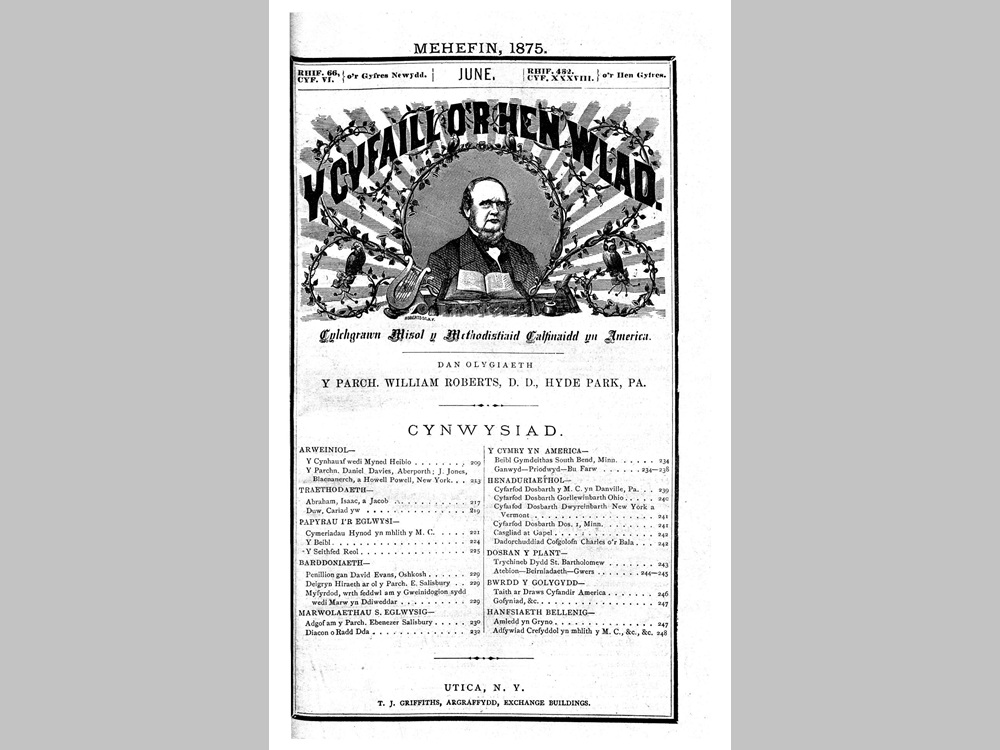
The first copy of Y Cyfaill o’r Hen Wlad yn America (‘The Friend from the Old Country in America’ ) appeared in January, 1838.
Its front page declared that it was published in Caerefrog-Newydd or ‘New York [City]’, providing a prominent early example of the way in which Welsh-speaking immigrants sometimes took conceptual possession of their new American homes by creating very Welsh versions of very American place names.
Six years previously, another periodical, Cymro America (‘the Welshman of America’) had been published in the same city, but it only lasted for a few months.
While some scholars have suggested that it was the 1832 cholera epidemic which brought it to a premature end, I suspect that another factor contributed to that early Welsh-American periodical’s failure: it was a bilingual publication, and most Welsh immigrants at the time were monoglot Welsh speakers upon arriving in their new country.
Whatever the reason – or combination of reasons – for the failure of Cymro America, the periodical launched in 1838 would succeed, and Y Cyfaill o’r Hen Wlad yn America would remain a cornerstone of Welsh-American publishing for nearly a century.
The Cyfaill was a denominational journal, designed to serve the Welsh-speaking Calvinistic Methodists of the United States. Two years later, Welsh-American Congrationalists would launch their monthly, Y Cenhadwr Americanaidd (‘The American Missionary’), and the Baptists would join the field in 1844 when Y Seren Orllewinol (‘The Western Star’) appeared.
Despite their denominational affiliations, all three of these periodicals sought to serve Welsh-speaking Americans in general; while they did contain a considerable amount of religious material, they also published news stories (including American news, Welsh news, British news and world news), poetry and other cultural content of a non-religious nature.
In 1851, a non-denominational Welsh-language weekly newspaper, Y Drych (‘The Mirror’) began publication.
While other smaller periodicals came and went, and while Welsh books continued to be printed on American presses (as was discussed in episode 75 in this series), by the middle of the century, the contours of Welsh-American publishing were largely defined by these three monthly journals and this weekly newspaper.
Creative writing
Interestingly, the very first piece in that very first number of the Cyfaill is a piece of creative writing (most likely penned by the editor, William Rowlands).
This is an ymddiddan or ‘dialogue’ between the personified journal and a Welsh-American everyman who is simply styled Cymro. It begins with an exchange of seasonal greetings, leading us to imagine the Cyfaill visiting the Cymro in his American home during the first days of 1838:
Y Cyfaill[:] Blwyddyn newydd dda i chwi, a llawer o honynt.
Cymro[:] Diolch yn fawr i chwi, am eich cyfarchiad caredig. Dymunwn yr un peth i
chwithau.
‘The Friend: A happy new year to you, and many of them!
The Welshman: Thank you very much for your kind greeting. I wish you the same thing.’
The Cymro is perplexed, however, and he can’t help saying that ‘it is a very strange thing for me to hear the language of my mother from a stranger in this country’ (mae yn beth go ryfedd gennyf glywed iaith fy mam gan ŵr dieithr yn y wlad yma).
This might be taken as a playful exploration of a growing realitiy. Welsh emigration to the United States was steadily increasing.
Census
The first US census noting immigrants’ places of origin was in 1850, and it would record nearly 30,000 people born in Wales. All of these would’ve spoken Welsh, and many of them raised their American children speaking Welsh.
While it was ‘very strange’ to hear Welsh spoken in North America at one time, by the middle of the nineteenth century it would be central to the fabric of a number of communities in several states, including New York, Pennsylvania, Ohio and Wisconsin.
Perhaps the most interesting part of this dialogue is when the curious Welshman notices the ‘pack’ (sypn) which his new Friend is carrying and asks him what it contains.
The Friend answers in a way which promotes the ‘value’ of the journal’s contents: ‘I have valuable treasures in the pack for sharing amongst the Welsh in America’ (Trysorau gwerthfawr sydd gennyf yn y sypyn i’w gyfrannu ymhlith y Cymry yn America.) The Welshman grows excited:
Cymro [:] Trysorau! Rhyfedd iawn – o b’le?
Cyfaill[:] O’r hen wlad.
Cymro[:] Ai o Gymru yr ydych yn meddwl?
Cyfaill[:] Ië, yn sicr.
Cymro[:] Wel, y mae hynny yn rhyfedd! Nyni a adawsom yr hen wlad i chwilio am drysorau yn y wlad hon: ac yr oeddem wedi anobeithio gweled lliw trysorau Cymru byth.
‘Welshman: Treasures! How strange – from where?
Friend: From the old country.
Welshman: Do you mean from Wales?
Friend: Yes, certainly.
Welshman: Well, that is strange! We left the old country to search for treasures in this country: and we had given up hope of ever seeing the colour of Wales’s treasures.’
Real experience
This exchange is rooted in the real experience of thousands of poor Welsh immigrants who left their homes in the hopes of finding a more comfortable life in America. However, this immigrant has jumped to conclusions and the Friend must correct him:
Pwyllwch, pwyllwch! Yr ydych yn camsynied natur y trysorau sydd gennyf, tybiwyf. [ . . . .] Nid trysorau aur ac arian sydd gennyf – ond trysorau gwybodaeth, y rhai er hynny, ydynt yn rhagori ar fwnau gorau’r grëadigaeth.
‘Hold on, hold on! You mistake the nature of the treasures which I have, I think. [ . . .] It is not treasures of gold and silver which I have – but rather treasures of knowledge, ones which, despite that, are better than the best ores of creation.’
This playful dialogue also draws attention to a truth essential to the maintenance of Welsh identity in the diaspora: the ‘treasures’ of culture are transmitted by means of language. Welsh culture can be maintained anywhere in the world, as long as immigrants carry these metaphorical treasures in their metaphorical packs.
And the periodical press would prove to be an effective way of adding to the Welsh-language treasures which immigrants brought with them from the ‘old country’.
Further Reading:
Jerry Hunter, Chapter 1 (‘The Bards and the Bowie Knife’) yn Sons of Arthur, Children of Lincoln [:] Welsh Writing from the American Civil War (Caerdydd, 2007).
‘Y Gymraeg y tu allan i Gymru: Cipolwg ar Lenyddiaeth Gymraeg yr Unol Daleithiau, 1838-65’, yn Angharad Naylor, Llion Pryderi Roberts a Dylan Foster Evans (eds.), Beth yw’r Gymraeg? (Caerdydd, 2023):
https://www.uwp.co.uk/app/uploads/9781786839503_WEB-1.pdf .
Rhiannon Heledd Williams, Cyfaill Pwy o’r Hen Wlad? [:] Gwasg Gyfnodol Gymraeg America 1838-1866 (Caerdydd, 2017).
In order to learn more about NAASWCH: https://www.naaswch.wales/saesneg-home
Support our Nation today
For the price of a cup of coffee a month you can help us create an independent, not-for-profit, national news service for the people of Wales, by the people of Wales.
Get more trusted Welsh news
Choose Nation.Cymru as a preferred source in Google News to see more of our journalism.



