

Yr Hen Iaith part 86: The ‘Treachery of the Blue Books’ and R. J Derfel’s dramatic response
 Jerry Hunter
Beelzebub sits on ‘a throne of malice’ (gorsedd malais). He is surrounded by his ‘main advisors’ (prif gynhorwyr), including Revenge (Dialedd), Jealousy (Cenfigen) and Hypocasry (Rhagrith). The forces of Hell are planning an assault on Wales, as the ruling devil explains:
Tân brwmstan gwyllt, darperwch fflamllyd Gethern,
Mwynhewch ei wrês â holl feginau uffern,
I drochi’r CYMRY yn ei fflamau gwyrddion;
I’w poeni – tyngaf fil-fyrdd o ellyllon!
Pob un a ddaw o’r genedl atgas yma
Eu hyrddio wnaf i lawr i’r dyfnder eitha’,
I gael eu rhwygo gan bicellau gwynias,
A seirph a dreigiau tanllyd yn gymdeithas:
Mae enw’r CYMRY bron mor anyoddefol
Gan lîd fy mron, ag enw’r Duw tragwyddol[.]
‘The fire of wild brimstone, prepare a flaming Legion of Devils,
Feed its heat with all of the bellows of hell
To drown the WELSH in its bluish green flames;
And to inflict pain upon them – I swear [to send] a thousand myriads of fiends!
Everyone who comes here from the hated nation [i.e., Wales]
I will shove down into the furthest depths
To be torn by white-hot pitchforks,
With serpants and firey dragons as companions:
The name of the WELSH is almost as intolerable
to my heart’s anger than the name of enternal God.’
So begins R. J. Derfel’s Brad y Llyfrau Gleision (‘The Treachery of the Blue Books’). Beelzebub is a personification of anti-Welsh British authority and his legions of devils are manifestations of the many faces of condescension shown to the Welsh people.
Published in 1854, this book was a forceful and radically creative reaction to the official reports published seven years earlier.
The official title of the three long volumes published in 1847 is The Reports of the Commissioners of Inquiry into the State of Education in Wales. It stemmed from a motion introduced in Parliament by William Williams, a Welshman serving as M.P. for Coventry.
There were growing concerns in the British government over unrest in Wales following the Rebecca Riots and riots in some industrial centres in south Wales. The three ‘commissioners’ selected to undertake the ‘inquiry’ were English lawyers who could speak no Welsh (and yet were supposedly assessing the state of education in a nation where the majority of the population could not speak English).
Additionally, they were Anglicans with very little sympathy for Welsh Nonconformism (and thus unlikely to value the educational roles filled by Welsh chapels and their Sunday schools).
Finding fault
The published Reports – termed ‘the Blue Books’ because of the colour of the covers – provided an overwhelmingly negative view of Wales, finding fault with Welsh education, religion, morality and culture.
As we’ll discuss in a future instalment, Welsh women were signalled out for special criticism as well. And the Welsh language was vilified as a barrier to all things good:
The Welsh language is a vast drawback to Wales, and a manifold barrier to the moral progress and commercial prosperity of the people. It is not easy to over-estimate its evil effects. It is the language of the Cymri, and anterior to that of the ancient Britons. It dissevers the people from intercourse which would greatly advance their civilisation, and bars the access of improving knowledge to their minds. As a proof of this, there is no Welsh literature worthy of the name.
There you have it; three Englishmen who couldn’t read Welsh declaring that there was ‘No Welsh literature worthy of the name’!
Welsh poets and writers reacted to this insult, directly or indirectly, in a variety of ways. As we’ll see in future instalments, some fell prey to the inferiority complex which this authoritative publication was designed to instil and strove to prove to the big British brother and to the Welsh themselves that they were a moral, religious and cultured people.
R. J. Derfel reacted by damning the Reports as a devilish assault upon Wales – while also claiming the nation to be the opposite of every criticism levelled at it by the Blue Books.
Nation-building
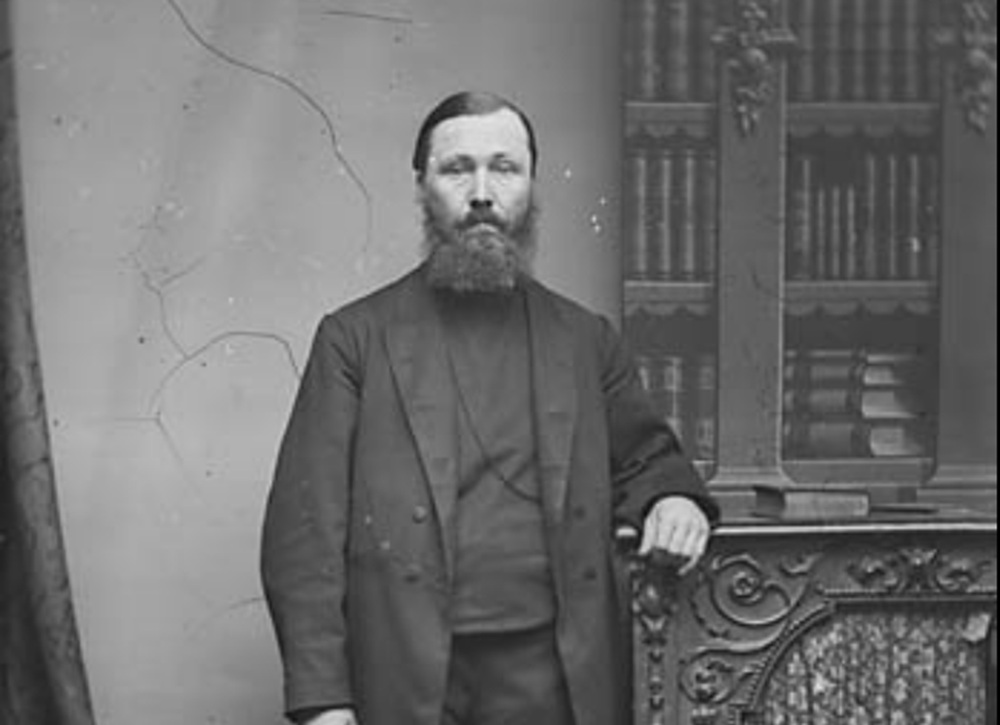
Robert Jones was born in the Llandderfel region of Merionethshire in 1824. He moved to Manchester when he was 21 years old, working for Welsh merchants there. He played an active role in the city’s Welsh literary society, adopting the bardic name ‘Derfel’.
A pioneering Welsh nationalist, R. J. Derfel wrote plans which foresaw some of the most important nation-buildings steps of the future, including the creation of a Welsh national library, a national museum, a Welsh-language school system and Welsh universities. He was also a pioneering socialist, and composed poetry such as Cwyn y Gweithwyr (‘The Workers’ Complaint’) which presented his anti-capitalist stance to readers.
However, Brad y Llyfrau Gleision is his most ambitious work. Nearly 200 pages long, it is a metrical drama, divided into gweithredoedd (‘Acts’) and swllau (‘scenes’). R. J. Derfel uses the speech of the devils to characterize them in elaborate detail and he employs the hellish assault on Wales as a vehicle for extolling the country’s virtues. Take, for example, the reply which a devil named Siom (‘Disappointment’) gives Beelzebub:
Ein pennaeth uchel! Cyfiawn yw dy gwynfan:
Yr ydym bron a cholli cenedl gyfan!
Nid oes ar wyneb daear bobl mor fradus
A’r CYMRY hyn, na neb mor elyniaethus
I dy lywodraeth di[.]
‘Our great leader! Just is y ur complaint:
We have almost lost an entire nation!
There is not on the face of the earth a people so treacherous
And so opposed to your government as the WELSH.’
The metrical play includes a wonderfully grotesque reflection of the three Anglican lawyers sent to Wales by the British government. Beelzebub sends ‘three spies’ (tri ysbïwr) to Wales, namely Haman (described as Aelod o Goleg Belial, a Meistr yr holl Asynod, ‘A Member of Belial’s College, and Master of All the Asses’), Judas Iscariot and Simon y Swynwr, (‘the Sorcerer’). When they arrive in Wales, Haman complains that ‘the stench of Nonconformism is in the air’ (mae arogl Ymneillduaeth ar yr awyr). Judas Iscariot complains agrees, and Simon the Sorcerer adds that ‘Nonconformism makes everything in the Principality a little ugly’ (mae Ymneillduaeth yn hyllu dipyn ar y Dywysogaeth).
The Welsh characters embody Nonconformist Wales in a very different way. They include Methodist Jones, Anibynwr Davies (‘the Congregationalist’), Bedyddiwr Williams (‘the Baptist’), Wesley Roberts, Athronydd Edwards (‘the Philosopher’) and Llewelyn y Bardd (‘the Poet’) . . . as well as Eglwyswr Fychan (‘the Little Anglican’). In the final scene, Llewelyn the Poet provides his analysis of what has transpired:
Do, do, fy ngwlad, cynllwynwyd yn dy erbyn,
Ond ti orchfygaist, er mor gryf dy elyn;
Er cael dy daro ar dy fan tyneraf,
Ni chwympwyd di, – am hyny llawenychaf,
[ . . . .]
Edrychir arnat gyda llygad gwawdiaeth,
A cheisir llwyr ddyddymu dy fodolaeth:
A gant hwy lwyddo, O fy ngwlad anwylaf?
‘Na chant, na chant,’ dy lais yn ateb glywaf, –
Na chant byth – byth, medd llais fy nghalon inau[.]
‘Yes, yes, my country, there was scheming against you,
But you triumphed, despite how strong your enemy was;
Despite being struck in your most sensitive place,
You were not knocked down – and for that I rejoice.
[ . . . .]
You are gazed upon with mockery’s eye,
And the complete erasure of your existence is attempted:
Will they succeed, oh my dearest country?
“No, no”, I hear your voice answering, –
“They never will – never”, my own heart’s voice says.’
J. Derfel describes the Blue Books as an attempt at ‘erasing’ the very ‘existence’ of the Welsh. Indeed, the programme suggested by the Reports might be described with a term used by modern champions of minoritized peoples as ‘ethnocide’.
Treachery of the Long Knives
J. Derfel’s creative attack on this attempt at erasing the existence of the Welsh is not read widely today. However, the phrase he coined for his 1854 work’s title is still used. I am sure that he modelled it consciously on a pre-existing phrase, Brad y Cyllyll Hirion.
That one, ‘the Treachery of the Long Knives’, has been used for centuries to describe a supposed incident during the early interactions between the Ancient Britons and the Anglo-Saxons when the later betrayed the former, treacherously murdering their leaders during a feast.
Both phrases have the exact same number of syllables and have brad, ‘treachery’, modified by a plural noun which is in turn modified by a plural form of an adjective. You can hear Brad y Cyllyll Hirion echoing in the phrase Brad y Llyfrau Gleision. This is a subtle way of suggesting that the most recent assault on the existence of the Welsh is but one more manifestation of a long-lasting drive to extinquish them as a nation.
Further Reading:
You can read both the original ‘Blue Books and R. J. Derfel’s Brad y Llyfrau Gleision on the website of the National Library of Wales:
Melin Bapur has recently published a collection of R. J. Derfel’s poetry:
J. Derfel, Cwyn y Gweithwyr a Cherddi Eraill (Melin Bapur, 2025).
Support our Nation today
For the price of a cup of coffee a month you can help us create an independent, not-for-profit, national news service for the people of Wales, by the people of Wales.
Get more trusted Welsh news
Choose Nation.Cymru as a preferred source in Google News to see more of our journalism.


