


Yr Hen Iaith Part 87:Welsh Women’s Writing in the Shadow of the Blue Books
Jerry Hunter
Welsh women were singled out for special criticism in the ‘Blue Books’ published in 1847.
Called ‘slovenly’ and ‘ignorant’ in this official governmental report, the women of Wales were described as faulty in terms of their morals, their manners, their culture and their education.
One attempt at countering this attack came in the form of a new journal, Y Gymraes: cylchgrawn i ferched Cymru (‘The Welshwoman: a journal for women’), which began appearing in 1850, but came to an end the following year because of its editor’s untimely death.
In a masterful study of the ways in which Welsh women were imagined in literature during the second half of the nineteenth century, Jane Aaron describes the literary ramifications of the Blue Books:
O ffwrneisi a daniwyd yn 1847, gyda chyhoeddi Adroddiad Dirpwywyr Addysg y wladwriaeth Brydeinig, y daeth y ddelwedd newydd. [ . . . .] O burdan enllib y Sais ymrithiodd yr arwres newydd, yn bur, yn dduraidd, ac yn hunan-ymwybodol Gymreig.[1]
‘From fires lit in 1847, with the publication of the Report of British state’s Education Commissioners, came the new image. [ . . . .] The new heroine emerged from the purgatory of the Englishman’s slander, pure, steel-like, and self-consciously Welsh.’
There was a distinctly literary aspect to the promotion of the new Welsh heroine, and it is surely no coincidence that the first volume of Welsh-language poetry by a woman ever published appeared in 1850, three short years after the ‘slander’ of the Blue Books was presented to the English-speaking world.
Publicly acceptable
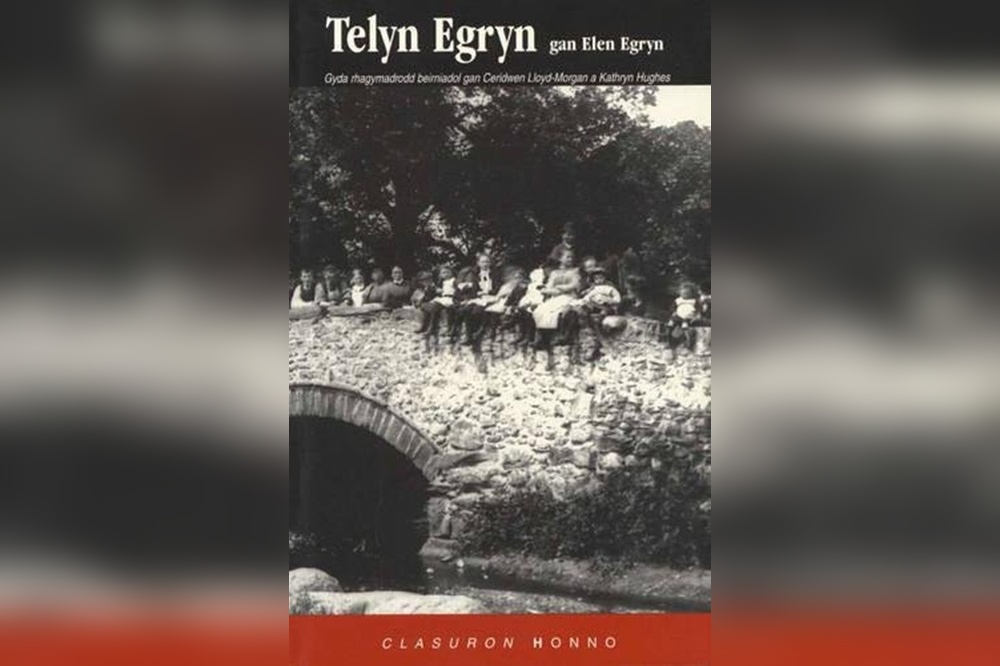
Elin Evans (1807-1876) was from Llanegryn in Merionethshire. Given to writing from a young age, she adopted the bardic name Elen Egryn. She described her 1850 book metaphorically as Telyn Egryn, ‘Egryn’s Harp’, harnessing the power of the age-old Welsh connection between cerdd dafod, poetry, and cerdd dant, harp music. This might also have been a publishing strategy driven by an assumption that a telynores (female harpist) was more publicly acceptable in Wales at the time than a barddones (female bard).
The introduction was written by William Rees, a man who had earned a reputation in literary circles as Gwilym Hiraethog. This was surely another strategy designed to coax readers to embrace this landmark publication by a Welsh woman.
Tellingly, he addressed his piece to the ‘Fond Men and Affectionate Women of my Country and my Nation’ (Feibion Hoffus a Merched Serchus fy Ngwlad a’m Cenedl. He then elaborates on the metaphor behind the book’s title: Y mae serch ein cenedl at lenoriaeth y delyn yn ddiarhebol er’s oesau. Nid oes un offeryn cerddorol yn taro mor felus a swynol ar y glust Gymreig. (‘The love of our nation for the literature of the harp has been proverbial for ages. There is no musical instrument which strike the Welsh ear so sweetly’).
He then addresses the sexist elephant in the room directly: Peth pur anghyffredin yn Nghymru ydyw gweled benyw yn anturio i faes llenyddiaeth (‘it is a fairly uncommon thing in Wales to see a woman venturing to the field of literature’), and says that Elen Egryn had to be ‘persuaded’ (darbwyllo) to publish her work.
If countering the insults thrown at Welsh women by the ‘Englishman’s’ Blue Books was a mater of national pride, Gwilym Hiraethog seeks to stir that pride by presenting an unfavourable national comparison: Ni phetrusa merched Lloegr ymgystaldu â’r gwŷr am anrhydedd llenyddol . . . ac ymddangos yn gyhoeddus trwy y wasg fel awduresau a beirddesau’ (‘the women of English do not shy from competing with the men for literary honour . . . and appear publicly by means of the printing press as authors and poets’).
While believing that the women of Wales are not ‘second to [English women] in talents and genius’ (yn ol iddynt mewn galluoedd ac athrylith), he states that they need ‘education and support’ (addysg a chefnogaeth) in order to fulfil their potential.
Sentimentality
Much of the poetry in Elen Egryn’s volume is characterized by the same sentimentality as work by Welsh men from the same period. We might read ‘Bwthyn fy Nhad’ (‘My Father’s Cottage’) biographically, noting that she returned to Wales after spending a period in Liverpool.
She writes that, ‘While enjoying the pleasure of a great abundance [of things – presumably while away from home]’ (Er bod mewn mawr lawnder a’i fwynder yn fad), she is nonetheless troubled by Gofidus feddyliau (‘sad thoughts’) as she remembers ‘the hills of the old country’ ([b]ryniau’r hen wlad.
Describing the disturbing feeling of being out of place, Elen writes that ‘there is no way of finding pleasure’ (does modd cael mwynhad) until returning to Wales ‘and obtaining a second look at my father’s cottage’ (Nes cyrraedd ail olwg ar fwthyn fy nhad).
The most memorable lasting poems in the collection are ones addressed to other women, such as ‘Dyhuddiant Chwaer mewn trallod ac iselder meddwl’, ‘Consolation for a Sister in tribulation and depression’.
The history of the word dyhuddiant (‘consolation’) endows it with rich resonances. One of the poems sung by Taliesin in the prose and verse tale of his feats is the Dyhuddiant addressed to his patron, Elffin.
Speaking of tradition, the strict-metre compositions in the book prove that Elin Evans studied cynghanedd. One series of englynion unodl union entitled ‘Ar Ymadawiad Ysgol’ (‘Upon Leaving School’) is addressed to her former teacher, Mrs. Williams of Dolgellau. It begins:
Athrawes gynnes fwyn gu, – mi ydwyf
Rwymedig i’w pharchu
Mor ffyddlon a boddlon bu,
Wedd esgud i’m haddysgu.
‘Dear, tender, warm teacher – I am
Bound to respect her;
So faithful and willing was
The lively manner in which she instructed me.’
Suggesting an educational lineage in which women of one generation educate those of the next generation, this poem also points up the plea made by Gwilym Hiraethog in his introduction that Welsh women only need addysg, ‘education’, and cefnogaeth, ‘support’, in order to manifest their inherent athrylith, ‘genius’.
Further Reading:
Jane Aaron, Pur fel y Dur[:] Y Gymraes yn Llên Menywod y Bedwaredd Ganrif ar Bymtheg (1998).
Elen Egryn, Telyn Egryn (1850, Honno reprint, 1998).
You can see the ‘Blue Books’ on the website of the National Library of Wales:
[1] Jane Aaron, Pur fel y Dur[:] Y Gymraes yn Llên Menywod y Bedwaredd Ganrif ar Bymtheg (Cardiff: University of Wales Press, 1998), 9-10.
Support our Nation today
For the price of a cup of coffee a month you can help us create an independent, not-for-profit, national news service for the people of Wales, by the people of Wales.
Get more trusted Welsh news
Choose Nation.Cymru as a preferred source in Google News to see more of our journalism.


