


Yr Hen Iaith part 89: ‘Love Like the Seas’: Gwilym Hiraethog
Jerry Hunter
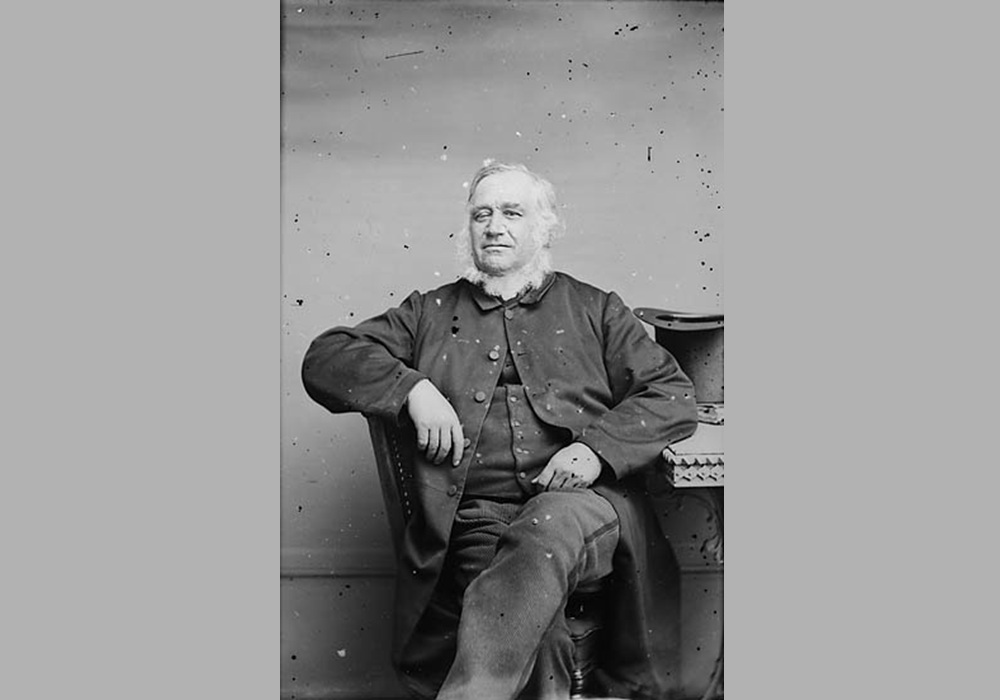
If I had to pick one writer to represent the best and most interesting aspects of Welsh literature from the nineteenth century, I’d pick William Rees (1802-1883).
Taking his bardic name from the Hiraethog Mountain near his home in the parish of Llansannan, Denbighshire, he was born into a comparatively poor family of farmers. He was, however, able to enjoy a rich cultural environment from the start.
There were many poets living in the area, and he learned the art of cynghanedd from one of them at a young age. As he had to work on the family farm, Rees was only able to attend school during the winter, and then only occasionally. However, despite his extremely limited formal education, Gwilym Hiraethog would go on to contribute in many different ways to the cultural, religious and intellectual life of Wales.
He was in many ways a rebel, exploring the boundaries of his own culture and taking it in new, directions, while also working within that culture. An early inkling of this radicalism was manifest in the fact that, while his family were Calvinistic Methodists – indeed, his older brother, Henry Rees, would become one of the most famous of that denomination’s ministers in Wales – he joined the Annibynwyr (the Independents or Congregationalists).
He was ordained as a minister, first serving in Mostyn, before moving, in 1837, to shepherd the flock of Denbigh’s Lôn Swan chapel. One of his predecessors in that storied house of worship was Robert Everett, who had immigrated to the United States and who would become the leading Welsh-American abolitionist.
Gwilym Hiraethog shared the Reverend Doctor Everett’s antislavery convictions, and this would be one of the many social justice causes which he championed during his long life. He moved to the Tabernacl chapel in Liverpool in 1843, and helped establish a fortnightly paper which he also edited, Yr Amserau.
Gwilym Hiraethog excelled as a poet, turning his hand to a wide range of forms and themes. Several of the hymns he composed are still popular today, none more so than ‘Dyma Gariad fel y Moroedd’ (‘Here is Love Like the Seas’). It begins by describing the power of divine love memorably, invoking the image of the vast, flowing seas:
Dyma gariad fel y moroedd,
Tosturiaethau fel y lli;
Tywysog bywyd pur yn marw,
Marw i brynu’n bywyd ni;
Pwyll all beidio cofio amdano?
Pwy all beidio canu’i glod?
Dyma gariad nad â’n angof,
Tra bo’r nefoedd wen yn bod.
‘Here is love like the seas,
Compassions like the flood-tide;
The prince of pure life dying,
Dying to redeem our life;
Who can refrain from remembering it?
Who can refrain from singing its praise?
Here is love which will never be forgotten
As long as the blessed heavens exist.’
Cariad
In grammatical terms, the noun cariad, ‘love’, is masculine, and so the rhetorical questions posed here are double, as the conjugated pronoun amdano and the possessive pronoun ei (`i) can refer to both this powerful, flowing ‘love’ and to Jesus or God. Everybody ‘remembers it [this love]’ while also ‘remembering Him’, just as they ‘sing the praise’ of both ‘it’ and ‘Him’.
The image of flowing waters continues in the second half of the hymn, describing Jesus’s sacrifice as ‘all of the wellsprings of the great depth’ (holl ffynonnau’r dyfnder mawr) ‘bursting forth’ (ymrwygodd). The ‘damns’ (argaeau) of heaven break, allowing ‘Grace and love like a flood’ (Gas a chariad megis dilyw) to ‘pour down’. This last word is ymdywallt, a powerful Welsh verb which is not easily translated. Its base is tywallt, ‘to pour’, but this meaning is strengthened, defined and complicated by the reflexive prefix ym-.
This might suggest that the waters of divine love pour forth from within, or that it is a special, heightened act which allows them to pour down. The nature of humankind’s redemption thus brought out is described with a new, stunning image presented in the final two lines: A chyfiawnder pur a heddwch / Yn cusanu euog fyd (‘And pure justice and peace / kissing a guilty world’).
Gwilym Hiraethog’s poetic presentation of Christianity’s driving metanarrative also expresses a desire to see ‘justice and peace’ visiting this troubled – or ‘guilty’ – world.
‘Heddwch’, ‘Peace’, is also the title of one of Gwilym Hiraethog’s most popular strict-metre poems, an awdl composed for the chair competition at the 1851 Tremadog Eisteddfod. While he didn’t win that chair, after publishing the poem in his 1855 collection, Gweithiau Barddonol Gwilym Hiraethog, it became one of the most popular awdlau of the century and is often taken as one of the best examples of poetry produced by nineteenth-century eisteddfodic competition.
It moves from the Fall which brought strife to a world previously characterized by only love and peace through a chronicle of man’s wars, from the fratricidal conflict between Cain and Able to Napoleon’s many wars conquest.
It ends by expressing a hope that peace will again reign on earth one day. One small part of the awdl has been anthologized and has thus enjoyed a life as a poem in its own right. Using that workhorse metre of the awdl, the cywydd, Gwilym Hiraethog invites us to witness a blacksmith at work:
Chwythu’i dân dan chwibanu
Ei fyw dôn wna y gof du;
Un llaw fegina a’r llall
Faluria’r glo fel arall.
Wedi trefnu, taclu’r tân
Ar bwynt allor ei bentan,
Yn hyf mewn hen gleddyf glas,
Luniai lawer galanas,
Gafaela y gof eilwaith;
Chwery ag ef cyn dechrau’r gwaith.
‘The soot-blackened smith fans his fire
while whistling his lively tune;
One hand works the bellows
As he breaks the coal.
Having ordered and tidied the fire
On the summit of his forge’s altar,
He boldly takes hold again
Of an old grey sword,
Which worked many a massacre,
He plays with it before beginning the work.’
Sword in hand, this blacksmith indulges in some boyish play, ‘the man pretending to be a soldier’ (ffugia’r gŵr yn filwr fod). He then changes tack and pretends to be an officer addressing his army, ‘Giving a speech, hatefully threatening / to massacre his enemies’ (Areithia, bygythia’n gas / I’w elynion alanas).
The reader is torn between enjoying this frivolous scene and acknowledging an increasing discomfort at what seems to be a romanticization of weapons, warfare and killing. Has the poet given up on the ‘Peace’ promised by the awdl’s title?
Then, leaving the indulgent play aside and returning to his work, the blacksmith plunges the old sword back into the flames, finally taking it out again and then placing the ‘white-hot’ (yn wynias) metal on his anvil. With a triumphant sigh of relief, we realize that this story is really about the transformation of the old weapon:
Ac mewn hwyl â’r morthwyl mawr,
Esgud, â nerth grymusgawr,
Fe’i cura nes â yn swch
Gywrain ei gwasnaethgawrch
I aru’r ddaear iraidd,
A thy’ o hon wenith a haidd.
And, with gusto, using the great swift hammer,
He beats it with a giant’s powerful strength
Until it becomes a ploughshare,
Cunningly wrought for its work
To till the fresh earth,
And from it wheat and barely will grow.’
As skilled a craftsman as the blacksmith he depicts, Gwilym Hiraethog thus uses his lines of cynghanedd to weave a narrative manifestation of the biblical description of warfare’s end found in Isaiah 2.4: ‘They will beat their swords into ploughshares and their spearheads into pruning hooks. Nation will not take up sword against nation, nor will they train anymore for war.’
Epic
Gwilym Hiraethog was also one of those Welsh poets who sought to craft an arwrgerdd, publishing an ambitious free-metre ‘epic’, Immanuel, in two volumes in 1862 and 1867. As if his many and varied poetic contributions weren’t enough, William Rees also stands out as the most important nineteenth-century writer of creative Welsh prose before the rise of the novelist Daniel Owen.
One of things which ensured the success of his paper, Yr Amserau, was a series of fictional pieces which he himself penned, ‘Llythyrau’r Hen Ffarmwr’ (‘The Old Farmer’s Letters’). Treating pressing matters of the day in satirical fashion, the ‘Old Farmer’ is a wonderful fictional creation in his own right, a lively and colourfully character as good as any of those in novels by Charles Dickens or Daniel Owen.
His personable voice and earthy Denbighshire accent bring him alive on the page, humorously drawing attention to a range of social injustices and triumphing the cause of Nonconformism. On 15 February 1849 Yr Amserau published a letter to the editor complaining bitterly about the political slant of the Old Farmer’s contributions:
Syr, Ffarmwr ydwyf fianu. Nid ydwyf yn stwffio fy hun i sylw fel hyn, welwch chwi, i’r dyben o geisio dynwared y Rhen Ffarmwr, nac i ysgrifenu yn ei le chwaith. Trin fy nhir ydyw fy ngwaith i; ac ni fuaswn yn meddwl am ysgrifenu oni buasai fy mod yn barnu fy hun yn fwy cywir fy ngolygiadau ar lawer o bynciau na’r hên wr yma.
‘Sir, I myself am a farmer. I am not stuffing myself in the middle of the attention like this, you see, in order to try to imitate the Old Farmer, nor to write in his place either. Tending my land is my work; and I wouldn’t think to write if it weren’t that I judge myself to be more correct in my views of many subjects than this old man.’
After suggesting that the writer using the Rhen Ffarmwr name is really no farmer at all, this ‘real’ farmer complains that the Old Farmer is ‘an old radical’ (rhyw hen radical).
While the Old Farmer complained about y degwm, the unjust ‘tithe’ which Welsh Nonconformist farmers had to pay to support a Church they did not attend, this farmer defends the status quo, citing biblical precedent for the agricultural tax.
What we have here is surely yet another fictional creation of Gwilym Hiraethog’s; he has fashioned a new farmer, casting him as a conservative Anglican and using his complaints about the content of Yr Amserau to draw attention to the very radical political and religious agenda he was supporting with the paper. If we accept this theory, then his ‘real’ farmer’s complaint that the Old Farmer is really not really a farmer, then it becomes a spiralling series of interlocked metafictional jokes.
Gossip
Another fictional character narratives the stories continued in Gwilym Hiraethog’s 1877 volume, Helyntion Bywyd Hen Deiliwr, ‘The Troubles of the Life of an Old Tailor’. Using the guilty pleasure of gossip as bait for his readers, this Tailor begins by stressing that his work allows him to see inside people’s homes and lives:
Hen Deiliwr, a Hen Deiliwr o ganol gwlad ydwyf, yn arfer myned o dŷ i dŷ i gyflawni dyledswyddau fy ngalwedigaeth, ac felly wedi gweled llawer o’r byd yma yn y cylch y bum i yn troi ynddo. Y mae gan deiliwr yn y wlad fwy o fantais i wybod dirgelion cymdeithas nag un crefftwr arall.
‘I am an Old Tailor, and an Old Tailor from the middle of the country, used to going from house to house in order to fulfill the duties of my profession, and thus I have seen a great deal of this world in the part I travel through. A rural tailor has more of an advantage when it comes to knowing society’s secrets than does any other craftsman.’
Gwilym Hiraethog’s most significant contribution to the world of Welsh fiction will require it’s own episode.
Non-fiction
Before finishing here, however, it’s worth noting that he also excelled at crafting non-fiction and political polemic.
Thanks to the combination of Rees’s interest in radical politics, his status as editor of Yr Amserau, and his ability to write powerful persuasive prose, the fortnightly paper became the main medium for introducing revolutionary politics to Welsh readers during the period.
The middle of the century was marked by a series of drives for national unification and wars of independence. Gwilym Hiraethog voiced support for the fight for Italian unification led by Mazzini and Garibaldi, and he supported Kossuth’s efforts to free Hungary from Austria. And, as already noted, Gwilym Hiraethog was a passionate advocate for the freedom of the slaves in America.
As we’ll see next time, this advocacy come together with a desire to establish the Welsh novel in one of the most important Welsh-language books published during the nineteenth century.
Further reading:
You can read Yr Amserau on the National Library of Wales’s website: https://papuraunewydd.llyfrgell.cymru/browse/4239147
Thomas Roberts a David Roberts, Cofiant y Parch. W. Rees, D.D. (Gwilym Hiraethog) (1893).
G. Millward, Yr Arwrgedd Gymraeg: Ei Thwf a’i Thranc (1998).
Jerry Hunter, I Ddeffro Ysbryd y Wlad: Robert Everett a’r Ymgyrch yn Erbyn Caethwasanaeth Americanaidd (2007).
Support our Nation today
For the price of a cup of coffee a month you can help us create an independent, not-for-profit, national news service for the people of Wales, by the people of Wales.
Get more trusted Welsh news
Choose Nation.Cymru as a preferred source in Google News to see more of our journalism.


