


Yr Hen Iaith part 90: Uncle Robert’s Hearth, Uncle Tom’s Cabin, and Welsh Reading Habits
Jerry Hunter
The Welsh novel did not come into being easily. While Nonconformist culture was intensely literate in many ways, it favoured material considered to be morally edifying if not patently religious, the flip side being that chapel-goers were encouraged to avoid literature which did not meet these criteria.
As people read novels for the sheer joy of reading rather than bettering themselves, that kind of literature was suspect. Ministers, deacons and Sunday school teachers told members of their flocks to avoid the sinful indulgence offered by novels.
While John Bunyan’s Pilgrim’s Progress was hugely popular in Wales after a translation was published in 1688, its obvious Christian teachings leavened its fictional nature.
A Welsh translation of Robinson Crusoe was published in 1795, providing monoglot readers willing to venture into the realm of the novel an isolated island of adventure. However, if anything, Nonconformist suspicion of the novel intensified during the early nineteenth century.
As we saw in the previous instalment, one of Gwilym Hiraethog’s many literary contributions was his willingness to experiment with creative prose.
His ‘Llythyrau’r Hen Ffarmwr’ (‘The Old Farmer’s Letters’) helped ensure the success of his periodical, Yr Amserau, in the 1840s. Given this and his enthusiastic support for the abolition of American slavery, it is no surprise that he was drawn to that best-selling antislavey novel, Harriet Beecher Stowe’s Uncle Tom’s Cabin.
Within two years of its appearance in 1851, two different Welsh translations were produced in the United States, one of them stemming from correspondence between Stowe and the leading Welsh-American abolitionist, Robert Everett.
No less than eight Welsh translations would appear by the middle of the 1850s. By far the most interesting is Gwilym Hiraethog’s Aelwyd F’Ewythr Robert neu Hanes Caban F’Ewythr Tomos, published in 1853.
The title translates as ‘Uncle Robert’s Hearth or the Story of Uncle Tomos’s Cabin’. That first noun, meaning both ‘home’ and ‘hearth’, is emotionally charged in Welsh, brining with it images of family and emotional as well as physical warmth.
The noun hanes, while sometimes meaning ‘story’, can also mean ‘history’, and in a very real sense this book is a fictional exploration of an interesting chapter in literary history – namely, how Uncle Tom’s Cabin came to have Welsh incarnations and how that antislavery novel was received in Wales.
Welsh context
Gwilym Hiraethog did not simply translate Stowe’s novel into Welsh. He also created a fictional Welsh context in which Welsh characters read, absorb and discuss the American ‘(hi)story’.
Uncle Robert is a kind old farmer, interested in books although he is illiterate. People thus read to him, and we, the readers of Aelwyd F’Ewythr Robert, witness a series of sessions in which Uncle Tom’s Cabin is read in Welsh to Uncle Robert, his wife, and others gathered at his hearth.
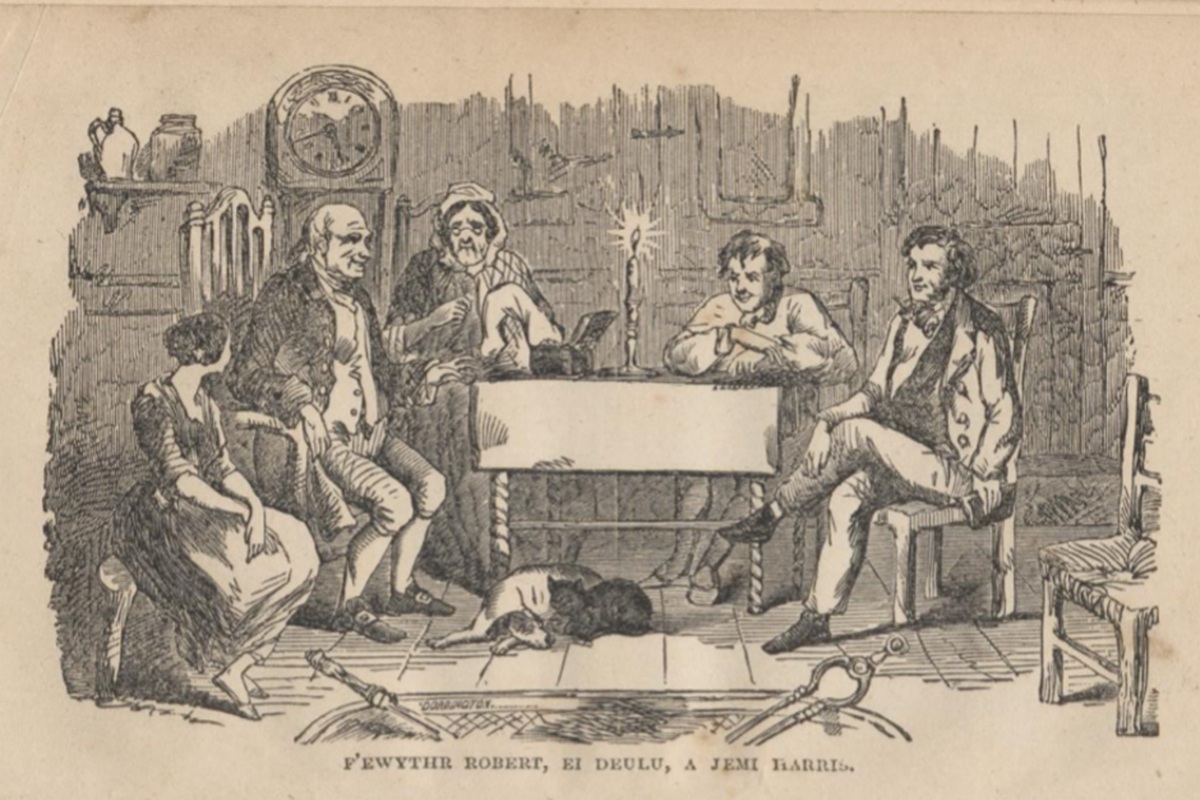
The book contains a series of illustrations, and while most of them are scenes from Stowe’s novel, the first one depicts the scene in which the novel is read and discussed. It is as if we are in the fireplace, looking out over the aelwyd or ‘hearth’ at the people assembled there, sitting comfortably around a table.
These characters are also described in the book’s opening pages, beginning with F’Ewythr Robert a Modryb Elin, ‘Uncle Robert and Aunt Elin’, a ‘pâr oedrannus’, ‘an old couple’ whose white hair is described wonderfully as ‘[c]oron harddwch hynafgwyr’, ‘the elders’ crown of beauty’.
Their gwas (farm hand) and morwyn (maid) are there as well – and we are told that they have been in the old couple’s service for a long time, the kindness of the aelwyd also emphasized by the fact that the employees sit by the hearth with their employers and are described as part of the teulu, ‘family’.
The picture also depicts two pets, introduced humorously in the text: the dog, Tobit, is ‘old enough’ (yn ddigon hen) to be ‘grandfather to all of the dogs in the parish’ ([t]aid i holl gŵn y plwyf), and as the cat, Judi, is so old that Uncel Robert jokes about getting glasses for her so that she might see the mice. This homey scene is completed by James (or ‘Jemi) Harris, a key figure in this book about a book:
Y mae gwr ieuanc yn byw yn y gymydogaeth, mab i amaethwr cyfrifol, yr hwn sydd o duedd fwy darllengar a meddylgar na’r cyffredin yn y fro hono. Afera y gwr ieuanc hwn dalu ymweliad mynych â F’Ewythr Robert, i ddarllen y papyrau newyddion, misolion, a llyfrau eraill iddo, a mawr fydd y croesaw a gaiff bob amser.
‘A young man lives in the area, the son of a responsible farmer, who is more inclined to reading and thinking than is the norm in that place. The young man often visits Uncle Robert in order to read the newspapers, monthlies and other books to him, and great is the welcome he receives every time.’
Jemi Harris thus embodies the ideal Welsh reader: not only does he read and think about a wide range of different texts, but he shares his interests, using reading as a way of building and maintaining community cohesion.
Aelwyd F’Ewythr Robert is structured around a series of sessions during which Jemi Harris reads Uncle Tom’s Cabin in Welsh. Other characters join, including his mother, and their lively discussions of the American antislavery novel are interspersed with selections from the novel itself.
Personable and appealing
The Welsh characters created by Gwilym Hiraethog are personable and appealing, and it’s easy for us to sink comfortably into their story and enjoy eavesdropping on both the reading sessions and the associated discussions.
However, I can’t help stepping back and marvelling at the metafictional play driving this work: it is fiction about fiction which both entertains and raises questions about the values and uses of the novel as a form.
Indeed, the metafictional play begins straight away. One expects an opening piece entitled At y Darllenwyr, ‘To the Readers’, to be by the book’s author, but in this case Gwilym Hiraethog has his fictional character, James Harris, address us instead: Ychydig a feddyliwn, pan yn cyrchu gyda’r “Caban” tua thŷ fy hen gyfaill, F’Ewythr Robert, y waith gyntaf . . . y buasai hyny yn arwain i’r hyn y gwelir heddyw y gwnaeth. (‘Little did I think when I took the ‘Caban’ to the house of my old friend, Uncle Robert, the first time . . . that it would lead to what it has become’).
To state the obvious, the evils of slavery is a theme central to this book. Perhaps less obvious, but extremely significant in terms of Welsh literary history, is a discussion about Welsh attitudes towards the novel. At one point, when several others have joined the original reading ‘family’ at the hearth, Mrs. Harris muses aloud:
‘Mi fum i’n meddwl lawer gwaith . . . bod arno ni eisiau mwy o lyfre fel Caban F’Ewythr Tomos yn Gymraeg, i ddenu pobol i ddarllen llyfrau fyddo’n cymysgu difyrwch âg adeiladaeth, i loni a dysgu y meddwl ar yr un pryd. Y mae llyfrau o’r fath hòno yn bethau lled ddyieithr i ni, yn ein hiaith ein hunain [.]’
‘I’ve often thought . . . that we need more books like Uncle Tom’s Cabin in Welsh to attract people to read books which combine entertainment with edification, to amuse and instruct the mind at the same time. Books of that kind in our own language are fairly rare things to us.’
Upset
Another character, Rhys, answers her pointedly: ‘Tae chi’n cynnig llyfre o’r fath hòno . . . mi gaech wel’d y code llawer dwlyn Phariseaidd o gryfyddwr `i wrychyn `n ofnadwy arnoch chi’ (‘If you offered books of that type . . . you’d see that many a Pharasaical fool of a chapel-goer would get horribly upset with you’). Mrs Harris agrees, while swiftly dismissing such critics: ‘ond ni fyddai’n werth sylwi ar rai o’r fath hòno, druain’ (‘but it wouldn’t be worth taking note of people like that, poor things’).
It’s worth remembering that Gwilym Hiraethog was an ordained minister and that he produced a great deal of religious literature. The argument which he has his characters put forth is not one which pits secular texts against religious ones, but rather one in favour of broadening the horizons of Welsh readers. While labelling those who would place puritanical constraints on people’s reading habits as ‘Pharasaical fools’, he also coats his criticism of them with kindness: rather than painting them as an opposing side in a struggle, they are ‘poor things’ to be pitied and ignored.
Further reading:
Daniel Williams, ‘Uncle Tom and Ewythr Robert: Anti-Slavery and Ethnic Reconstruction in Victorian Wales’, Slavery & Abolition, cyf. 33 (2012).
You can read Aelwyd F’Ewythr Robert on the webiste of the National Library of Wales:
Gareth Evans-Jones, Mae’r Beibl o’n tu: ymatebion crefyddol y Cymry yn America i gaethwasiaeth (1838-1868) (2022).
Jerry Hunter, ‘The Pilgrim and the Hearth in the Welsh Reception of Bunyan’s The Pilgrim’s Progess’, yn Angelica Duran a Katherine Callowy (eds.), Global Bunyan and Visual Art (2025).
Jerry Hunter, I Ddeffro Ysbryd y Wlad: Robert Everett a’r Ymgyrch yn Erbyn Caethwasanaeth Americanaidd (2007).
Support our Nation today
For the price of a cup of coffee a month you can help us create an independent, not-for-profit, national news service for the people of Wales, by the people of Wales.
Get more trusted Welsh news
Choose Nation.Cymru as a preferred source in Google News to see more of our journalism.


