

Yr Hen Iaith part 91: Serving the People of Wales: Cranogwen
Jerry Hunter
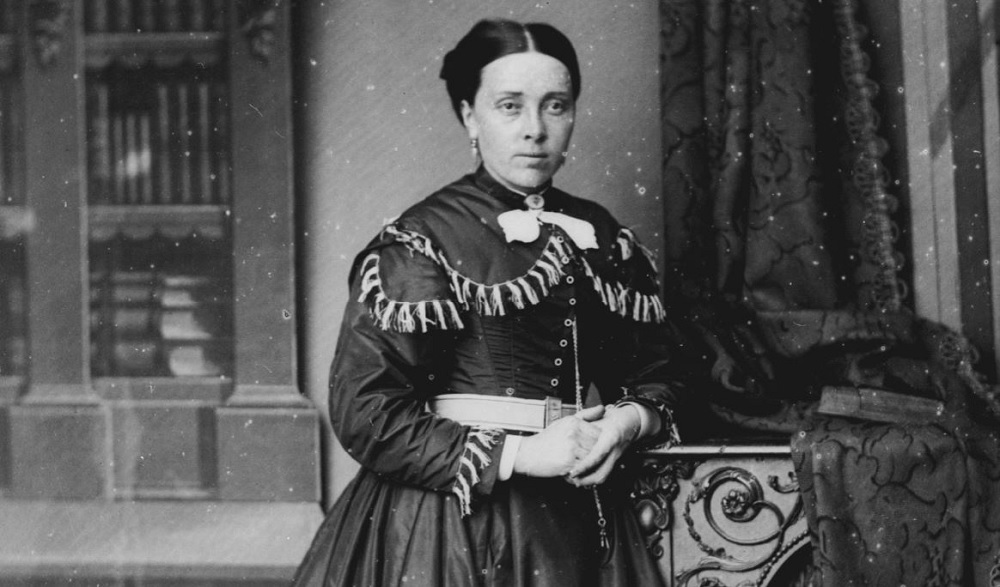
Succinctly describing the life and work of Sarah Jane Rees (1839-1916) is a daunting task given the many contributions which she made in a dizzying range of fields and spheres. We can perhaps begin to appreciate the spirit characterizing her storied life and impressive work by considering a poem which she titled, simply, ‘Fy Ngwlad’ (‘My Country’).
After praising the landscape of Wales, she ‘sings the praise’ (canu clod) of her nation’s people, emphasizing that it is both the ‘daughters’ and the ‘sons’ (‘[m]erched’, ‘[m]eibion’) for whom she is thankful, singling out the people of her country as its ‘greatest glory’ ([g]ogoniant pennaf). The Welsh are what makes Wales great, she says, and the contributions of Welsh women are stressed by mentioning them first.
Writing in the shadow of ‘The Treachery of the Blue Books’, she uses some of the morale-boosting phraseology which quickly fossilized into cliché as Welsh poets focussed on uncritically positive images of their country in order to counterbalance condescension. Her country is thus ‘Cymru lonydd’, ‘calm Wales’, a land described as ‘tawel’, ‘quiet’.
However, if this unoriginal wording suggests the inferiority complex engendered by the Blue Books and all that they represented, the body of the poem acknowledges this social complexity in a more original and combative fashion. Rees admits that ‘some’ (‘rhai’) Welsh people ‘betray their country and their language’ (‘bradychu / Eu gwlad a’u hiaith’), while also insisting that they are ‘exceptions’ (‘eithriadau’). Most Welsh people are ‘faithful ones’ (‘ffyddloniaid’) who ‘love their country, their language and each other’, as well as ‘loving true freedom’ and ‘religion’ (‘yn caru eu gwlad, eu hiaith, yn caru ei gilydd, / Yn caru rhyddid gwir, yn caru crefydd’).
It is these people who make Wales, and she gives thanks for them by thanking Wales. In the poem’s concluding verse, Sarah Jane Rees describes this in terms of attempting to repay a debt, an endeavour which is the focus of her entire life:
Mi allaf ddiolch, gallaf, ar fy ngliniau,
A chynnig iti fy ngwasanaeth goreu;
Ond beth f’ai hynny oll yn ymgen na chydnabod
Fy nyled bwysig iawn? – Ah, mae ei thalu’n ormod
O waith i mi, tra’n fyw! gan hynny, wele fi,
Fy ngwlad, am dreulio ’mywyd i’th wasanaeth di.
‘I can give thanks, yes I can, on me knees,
And offer you my best service;
But what would all that be other than recognizing
My weighty debt? – Ah, repaying it is too much
Work for me, as long as I live! And with that, here I am,
My country, spending my life in your service.’
She did indeed spend her life in the service of her country, working to educate others, furthering the cause of Nonconformism and associated social movements – Temperance, especially – and labouring in literary spheres, both as creator (whether poet or prose writer) and as editor. And all of these many activities had a unifying aspect which makes her life and work momentously significant: she challenged and overcame the barriers which women faced in a sexist society again and again, paving the way for and inspiring generations of Welsh women. It is life worth reading about in detail, and to that end Welsh readers are encouraged to turn to Jane Aaron’s excellent biography (see below).
Llangrannog
Sarah Jane Rees took her literary name, Cranogwen, from her birthplace, Llangrannog. Overcoming prejudices against educating women and allowing them to work in certain industries, she persuaded her father, a sea captain, to educate her and take her on ship with him, eventually earning her master mariner’s certificate.
In addition to serving as a headteacher (a role rarely given to women at the time) back in Llangrannog, she also taught maritime skills to young men set on a sailing career. Despite being a committed Calvinistic Methodist, extremely educated and unusually eloquent, the role of minister was closed to Cranogwen, as it was to all women. However, she defied the norm and went on to preach, becoming such a popoular lay preacher that we can call her a Welsh Methodist celebrity.
She also founded the South Wales Women’s Temperance Union and did much in the service of that cause. It’s important to remember that, rather being a sterile puritanical impulse (as it’s seen by many today), the movement urging people to avoid alcohol was driven largely by an urge to enact radical social change for the better, especially in the poorer families where a man’s addiction to drink often plunged his wife and children deeper into poverty, while also fuelling domestic violence.
It was aimed directly at improving the lives of women, and an interesting bi-product was that the Temperance movement afforded women like Cranogwen a rare opportunity to operate in political spheres, organizing public meetings, delivering speeches to large crowds and lobbying influencers and policy makers.
Cranogwen smashed a literary glass ceiling when she won a poetry contest at the 1865 National Eisteddfod held in Aberystwyth with her pryddest (a long free-metre poem), ‘Y Fodrwy Briodasol’ (‘The Wedding Ring’), beating two of the nation’s most famous male poets, Ceiriog and Islwyn. This narrative piece moves from ‘scene’ (‘darlun’) to scene, the first of which presents an impossibly luxurious and indulgently romantic portrait of a new bride:
Eistedda ieuangc, brydferth wraig,
Brydnawnddydd ei phriodas,
Ar esmwyth-faingc odidog yn
Ystafell oreu’r palas:
Byd o lawenydd sydd o’i chylch[.]
‘A pretty young woman [or ‘wife’] sits,
On the afternoon of her wedding,
On a splendid sofa in
The best room of the mansion:
A wold of joy surrounds her.’
As she enjoys ‘the tender breezes of pure love’ (‘mwyn awelon cariad pur’), we see ‘a blush perfecting her face’ (‘wele wrid / Ei hwyneb yn perffeithio’), ‘her heart quickening’ (‘Ei chalon frysia’), as she touches ‘the wedding ring’ (‘y fodrwy briodasol’) on her finger.
The reader stumbles from the stupor of this idyllic marital bliss into the rude awakening of the second scene:
Tra rhua ’r corwynt nerthol, dig,
Yng nghoed y wig oddiallan,
Eistedda gwraig mewn bwthyn gwael,
I geisio trin ei baban;
Y mae ymron a methu gan
Ei gŵyn a’i gri hiraethlon,
A chofio fod y gell a’r fron
Yn wag, a rwyga ’i chalon.
Pe bai yn gallu, gwnelai frys,
Gan fod yn hysbys iddi,
Mai yn y dafarn drwy y dydd
Y mae ei gŵr yn meddwi;
A gwyr y daw oddiyno ’n llew
Cynddeiriog ’mhen ychydig,
I larpio, hwyrach, yn ei gŵydd
Ei hangel bach gwywedig!
‘While a strong, angry storm roars
In the trees of the grove outside,
A woman [or ‘wife’] sits in a miserable cottage,
Trying to sooth her baby;
She is nearly undone by
His complaint and his longing cry,
And at remembering that the pantry as well as the breast
Is empty, and it rends her heart.
If she could, she’d make haste [and leave],
As she knows that
Her husband has been drinking
In the pub all day long;
And she knows that he’ll come from there soon
Like a raging lion,
Possibly to maul, right in front of her,
Her withered angel!’
The language used to highlight the evil wrought by alcohol is brutally simple, and Cranogwen weaponizes italic print in order to make sure that her blows land with even more force. Because her husband spends the family’s money on drink, the ‘pantry’ is bare. The wife is thus malnourished and her ‘breast’ has no milk for the baby. Applying the adjective ‘withered’ (‘gwywedig’) to the child is another brutal blow which emphasizes the human tragedy unfolding in families oppressed by a poverty worsened by alcoholism.
A book-length collection of Cranogwen’s poetry was published in 1870, helping to cement her literary reputation. Nine years later she would embark on a career as an editor, shepherding in the birth of the first Welsh-language periodical produced specifically for women since the demise of the short-lived Y Gymraes in 1851. The title of that earlier publication translates as ‘The Welshwoman’, and Cranogwen’s Y Frythones can be rendered the same way. However, referring to a Welsh woman as a Brythones describes her as a descendant of the ‘Ancient Britons’, invoking the wealth of heroic connotations which comes with reference to that medieval tradition.
In her inaugural editorial address to her readers in the first number published in January 1879, she begins by defining her intended readers as women joined in sisterhood:
ANWYL CHWIORYDD, – Wele ni yn ymddangos ger eich bron drwy gyfrwng newydd Y FRYTHONES. Na thybiwch ni yn ymhongar nac yn eofn; na thybiwch ni yn anymwybodol neu yn ddisytyr o’r cyfrifoldeb yr ydym wedi ymgymeryd ag efo: nid ydym y naill na’r llall. Yr ydym wedi petruso llawer, ac o hyd yn bryderus, ac eto ar ddechreu y flwyddyn 1879, yn ymddangos yn eich plith, ac yn gwahodd eich sylw yn y ffurf newydd ac anturiaethus hon.
‘DEAR SISTERS, – Here we are appearing before you by means of Y FRYTHONES. Do not assume that we are pretentious or bold [in doing so]; do not assume that we are ignorant or unheeding of the responsibility we are undertaking: we are neither the one nor the other. We have hesitated a great deal, and are still hestitant, yet at the start of the year 1879, we are appearing amongst you and ask for your attention in this new and adventurous way.’
Cranogwen invited contributions from other Welsh women, thus nurturing a new generation of female poets and writers. She also offered advice of various kinds and published short biographies of women, providing her readers with a range of role models which, taken together, demonstrated that there were more ways than one to lead life as a woman.
Such was her fame that she became an important player in that transatlantic Welsh culture discussed in earlier instalments of this series. She crossed the sea and travelled around Welsh communities in the United States in 1869-1870, conducting an extremely successful preaching and lecture tour. Typical of the reception she received is a notice published in one of America’s Welsh-language periodicals, Y Cyfaill o’r Hen Wlad (in July,1869), suggesting that a Temperance meeting in Floyd, New York, attracted a particularly large crowd because it was known ‘that Miss Sarah J. Rees (Cranogwen) would be present’ (‘y byddai i Miss Sarah Jane Rees (Cranogwen) yn bresenol’).
The author goes on to say that she ‘has immortalized her name by her connection with Temperance, as well as with many other good things’ (‘wedi anfarwoli ei henw yn ei chysylltiad â Dirwest, yn gystal a llawer o bethau da eraill’). The verdict was unanimous following the meeting: ‘areithiodd Miss Rees yn swynol dros ben. Rhyfeddai pawb at ei galluoedd, nid yn unig i draddodi, ond i gyfansoddi ei hareithiau.’ (‘Miss Rees delivered her speech in an extremely charming manner. Everybody was amazed at her talents, not just in delivering, but also in composing, her speeches.’)
Cranogwen was apparently asked to stay in America, and she could have enjoyed an extremely prosperous career there. However, she returned to the land of her birth and spent many more years working to ‘repay’ her ‘debt’ to Wales by ‘serving’.
Further Reading:
Sarah Jane Rees, Caniadau Cranogwen (1870): https://www.library.wales/discover-learn/digital-exhibitions/books/poetry-volumes/caniadau-cranogwen
Jane Aaron, Pur fel y dur [:] Y Gymraes yn Llên Menywod y Bedwaredd Ganrif ar Bymtheg (2013).
Jane Aaron, Cranogwen (2024).
Support our Nation today
For the price of a cup of coffee a month you can help us create an independent, not-for-profit, national news service for the people of Wales, by the people of Wales.
Get more trusted Welsh news
Choose Nation.Cymru as a preferred source in Google News to see more of our journalism.



