


Yr Hen Iaith part 92: Yankee Tricks and the Patagonian Fonda: policing Welsh life in the Diaspora
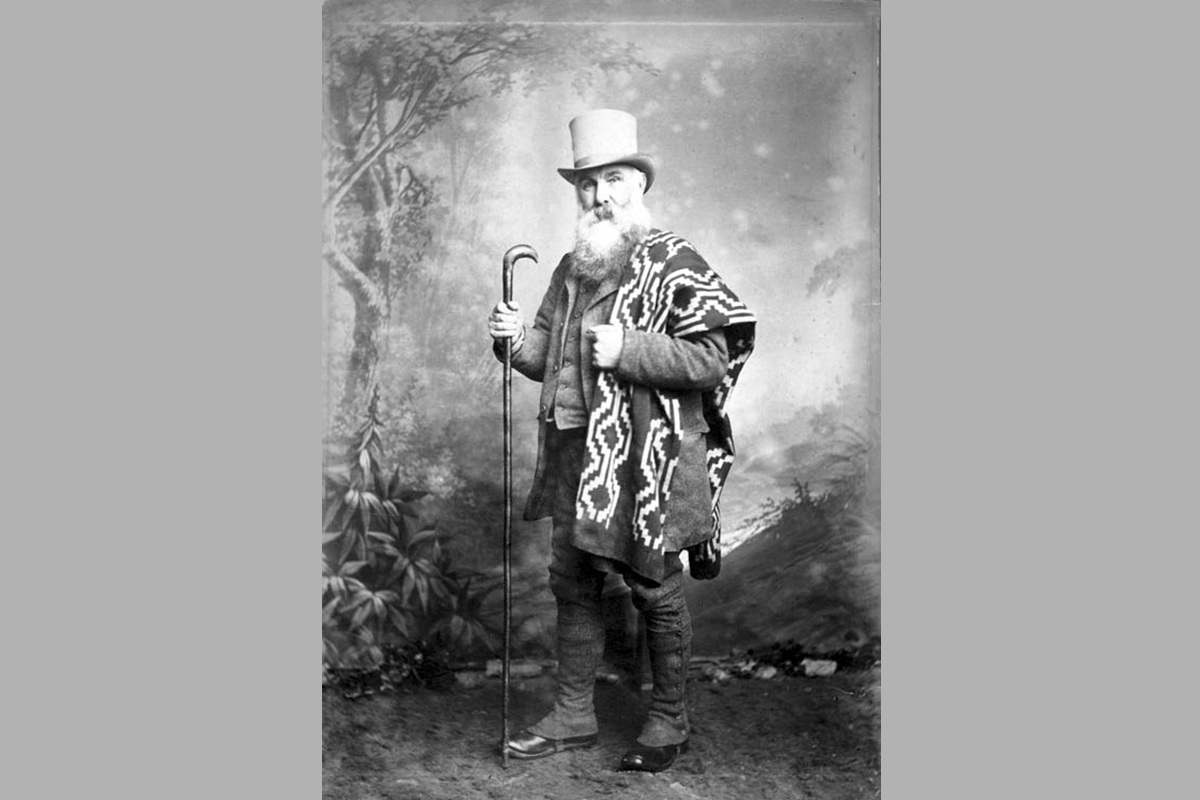
Jerry Hunter
Michael D. Jones is remembered for many things. By his death in 1898, he was one of the most influential Independent ministers in Wales, exerting considerable influence from his seat as principal of the theological college at Y Bala.
The Dictionary of Welsh Biography describes him as ‘the father of the nationalist renaissance in Wales’, one of those responsible ‘for transforming Welsh patriotism into a vigorous practical nationalism.’[1]
Using less flowery and more academic terms, my co-host on Yr Hen Iaith, Richard Wyn Jones, has described Michael D. Jones as an example of the second of the three stages in Miroslav Hroch’s periodization of the history of nationalism, as an intellectual working to bring a national awareness to the wider population.[2]
And many people remember Michael D. Jones first and foremost as the ‘father’ of Y Wladfa, the Welsh colony in Patagonia.
Less widely known is the fact that, while never actually visiting South America, Jones spent several years in North America.
Indeed, he was ordained as a minister in a Welsh chapel in Cincinnati, Ohio. And the Welsh-American periodical press was the first engine he used to drive his campaign to establish a new Welsh ‘settlement’ or ‘colony’ (gwladfa or gwladychfa).
He published an open letter presenting this vision in the Welsh-language American monthly, Y Cenhadwr Americanaidd, in 1848.
After noting that the Welsh are ‘scattered here and there through every part of North America’ (ceir rhai o honynt yma a thraw yn wasgaredig drwy bob ran o Ogledd America), he bemoans the fact that they are not gathered together in one big Welsh settlement: Pe cadwai y Cymry fel byddin yn nhgyd, teimlai cenhedloedd eraill eu dylanwad fel pobl foesol a chrefyddol (‘If the Welsh were kept together like an army, other nations would feel their influence as a moral and religious people’).
Describing this wide American diaspora as ‘a madness’ (gwallgofrwydd), Jones claims that it undermines the Welsh immigrant’s character and morals:
Sut y ceir ef i fod yn onest fel ei dadau, ac i ymgadw rhag dysgu ‘Iankey tricks?’ [. . . .] Atebaf trwy ofyn sut y ceidw y fam ei phlant rhag dysgu castiau drwg? Onid drwy eu cadw rhag cwmni drwg? [ . . . .] Myner, ynte, Wladychfa Gymreig.
‘How can he be kept honest like his forefathers, and keep himself from learning “Yankee tricks”? [. . . . ] I answer by asking how does a mother keep her children from learning bad habits? Is it not by keeping them from bad company? [ . . . . ] Demand, then, a Welsh Settlement.’
In this 1848 piece Jones suggests that the newly-formed state of Wisconsin might be a likely place for such a Welsh Settlement. But eventually Jones came to believe that, in order to avoid the corrupting influence of Yankee tricks as well as British condescension, the Gwladychfa should be created in Patagonia, far from both influences.
Michael D. Jones returned to Wales in 1850, and he continued to use the periodical press to promote his vision, publishing spirited calls to action on both sides of the Atlantic.
This was taken as an insult by Welsh-American readers who were living very Welsh lives in their American communities.
Blue Books
Just as Jones himself referred to the 1847 Blue Books as a manifestation of the British oppression which Welsh people could escape by moving to a distant gwladychfa, one Welsh-speaking resident of the United States complained, in a letter published in Y Drych in 1863, that Jones was making his own ‘“Blue Book” about the Welsh of America’(‘Llyfr Glas’ am Gymry America).
The Mimosa sailed from Liverpool in late May 1865, after a voyage lasting two months, landed in Patagonia with 153 Welsh emigrants. That story has been told and retold. What interests me here is the extent to which the very real Welsh colonization of a part of Patagonia was in part born out of discussion and argument on the pages of the Welsh diaspora’s periodical press.
And, despite the hardships facing those early settlers, Patagonia would soon have its own Welsh periodical.
Y Brut was started by R. J. Berwyn (Richard Jones, 1837-1917) in 1868. Amazingly, this periodical was produced without a printing press.
Eking out a living and providing the basic foundations for life was challenging enough, and purchasing a printing press was well beyond the means of R. J. Berwyn and his fellow settlers. This was an unpublished publication, written long-hand and passed from home to home.
Floods
While the original manuscript copies disappeared in floods which ravaged the area later in the century, a record of the first number’s contents survives. They include, in addition to short news pieces, ‘Anerchiad y Golygydd’ (‘The Editor’s Address’), ‘Llythyr oddi wrth M. D. Jones’ (‘A Letter from Michael D. Jones’), minutes of the colony’s committee meetings, and a practical piece on ‘Dal morloi’ (‘catching seals’).
One of the most interesting things about Y Brut is its name, for it harkens back to those popular medieval historiographical texts, Brut y Brenhinedd (The History of the Kings of the Ancient Britons) and Brut y Tywysogion (The History of the Welsh Princes). The word brut reminds Welsh readers that their ancestors were the original inhabitants of the Island of Brut-ain, and there are few single words punctuating Welsh literary history which are so laden with meaning.
That medieval term was being used as a label for a literary project designed to help cement the bonds of community in a startingly new context.
Y Wladfa – as it came to be called (rather than Y Wladychfa) – eventually acquired a printing press. A new periodical, Ein Breiniad (‘Our Right’) was produced in 1878 and used primarily as a mechanism for urging Welsh Patagonians to engage with their community’s political life.
It was short-lived, and it wouldn’t be until 1891 that Y Dravod would appear. Edited by Lewis Jones, this fortnightly newspaper became the mainstay of Welsh Patagonian print culture and remained as such well into the twentieth century.
Creative writing
What stands out most for me about the early contents of Y Dravod are the pieces of creative writing used to police what the editor saw as communal norms and values. The anonymous Llith y Llwynog (‘the Fox’s Advice’) appeared in many numbers. A lively fictional creation, this talking fox tells readers about his travels around Y Wladfa, slyly observing Welsh life and commenting on the follies he witnesses. The first instalment, published on 26 January 1893, begins thus:
Wn i ddim yn y byd mawr a ganiatewch i greadur vel vi, oddiar y paith, i roddi ychydig o’m helyntion. Gwyr pawb mai ychydig yw’n croesaw ni, lwynogod; ond rhaid i ninnau weithiau ddyvod am dro i’r dyfryn a thalu ymweliad â’r avon, pan vo bwyd y paith wedi darvod a’r llwnc yn sych. Disgynais ar waelod y Dyfryn Uchav, ac wrth vyned i vyny hyd linell y Bryn Crwn, gwelais ddau hogyn yn dyvod a chefylau rywle o’r top, a llechais wrth glawdd, a thrwy drugaredd nid oedd yr un ci ganddynt.
‘I have know idea if you will permit a creature like me, from the desert, to describe some of his travels. Everybody knows that we, the foxes, receive scant welcome; but we must come sometimes on a trip to the valley and visit the river, when the desert’s food has finished and the throat is dry. I came down to the bottom of Dyffryn Ucha, and as I went up along the crest of Y Bryn Crwn, I saw two lads coming with horses from somewhere above, and I hid by a ditch, and mercifully, they had no dogs with them.’
The fox then eavesdrops on their conversation, and tells us how they delighted in their recent financial windfall. These young Welsh Patagonians had been rounding up ‘stray’ horses and receiving rewards, thus profiting from their neighbours’ misfortune.
In an instalment published the following month, the fox describes seeing another young man on horseback, described as ‘carwr’, ‘a lover’, the term applied dismissively to a Welshman who has adopted Spanish Argentinian fashion and who leads a life deemed wasteful and hedonistic:
Carwr oedd hwn, ar gevn ei varch penuchel, yn ei votasau gloewon, ponsho amryliw ar ei vraich . . . ac wrth gwrs ei savn yn pwfio cwmwl ar gwmwl o vwg costus vel corn simdde peiriant y relwe. Mwng ei varch tyngroen wedi ei gropio yn y style ddiweddarav, a chavestro hir yn llusgo ac yn codi’r llwch ar ei ôl.
‘He was a lover, on the back of his high-headed horse, in his shiny boots, a varicoloured poncho over his arm . . . and of course his mouth puffing cloud after cloud of expensive smoke like the chimney stack of the railway’s machine. His sleek horse’s mane was cropped in the latest style, and a long halter dragged and bringing up dust behind him.’
Halter
Rather than employing one of the Welsh words (penffrwyn or cebystr), the writer uses the Spanish word for ‘halter’, cabestro, written as it is pronounced, cavestro, and mutated (c -> ch) according to the rules of Welsh grammar. Like the ‘poncho’, it was part of the Spanish trappings which are an outward suggestion that the inner life of this young man is worryingly un-Welsh. Indeed, after paying only a passing visit to his ‘cares’ or ‘girlfriend’, the young rider makes for the real object of his affections, the Fonda.
This Spanish word fonda is used to describe a Patagonian tavern. Several different kinds of texts published in Y Dravod vilify the fonda as a place of vice, seen as inherently un-Welsh in nature while also attracting the younger generation of Welsh Patagonians. In March 1893, the newspaper published a poem by ‘Gwanvab’ entitled simply ‘Y Ffonda’. Using the strict-metre englyn unodl union form, he belittles those who frequent such a place:
Tŷ’r anwar a gâr gwrw – tŷ’r yved
Tŷ ravio a thwrw;
A rhwyg a llid, rheg a llw,
Uchel helynt chwil ulw.
Tŷ am loddest ymladdwr – avradlawn,
Hyvrydle troseddwyr;
Tŷ euog hil, teaog wŷr,
A nevoedd i hen yvwyr.
‘The house of the uncivilized ones who love beer – the house of drinking,
The house of ranting and commotion
And contention and anger, swearing and cursing,
A thoroughly drunken loud trouble.
‘A house for a fighter’s carousal – wasteful,
The beloved place of criminals,
The house of a guilty race, lowly men,
And heaven for old drunkards.’
The poet’s pseudonym, Gwen-fab, describes him as a ‘weak-son’, suggesting that he himself has been tempted by the sinful delights of the fonda.
Back in 1848, Michael D. Jones published that piece urging the Welsh in North America to avoid the corrupting influence of ‘Yankee tricks’. Forty-five years later we find ample evidence on the pages of this South American periodical proving that some Welsh Patagonians were worried by what they saw as the corrupting influence of Argentinian culture.
Further Reading:
Gareth Alban Davies, ‘The Welsh Press in Patagonia’, in Philip Henry Jones and Eiluned Rees (eds.), A Nation and its books. A History of the Book in Wales (1998).
Walter Brooks, ‘Welsh Print Culture in Y Wladfa: The Role of the Ethnic Newspapers in Welsh Patagonia, 1868-1933 (PhD, Cardiff University).
- Wyn James and Bill Jones (eds.), Michael D. Jones a’i Wladfa Gymreig (2009).
- Bryn Williams, Rhyddiaith Y Wladfa (1949).
Richard Wyn Jones, Putting Wales First [:] The Political Thought of Plaid Cymru, volume 1 (2024).
Richard Wyn Jones, Rhoi Cymru’n Gyntaf [:] Syniadaeth Plaid Cymru, cyfrol 1 (2007).
[1] https://biography.wales/article/s-JONE-DAN-1822.html#?c=0&m=0&s=0&cv=0&manifest=https%3A%2F%2Fdamsssl.llgc.org.uk%2Fiiif%2F2.0%2F4702600%2Fmanifest.json&xywh=416%2C561%2C3007%2C2426
[2] See Chapter 1 in Richard Wyn Jones, Putting Wales First [:] The Political Thought of Plaid Cymru, volume 1 (2024).
Support our Nation today
For the price of a cup of coffee a month you can help us create an independent, not-for-profit, national news service for the people of Wales, by the people of Wales.
Get more trusted Welsh news
Choose Nation.Cymru as a preferred source in Google News to see more of our journalism.



Very interesting, so when did they start the clothing company, whose logoed T-shirts were much in evidence in Cymru the day England played Argentina…
Enjoyed that always been fascinated by the Welsh in Patagonia