


Yr Hen Iaith part 95: Nature’s Anthem: Islwyn’s ‘Storm’
Jerry Hunter
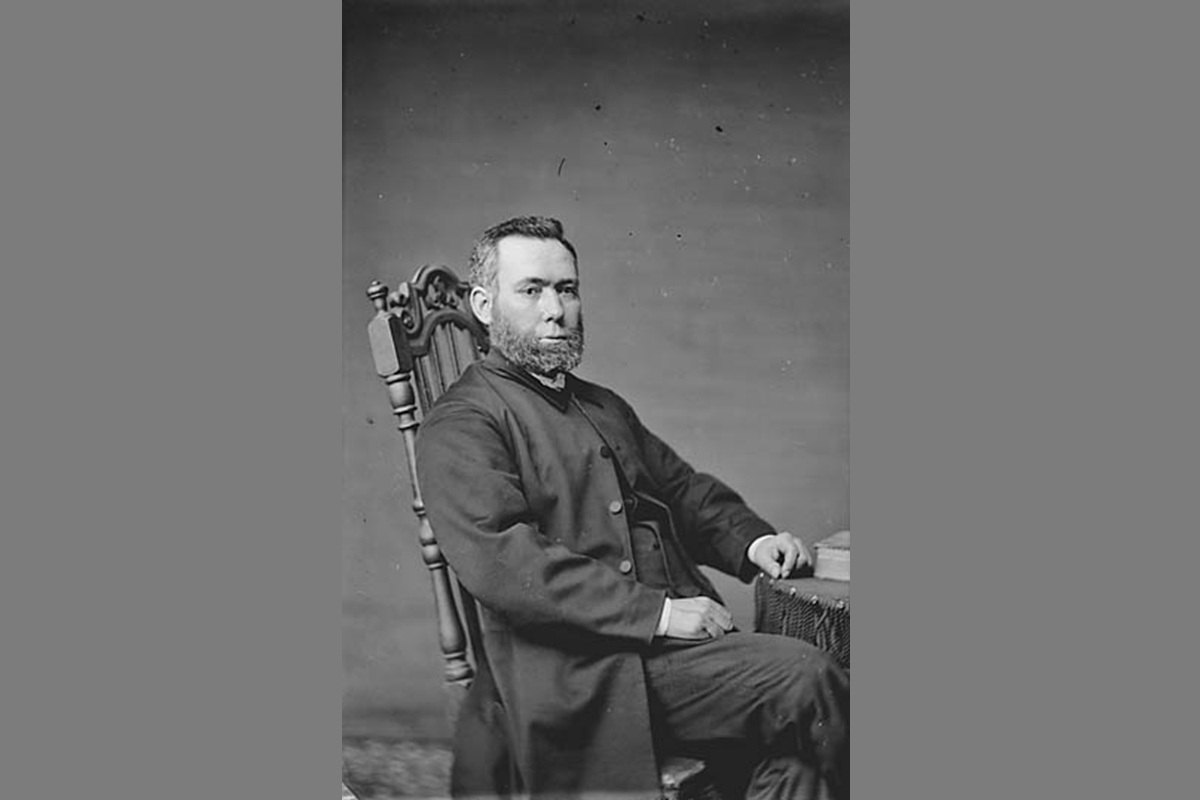
‘If Wales had a great poet in the 19th century it was the young William Thomas (Islwyn, 1832-78).’¹
Glyn Tegai Hughes published those words at the end of the 20th century.
Statements proclaiming this writer to be ‘the best’ and that poet to be the ‘greatest’ are sure to raise eyebrows and provoke counter-claims. However, Glyn Tegai Hughes was a very good scholar and an astute reader of poetry, and his words should be taken seriously (if not taken entirely at face value).
Note that the scholar qualifies his proclamation with the adjective ‘young’: it is because of one long poem which Islwyn wrote when he was a young man that Glyn Tegai Hughes awards him this accolade.
Born in Monmouthshire’s Sirhowy Valley in 1832, William Thomas grew up in a community which was increasingly industrialised and increasingly bilingual as a result of that industrialisation. His was a family of some means: his father worked as a land and railway agent and his older brothers were surveyors and engineers.
Thomas was well educated in a series of private schools and then at the Swansea college run by Evan Davies. Although ordained as a Calvinistic Methodist minister, he did not care for a specific chapel, but rather served as an unattached preacher, earning his living by editing a number of Welsh- and English-language periodicals as well as by preaching.
Competitions
He caught ‘y dwymyn eisteddfodol’ (‘the eisteddfodic fever’) at an early age and would spend a great deal of time and energy composing poetry for competitions during most of his life. Although winning in several smaller eisteddfodau, he never won the chair in the National Eisteddfod. Islwyn left behind a large body of this poetry when he died in 1878, but he’d only be remembered as one of many middling eisteddfodic poets from the Victorian age if it weren’t for that one long poem which he composed as a young man.
This work is Y Storm, ‘The Storm’, a pryddest or long free-metre poem numbering more than 6,000 lines. He apparently started working on it in the early 1850s while in the grip of grief following the death of his fiancée, Ann Bowen. He published a few of the opening lines in Y Gwerinwr in April 1855, but the vast majority of the work would remain unpublished until after the poet’s death.
Several themes weave fugue-like through the pryddest, including a multifaceted exploration of grief, religion and a romantic tribute to nature’s beauty and power. We are introduced to the eponymous storm in the very first lines:
Fel utgorn dyrchaf ei llais ar y bryn
A gwrendy y glyn
Dan grynu fel colfen ar raeadr bryd hyn!
A wyt tithau yn crynu? Tyrd, gwrando yn hy,
Llais natur sy fry,
A Natur sy’n canu ei hanthem i mi.
‘Like a trumpet it raises its voice on the hill
And the valley listens,
Quaking now like a tree caught in the torrent!
Are you also quaking? Come, bravely, [and] listen:
It is nature’s voice which is aloft,
And it is Nature which is singing its anthem to me.’
Invited to imagine the experience, we are carried by the musicality of Islwyn’s flowing words as we imagine rushing floodwaters engendered by the storm:
Clywch, acw ar daflod y nefoedd mae’n rhuo,
A’i tharan dros lofft y cymylau yn treiglo!
Yr afon a gyfyd o’r gwely i wrando.
A Rhyfel yw ysbryd y dymestl hy,
Goresgyn y bryniau a’r wybren mae hi;
A themtia yr afon anwadal i estyn
Ei gwleb deyrnwialen dros waelod y dyffryn,
A chroesi y terfyn â’i thonnau[.]
‘Listen, there in the heaven’s garret it roars,
Its thunder rolling over the upper chambers of the clouds!
The river rises up from its bed to listen.
And this bold tempest is War,
It conquers the hills and the sky;
And it tempts the inconstant river to extend
Its wet sceptre over the bottom of the valley,
And break the banks with its waves.’
The poet’s persona addresses us urgently using words suggesting how the violent weather outside mirrors the tempestuous feelings raging within him:
Edrychaf allan yng ngoleuni’r mellt,
Mae’r wybyr yn goch a’r holl gymylau ar dân.
Gwêl! Mae’n tywyllu eto; tywyll yw
Fel bru anobaith. Nid oes seren draw
Yn gwawrio o eigionau’r nef, er fod
Milfiliwn yno.
‘I look out in the lightning’s light,
The sky is red and all of the clouds are on fire.
Look! It grows dark again; it is black
Like the womb of despair. There is no star yonder
Appearing from the depths of heaven, although there are
A billion of them there.’
This striking passage sets knowledge against perception, with the latter dictating the speaker’s emotional state. The intellectual faculties which help him to ‘know’ that there are many stars out there fail in the face of the depression brought by the darkness which conceals all of those lights from view.
The Thames
One of the strengths of this ambitious pryddest is the way in which Islwyn grounds his storm in a familiar geography. He asks us to see the ‘Thames’ (Tafwys) swelling ‘like a sea’ (môr), while, on the border of Wales, this scene unfolds:
Mae yr Hafren a’i thonnau
Yn croesi y glannau
A Mynwy yn brysio i agor y ddôr,
A gwae a farchoga eu tonnau yn awr.
Clyw! Taflant y llongau
Fel gro ar y creigiau!
A fforest o fadau
 thraflwnc aruthrol a yfant i lawr [ .]
‘The Severn’s waves
Break the banks
And Monnow rushes to open the gate,
And woe rides on its waves now.
Listen! They throw the ships
Like gravel upon the rocks!
And a forest of boats is swallowed with a gigantic gulp.’
Descriptions of the storm and meditations on its significance bring the persona’s thoughts back repeatedly to God’s power. And this religious theme is often tempered with reflections on death and grief.
Mae Duw yn y nefoedd
Yn pwyso y croesau,
Yn mesur yr yrfa,
Yn rhifo y beddau.
‘God is in the heavens
Weighing the crosses,
Measuring the course [of life],
Counting the graves.’
One might read this in terms of Calvinistic theology and conclude that it is the poet’s way of expressing the doctrine of predestination. However, the image of a god relentlessly counting out everybody’s graves and measuring the crosses all will bear in life might be taken as a grief-stricken protest against a deity whose plan is unknown and unknowable.
Other than a few lines, Islwyn’s Y Storm would not be published until 1897. And that version was heavily edited by O. M. Edwards and only contained about half of the original poem. The entire work would not appear until 1980, more than a century after Islwyn’s death.
In a very real way, this literary storm took a long time to break.
More reading
‘Y Storm’ Gyntaf gan Islwyn, ed. Meurig Walters (1980).
Glyn Tegai Hughes, ‘Islwyn and Y Storm’, in Hywel Teifi Edwards (ed.), A guide to Welsh literature c. 1800-1900 (2000).
Meredydd Evans, ‘Y Storm’ gyntaf (1988).
Alun Llwelyn-Williams, Y Nos, Y Niwl a’r Ynys [:] Agweddau ar y Profiad Rhamantaidd yng Nghymru 1890-1914 (1960).
¹ Glyn Tegai Hughes, ‘Islwyn and Y Storm’, in Hywel Teifi Edwards (ed.), A guide to Welsh literature c. 1800-1900 (2000), 69.
Support our Nation today
For the price of a cup of coffee a month you can help us create an independent, not-for-profit, national news service for the people of Wales, by the people of Wales.
Get more trusted Welsh news
Choose Nation.Cymru as a preferred source in Google News to see more of our journalism.



The reality is a little more confusing than Jerry’s presentation though I can understand why he didn’t feel the need to go into the specifics for this overview. Islwyn actually completed *two* long poems called Y Storm between 1854-56, each of which is in the 6,000 range in terms of length. They are extremely similar in tone, imagery and subject matter but are separate poems rather than the second being a revisions or redraft of the first. Neither was published in his own lifetime. The second was published by OME in the 1890s, albeit, as Jerry notes, in an imperfect… Read more »