Several periodicals were published in Caernarfon during the second half of the nineteenth century, one of which was Y Geninen (meaning ‘The Leek’, spelled y genhinen today).
The January 1896 number of this literary quarterly contained two very different pieces about contemporary poetry, both presented under the heading ‘Y Bardd Newydd’ (‘The New Poet’).
This term was applied to contemporary poets who claimed to be – or were identified by others as being – part of a new trend. These beirdd newydd produced introspective, meditative poetry which contrasted sharply with the more descriptive verse which had dominated earlier in the nineteenth century.
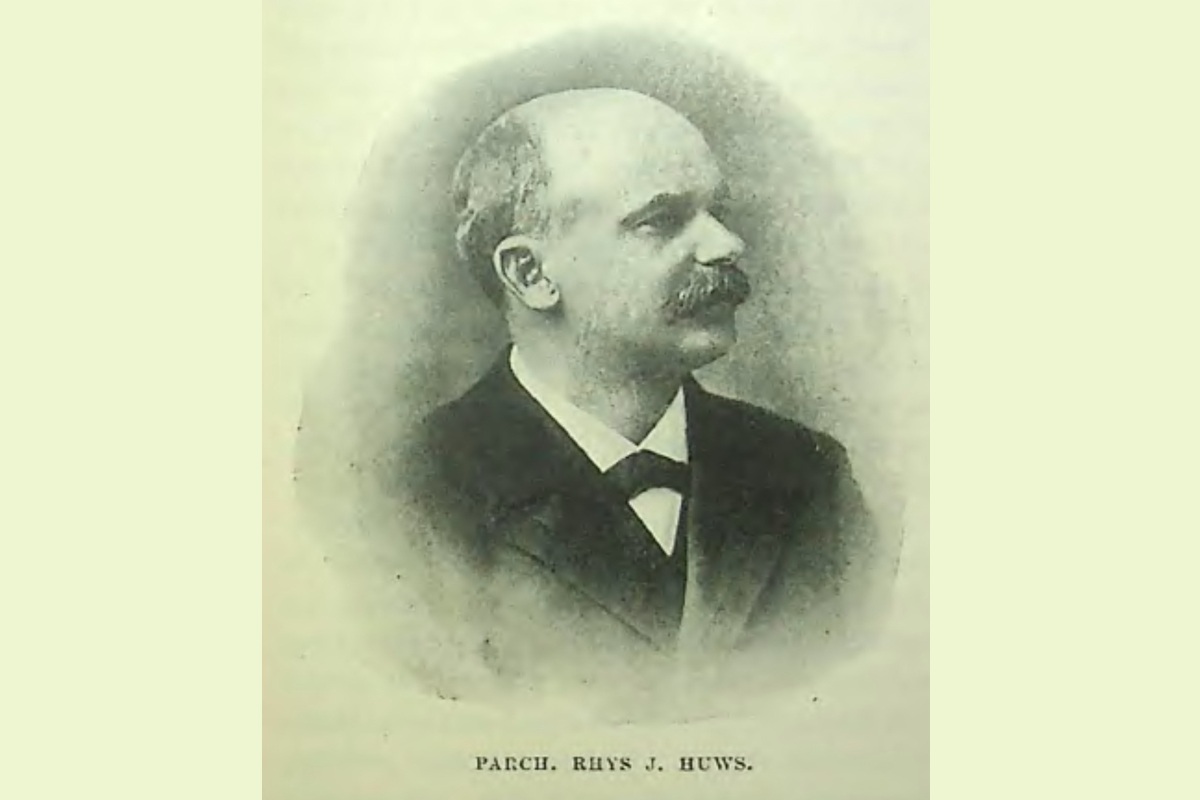
Rhys J. Huws (1862-1917) was perhaps the most prominent – or at least the most vocal – proponent of this new school. After working as a school teacher and studying at University College, Aberystwyth, Huws was ordained as an Independent minister. In addition to publishing a considerable amount of poetry, he produced a great number of lively essays, including the piece on ‘Y Bardd Newydd’ published in January 1896.
It is characterized by a bombastically confident tone, claiming a place for the ‘New Poet’ which he presents as both moral high ground and high point in the history of Welsh verse.
The first words of the first sentence state that the poetic movement to which the author belongs is concerned with ‘truth’: ‘Y mae gwirionedd yn gwythïenu drwy hanes oesau: mewn un oes ceir cangen-wythïen yn y dyfnder; mewn oes arall ceir hi yn y brig’ (‘Truth runs through the history of the ages like a vein [runs through the earth]: in one age a branch of the vein is found in the depths; in another age it is found on the surface’).
While suggesting that Y Bardd Newydd deals in (and with) ‘Truth’, Huws makes an equally lofty claim, presenting these ‘new’ poets as societal agents on a par with pioneering scientists: ‘Os mai wrth y gwyddonydd yr edrydd Cread ei freuddwydion gyntaf, y bardd, fel rheol, sydd yn eu dehongli’ (‘If it is to the scientist that Creation relates its dreams first, the poet, as a rule, interprets them’).
And this leads to his definition of ‘the special role of poetry’ (‘swyddogaeth arbenig barddoniaeth’), as Huws tells us that the purpose of poetry is ‘to guide truth to new connections, and to create [those new connections] for it’ (‘arwain gwirionedd i, a chreu iddo, gysylltiadau newyddion’).
Having already declared the new poets to be truth’s special servants, it comes as no surprise that Rhys J. Huws also casts them as dedicated servants of Wales.
Cymru Fydd
This was the age of the Cymru Fydd movement, and this is one of many pieces published in the 1890s which shows that Welsh politics and Welsh literature were symbiotically linked in the minds of many adherents of that movement:
Honir fod Cymru yn bresenol yng nghanol cyfnod o ddeffroad. Os yw yn deffro, y mae yn dod i weled, clywed a theimlo. [. . . .] Os na chamsyniwn yn fawr, y mae arwyddion ym marddoniaeth ddiweddar Cymru fod genym feirdd yn codi wedi gweled gweledigaethau mwy dyeithr, clywed seiniau mwy anghyfarwydd, a theimlo dylanwadau pellach, na’u blaenoriaid; ac y mae yn bosibl, os nad yn debygol, y clywir Cymru Fydd yn siarad â’r byd.
‘It is claimed that Wales is presently in the middle of a period of awakening. If it is awakening, it is coming to see, hear and feel. [ . . . .] If we are not greatly mistaken, there are signs in the recent poetry of Wales that we have poets arising who have seen rarer visions, heard newer sounds, and felt farther-reaching influences than their predecessors. And it is possible, if not probable, that Cymru Fydd (the Wales which will Come) is heard speaking with the world [in their work].’
His rhetoric then loops back to his opening paragraph’s vein-of-ore metaphor as he sets the truth-telling new poets against the poets of the past who lived in a time when truth was hidden in the unseen depths: Credaf y rhaid i bawb cyfarwydd gydnabod mai eiddil ac arwynebol iawn, gydag ychydig eithriadau, ydyw barddoniaeth Gymreig yr hanner canrif diweddaf wedi bod (‘I believe that everybody familiar with such things will have to admit that, with a very few exceptions, Welsh poetry of the past half century is very weak and superficial’).
Like Rhys J. Huws, Robert Arthur Griffith (1860-1936) was educated at Aberystwyth’s new University College. Born in Caernarfon, he was a successful lawyer in 1896 and on his way to becoming an even more successful barrister.
Adopting the bardic name Elphin, he was also well-known nationally as a poet, author and critic. The piece he published in Y Geninen about ‘Y Bardd Newydd’ took issue with the assertion that Welsh poetry from earlier in the century was no good and he questioned the claim to superiority being made by, and on behalf of, ‘the new poets’.
Elphin was a talented satirist, and he begins to contrast the older poets whom he champions with the new poets by drawing cartoonish sketches of their physical appearances.
The poets of previous generations were ‘Sons of Nature’ (‘Meibion Natur’) who ‘most often began their working life at the plough, in the quarry or in the workshop, and who gained muscle and bone while doing hard labour’ (‘wedi cychwyn eu gyrfa gan amlaf wrth yr aradr, yn y chwarel, neu yn y gweithdy, ac wedi magu cnawd ac asgwrn wrth ymarfer â llafur caled’).
Espousing a kind of bardic machismo, Elphin claims that these Sons of Nature ‘were no lesser men than they were poets’ (‘Nid oeddynt lai o ddynion nag oeddynt o feirdd’), and he suggests that, like the professional bards who accompanied medieval Welsh warbands to battle, ‘if they were called to the field they wouldn’t be less able to defend their country with physical might than they were to sound its praises in metre and song’ (pe buasai galw arnynt i’r maes na fuasent yn llai hyfedr i amddiffyn eu gwlad gyda nerth braich ac ysgwydd nag oeddynt i seinio ei chlodydd ar fesur a chân).
Then comes Elphin’s description of the ‘beirdd newydd’:
Ond beth am y genhedlaeth newydd? A siarad yn gorfforol, rhaid dweud nad ydynt ond silod mân, egwein, llesg, diraen, a diolwg i’r eithaf. Pe bai “recruiting sergeant” yn digwydd dod heibio ddydd yr Eisteddfod, yr wyf yn ofni na roddai gymaint â grôt y dwsin amdanynt. Nid yn wawdus yr wyf yn dweud hyn, ond yn unig fel mater o ffaith. [ . . . .] Dywedais mai plentyn Natur oedd y bardd a adwaenwn gynt: cynnyrch y study ydyw y Bardd Newydd. Wrth bwnio ei ben mewn llyfrau er mwyn ehangu ei feddwl, y mae wedi crebachu ei gorff i’r fath raddau fel mai lle go gyfyng sydd gan ei enaid mawr i droi ynddo.
‘But what about the new generation? Speaking in terms of their bodily appearance, one must say that there are but small fry, weak, feeble, lack-lustre and plain-looking in the extreme. If a recruiting sergeant happened to come by on the day of the Eisteddfod, I fear that he wouldn’t pay as much as a groat a dozen for them. I am not saying this mockingly, but only as a matter of fact. [ . . . .] I said that the poet whom we knew of old was a child of Nature: the New Poet is the product of the study. By poking his head in books in order to expand his mind, he has shrivelled his body to such a degree that his soul is forced to dwell in a very confined place.’
Grotesque excess
This comical tour-de-force is tinged with grotesque excess just as its tongue-in-cheek tone revels in rhetorical extremes. Given the surrounding sentences, Elphin’s claim that he is not saying this ‘mockingly’ but ‘as a matter of fact’ is truly hilarious. The barrister Robert Arthur Griffith surely employed this kind of comical rhetoric while arguing cases in court.
Despite the humorous delivery, it is difficult to miss one very serious criticism. Elphin says that the ‘Bardd Newydd’ is the ‘product of the study’: poetry associated with the movement tended to be abstract and philosophical, and the ‘new poets’ often used their verse as a vehicle for displaying their book learning. While much of their poetry is characterized by a kind of Romanticism, it is a Romanticism tempered heavily by Nonconformist theology. It is poetry designed to appeal to the head rather than the heart and soul, Elphin suggests.
More serious criticism comes as Elphin notes that the new poets often indulge in long monologues, which he describes in gleefully acerbic detail:
. . . math o gân neu bryddest . . . ym mha un y sieryd y bardd ag ef ei hun mewn dull tra rhwysgfawr a chwyddedig. Er mwyn rhoddi arbenigrwydd ar ei gân arfera yn aml gymysgu ei ymadroddion a chymylu ei feddylddrychau yn y fath fodd na fedr yr un dewin mo’u deall, a cheisia gennym gredu ei fod drwy hynny yn tynnu y llen i ryw fesur oddiar feddyliau a bwriadau y Bod Mawr ei Hun er budd i ddynoliaeth.
‘[it is a] kind of song or pryddest . . . in which the poet speaks with himself in an extremely pompous and overblown manner. In order to dress his poem with a specialness, he often mixes his ways of speaking and clouds his ideas in such a way that not even a wizard can understand them, and he tries to get us to believe that, by doing so, is to some degree unveiling the thoughts and intentions of the Supreme Being Himself for the sake of humanity.’
Unique
Islwyn – whom Elphin praises – influenced the new poets, but what is strikingly unique in Islwyn’s ‘Y Storm’ (see the previous episode) becomes trite, worn and pretentious in the second-hand versions produced by so many of the beirdd newydd. Elphin’s criticism of the ‘pompous and overblown’ conceit of the new poets rings true, and it would be echoed by other critics for the next century.
What happens if we read that piece on ‘Y Beirdd Newydd’ by Rhys J. Huws in this context? If Elphin complains that the new poets pretend to be able to reveal the thoughts of God, their spokesman claims in no uncertain terms that they are the interpreters of truth. This was nothing new: many have claimed through the ages that poets are the ones who speak truth. Criticism of that supposed importance is just as old.
After all, Plato was worried about including poets in his Republic because he considered them to be imitators and fakers. This debate is as relevant today as it ever was. Think about that if you find yourself walking past the Wales Millennium Centre and looking at those words written by the poet Gwyneth Lewis:
CREU GWIR FEL GWYDR O FFWRNAIS AWEN
(‘Creating Truth Like Glass from the Furnace of Poetic Inspiration’).
Further Reading:
Ann Rhian Hughes (ed.), Beirniad Llym Gynddeiriog: Ysgrifau a Cherddi Elphin (Dalen Newydd, 2026).
You can read Y Geninen on the website of the National Library of Wales.