


Yr Hen Iaith part 97: Poet and Scholar: John Morris-Jones
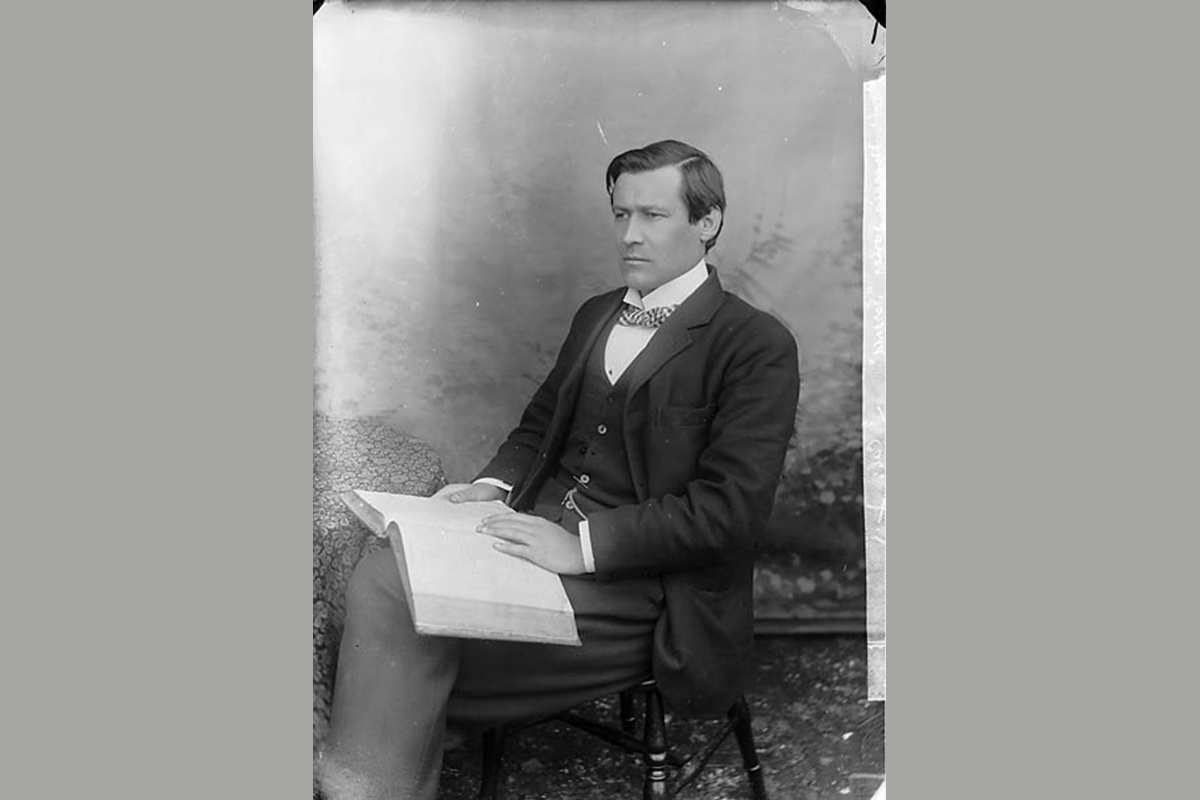
Jerry Hunter
The politics of the Cymru Fydd movement and Welsh-language literature were intimately connected during the late 19th century.
One of the leaders of the movement, O. M. Edwards, edited the influential journal Cymru (which he had also founded), and it was surely no surprise that, in August 1892, Edwards chose to publish an awdl by John Morris-Jones entitled ‘Cymru Fu: Cymru Fydd’ (‘Wales Which Was: Wales Which Will Be’).
While seeking self-government or ‘home rule’ for Wales was Cymru Fydd’s clearest objective, my co-host Richard Wyn Jones notes that one of the most salient features of the movement was optimism. Cymru Fydd-ers could imagine a bright future. And they could imagine that the Welsh language and its culture would survive and thrive.
In this poem, John Morris-Jones – or his poetic persona – addresses Wales directly, describing the bright future he sees for the nation:
Eithr os du yw, na thristawn;
Mewn da bryd, cyfyd cyfiawn
I’th arwain o gaeth oror
I rydd wasanaeth yr Iôr;
Dwyn o aflan wasanaeth
Gau Famon feibion dy faeth:
E dyr gwawr, wlad ragorwen,
Nac wyla, O Walia wen.
‘Yet if [the present] is dark, we will not be sad;
In good time, a just one will arise
To lead you from dire straits
To serve the Lord willingly,
Freeing the sons nurtured by you
From the foul service of false Mammon:
Dawn will break, fine blessed country,
Do not weep, blessed Gwalia.’
While the title’s reference to Cymru Fydd demands reading these lines in the context of contemporary political discourse, this part of the awdl is driven by older concepts as well: the ‘just one’ who will lead the nation to a bright future is a reworking of the medieval mab darogan theme, the prophesied national saviour. And as Richard Wyn Jones notes in the podcast, another aspect of this poem which reflects a current in Cymru Fydd thinking is the neo-socialist critique of capitalism (represented here by ‘Mammon’).
The poet describes the future nation as a very Welsh utopia. He tells Wales that she will raise ‘the best of men’ ([g]oreuwyr) and that they ‘will love you’ (i’th garu), adding that future Welsh people will also ‘love your language’ (a charu’th iaith). Moreover, ‘beautiful poets will come to you to sing the Glory of the just ones’ (Ac fe ddaw it heirdd feirddion – i ganu / Gogoniant y cyfion).
Like the professional bards of medieval Wales, future Wales will spawn talented praise poets: this combination of past and future reminds us that the poem’s title has two parts, one using the past tense of the verb ‘to be’, bu, and one using the future tense, bydd. It is not merely a rebirth of an old tradition which this poet foresees, for he also stresses that these future bards will make ‘new songs’ (newydd ganeuon). And these words, referencing oft-quoted lines in Psalms, also reinforce the religious theme interwoven with the optimistically nationalistic one.
This utopian vision of a future Wales reaches ecstatic heights in two englynion unodl union:
Ni thrig annoeth ddrygioni – ynod mwy,
Na dim ôl gwrthuni;
Nac anwybod na thlodi,
Yn wir, nid adwaeni di.
Yno bydd pob daioni, – hoff bau deg,
A phob digoll dlysni;
Pob gwybod a medr fedri;
Aml fydd dy ddrud olud di.
‘Foolish wickedness will no longer dwell within you,
Nor will there be any trace of shame;
Nor ignorance nor poverty,
Truly, you will not know yourself.
There all goodness will be, fair beloved land,
And all perfect beauty;
You will master all knowledge and skill;
Your dear wealth will be ample.’
John Morris-Jones was a young college lecturer when he published this awdl. He was born in Trefor, Llandrygarn, Anglesey, and his family moved to Llanfairpwll when he was four years old. After receiving schooling in Bangor and Brecon, he went on a scholarship to study at Jesus College, Oxford, graduating in mathematics in 1887. However, while at Oxford he attended lectures on Celtic languages and literatures by John Rhys and spent a considerable amount of time studying old Welsh books and manuscripts held in several Oxford libraries.
The suggestion that he lived a fairly Welsh life while at Oxford is reinforced by the fact that he was one of the founders of the university’s Welsh student society, Cymdeithas Dafydd ap Gwilym. In 1889, he was appointed as a lecturer in Welsh at the University College of North Wales (now Bangor University). Before the end of the 19th century, John Morris-Jones had made a name for himself as both scholar and poet, and this bridging between academic research and creative writing is still a salient feature of Bangor University’s Welsh Department today.
While his poetry is often taken as a studied and disciplined counterpoint to the long-winded and overly complicated work of the ‘New Poets’ discussed in our previous instalment, and while he is sometimes credited with setting the benchmark for a new generation of poets at the turn of the century, John Morris-Jones is most remembered for his scholarly work.
Among his early scholarly projects, he worked with John Rhys to print an important medieval manuscript, ‘Llyvyr Agkyr Llanddewiverfi’, in 1894. Two years later he would be responsible for a new edition of Ellis Wynne’s 1704 classic, Gweledigaetheu y Bardd Cwsc.
The young scholar put his learning at the service of the Welsh nation, serving as secretary of the committee working to standardise the orthography of the Welsh language (that is, the way in which the language is spelled). He was responsible for the volume Welsh Orthography, published in 1893. This service cannot be overestimated: for the first time in its history, there would now be an agreed way of spelling the language.
Early in the following century, John Morris-Jones would also seek to produce a new standard grammar of the Welsh language as well as a codification of the rules of strict-metre poetry.
We might have to return to John Morris-Jones in the next series of Yr Hen Iaith, as it’s difficult to discuss the history of Welsh literature during the early twentieth century without mentioning him.
Further reading
John Morris-Jones, Caniadau (1907). A reprint has been published recently by Melin Bapur.
Allan James, John Morris-Jones (2011).
Huw Walters, John Morris-Jones, 1864-1929: Llyfryddiaeth Anodiadol (1987).
Richard Wyn Jones, Rhoi Cymru’n Gyntaf: Syniadaeth Wleidyddol Plaid Cymru, volume 2 (appearing in 2027). Cymru Fydd receives considerable attention in this volume. An English translation will appear shortly as well.
Support our Nation today
For the price of a cup of coffee a month you can help us create an independent, not-for-profit, national news service for the people of Wales, by the people of Wales.
Get more trusted Welsh news
Choose Nation.Cymru as a preferred source in Google News to see more of our journalism.


