

Yr Hen Iaith part part 79: Bard of liberty and arch-forger: Iolo Morganwg
Jerry Hunter
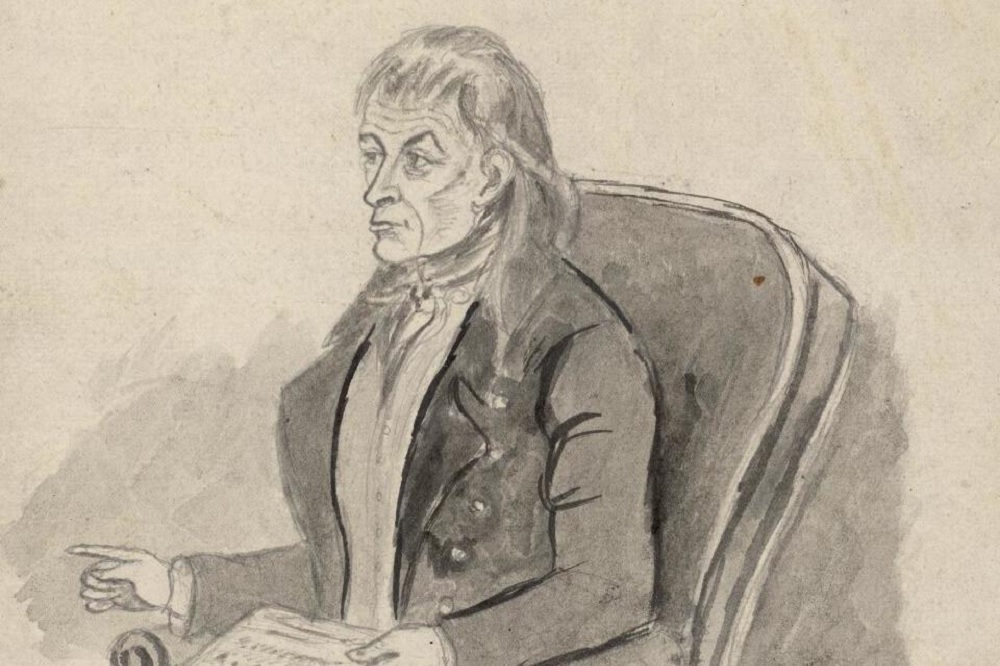
Early in this century, the historian Geraint Jenkins spearheaded a large research project at the Centre for Advanced Welsh and Celtic Studies, ‘Iolo Morganwg and the Romantic Tradition, 1740-1918’.
For nearly a century before this, Edward Williams (1747-1826) – or, to use his bardic name, Iolo Morganwg – had been known first and foremost as a literary forger and an inventor of tradition. I certainly remember hearing his name used both as a joke and as a curse in academic circles.
But that was back before a series of hefty books stemming from the Centre’s research project helped to resituate Iolo’s many cultural contributions and make more nuanced – if complicated – analyses of this enigmatic character mainstream.
There is no question that Iolo created a great many things which he passed off as tradition and fact. He invented Coelbren y Beirdd, the bardic alphabet which he claimed had been used by the ancient druids.
He invented the Gorsedd of the Bards and convened it for the first time on Primrose Hill in London in 1792. He wrote poems which he claimed had been composed in the medieval period. He created a great amount of Welsh history, especially things which glorified his native Morganwg (Glamorgan).
However, despite the negative way in which he was often viewed during the late twentieth century, a more positive view of Iolo had been presented by G. J. Williams – the very scholar who had exposed some of Iolo’s more audacious forgeries several decades earlier.
In a 1956 book, Williams describes the wondrous version of Morganwg and its history which Iolo invented as ‘creadigaeth artistaidd y cyfnod rhamantaidd’, ‘an artistic creation of the romantic period’, urging readers to ‘edrych arni fel darn o’n hetifeddiaeth lenyddol’, ‘look at it as a piece of our literary heritage’. Iolo’s fictional Morganwg can be seen as a masterpiece of fantasy akin to J. R. R. Tolkien’s Middle-earth in its scope and ambition.
The reason why Iolo invented all of this is open to debate. Many have suggested that his wider flights of fancy were fuelled by the laudanum which he took.
However, even if he did pen some things under the influence of the drug, it’s hard to believe that he didn’t realize in his sober hours what he was doing. It would take a masterful exercise in historical forensic psychology to work out why he did what he did.
One thing is sure, he didn’t do it for money. He didn’t do it for fame either; rather than shouting ‘my poems are as good as Dafydd ap Gwilym’s’ from the rooftops, he wanted everybody to believe that his forged poems were in fact by that most famous of medieval Welsh poets.
It was largely thanks to Iolo’s scholarly drive and philological talents that Dafydd’s poetry was published for the first time. When Barddoniaeth Dafydd ab Gwilym appeared in 1789 it became a milestone in the history of the rediscovery of medieval Welsh poetry.
Forgeries
Yet some of the poems which were passed off as Dafydd’s work were actually forgeries by Iolo. And some more of his forgeries were published in various periodicals as well. These fakes held their ground for more than a century. It was only when G. J. Williams published Iolo Morganwg a Chywyddau’r Ychwanegiad in 1926 that the deceit was finally uncloaked once and for all.
It’s worth looking at how Iolo assumed the bardic voice of Dafydd ap Gwilym. Not only did he master the strict-metre cywydd form, but he also employed Middle Welsh vocabulary and addressed Dafydd’s favourite themes. For example, while several of the fourteenth-century poet’s love poems are addressed to Morfudd, ‘Arwyrain Morfudd’ (‘In Praise of Morfudd’) is by Iolo. It begins:
Y mun gain, hoyw em goeth,
Y cyfan wyd o’m cyfoeth.
Gorau meinir a garaf,
Gwymp yw’th wên fel heulwen haf.
‘My fair maiden, a fine radiant gem,
The best sweetheart whom I love,
Your smile falls [on me] like summer’s sunshine.’
Vivaciousness
There is a vivaciousness here which nicely matches the voice and tone of the medieval master. While there are surving ‘death-bed poems’ by several medieval Welsh bards, no such composition by Dafydd ap Gwilym is extant. Thus, when Iolo wrote ‘Cywydd Olaf Dafydd ap Gwilym’ (‘Dafydd ap Gwilym’s Last Cywydd’), he was filling in a gap. And he filled it in nicely. Not surprisingly, he also forged poetry ‘proving’ that Dafydd had a strong connection with Morganwg.
Iolo wrote in English as well as Welsh, and he styled himself as the ‘Bard of Liberty’ perhaps partly with an eye to his reputation outside of Wales.
Interestingly, the same year which saw the publication of Dafydd’s poetry also witnessed the explosion of the French Revolution. Like the subject of our last instalment, Jac Glan-y-Gors, Iolo embraced the radical ethos of the Age of Revolution. One of his free-metre poems, ‘Gwawr Dydd Rhyddhad’ (‘The Dawning of Freedom’s Day’), is a joyous hymn to the new era:
Mae gwawr
Dydd ein rhyddhad yn deffro’n awr,
Disgleirdeb y gwirionedd mawr;
O! gwêl y bore’n deg ei dardd,
Mae’n gwenu ar hyd y bryniau draw,
Mae’r haul gerllaw a’i dywyn hardd.
‘The dawning
Of the day of our freedom is awakening now,
The brightness of the great truth;
Oh! Behold the morning of fair origin,
It’s smile [can be seen] upon the hills yonder,
The nearby sun [is here] with its beautiful brilliance.’
The poem urges an imagined reader who, plagued by ‘fears’ (ofnau), is ‘too weak in faith’ (rhy wan dy ffydd) to take heart; ‘come closer’ (dere’n nes), the bard commands, and see that ‘summer is very near / with its bliss and its gentle warmth’ (haf yn agos iawn / A’i wynfyd llawn a’i dawel des).
Continuing in this coaxingly triumphant tone, the Bard of Liberty declares that ‘truth’ (gwir), ‘after the death of a long winter’ (Ar ôl marwoldeb gaeaf hir) will emerge. His metaphor beats with a mystical heart; the emerging sun is the emerging truth. Referencing recent revolution more directly, the new age brought by the dawn of truth and freedom is then described in more detail.
Although ‘the weight of oppression in the world’ (baich gorthrymder yn y byd) has been born for such a long time, and despite the power of the ‘the pomp of ugly falsehood’ (rhwysg anwiredd gwael ei fryd), ‘the mighty one will be bound [and] his sword will be broken’ (Fe rwyma’r traws, fe dyr ei gledd).
Slavery
Iolo Morganwg matched his words with action. He was a vocal opponent of Britain’s involvement in the slave trade. Although he struggled financially for most of his life, Iolo turned away profit if it was connected to slavery.
He didn’t allow Bristol merchants and craftsmen involved in the slave trade to subscribe to his books. Famously, he is said to have placed a sign in the window of his Cowbridge shop stressing that the sugar products which he sold were from the East Indies and ‘uncontaminated with human gore’ (as was sugar produced by slavery in the West Indies).
When Wales became the world’s first Fair Trade Nation in 2008, some pointed to Iolo Morganwg as an early pioneer of that Welsh push for freedom.
Further Reading:
J. Williams, Iolo Morganwg (1956).
Geraint Jenkins, A rattleskull genius: the many faces of Iolo Morganwg (2005).
Mary-Ann Constantine, The truth against the world: Iolo Morganwg and Romantic forgery (2007).
Marin Löffler, The literary and historical legacy of Iolo Morganwg, 1826-1926 (2007).
Geraint Jenkins, Bard of Liberty: the political radicalism of Iolo Morganwg (2012).
Prys Morgan, ‘From a Death to a View: The Hunt for the Welsh Past in the Romantic Period’, yn Eric Hobsbawn a Terence Ranger (goln.), The Invention of Tradition (1983).
The Centre for Adanced Welsh and Celtic Studies, ‘Iolo Morganwg’ project: https://web.archive.org/web/20170215125044/http://www.iolomorganwg.wales.ac.uk/
Support our Nation today
For the price of a cup of coffee a month you can help us create an independent, not-for-profit, national news service for the people of Wales, by the people of Wales.



That was nice to learn a bit more about Iolo, having grown up in the shadow of Nannau and Hengwrt, Hengwrt after the fire especially, some very political mid 20th Century stuff took place there, ‘weekend retreats’ that may not have been looked at in detail.
What a setting for a play or two or three, lets not forget the guest either, a three act play, two heads per act. A play to be performed at Coleg Harlech or The Dragon Bermo sometime in the future…
Wish upon a star…