

Yr Hen Iaith part sixty-nine: Introducing the Anterliwt
Jerry Hunter
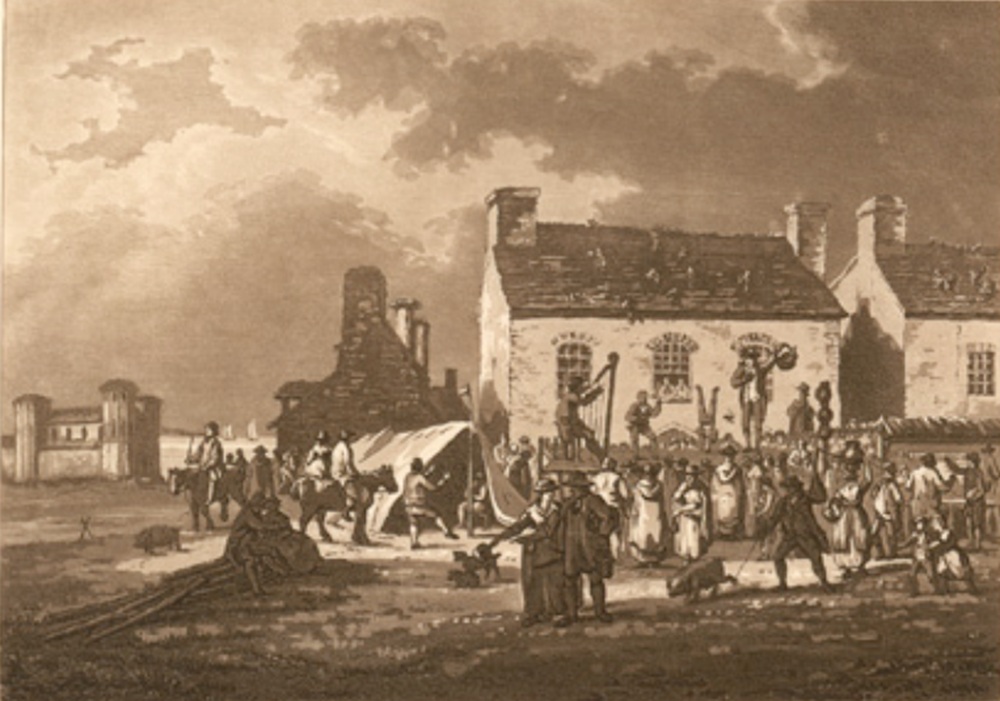
As was stressed in episode 67, the triumph of Nonconformism in Wales ensured the loss of some traditional aspects of Welsh culture. These cultural casualties included the gwylmabsant festival and the anterliwt, a kind of play which was often performed in that carnivalesque social context.
Between 35 and 40 anterliwt texts have survived in print or in manuscript, and some of them highlight the symbiotic relationship between text and context, between play and festival. Take, for example, the opening scene of Cybydd-dod ac Oferedd (‘Miserliness and Vanity’) by Thomas Edwards (1739-1810), better known as Twm o’r Nant. Mr. Oferedd (‘Mr. Vanity’), who also fulfils the functions of the fool (a traditional character found in almost all of these plays), presents himself as the one who has been advertising the play and attracting the audience:
Ond y fi ddarfu gludo gair drwy y gwledydd
I wadd hynny fedrwn i wylmabsant ynfydrwydd,
I glywed Interliwt Thomas o’r Nant,
Bob rhai sy a chwant llawenydd.
‘But it is I who carried word through the regions
To invite all whom I could to a gwylmabsant of foolishness,
To hear an anterliwt by Thomas of the Nant,
All of those who desire merriment.’
It makes sense to have a fool emphasizing the ‘foolishness’ of the entertainment in which he and his audience are revelling. However, it’s also important to note that it is not just the play which he describes here but also the entire gwylmabsant which provided the context for the play’s performance.
Merriment
The adjective llawenydd, ‘merriment’, also stresses the value of both anterliwt and gwylmabsant – a kind of enjoyment which was attacked by those evangelical reformers.
Surviving anterliwt texts suggest that these performances provided many interweaving kinds ‘foolishness’ and ‘merriment’, some of them slap-stick and obvious, and others more subtle.
As seen in the stanza quoted here, the name of the poet who composed the anterliwt was often woven into the fabric of the text, and the way in which the an author placed himself in his own composition could in itself be a vehicle for a special kind of humour.
Take, for example, the opening stanzas of Y Brenin Dafydd (‘King David’), jointly authored by Huw Jones of Llangwm and Siôn Cadwaladr of Y Bala. The play’s fool, Cecryn (‘An Argumentive One’), comes before the audience and declares that he has heard members of the audience arguing about the play’s authorship. One woman scoffs at the anterliwt and the poet whom she believes to be its author:
‘Ie’, medde un arall gwedi,
‘Gwaith Siôn o’r Bala ydy’.
‘Ha!’ medde hithe, ‘myn gwaed y cawr,
Nid oes ynddi hi fawr ddaioni’.
‘ “Yes”, says another one then,
“It’s a compostion by Siôn from Y Bala.”
“Oh-ho!” says she, “by the giant’s blood,
There is not much good in it.”
A man described as rhyw luman lledlwm, ‘a ragged banner [of a fellow]’, joins in the discussion, contradicting the woman by saying ‘Nage, Huw o Langwm’, ‘ “No, [it was] Huw from Llangwm [who composed it].”’ And then a morwyn, ‘maid’, from Tai yn y Foel adds
“Nid oes arni na choel na chwlwm” (‘ “it has neither credence nor plot” ’). Others join in, developing – and complicating – the debate about the authors and the worth of their play:
Ond ebr un arall eilweth,
“Mae Huw yn fwy ei wybodeth;
Fe’i gwnâi hi yn well, debygwn-i,
Na Sionyn ddiwasaneth”.
“Ho! ho!” ebr rhyw ŵr moesol
Dan ’studio’n grach wastadol,
“Ni chymerth Sionyn erioed i’w ran
Ond testun gwan rhyfeddol”.
‘But yet another one said,
“Huw has greater knowledge;
He’d make it better, I presume,
Than would worthless Sionyn.”
“Ho! ho!” said some moral man,
Thinking about it in an incessantly mean way,
“Sionyn, for his part, never took on
Anything other than incredibly weak subject-matter.”’
During the course of the anterliwt, the fool will employ a variety of strategies in order to make his audience laugh, including his traditional deception and debasement of another stock character, the miser (cybydd) as well as directing lewd comments at members of the audience. And, providing humor which is more sophisticated ideationally, the fool can make the poet who authored the lines he utters the butt of his jokes. (Yes, poets: the anterliwt is a metrical play and almost always uses the kinds of traditional free-metre stanzas often employed as the vehicles for folk songs and poems.)
Familiarity
However, in addition to eliciting laughs with this exuberant self-satire at the start of their play, Huw Jones and Siôn Cadwaladr are also doing something else here; they are assuming that the audience knows them, and by writing that assumption into their script they are creating that familiarity.
Siôn Cadwaladr is referred to twice in the above quotes as ‘Sionyn’, a form of the name employing the diminutive suffix, -yn. This single syllable transforms a Welsh name, and, depending on the way in which it is used, it can imply familiarty, fondness and/or scorn. Cecryn the fool tells us that his audience is familiar with the two poets and with their work, and, while he is making that audience laugh by belitting those very poets, the very fact that they are laughing ensures that they will stay and watch the rest of the play.
They also provided the basis for a tour de force performance by the actor playing Cecryn the fool. In describing the argument about the play and its authors, he quotes at least thirteen different people, thus providing an opportunity for the actor to employ a wide range of comic voices and create a range of colorful cameos. The opening scene of Y Brenin Dafydd can be seen as a play within a play, and it is a play about the composition and nature of the play which contains it.
An anterliwt was a long play. We have no detailed descriptions of eighteenth-century performances, but, judging by the existing texts (or ‘scripts’), we can suggest that an average performance lasted for two or three hours. Music, singing and dancing were essential parts, and, while the tunes to which songs are sung are usually noted, and while the fact that a character – usually the fool – dances is noted, there is no way of knowing either the tempo of the music or the length of any particular dance.
Standardised
While standardised by modern scholars as anterliwt, period texts use a variety of forms and spellings of the word. Indeed, some of these Welsh texts use the English word from which the Welsh forms were borrowed, ‘interlude’.
That cross-border connection, however, is more of a puzzle than an explanation of the Welsh tradition’s origins; English interludes in the early modern period tended to be short performances staged during a feast or between other entertainments (as the word ‘interlude’ itself tells us). The very length of the Welsh anterliwt as well as other aspects of the tradition make it very different from extant English interludes.
Almost all anterliwtiau have two stories or story lines, one of which is the story of the fool and miser, already referred to above. This is the most traditional part of the form, and any audience gathering to watch a new anterliwt would expect the fool to be the first character to appear and address them, just as they would look forward to seeing the fool turn the miser’s world upside-down.
The other story could be whatever the poet-playwright chose (recalling the self-satire criticizing Siôn Cadwaladr for using ‘incredibly weak subject-matter’). This subject-matter could be based on a biblical narrative, a folktale, Welsh history or recent events. The French Revolution provided a story for one anterliwt, and the American Revolution provided the background for another.
Bawdy humour
Most anterliwt texts display a combination of heavy-handed moralizing and extremely bawdy humour, swinging between the serious and the silly, the godly and the grotesque.
This combination might strike us as strange today. If so, then it’s safe to conclude that the strangeness which we perceive is in part due to the efforts of those eighteenth-century religious reformers.
With the triumph of Nonconformism, the Welsh became estranged from things which had been central to their own culture, and the anteriwt is one of those things.
Further Reading:
Part 67 in this series: https://nation.cymru/feature/yr-hen-iaith-part-67-that-which-was-lost/
Dafydd Glyn Jones, ‘The Interludes’, in Branwen Jarvis (ed.), A guide to Welsh literature c.1700-1800 (Cardiff, 2000), 210-55.
For texts of anterliwtiau by Huw Jones of Llangwm edited by A. Cynfael Lake, see the Swansea University website: baledihuwjones.swan.ac.uk.
Support our Nation today
For the price of a cup of coffee a month you can help us create an independent, not-for-profit, national news service for the people of Wales, by the people of Wales.



I do note the use of the word ‘some’ in the article, but I disagree with those who wish to give us the impression that Nonconformity represents a general ‘estrangement’. I prefer Gwyn Alf’s interpretation – that Welsh resistance at this particular time was expressed in the creation of the ‘Pseudo nation of Welsh Nonconformity’. Whether we agree or disagree with the ideological, philosophical, basis of religious Wales at this time or no, the scale of its cultural and literary output was substantial – book publishing prolific, unmatched to this day – all through the medium of the Welsh language.… Read more »