


Abolition of police commissioners in Wales raises questions about accountability
Alec Doyle, Local Democracy Reporter
Who takes on the responsibilities of Police and Crime Commissioners in Wales has still not yet been decided according to North Wales PCC Andy Dunbobbin.
Following the shock announcement last month that all PCCs across England and Wales would be scrapped by 2028, the UK Government said that the elected regional mayors or council leaders would absorb the job into their roles.
But in Wales – where all police forces cross multiple counties and there are no elected mayors – there is currently no plan for how to replace PCCs.
“We still have a job to do and have no intention of scooting off into the sunset anytime soon,” said Andy. “I’ve been elected to do a job. I thoroughly enjoy the work we do here and I remain focused on the role.
“For now I am still in a position where I’m able to influence change and how that would look for the future of the PCC model. The main thing for me is preserving public accountability.
“Wales is quite unique because although policing isn’t devolved, we work with Welsh Government, the WLGA and other key stakeholders who are. Policing has been going on in a devolved environment since the role of the PCC was created.
“What the future looks like depends on how the Government recognises that. In England it is using the mayoral model to make the deputy mayors the equivalent of the Police and Crime Commissioners.”
Wales has no comparable mayoral model however, leaving question marks over who takes on the role when the PCCs are abolished – and how they are held accountable.
“We’re still working through that,” said Andy. “Police and Crime Commissioners and Chief Constables are in discussions with Welsh Government and the WLGA – which PCCs are affiliated in Wales – to see what a new model for Wales would look like.
“If the PCC isn’t performing well we have the Police and Crime Panel to scrutinise and we’ve got the electorate at the ballot box. How do we retain that accountability in a new model? That’s one of the big challenges.
“The role of the PCC is to be a bridge between the Chief Constable and the Police and the community, particularly with so many local authorities with competing priorities to consider.
“One of the things I’m most proud of is the amount of engagement I’ve taken on as PCC. From the number of shows we attend to community engagement and working with organisations across North Wales. That will be a challenge for the new model to replicate.
“I think that myself and the other Welsh PCCs – Dafydd Llwellyn in Dyfed-Powys, Emma Wools in South Wales and Jane Mudd in Gwent – are really well versed and skilled in navigating through this period.”
Despite the seeming lack of a plan for policing in Wales, Andy said he did believe that the abolition of PCCs had been in the pipeline for some time.
“The day of the announcement we had a briefing from the Policing Minister on the Thursday morning at 9.30am with other PCC colleagues across England and Wales,” he said.
“Once that news came through my job was to ensure that was communicated to the rest of the team in the Office of the Police and Crime Commissioner (OPCC) swiftly by myself and Stephen Hughes, Chief Executive of the OPCC.
“Then we got in touch with Unison – the union many members of the OPCC are in – to make sure they had that welfare support and any other support that was needed. Making sure the workforce was taken care of was my priority.
“It was a blow but when we look back to what was said at the National Police Chiefs Council and Association of Police and Crime Commissioners summit last year when Yvette Cooper was Home Secretary, her keynote address mentioned ‘landscape reform’ and a ‘National Centre of Policing’ – a piece of work I’ve been involved in.
“It is sad and the team have been bruised but it doesn’t take away from how they have carried out their duties. They have remained professional throughout and it’s a testament to how we work together as a unit.”
Andy said he felt the low public turnout at the last PCC election had influenced the decision.
“I think that’s where the issue lies,” he said. “The turnout at the last PCC election was around 17%. In 2021 when I was first elected it was around the same time as the Senedd elections and turnout was around 46%.
“I think that would be fair to say there’s some questions about the scheduling of the last election.
“There’s quite a lot of work we have been doing to raise that awareness of the role of PCC with the public however.
“Winston Roddick, my predecessor, set up one of the first dedicated rural crime teams in England and Wales. The victims panel that I introduced that allows victims of crime an opportunity to share their experience and shape change.
“The recent conference on Modern Slavery in partnership with Welsh Government we hosted in Conwy. These achievements are worth celebrating.”
But he said that one of his key priorities in shaping the transition from PCC to whatever model Wales decides was protecting victim support, crime prevention and community engagement initiatives.
“We’ve been able to do a lot of things to reduce demand on policing,” he said. When you look at schemes like Innovate to Grow, the hundreds of community groups we have supported the hundreds upon hundreds of young people who have benefited from schemes we support to divert them towards becoming responsible young adults.
“One of the best examples I can give, following on from his visit from Prince William, is Scott Jenkinson at Youth Shedz. That’s now being implemented across North Wales. To see him with Prince William and getting the recognition for their project, that’s part of the legacy we leave behind.
“These community projects we support are part of our crime prevention and diversionary work. The impact is not immediate, but over the next few years you will begin to see the effect that supporting these youth and community projects has on reducing crime and building communities.
“We are already seeing some effects. 18 months ago crime in North Wales was down 13%. This year to date it’s down a further 3% so it’s on a downward trajectory. The work I and the team have been doing to scrutinise North Wales Police and engage with the community has contributed to that.”
Asked about the possibility that a model that transferred control of PCC responsibilities – and budgets – to cash strapped local authorities could result in criminal justice or victim support cuts to keep council tax down, Andy said he would be advocating for a clear ringfencing of police finance.
“The budget for North Wales Police is about £200m. Of that 47% comes from UK Government and 53% comes from local taxation paid by everyone through their Council Tax.
“You could say there is a risk, but what I will be advocating for whatever the policing allocation is that it should be ringfenced for policing.
“Regarding commissioned services it depends on the funding that comes from the Ministry of Justice or Welsh Government. We’re still waiting for more clarity on that from the Government.
“We don’t know what that pot of money will look like, at this moment in time it is quite uncertain but that is something I want to be working through to make sure victims are looked after.”
Andy first came to prominence as a town councillor in Flintshire, before rising to the role of PCC in 2021.
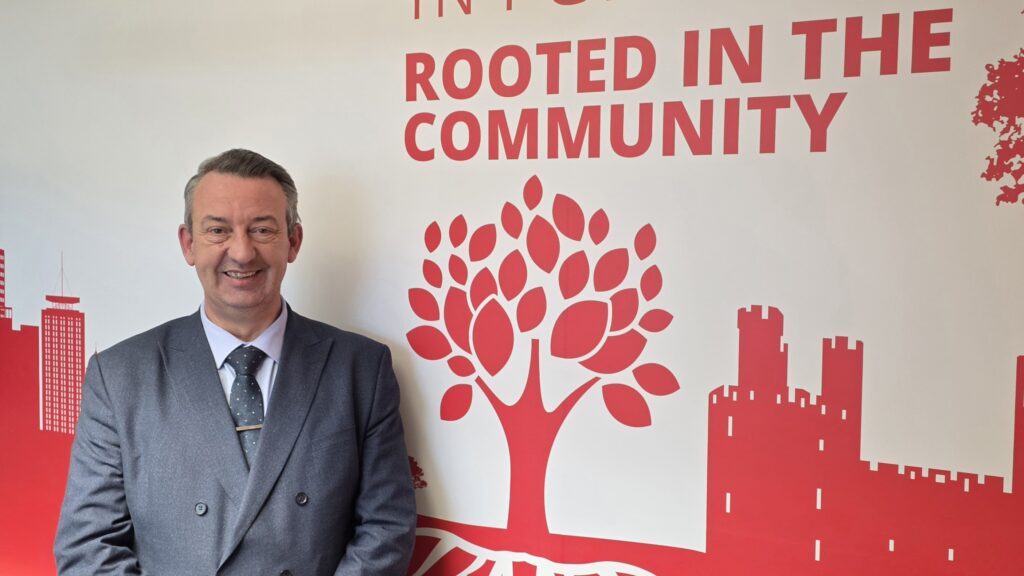
“I am really proud of the team and the achievements we have made here,” he said. “My strapline was always ‘rooted in the community’. It’s not just a slogan it’s the way I am. I want to make a positive difference to people’s lives.
“I’m still passionate about the job I do. There will be a lot of work to do on the governance going forward. I’ve still got a few irons in the fire which I hope to implement in the time I have left.
“I still have two-and-a-half years left. I’ve not thought about what I’ll do next because I’ve never seen this as about me.
“The first time I stood for election was for Connah’s Quay Town Council in 2012. I lost my dad and we became carers. My wife Louise was there with me through it all and was a pillar of strength despite the fact she was probably struggling too.
“We needed support at that time and we got it from our local councillors. At that time I started to reflect and realised I didn’t want to be one of those people moaning about their situation, I wanted to do something about it. That’s what drove me first to the town council, then to Flintshire County Council the year after where I was Armed Forces Champion and then, in 2021, to the PCC.
“I’ve been really blessed in the success I’ve had but I know that’s thanks to my wife, my family and the community who have put me in this position. To all of them I am incredibly grateful.”
Support our Nation today
For the price of a cup of coffee a month you can help us create an independent, not-for-profit, national news service for the people of Wales, by the people of Wales.


