


Ancient Welsh woodland reaches major milestone after 20-year restoration
Nation.Cymru Staff
An ancient woodland in south Wales has become predominantly native broadleaf for the first time in around a century following 20 years of restoration work.
Wentwood, which stretches across more than 1,000 hectares, forms part of the largest block of ancient woodland in Wales and a surviving fragment of the continuous woodland that once extended from the River Usk to the Wye.
Wentwood’s history stretches back thousands of years, and Bronze Age funerary barrows remain on its ridge tops, while the woodland is mentioned in the 12th-century Book of Llandaff. It later provided timber and charcoal for local industry and was once part of the hunting grounds of Chepstow Castle.
However, much of Wentwood’s broadleaved woodland was felled during the world wars, and by the 1960s, all the land now owned by Coed Cadw, the Woodland Trust in Wales, had been planted with conifers.
Two decades after acquiring the 353 hectares of Wentwood between Newport and Chepstow, Coed Cadw has marked a major milestone in its long-term recovery.
Since acquiring the site, the charity has gradually thinned conifer plantations and supported the return of native woodland, while restoring ancient woodland, heathland and wood pasture habitats.
The work has combined the careful removal and thinning of conifers with natural regeneration and active planting, including techniques such as direct seeding and drench planting.
Conifers now account for around 43% of the Trust-owned site, compared with native broadleaf trees, which make up an estimated 54% of the canopy.
Approximately 148 hectares are now covered by native broadleaved woodland, in addition to the roughly 44 hectares of broadleaf woodland that was already present when Coed Cadw took over management. There are approximately 151 hectares of conifer woodland, and the remainder is tracks, paths and forest roads.
Rob Davies, Site Manager for South East Wales at Coed Cadw, said: “Native broadleaf woodlands support a much greater variety of species, so this milestone means Wentwood is well on the way to becoming a more diverse and special place for woodland plants and animals.
“Our focus now is on ongoing management in the form of thinning and felling of both the remaining conifer and the broadleaf woodland to ensure this trend continues.”
The restoration is intended to create a healthier and more resilient woodland, with a range of native habitats for the wildlife at Wentwood.
More than 70 bird species and 23 butterfly species have been recorded at the woodland, which also supports hazel dormice, bats, adders, otters, southern wood ants and woodland plants including bluebells, wood anemones and honeysuckle.
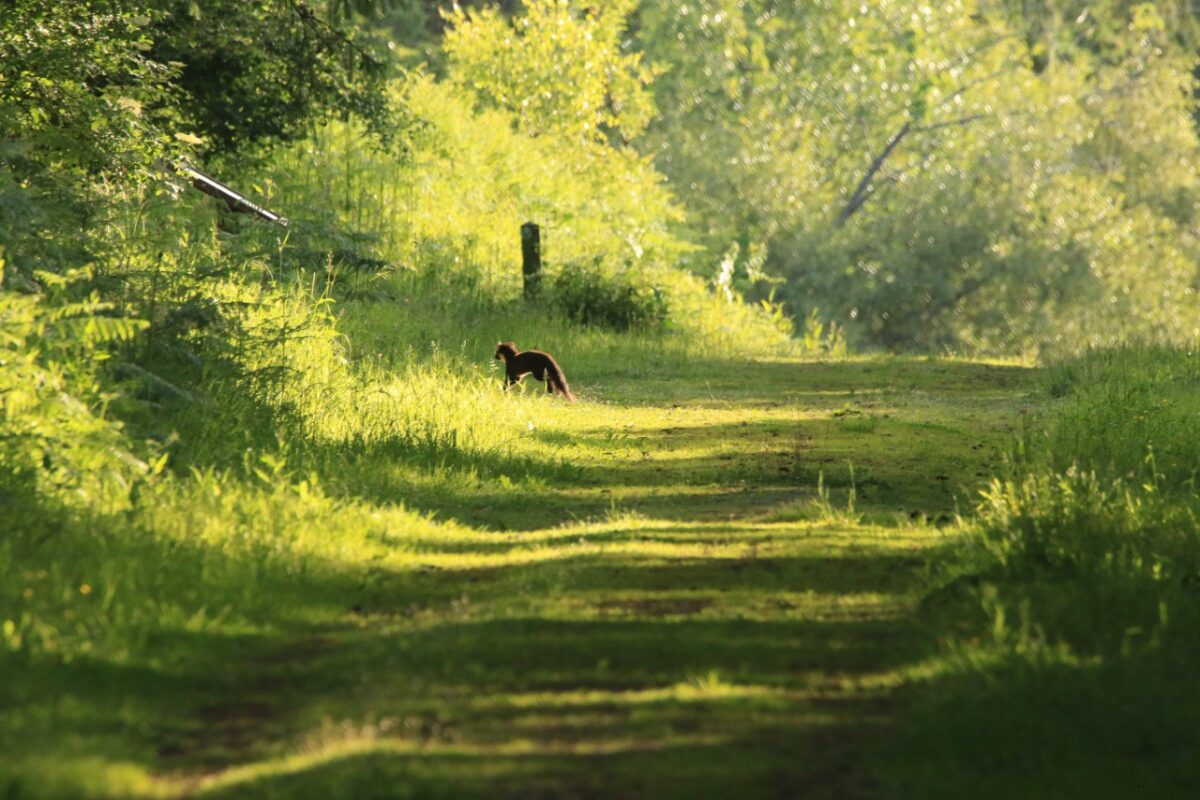
Coed Cadw said that recent pine marten sightings highlighted the variety of wildlife using the woodland, which also includes goshawks, nightjars, common lizards, wood warblers and native roe deer.
The charity added that natural regeneration of native broadleaf species had previously been limited by high deer numbers and dense conifer shade, but better management of both has since helped the forest regenerate and increased the diversity of ground flora in many areas.
Rob Davies continued: “Woodland species require a diversity of woodland habitats and forests that have a mix of tree species and ages; without the active restoration of ancient woodland, the well documented declines in these species would continue.
“What’s more, woodland canopies with a good variety of tree species are needed to ensure that our forests are resistant to the increasing threats of tree disease, wildfire and drought – linked in part, to our changing climate. The restoration work at Wentwood will ensure that it continues to be a haven for wildlife for generations to come.”
Today, Wentwood’s extensive network of roads, tracks, footpaths and bridleways makes it a popular destination for walking, cycling, horse riding and orienteering, with the 77km Usk Valley Walk also passing through the forest.
Wentwood is also part of the National Forest for Wales and is free for everyone to visit. For more information, visit the Woodland Trust site here.
Support our Nation today
For the price of a cup of coffee a month you can help us create an independent, not-for-profit, national news service for the people of Wales, by the people of Wales.
Get more trusted Welsh news
Choose Nation.Cymru as a preferred source in Google News to see more of our journalism.


