
Annual Population Survey shows fall in number of Welsh speakers living in Wales

Stephen Price
The number of Welsh speakers in Wales has declined over the past two years, according to the latest Welsh language data from the Annual Population Survey.
Published on Wednesday 21 January 2026, the latest survey on people’s ability in Welsh and how often they speak the language covers the period from October 2024 to September 2025.
A line chart produced to highlight the findings of the survey shows that, having fallen between 2001 and 2007, there has since been a general increase in the estimated number of Welsh speakers recorded by the APS save for a slight dip in and around 2018/2019, before the numbers steadied themselves again up to 2023.
In the period since however, the last two years have seen a continued fall. According to the APS, there were an estimated 828,500 Welsh speakers living in Wales in the year ending 30 September 2025.
A line chart highlighting the data shows that the number of Welsh speakers has declined over the past two years. Despite the recent fall, the overall trend since March 2010 has been one of growth (25.2%, 731,000), following a gradual decline between 2001 and 2007.
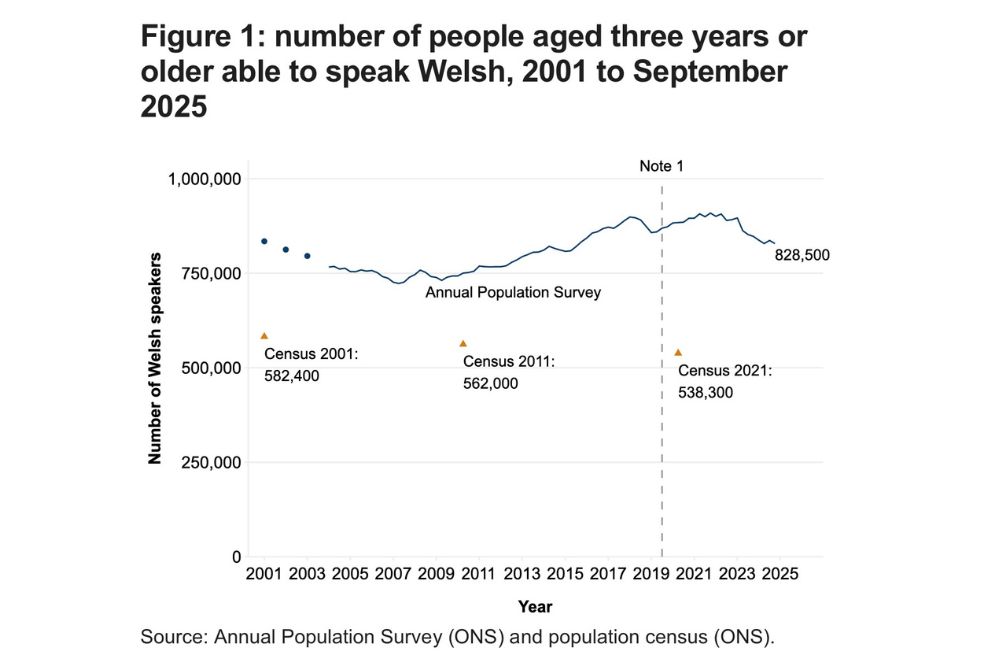
According to the APS, there were an estimated 828,500 Welsh speakers living in Wales in the year ending 30 September 2025. The number of Welsh speakers recorded in the 2001, 2011 and 2021 Census are plotted on the same chart, labelled 582,400, 562,000 and 538,300 respectively.
Face-to-face interviews were suspended in mid-March 2020 in response to the coronavirus (COVID-19) pandemic and all interviews were conducted over the phone. Face-to-face interviews were reintroduced in autumn 2023 meaning that the latest data are based on a combination of phone and face-to-face interviews.
For the year ending 30 September 2025, the Annual Population Survey estimated that 26.9% of people aged three years or older were able to speak Welsh. This figure equates to around 828,500 people.
Children and young people aged 3 to 15 years were more likely to report that they could speak Welsh (46.5%, 227,300) than any other age group. This is consistent over time, but the percentage of children and young people aged 3 to 15 years who can speak Welsh has been decreasing in general since the beginning of 2019.
It should be noted, however, that the Office for Statistics Regulation has agreed that the accreditation of the statistics from this survey should be temporarily removed because of a fall in sample size over time, and therefore there is more uncertainty about the data.
The results should also not be compared with census results, nor used to measure progress towards the Welsh Government target of a million Welsh speakers by 2050. The Welsh language strategy, Cymraeg 2050, clearly states that this target was based on census data and that progress towards this target will be monitored using census of population data.
Key findings
The highest estimated numbers of Welsh speakers are found in Gwynedd (89,400), Cardiff (88,000) and Carmarthenshire (85,100).
The lowest estimated numbers of Welsh speakers are in Blaenau Gwent (7,100) and Merthyr Tydfil (9,100).
The highest estimated percentages of Welsh speakers can be found in Gwynedd (73.4%) and the Isle of Anglesey (61.8%).
The lowest estimated percentages of Welsh speakers are in Blaenau Gwent (10.6%) and Merthyr Tydfil (15.0%)
14.0% (431,700) of people aged three years or older reported that they spoke Welsh daily, 4.9% (152,100) weekly and 6.6% (204,000) less often. Around 1.3% (40,400) reported that they never spoke Welsh despite being able to speak it, with the remaining 73.1% not able to speak Welsh.
31.2% (961,700) reported that they could understand spoken Welsh, 24.2% (746,100) could read and 21.6% (666,000) could write in Welsh.
Owain Meirion, Chair of Cymdeithas yr Iaith said: “We often hear from politicians that the Welsh language belongs to everyone, but this rhetoric is not realised. The result of that is the continuous decline in the number who can speak Welsh.
“The current Government has run out of time but we recently published a document with measures that we challenge the politicians to implement in the next Senedd so that it can be a turning point for the language to become a community language.
“Among the calls are to improve the regulation of the housing market and legislate to treat houses as homes, implement the recommendations of the Commission for Welsh-speaking Communities, set a target for the number of children in Welsh-medium education, restore and increase the amount of Welsh content in the media and expand and strengthen the legal rights of the people of Wales to use the language.”
Welsh Government response
The Welsh Government consider these data alongside other data sources about Welsh speakers, such as the National Survey for Wales and the school census.
The Welsh Government says: “We’re working on a wide range of actions to achieve our aim of a million Welsh speakers by 2050, and to increase opportunities for people to use their Cymraeg.
“This includes introducing the Welsh Language and Education Act, our response to the report of the Commission for Welsh-speaking Communities, the second phase of the Commission which is looking at the Welsh language in areas with fewer Welsh speakers, free Welsh lessons for 16-25 year olds, and increasing the amount of Welsh language technology that’s available.”
Fight Welsh language decline
Find your nearest Welsh language school here.
Click here to find out more about SaySomethingInWelsh.
Click here for more info on DuoLingo.
Click here for information on local Wales-based Welsh classes or London classes (Not exhaustive so please check social media and search engines for what’s on in your area)
Click here to find out more about Lingo Newydd.
Support our Nation today
For the price of a cup of coffee a month you can help us create an independent, not-for-profit, national news service for the people of Wales, by the people of Wales.



3 main reasons come to mind Loss of bright young people going to higher education and chasing jobs outside of Wales. Influx of an assortment of Anglophonic people for work, retirement, goodlifers etc generally with one thing in common – no interest in Welsh culture, language or anything other than the baggage they bring with them. Most of these are beyond salvage. Refugees, asylum seekers and other migrants from beyond UK who have little or no prior knowledge of a distinctive Welsh identity. Credit to those who become aware and get to grips with real integration but right now they… Read more »
Racist towards people who bring money into the country then. It shouldn’t matter if they are from rest of UK. According to Plaid Cymru, if you live here for more than 3 years then your considered Welsh.
You are a bit too quick with that racist label. The article is concerned with the apparent decline in numbers of Welsh speakers. I listed factors that are influencing that apparent decline. If you need to plaster the “racist” label on anyone look closer at those who come to Wales to live thinking it suffices to be AngloBrit and treat anything remotely Welsh with indifference or even contempt. Sounds like you may be one of those. Over to you to define your stance on this matter.
Anyone who has lived in Wales for 5 Minutes is a Citizen of Wales let alone 3 Years.
In Mid, West and North Wales Incomers from mainly England have bought practically everything that exists.Yes they are fellow Citizens of Wales but one thing all their money will never buy is a Welsh Identity.
Propaganda by outside bodies that want us to believe their lies. There are more Cymraeg speakers now than ever before. Think about it. Most schoolchildren are being taught to speak the language wheras before they were not. To me, that only means one thing ….. there are more Cymraeg speakers than less!! Every year thousands of schoolchildren are starting school and learning the language and thousands are leaving school with the ability to speak it. Common sense. How do they find out these things anyway? Have they gone around asking every individual if the speak Cymraeg? No one has asked… Read more »
They study Welsh as a second language for 13 years and leave school barely able to string a sentence together. And then have children and raise them as Anglophone English speakers. And thus the vicious circle continues.
I don’t know what part of Cymru you live but here in Carmarthenshire I know for certain that a large proportion of schoolchildren can speak Cymraeg fluently. I would imagine this is matched by Ceredigion, Gwynedd and other Welsh strongholds.
Then they must have an attitude problem. I know many incomers whose children have gone through the system. They speak perfect Cymraeg. If children were brought up here, I refuse to speak english with them.
O diar… statistics and the methodology of surveys not really your strong point, are they?
Wasn’t it Benjamin Disraeli who said Lies,Damn Lies and Statistics.
This debate shows how passionate we all are about Wales! Lots of English people I know love Wales because of the culture. Who is the world can been the Eisteddfod and Choirs?
The Welsh language will thrive and slowly get more users as there is a desire.
Post Covid lots of English have relocated to Wales, so there may be a short term drop in Welsh speakers.
Have you experience of Welsh learning in schools? I’m not sure children leave school – unless it’s a Welsh medium establishment- actually speaking Welsh and if they are from an English speaking background they don’t keep up with anything they have learned. Sadly because they have to do Welsh lessons they don’t learn foreign languages either and this impoverishes Wales.
I live in Aberaeron. Do I live in Cymru, Nghymru, or in Gymru? The mutations are complicating the language learning process.
You live in I live in Aberaeron, Wales
It complicates learning only if you are constrained by having to be right first time. Right first time is eminently appropriate in many spheres of life but picking up a passable working knowledge of any language is a multistage process, so learn to get an understandable message across first and move on later to refine the grammar. Like what I do do with English, see!
Some people lack confidence in their knowledge of the Welsh language. I can’t speak for others but I am very self-conscious when trying to communicate in Welsh.
So am I, but having both taught and learnt languages, I realise that the more Cymraeg is in use, the easier it will be for me and others to learn. A lot of people (usually men) have problems learning a foreign language because they are terrified of looking foolish and not being in control. If you are scared of making mistakes in front of others, you will never learn a language, or anything else for that matter. If you are blessed with the ability to laugh at yourself, you will progress, since mistakes are an essential part of learning.
Well said DJ.
Dw i’n cytuno Brian, mae’n anodd. Ond rhaid i ni drio. Dw i’n trio siarad Cymraeg pan gen i gyfle. Dw i’n gwneud camgymeriadau efo’r treigladau, ond paid a phoeni. Os un person fel fi’n clywed fi siarad Cymraeg ddrwg, fedrwn nhw’n trio hefyd. Byddan ni ennill!
Is that all? Mutations are not that important and the place names can be used as is without any problem ….. and before anyone says that the language is being “forced” on anyone it does not happen. It’s only the agitators that say this.
As for mutations, if you want to learn a simplified language, try Esperanto. I assume you are english; how would you feel if I suggested a complete revision of english spelling? Yu myte fynd that a tuch insulting, mytent yu? You worry too much about mutations; if you get them wrong you will still be understood. They are only a problem if you want to look up a word in the dictionary, or if you are reading cymraeg, where you need to be aware of them, even if you haven’t memorised them. As your fluency improves, you will find yourself… Read more »
For your information I was born in my mother’s house in the Rhondda Valley. I come from a fluent Welsh speaking family. My comments about mutations are merely a more radical way of increasing the numbers of Welsh language speakers. If you keep on doing the same thing you are likely to get the same result!
Dwin yn byw yn Aberaeron. Dwi yn dod o Aberaeron.
I see the house of Un-Welsh Activities Committee are at it again
Is that Reform calling? or another anti-Welsh league of Unionist loyalists?
Losing 63,300 speakers in two years makes no sense. Annual population surveys are absolute rubbish.
I’d have to question the accuracy of yet another survey as what it suggests completely contradicts what I see in real life.
How many people speak Welsh in England? How many adults and children are learning Welsh in England?
How do these people who carry out surveys get their figures? Do they actually ask everyone in Cymru if they speak Cymraeg? Where are these surveys carried out? Probably in the border towns. No one asked me? Did they ask you? It’s all bullsh*t to suit an agenda.
Speaking as someone who was educated in Welsh throughout primary and secondary education, where is the ongoing incentive for adults?
There are loads of opportunities for young people, as should be the case, but if you want people speaking Welsh into adulthood there has to be some kind of pragmatic gain.
For those that missed it:
“the Office for Statistics Regulation has agreed that the accreditation of the statistics from this survey should be temporarily removed because of a fall in sample size over time, and therefore there is more uncertainty about the data”