


Assisted dying ‘not in scope’ of NHS purposes, says former health service chief
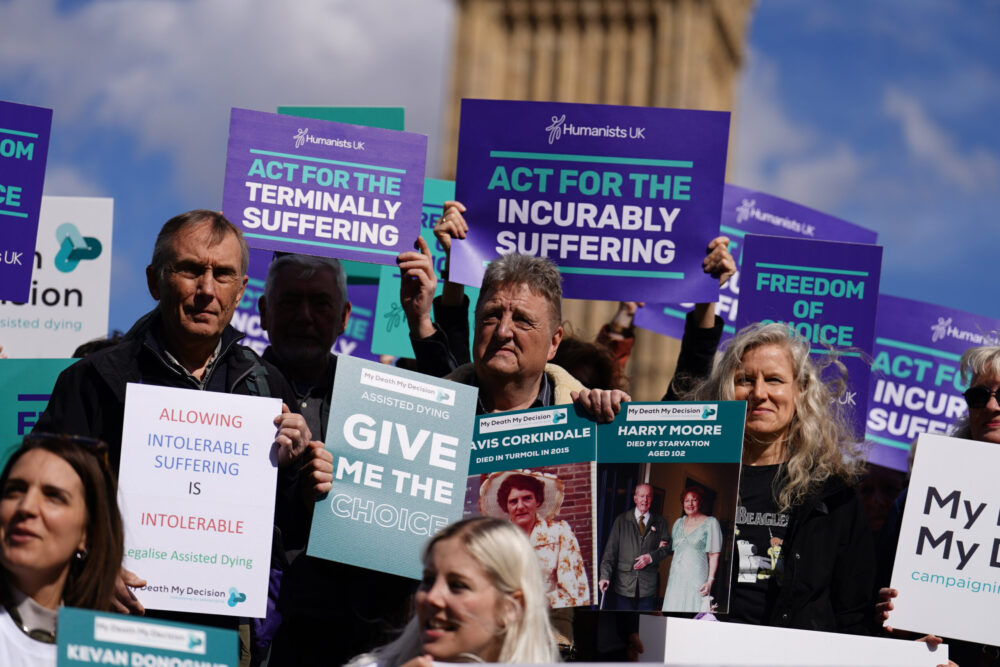
Assisted dying supporters have faced renewed calls to protect the NHS’s purposes – to prevent, diagnose and treat ailments.
Former NHS England chief Lord Simon Stevens of Birmingham has said assisted dying “does not fall within the scope” of the health service’s purposes, as peers began their seventh day debating the Terminally Ill Adults (End of Life) Bill line-by-line in committee.
He clashed with doctor and broadcaster Lord Robert Winston, who said the NHS is not a “static” institution.
Part of the Bill would give the Government powers to update the National Health Service Act 2006, to include voluntary assisted dying services as part of the NHS’s purposes.
“Organisationally, just because doctors, like lawyers or social workers, are proposed to be involved in this, doesn’t mean it is inherently part of the National Health Service,” Lord Stevens said in the upper chamber.
“Doctors do DWP (Department for Work and Pensions) assessments, that doesn’t mean the NHS runs the benefits system.
“Doctors are involved in driving licence assessments, that doesn’t mean the NHS runs the DVLA.
“Doctors are involved in the criminal justice system as forensic medical examiners, that doesn’t mean the NHS needs to run the court system.”
Lord Stevens, who is the Cancer Research UK chairman, said the NHS’s purpose is to “promote the establishment of a comprehensive health service designed to secure the improvement in the physical and mental health of the people of England and Wales and the prevention, diagnosis and treatment of illness”.
He continued: “Assisted dying does not fall within the scope of that purpose.”
He also told peers the Covid-19 posters urging people to “stay home, protect the NHS, save lives” put off patients receiving treatment they needed during the early stages of the pandemic.
“The idea that an NHS-branded assisted dying service might therefore, in people’s minds, at least, come to be associated with helping protect the NHS by virtue of choosing an earlier death seems to me a blurring of the lines that we should be careful to avoid,” the crossbench peer said.
Former BBC director-general Lord John Birt, who is also a crossbench peer, suggested the Bill should set up in law an Assisted Dying Help Service, to help patients navigate the end-of-life process.
But Lord Charles Moore of Etchingham, who was previously editor of The Telegraph, warned Lord Birt’s proposal “actually amounts to the NHS trying to persuade people to accept assisted dying”.
The independent non-affiliated peer said: “In the ancient world, the dead were carried across the River Styx by Charon, and it seems to me that that role would be performed by the navigator, because where is he navigating?
“He’s navigating you to the River Styx and he’s not trying to navigate you anywhere else.
“Now, if that is actually included in the NHS, it creates a quite different purpose from the normal purposes.”
When MPs debated the proposal in the Commons, Labour MP for Mitcham and Morden Dame Siobhain McDonagh raised fears the Bill could be the “Trojan horse that breaks the NHS”.
She last year said the Bill’s drafting might mean “the founding promise of the NHS can be quietly rewritten not through open debate, not by an act of Parliament, but by a handful of MPs behind closed doors in a committee room – and once the past is sold, there is no telling what future governments might do”.
Lord Birt said his amendment is intended to support a terminally ill patient to “navigate the complex process set out” in the Bill.
But he warned assisted dying supporters “cannot throw this complexity of issues at the NHS”, as he called for a “proper organisational framework”.
Lord Winston, who worked on several documentaries including the BBC’s The Human Body and Child Of Our Time, said: “There are many people who go to the health service who do not get treatment.
“It’s not always a treatment. I for years was pioneering in vitro fertilisation (IVF) which was really not successful for a very long time.”
He warned “many” peers opposed IVF in the early stages of its development.
“The fact of the matter is that the health service develops,” the Labour peer said.
“It’s not static. It changes depending on what the need is.”
Lord Charlie Falconer of Thoroton, the Labour peer who is steering the Bill through the Lords, said he would “come forward with more detail” on how the Bill might affect NHS purposes.
He acknowledged ministers’ powers in the Bill were “currently very, very wide”.
Lord Birt had earlier called for provisions in law “to ensure that the assisted dying process is expeditious and, when conditions demand it, flexible”.
This could help doctors act more swiftly in “genuine emergencies”, he said.
Conservative former minister Baroness Elizabeth Berridge warned this could create a race for young people to break records, if they are eligible for an assisted death.
She said: “I’m sorry I don’t think I’m a cynic but I can see a competition – ‘Can I get to 18 years and 18 days and be the first young person to go and meet that milestone?’
“That is something we don’t want to have, that culture of speed in the process and limiting that reflection.”
Lord Birt withdrew his amendments, but is able to table similar proposals at a later stage in the parliamentary process.
Support our Nation today
For the price of a cup of coffee a month you can help us create an independent, not-for-profit, national news service for the people of Wales, by the people of Wales.


